
By Pat Colquhoun
On Monday 29 June, Prime Minister in waiting, Andy Burnham, once again donned his dark blue t-shirt and suit jacket to give his first meaningful public address since he was elected as Labour MP for Makerfield, indicating the direction that his government may take if he, as expected, becomes Prime Minister in a few weeks’ time.
Standing on a podium at the People’s History Museum in Manchester, Burnham had the air of Henry “Orator” Hunt at Peterloo Fields before the famous 1819 massacre, addressing a disaffected mass of people desperate for change. Of course, the event itself was nothing like Peterloo, but rather carefully curated, with attendees including political grandees such as regional Labour Mayors and Labour MPs.
Like at Peterloo, however, Burnham was here to rail against the politics of old; against a “broken” Westminster system, which has centralised power in Whitehall and left the rest of the country behind. He was here to “take power out of the centre” and offer the country the same “place-based approach” which he calls the “Greater Manchester way” or simply “Manchesterism”, which he has pioneered in the region for the last nine years. This, he said, is a collaborative approach bringing together the public sector, private enterprise, voluntary organisations, community and faith groups, as well as trade unions to work together in a rejection of the “trickle down model” of economics and to promote “good growth in every postcode”.
Perhaps the most eye-catching announcement Burnham made indicating his ambition to redistribute power away from Westminster to the “nation’s places”, was the creation of No.10 North. In practice this would mean moving some of the Government’s main operations out of London to the north of England, to be based at a site in Manchester.
“No.10 North” is to be the “nerve centre of a rewired Britain”, we are told, and its job will be to ensure power is spread out fairly across the country through increased devolution and local control over areas such as transport, education, housing and industrial transition.
As Burnham put it, “the days of Whitehall fighting the devolution of power into the regions and nations are over, for good.”
Regional inequality
The UK genuinely is a highly centralised country, with London and the South East at the heart of its economy and politics. Levels of regional inequality in the UK are among the highest in the Western world and cut across multiple dimensions, including pay, productivity, educational opportunities, skill levels, health and even life expectancy.
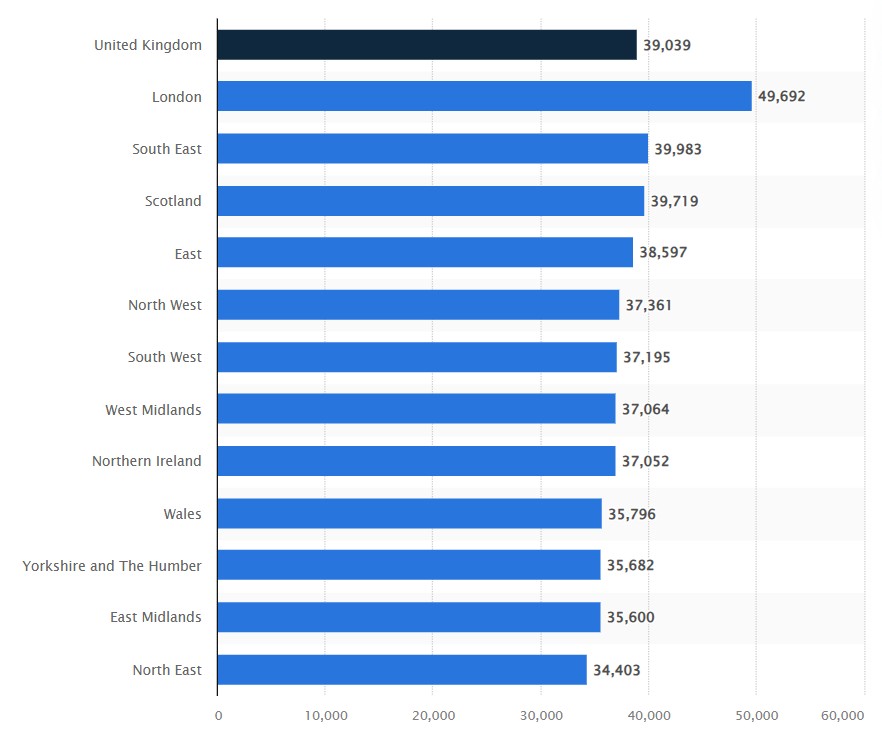
When it comes to pay, London has the highest median annual salary for full time employees at £49,692 in 2025, whereas the North East of England has a median annual full time salary of just £34,403. [i]
Productivity in London, as measured by output by hour, is 26.2% higher than the UK average. With the exception of the South East of England, every other English region and the three other nations of the UK fell below the UK average level of productivity.
Educational outcomes vary widely across the UK. At the end of primary school, just 58% of children in the South West of England meet the expected standards in reading, writing and maths. This compares to 69% in London. At the end of Key Stage 4, when pupils in English schools take their GCSE exams, 62% of pupils in the West Midlands achieve a passing grade in English and Maths versus 72% in London. [ii]
Disparity in outcomes
The disparity in these outcomes extends beyond school level attainment too. For young people in the South West of England in 2022/23, participation rates in higher education were 4.2% lower than the England average and almost 18 percentage points below higher education rates among the same cohort of young people from London. [iii]
Likewise, the rates of young people aged 16+ who are not in employment, education or training (NEET) is drastically higher in regions like the North East, the East Midlands and Yorkshire and the Humber than in the South East of England.[iv]
Naturally, these inequalities impact on the opportunities to live a comfortable life that are available to people living furthest away from the seats of power and finance.
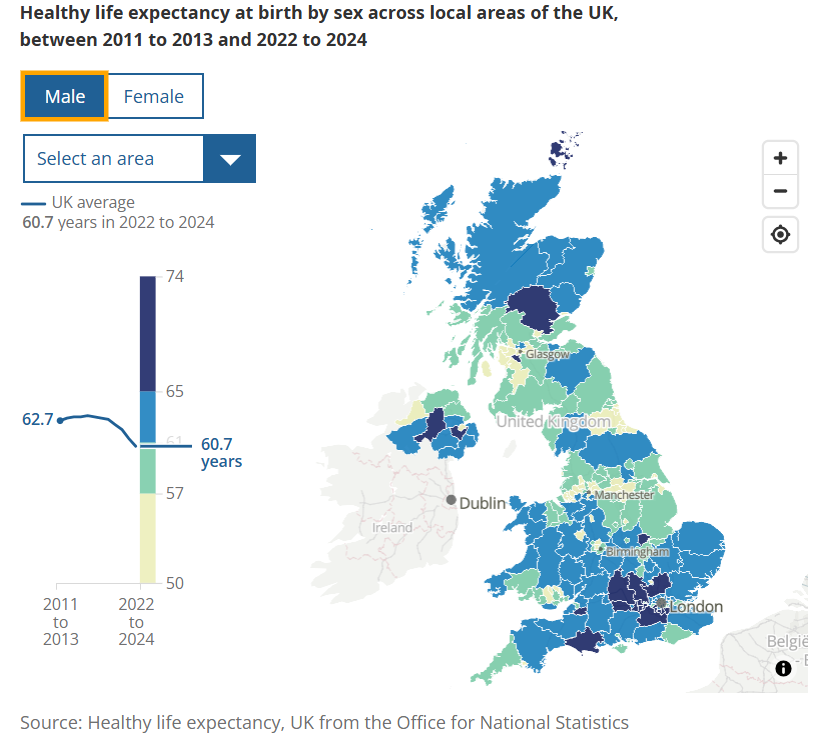
Sadly, this is even reflected in data around healthy life expectancy, where an adult male living in Richmond upon Thames can expect to spend 69.3 years of their life in good health, whereas an adult male in Blackpool can only expect to do so for 50.9 years.[v]
No matter which metric you look at, there is a clear case to be made for redistribution of opportunity and power out into the UK’s regions and nations to address these shocking inequalities.
A word of caution is necessary, however. It would be wrong to characterise the issue here as London and the South East versus the rest of the country. London and the South East do, indeed, contain the highest earners, the highest rates of productivity, obtain the best educational outcomes and have the highest healthy life expectancy – but the picture is more complex than that.
London also has the highest unemployment rate of any region in the UK[vi]. The London Boroughs of Tower Hamlets, Hackney and Newham have the some of the highest rates of child poverty[vii]. Even within London, there is great disparity between the most-advantaged haves and the least-advantaged have nots.
Burnham’s plan
In addition to No.10 North and greater devolution of power, the pillars of Burnham’s plan to reform the UK include:
- Reforming essential utilities
- Reindustrialisation
- The regeneration of places
These will include taking essential services like water, housing, energy and transport into “public control” based on the model Burnham has employed regarding the bus network in Greater Manchester. He will look to support regions to develop their industrial ambitions and set up local Good Growth Funds which will support public and private investment at a place-based level.
Whilst this may seem somewhat vague, Burnham also offers more tangible policies, fleshing out his plans. He promises to embark on the biggest council house building scheme since the post-war period, and to devolve employment support to regional mayors to change the way people are supported to remain in employment, so that they are more locally focused.
To his credit, Burnham acknowledges the role of class in his speech. He openly states he wants to bring back the foundations of “working class aspiration” – a council home and good, technical education – which he says have been “taken away over the decades”. His stated aim is to ensure that “the chance of somebody growing up here to be everything they can be…where no one has to leave to get on in life”.
A vision of hope?
Burnham’s stated ambitions offer a tempting vision for those struggling to get by in what is one of the most unequal developed countries in the world, both in terms of income and distribution of opportunity across regions and nations. Indeed, the aim of the speech was to offer “hope in every heart”.
It is hard to argue against the case that the British state needs change and the balance of power needs shifting away from its traditional strongholds. It is refreshing to hear a future British Prime Minister prioritise the need to build council housing for what must be the first time in half a century. No one would contest the fact that the nation’s high streets need revitalising, nor that our local authorities need increased levels of funding, not just to fix potholes but to support major regeneration projects which can spread greater opportunity into areas far away from the seat of power.
However, we must also be aware of how Burnham’s ambitions will translate into action, as he takes his seat at the cabinet table in No.10, whether that’s in Downing Street or Greater Manchester. We should consider how this promised growth and regional redistribution will be funded and the implications this transition of power will have for working class people.
Burnham firmly commits himself to running what he calls “sound finances” by sticking to the fiscal rules of the current Labour government. This means funding day-to-day public sector spending through tax revenues and other income, rather than through borrowing, as well as ensuring debt falls as a percentage of GDP. Furthermore, he has accepted the rush to increased funding of defence which will divert resources from social spending.
He speaks of reducing the welfare bill, albeit through the prism of moving people off welfare and into work, rather than simply slashing benefits. Whilst this is a noble ambition, it should be noted that a sizeable portion of people claiming Universal Credit is in work. The issue is that work doesn’t pay well enough for them and their families to live well enough. Personal Independence Payments (PIP) for disabled people are unrelated to whether the claimant is employed or not.
Public and private investment
Burnham talks of encouraging both public and private investment to stimulate economic growth, modelled on his experience in Manchester. There is certainly some evidence to suggest that this is effective. Research shows that investment, and particularly foreign inward investment, has led to increased productivity[viii] in the city compared to other regions outside London. The local economy in Manchester is also growing at a faster rate than other areas of the UK. It seems that giving increased powers over local decision making to regional Mayors and combined authorities does bring benefits.
But despite this, at the same time, inequality in the Greater Manchester has been rising. According to the analysis carried out by Greater Manchester Combined Authority (GMCA) – the organisation Burnham headed up as Mayor, the Greater Manchester region has relatively high levels of deprivation compared to the national average[ix]. In 2025, the city of Manchester itself rose from sixth to fourth most deprived local authority area in the country. Furthermore, the GMCA report states that there has been a widening in the gap between the most and least deprived areas of the region.
It seems that Burnham’s “Greater Manchester way” may be enough to increase productivity and bring growth, but it is not enough to tackle inequality. Much like in London, where the wealthiest and poorest often live side by side, in Greater Manchester, a distance of just three miles separates the most deprived and the least deprived areas of the region.
This is something to bear in mind in discussions of regional inequality and devolution of power. There can be no doubt that inequality exists in life outcomes and access to opportunity, depending on where in the UK you live, but the picture is often more nuanced. Inequalities exist within regions as well as between them, and greater devolution of power away from the centre, while something to be welcomed, is not alone a guarantee of a better living conditions.
Instead it is class, not geography, which is the biggest indicator of inequality in this country. It determines your educational outcomes, your opportunities of finding stable, well-paid work; it determines your living conditions, health and your life expectancy. Working class people in Greater Manchester have more in common with working class people in London, Hartlepool or Coventry than they do with the Chief Executives of the property developers and private equity firms who are responsible for building the array of new tower blocks that have risen in central Manchester, often with the help of loans from the GMCA[x].
These tower blocks, much like the many of the fortunes made during the region’s recent economic boom, remain inaccessible to the people living in its boroughs. They may look good as they shine in the rare Mancunian sunshine, but they don’t offer the affordable housing the city region needs, despite the use of public money to build them.
Class interests
This is an example of how the public/private investment enabled by Burnham during his time as mayor, and now much lauded as part of his campaign to become PM, can deliver flawed outcomes for people. If these are replicated as he rolls devolution out across the country, then is it is difficult to regard his approach as much different from what is currently done from the centre. Being more local does not automatically make your politics better; it depends on whose class interests you serve.
This highlights the conundrum at the heart of Burnham’s vision of hope – his Manchesterism. Will it bring the radical change the UK needs to tackle its deep-rooted inequalities, regardless of geography, or does it simply deliver monuments to a vision of hope that remains unrealised for most people?
Burnham speaks of “rebalancing power”. He says “it is time for Whitehall to accept that growth cannot be ordered from the top down. Instead, it can only be nurtured from the bottom up. It comes from having the power at ground level to make a real difference.” He offers a tangible set of ideas for how this may be achieved, from devolving power away from Westminster to regions, to building council housing and reforming the education system to offer people a route into work.
Yet Burnham, from the day he takes office, will be under enormous pressure from vested financial interests and the entrenched interests of the state machine to water down or abandon any of his proposals that challenge their power and influence. If his reforms rely on the private sector, investment will depend on private capital being guaranteed a handsome profit.
Socialists should support the ideas he puts forward but keep a keen eye on the specifics of how they will be funded and delivered, and who will be put in charge of overseeing them. Pressure must be exerted by the labour movement, through trade unions and both inside and outside the Labour Party to counter-balance the pressure from the capitalist class.
It is one thing to promise power at the ground level but, as the lessons of Burnham’s time as Mayor of Greater Manchester indicate, another thing to make it happen in a way the really improves workers’ lives.
[Featured photo – Andy Burnham visiting a school in Manchester with Sir Keir Starmer (cropped out). From “No 10” via wiki commons here]
Notes
[i] UK full-time annual salary by region 2025| Statista
[ii] Educational-outcomes-across-england_0.pdf
[iii] Release home – Participation measures in higher education – Explore education statistics – GOV.UK
[v] Healthy life expectancy, UK – Office for National Statistics
[vi] Labour market in the regions of the UK – Office for National Statistics
[vii] Children in low income families: local area statistics, financial year ending 2025 – GOV.UK
[viii] The Manchester Model: what foreign inward investment reveals about the UK’s most productive city outside London – Bennett School of Public Policy
[ix] Indices of Deprivation analysis – Summary of Indices for Greater Manchester
[x] Manchester’s skyscraper boom: New tower plan among Europe’s tallest – BBC News