By Jamie Green
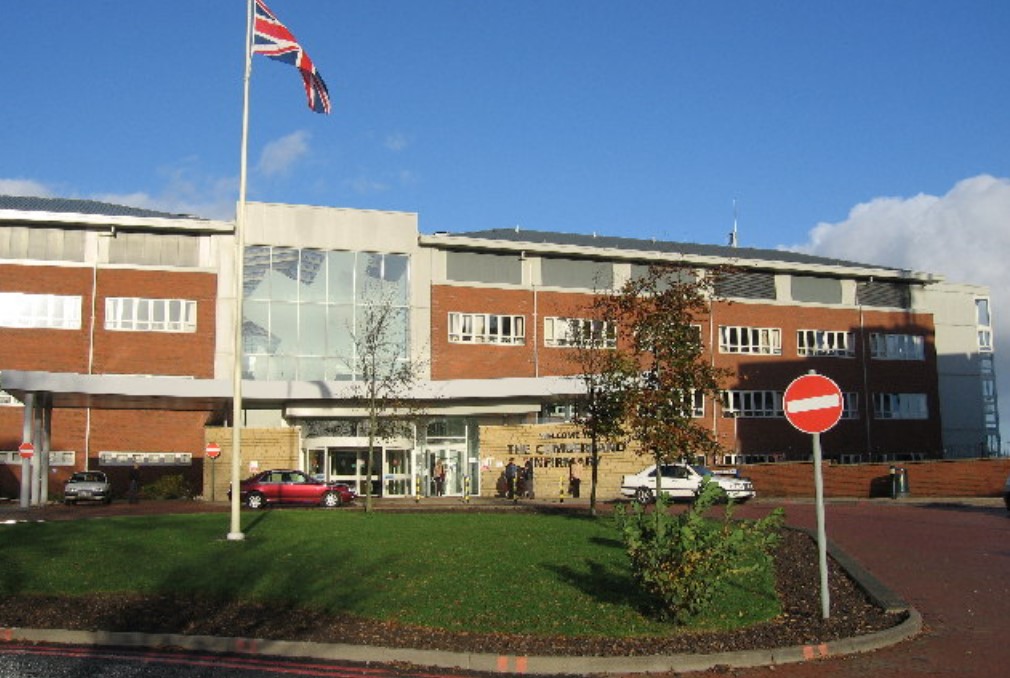
Following the termination of a highly exploitative PFI deal involving their local hospital in Carlisle, Cumbria residents have been denied key information about the deal, leaving people with the impression that the NHS, yet again, has been ripped off for the benefit of private corporations.
Cumberland Infirmary was granted a “no-fault voluntary termination” back in January, four years early, subject to a buy-out agreement of an unknown amount with the private investor, Health Management (Carlisle) Limited.
The PFI deal has already cost the Trust – and taxpayers – an estimated £570m for a hospital now valued at a measly £67m – as revealed by a Freedom of Information (FOI) request submitted by Labour cllr. Joseph Ghayouba. The total cost to taxpayers, however, exceeds this amount as the Trust, unable to afford the hefty PFI payments, was given supplementary state support payments from 2012-2025 – an additional £90m.
Another FOI request for the cost of the buy-out was refused on grounds of “commercial sensitivity”, but a local newspaper, the Cumberland News and others requested a review, arguing that residents, as key stakeholders, should be informed promptly of the cost and this was also denied. It seems local residents come secondary in priority to capital interests, and residents are simply expected to wait until the annual accounts are published on the Trust website, for those who know where to look.
“A public scandal” – PFI expert
Professor Allyson Pollock, an expert researcher on PFI, whose research contributed to much of the investigation, called the deal, “a public scandal”.
“You just need to look at the parliamentary select committee reports,” she said, “which show that, for all the billions of pounds spent on PFI, they’ve never been able to show value for money…It’s a political decision…
“Everybody knows that it’s much more costly [way to finance public sector projects]. How can it be more efficient when you’ve got shareholders and private equity who are leeching out money?” – Pollock (Coleman, 2026).
PFI, one of the many varieties of exploitative “private/public partnerships” (PPPs), has essentially allowed governments to spend while keeping public expenditure “off the books”. Researchers warned politicians very early on not only of the financial dangers of PFI, but also the future damage to services. It was clearly demonstrated to politicians at the time – before Cumberland Infirmary was even built – that hospitals, staff and patients alike would suffer because of the exorbitant and destructive costs of PFI, far removed from “value for money”.
After being built, the Infirmary went on to have a substantial bed shortage and several severe safety concerns. Problems included wastewater backing up into a theatre block, collapse of a maternity ward ceiling, and a generator failure that left part of the hospital without power for 13 minutes.
The latter, putting patients at risk, was caused by “poor maintenance work by an external contractor and inadequate monitoring by the PFI operator”. It was also later discovered that there was inadequate fire safety throughout the entire building and had there been a fire, it would have been catastrophic, on par with the horrific Grenfell Tower fire.
Disgracefully, neither the former Labour MP nor the current sitting Labour MP have spoken out against this shambolic deal, the safety failures or decades of harm it has caused for the NHS. All of these ‘Labour’ politicians express their full support of the NHS but few politicians have the temerity to name the systemic economic factors, policies, and political choices that are undermining the service.
At each step of the building and running of Cumberland Infirmary, the private sector has taken a chunk, and then some. £18m was demanded at the start of the build for supposed “financing costs” (a pre-build bonus). The fire safety failures cost £14m to rectify – charged made to the Trust and NHS – not to the those who failed to build properly in the first place.
The unitary charges of the PFI were subject to Retail Price Index (RPI) rates, fluctuating wildly because of inflation, rather than by Consumer Prices Index (CPI) rates, that is fixed unitary charges. RPI is notorious for running higher than CPI, automatically creating higher cost increases, large profits and larger dividend payments to the private contracts.
Repairs, staffing, services all cost more! Even worse, it is a legal requirement that the Trust prioritise making these payments over patients, repairs, staffing and services. These are hospitals that could have been built by publicly funds through the Public Works Loans Board (PWLB). This body could have provided a low-interest, long-term loan for a hospital-build or refurbishment, that would have retained public ownership, avoided the profiteering, and ensured reasonable and timely loan repayment with funds would go back into the public purse, not into private pockets.
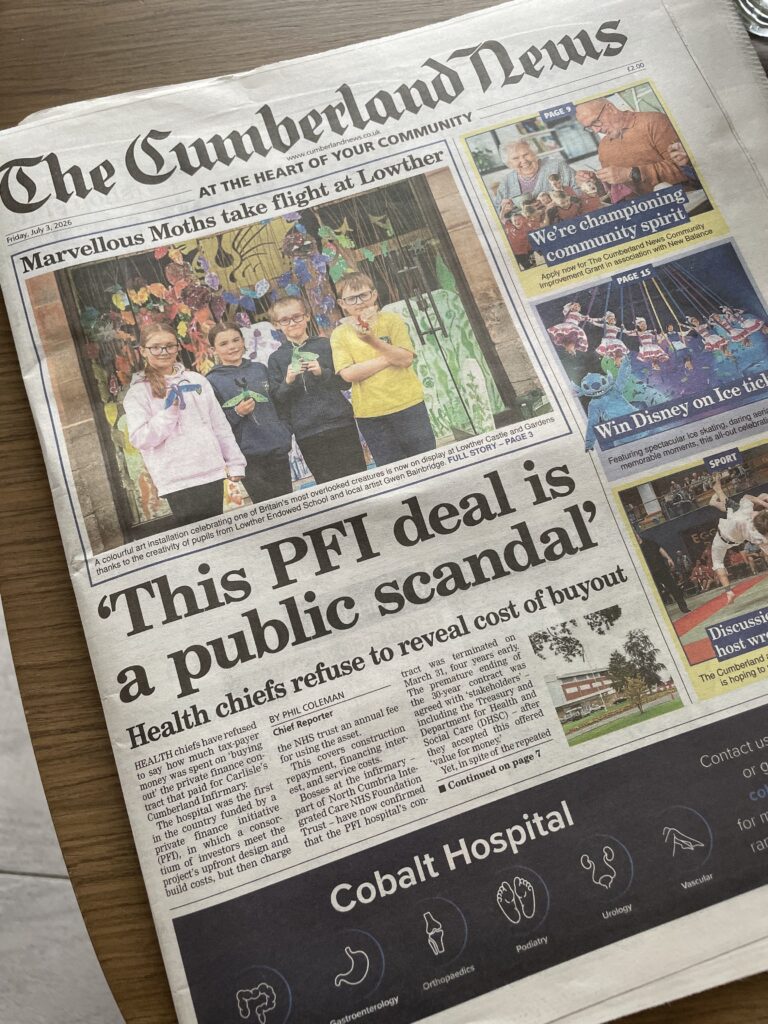
The full story of of the scandalous Cumberland Infirmary PFI was covered recently in an exclusive in the Cumberland News, by journalist Phil Coleman. (subscribe and read here)
A river of money flowing out of the NHS
The Cumberland Infirmary PFI is only one PPP deal amongst hundreds across the NHS and the public sector. While “efficiencies” and cuts are being made to the health service, patients are forced to wait or travel for treatment, or pay for expensive private treatment, the PFI system is robbing the public purse of billions. There is every week a river of money flowing out of the NHS into the private sector as a result of these scam deals.
Meanwhile, the residents of Carlisle cannot find an NHS dentist, and are forced to travel to Hexham or as far as Hawick in Scotland for an NHS appointment. The idea that PFI is not directly connected to this paucity of NHS care simply does not bear examination.
Another Northern hospital, the James Cook University (Middlesborough) faces a “lifetime bill” of £1.5b with its PFI bill, and is now under further pressure as its trust, South Tees is being pressed to make £100m worth of “efficiency savings” in the next financial year. According to the Guardian, private firms providing services in the NHS made £1.6bn profit in two years. There is now a backlog of repairs in NHS hospitals, estimated at £10 bn. The choice for the NHS is either serve patients, emply staff and repair hospitals…or fund private profit. It cannot do both.
Dr Rathi Guhadasan of the Socialist Health Association noted that “We still owe £44 billion and on average, trusts are repaying private investors at an average rate of roughly 6 times the original investment – as high as 27 times for one trust – with the taxpayer set to fork out £80 billion in total for NHS buildings and facilities worth £13 billion.
“This is despite the fact that almost all trusts have already paid off the capital investment and leaves some trusts paying more in historic PFI debt than it spends on medicines or nursing staff.”
Private provision, by outsourcing as well as subcontracting services, has been shown to fuel inequality, drive up waiting lists, impact quality of care, sanitation, and mortality rates with an increased number of treatable and preventable deaths.
Privatisation must end: restore the NHS as a PUBLIC service
Alan Milburn, once ‘Labour’ Secretary of State for Health (1999-2003), has millions personally from his connections to the NHS, while advocating for PFI, and landing him a career as a strategic consultant for private health. In office his slogan was “PFI or bust”, and when he left Westminster, he landed contracts consulting for private American Health insurance companies.
AM Strategy Ltd, owned by Milburn and family members, paid out more than £8m to them in 2024. Yet another example of a former ‘Labour’ grandee “emancipating the working class, one-by-one, starting with himself.”

Public money will continue to bleed out of the NHS as long as PFI contracts remain, and there is a real danger that Labour’s right wing establish new PFI-style schemes to fund hospital builds. The plans announced in the proposed “Neighbourhood Health Centres”, by the then Labour Health Secretary, Wes Streeting might as well be called PFI 2.0.
Streeting is one of several Labour leaders who have accepted donations, gifts, dinners, staff and trips from the private health sector, demonstrating a clear and unacceptable conflict of interest. When confronted, Streeting and other right wing Labour MPs, refuse to acknowledge the ongoing exploitation and preventable deaths caused by PFI.
Their logic, based entirely on the ‘market’ and capitalism, is that the private sector is providing timely care and driving down wait times, when the reality is the entire opposite. Private provision, across ophthalmology, otorhinolaryngology, podiatry and more, is undermining the national service, driving up waiting lists, denigrating knowledge and privatising the service by stealth.
There are still over 100,000 vacancies in the NHS, with increasing numbers of doctors and nurses leaving the service, with pay, mental health, overwork and burn-out often cited. Resident doctors, including those at Cumberland Infirmary, have taken industrial action fifteen times since March 2023, over pay deals that have steadily chipped away at wages in real terms.
Trust failed to pay proper wages for decades
Those NHS workers who are ‘outsourced’ employees, working for Mitie and other private providers, are also impacted. In Cumbria in 2021, over 150 support staff workers, represented by UNISON and GMB, took industrial action when the Trust failed to pay over a decade’s worth of enhanced rates for working unsociable hours – weekends and nights – estimated by one trade union of upwards of £260,000 annually.
In this occasion, three Labour councillors called for an investigation and transparency into the whereabouts of a “substantial sum” that was alleged to have exchanged hands – that is given to Health Management (Carlisle) Ltd – but not passed onto the workers (Coleman, 2021). Mitie NHS workers elsewhere have also had to undertake industrial action to confront pay disparities over the years.
Now that the Cumbria PFI has been bought out, instead of immediately bringing these outsourced workers back ‘in house’, on meaningful contracts, and in line with NHS Agenda for Change (AfC) standards, the Trust has struck a new contract with Mitie, hailing the extended 26 year contract a “huge success”.
We are nearly two years into a Labour government and the campaign promise from Labour to deliver the “biggest wave of insourcing of public services in a generation” has yet to materialise. As Health minister, Wes Streeting called resident doctors seeking adequate pay and job security “unreasonable” and wage restoration “unaffordable”. Imagine what the NHS could afford if it wasn’t being robbed by private profiteers, week-in and week-out!
Because of the failures of the Starmer leadership, we are unfortunately facing the possibility of a government of Reform UK. For the NHS and other vital public services, the reality of a Reform government – a fact hidden in Farage’s daily rhetoric about migrants – would be a bonfire: a nightmare of cuts, privatisations, charges and even more looting.
The basic underlying aim of the NHS was always care “free at the point of use”. Imagine here in Britain getting saddled with expensive bills like American workers. In the USA, the big majority of personal bankruptcies are due to health bills. Those cannot fund their healthcare simply die.
Andy Burnham, now staring at the door of Number 10, could end PFI at a stroke, and make a clear show of his commitment to the interests of the working class. It would to consolidate his support more than any other measure. But only if he has the political will to do it.
Workers cannot simply wait to see what Burnham does. Our demands remain the same. We demand:
- An end to a two-tier health system
- An end to the privatisation of the NHS
- An end to PFI without any further compensation
- Call out those politicians complicit in the looting of the NHS
- Restore the NHS as fully publicly-owned and publicly-operated
- Comprehensive healthcare for all, fully funded and free at the point of use.