
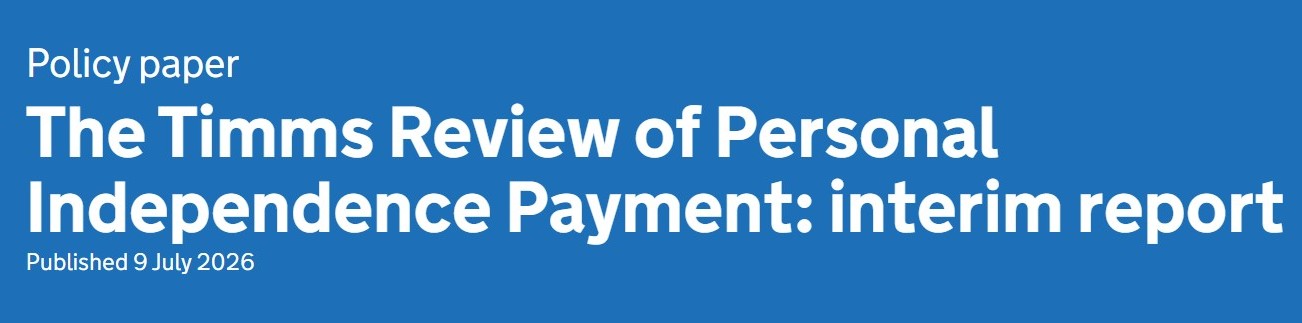
John and Glenda O’Brien, in Carlisle, consider the interim report of the Timms PIP Review.
******
On 9 July, 2026, the Department for Work and Pensions published the interim report of the Timms Review, the government’s co-produced review of Personal Independence Payment. It makes no recommendations. Those are due in the autumn. But it does something important: it puts in writing, in an official government document, what disabled people have been saying for years, that PIP is “not fit for purpose”.
We have spent decades between us on the front line of this system. John O’Brien is a welfare rights adviser and tribunal representative. Glenda O’Brien is a retired mental health nurse with 30 years of clinical experience and a Central Council member of the Socialist Health Association.Both of us are also full-time users of power wheelchairs. So we read this report from both sides of the desk at once. Here is what stood out.
The benefit is valued. The process is not.
Of the 38,713 responses to the call for evidence, between 50 and 58 percent expressed positive views of PIP as a benefit. But over 90 percent of responses about the process itself were negative. This is not a contradiction. It is the clearest possible signal that PIP’s design is sound in principle and broken in delivery.
People do not resent the idea of PIP. They resent being made to prove, again and again, in a hostile format, that they still need it.
What people actually told the Review
It is worth dwelling on the 38,713 people who responded to the call for evidence, because the range of what they reported is the real substance of this report.
On the positive side, many respondents described PIP as genuinely life-changing. People said it had allowed them to stay in work by covering costs an employer would never meet, such as specialist equipment, accessible transport to a workplace, and support workers. Others said it had let them stay connected to family and community life, manage day-to-day tasks like food preparation and household safety, and simply retain a level of dignity and choice that would otherwise be out of reach. A small number of respondents, around 5 percent, described a genuinely positive assessment experience, with an assessor who listened and made them feel at ease.

Minister of State for Social Security and Disability
[photo – House of Commons – wikicommons]
The negative side was far larger and far more consistent. Over 90 percent of process-related responses were negative. People used words like dehumanising, soul-destroying and degrading to describe the assessment itself. Many described being made to talk about intimate details of personal care, toileting, and mental distress to a stranger, only to feel that what they said was later misrepresented and dismissed.
Around 25 to 30 percent of responses mentioned decisions being overturned later at appeal, after what is often described as a long and exhausting fight. The administrative burden was raised in around 28 percent of responses, and multiple and interacting health conditions were mentioned in around 83 percent, with less visible conditions such as mental health and neurodivergence appearing in around 70 percent.
A smaller number, around 8 percent, raised concerns that PIP costs are rising unsustainably, and around 6 percent felt some elements, particularly around the Motability scheme, were too generous. A further 10 percent highlighted concerns regarding fraud and misuse, though notably four in ten of that group still expressed full support for the current system’s design, which tells you the concern is more about occasional headlines than about wanting the system dismantled.
Taken together, this is not a picture of a benefit that people want removed, shrunk, or reduced. It is a picture of a benefit people rely on and mostly value, delivered through a process that a clear majority experience as adversarial, exhausting, and actively harmful to their health.
Punished for coping
One line from a respondent should be printed on the wall of every DWP assessment centre: “You are punished for coping. If you manage to do anything, it is used as evidence that you don’t need support.”
This is something we have argued for years in tribunal rooms and in writing. The functional assessment rewards people who present at their worst and penalises anyone who has built strategies to manage their condition. Managing well is treated as evidence of reduced need rather than evidence of the very support that made the management possible. The report confirms this pattern is systemic, not anecdotal. Around 45 percent of responses raised difficulties capturing fluctuating conditions, and 70 percent raised issues with the assessment itself.
The Minister for Social Security and Disability, Sir Stephen Timms, even acknowledged this perversion of the system’s intent following the report’s release. He noted that the constant fear of losing vital support creates a massive barrier, actively scaring people away from attempting employment, physical activities, or community participation because any sign of independent activity is immediately twisted into evidence of improved functional ability.
The evidence problem and the “informal observation” trap
We were struck by the finding that clinical and medical evidence is regularly treated as secondary to a single assessor’s observations during a short interaction. Respondents describe assessors lacking specialist knowledge of complex and rare conditions, and evidence for multiple overlapping conditions being considered separately instead of together, so the combined impact never gets properly weighed.
This matches what we see in casework constantly. Medical letters and consultant reports carry less practical weight in the process than twenty minutes with an assessor who has never met the claimant before and will never see them again. Any serious reform has to fix the hierarchy of evidence, not just the tone of the assessment.
Part of this failure is the heavy reliance on “informal observations” during face-to-face and phone consultations. Assessors routinely note superficial snapshots—such as a claimant appearing well-groomed, carrying a handbag, or sitting relatively still for fifteen minutes—and use those brief moments to completely override years of detailed consultant records.
Furthermore, the system creates unnecessary anxiety by under-utilising paper-based reviews. Thousands of individuals are forced through highly stressful, face-to-face or telephone consultations when their written clinical evidence is already more than comprehensive enough to make a fair and accurate, decision.
Digital exclusion and administrative barriers
The review reveals how the current claims process imposes a punishing administrative and emotional burden on claimants, particularly those with learning disabilities, cognitive impairments, or severe fatigue. The sheer length of the physical application forms, combined with rigid digital portals and strict thirty-day return deadlines, creates massive structural barriers.
Instead of opening up access, shifting elements of the application system online has contributed to digital exclusion, punishing those who lack the specialized literacy, technology, or physical stamina required to navigate a complex administrative obstacle course within an unforgiving timeframe.
Representation, tribunal win rates, and the GP evidence gap
The Review itself makes an important point without quite putting a figure on it: outcomes depend heavily on whether someone has advocacy combined with the confidence to challenge a decision, rather than purely on need. The published statistics back this up starkly.
DWP’s own figures show that only around 20 percent of mandatory reconsiderations result in a changed award. Yet a written answer from DWP to Parliament confirms that of the cases that go all the way to an independent tribunal, 67 percent are overturned in the claimant’s favour, a rate that has stayed broadly stable since 2021. That gap between roughly one in five overturned at the mandatory reconsideration stage and two in three overturned at tribunal is not a coincidence. A mandatory reconsideration is the DWP reviewing its own decision. A tribunal is independent, and looks at the same evidence with fresh eyes.

disability payments [photo – J O’Brien]
Put those figures together and the uncomfortable conclusion is this: most PIP decisions that are properly challenged all the way through the system turn out to have been wrong. Yet DWP’s own statistics on initial decisions show that, once you count every single decision the DWP makes, not just the ones someone challenges, only around 7 percent are ever appealed to tribunal, only around 4 percent get as far as actually being heard at a hearing, and only around 3 percent are overturned.
That 3 percent figure looks small, and it is often quoted by DWP as evidence that the system is largely getting things right. It is nothing of the sort. It is diluted by the huge majority of people who never appeal at all. Within the small group who do go the full distance, the overturn rate is 67 percent, not 3 percent. The true error rate in initial decision-making is very likely far higher than the headline 3 percent figure suggests. It is simply hidden by how few people have the stamina, support, and knowledge to push a case through three stages of challenge.
This is exactly where professional representation earns its keep. Anyone who has sat with a claimant through preparation and a hearing, as John has throughout his career, knows the difference a properly built submission and a representative in the room makes to how a case is heard and understood. The Review’s own evidence supports this, noting that outcomes can depend on whether someone has advocacy and can challenge a decision, and that the system currently rewards confidence, literacy, stamina and support networks, rather than need.
There is also a specific, long-standing problem with GP evidence that predates this Review and that we encounter constantly in casework. Claimants are asked to list their GP alongside any consultants on the PIP2 form. Many reasonably assume the DWP will then contact those professionals directly. In practice this rarely happens.
Evidence submitted to the Work and Pensions Select Committee by Disability Rights UK found that claimants list GPs and consultants on their forms but they are rarely contacted, and that claimants often wrongly believe the DWP has already been in touch with them. People go into assessments, sometimes continuing all the way to appeal, believing their medical evidence has been gathered when nobody has ever requested it. This is a straightforward, fixable administrative failure. It should be near the top of the list when the Review’s final recommendations are published in the autumn.
The trauma of endless reassessment cycles
The report brings to light the profound distrust and intense anxiety caused by forcing people with progressive, degenerative, or permanent, lifelong conditions to undergo repeated, cyclical reassessments. There is a massive human cost to treating permanent disabilities as temporary conditions that might spontaneously improve. Forcing individuals whose clinical reality will never alter to continually justify their basic right to support is a source of immense psychological harm, representing an enormous administrative waste for the taxpayer and a profound failure of basic empathy.
The numbers behind the pressure
The financial context is stark. PIP expenditure was around £15 billion in 2019/20 and is forecast to rise past £41 billion by 2030/31, both figures given at 2026/27 prices, meaning this is real-terms growth, not simply the effect of inflation. The working-age PIP and DLA caseload has grown by over 54 percent since 2020. The Review has to find recommendations that sit within the Office for Budget Responsibility’s spending projections, which sets up a real tension between fixing a broken process and controlling cost, one the final report in the autumn will have to confront directly.
We would note, as the report itself does, that rising PIP spending has occurred alongside falling spending on other working-age welfare support, and alongside real pressure on the NHS, social care and housing. PIP is being asked to absorb strain that belongs to other parts of the system. That is not a reason to cut it. It is a reason to fix the system around it.
What we will be watching for
The steering group has agreed a working definition of PIP’s purpose: to reduce the inequalities disabled people face in participating in everyday life through a contribution towards the extra costs of disability. That is a good starting point. Whether the final recommendations in the autumn actually deliver it, particularly on evidence weighting, reassessment frequency for stable long-term conditions, plus genuine accessibility of the claims process, is the real test.
We will be reading the final report closely when it lands, and we will be writing about it again then. In the meantime, we would urge anyone with current experience of claiming PIP to keep documenting what happens to them. The 38,713 responses to this call for evidence are the reason this report exists at all. The next stage of the Review will need the same weight of evidence behind it.
[Featured image – title page of the Timms Report – HM Government]












Well presented