
By John O’Brien
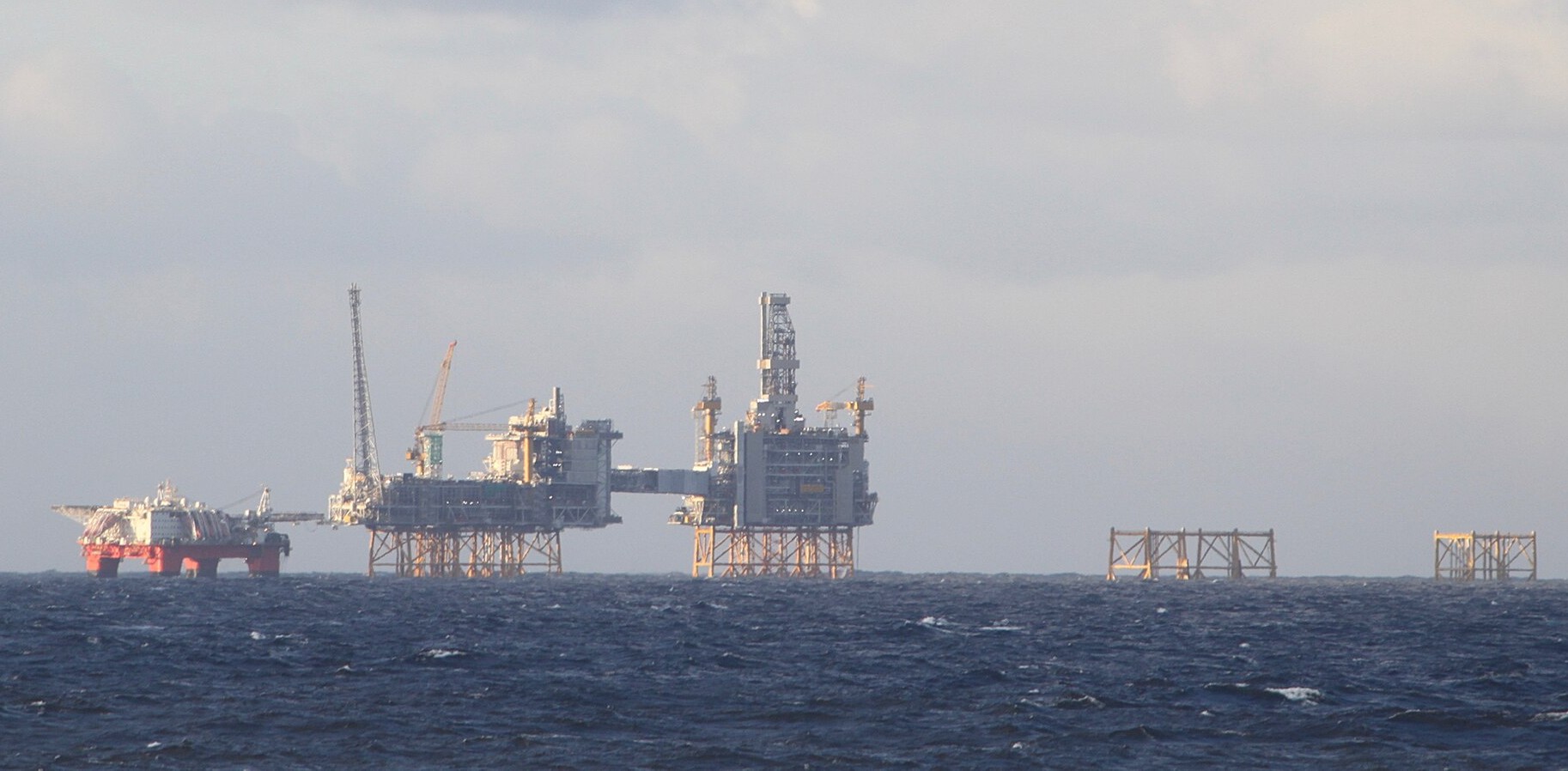
There is a question about modern Britain that has bothered me for some time. Britain and Norway both discovered extraordinary quantities of oil and gas beneath the North Sea. Both countries suddenly possessed something previous generations could only have dreamed about: a natural resource worth billions, sitting beneath their own waters, capable of transforming their economies.
Norway eventually turned much of its petroleum wealth into a national investment fund now worth more than 2.2 trillion Norwegian kroner (£175 billion). But Britain didn’t. So where did our money go?
The easy answer is look back at the 1980s, blame Margaret Thatcher and leave it there. But having looked more closely at the history, I don’t think that tells the whole story.
The truth is more complicated, and in some ways considerably more troubling. Because there actually was a debate in Britain about what should be done with this once-only windfall. It was known that the oil would eventually run down, and that the revenues would not last forever. The government even considered creating a separate fund. And then chose a different path.
British National Oil Corporation 1975
When the Labour Left politician, Tony Benn, became Secretary of State for Energy in June 1975, Britain’s North Sea oil industry was gathering extraordinary momentum.
The Labour government in which he served had already introduced the Petroleum and Submarine Pipe-lines Act 1975, creating the (BNOC) which was to receive royal assent in November of that year. Benn’s position was straightforward. These resources were too important to Britain’s future for the state simply to stand back and allow multinational oil companies to determine what happened to them.
One misunderstanding is often repeated. It is sometimes claimed that the 1975 Act automatically gave BNOC a 51 per cent stake in every North Sea oil licence. It didn’t. The legislation created the machinery for state participation. For future licences, participation could be incorporated into licensing arrangements. For existing licences, the government sought agreements through negotiation.
The political ambition, however, was unmistakable. The government wanted majority state participation in important North Sea developments. During the Commons debate on 30 April 1975, the Energy Minister at that time, Eric Varley, explained that BNOC could become the majority holder, and in some cases the sole licensee, in future licensing rounds. His argument was that Britain should receive the rewards of North Sea development not merely as a tax collector, but as an owner. That is a very different philosophy from what followed.
Tony Benn, who took the Bill through its third reading on 29 July 1975, believed Britain’s natural resources belonged, in a meaningful sense, to its people. And he understood something else. Oil is not renewable. Once you pump a barrel out of the North Sea and sell it, it has gone forever. You can spend the money. But you cannot sell that barrel again. That simple fact sits at the heart of this entire story.
Callaghan government actually considered an oil fund
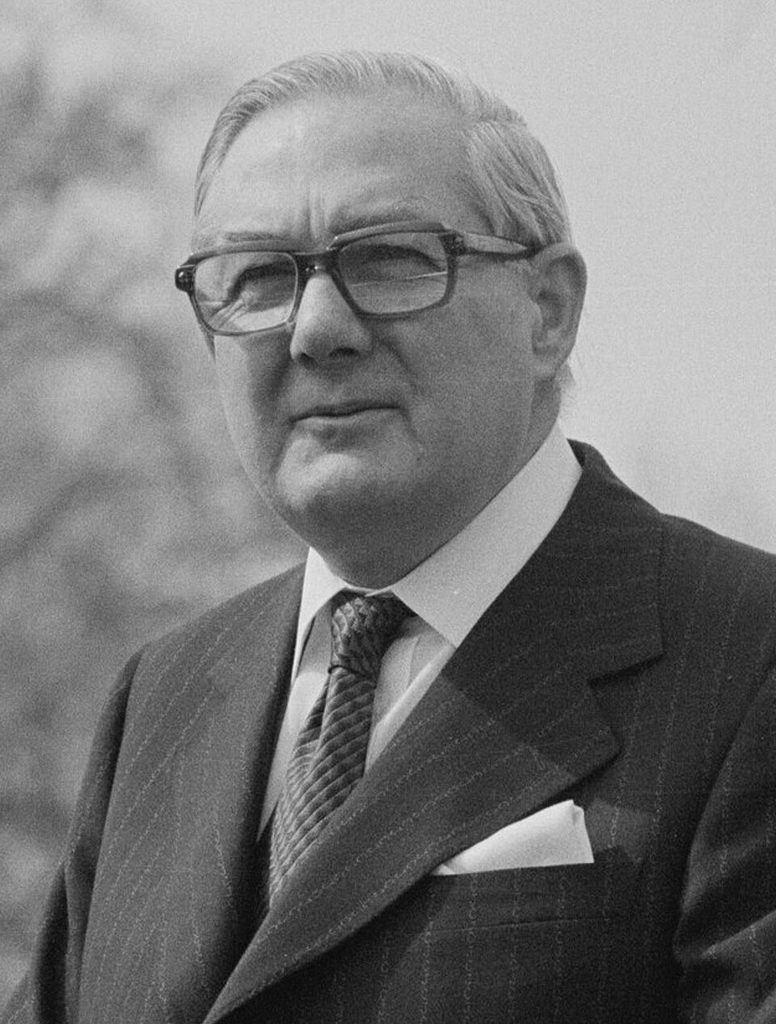
Labour Prime Minister 1976-79
[Photo – Marion S. Trikosko – wikicommons]
This is perhaps the most fascinating part of the history. The idea that Britain should somehow preserve the North Sea windfall was not invented retrospectively after people saw Norway becoming rich. British ministers were discussing the problem while the oil was flowing.
In March 1978, the Labour government set out what it intended to do with North Sea revenues. The government described the oil as a valuable but temporary bonus and said Britain should emerge stronger when the revenues eventually declined. Its priorities included industrial investment, energy conservation and alternative energy, reductions in personal taxation, improvements to public services, rebuilding inner cities and improving skills.
And then comes the remarkable part. The government confirmed that it had considered creating a separate fund for North Sea oil revenues. It rejected the proposal. The reasoning was that it would be difficult to identify precisely which public expenditure and tax reductions had been made possible by North Sea revenues.
That decision deserves far more attention than it receives. Because the question wasn’t, “Could anybody possibly imagine saving some of this money?” The Labour government had imagined it. They discussed it. And chose not to do it.
Thatcher
Margaret Thatcher entered Downing Street in May 1979 with a fundamentally different economic philosophy. Where Benn had emphasised public ownership and state participation, Thatcher believed private ownership and markets would allocate resources more effectively.
BNOC’s oil-producing business was separated and became Britoil. In October 1982, the government announced plans to sell 51 per cent of Britoil. This wasn’t an administrative adjustment. It represented a profound change in Britain’s approach to its North Sea resources. The state was retreating from being a commercial participant.
And all the while, an extraordinary amount of money was arriving at the Treasury. Just how much money are we talking about? The figures are staggering. Official figures show that petroleum tax revenue from the North Sea rose steeply through the early 1980s, reaching around £12 billion in 1984 to 85 alone. The Office for Budget Responsibility records that this was equivalent to around 3.1 per cent of the entire UK economy, GDP, in that year.
Taken together, revenue from oil and gas taxation between 1979 to 80 and 1986 to 87 came to roughly £57.8 billion, in the money of the time, not today’s prices.
Great fiscal windfall
North Sea revenues are estimated to have represented somewhere around a tenth of total Consolidated Fund revenue in 1984 to 85. Think about that. A significant slice of central government revenue, roughly one pound in every ten, was coming from the North Sea. This wasn’t loose change. It was one of the greatest fiscal windfalls in modern British history. So what happened to it?
This is where we need to be careful. It is too simplistic to say North Sea oil paid for Thatcher’s tax cuts. Government finances don’t work like separate household envelopes. Petroleum taxes went into the government’s overall finances alongside income tax, VAT, corporation tax and other revenues. There wasn’t an oil bank account marked Margaret Thatcher, tax cuts.
But the timing is impossible to ignore. In the first Conservative Budget of 1979, the basic rate of income tax was reduced from 33 per cent to 30 per cent. The top rate on earned income fell from 83 per cent to 60 per cent. By 1988, the basic rate had fallen to 25 per cent and the top rate to 40 per cent.
At the same time, Britain experienced enormous industrial upheaval. Unemployment exceeded three million during the early 1980s. Manufacturing communities across northern England, Scotland, Wales and the Midlands experienced factory closures and enormous economic disruption. Those unemployed workers needed benefits. Their families needed support.
The Treasury therefore had a huge source of additional revenue arriving at precisely the moment Britain was undergoing one of the most dramatic economic restructurings in its modern history.
It would be wrong to claim every pound of North Sea revenue funded tax reductions and unemployment benefits. But it would be equally absurd to pretend tens of billions of pounds of petroleum revenue made no difference to the government’s room for manoeuvre. It plainly did.
The industrial question
There is another uncomfortable aspect of this period. Economists have long discussed something called “Dutch disease”. The basic idea is relatively simple. A country discovers an enormously valuable natural resource. Exports rise. Money pours into the country. The currency can strengthen. That makes other exports more expensive internationally and can make manufacturing less competitive.
North Sea oil was certainly not the sole explanation for Britain’s industrial decline. That would be far too simplistic. High interest rates, monetary policy, international competition, technological change, industrial relations and long-standing weaknesses in British manufacturing all mattered.
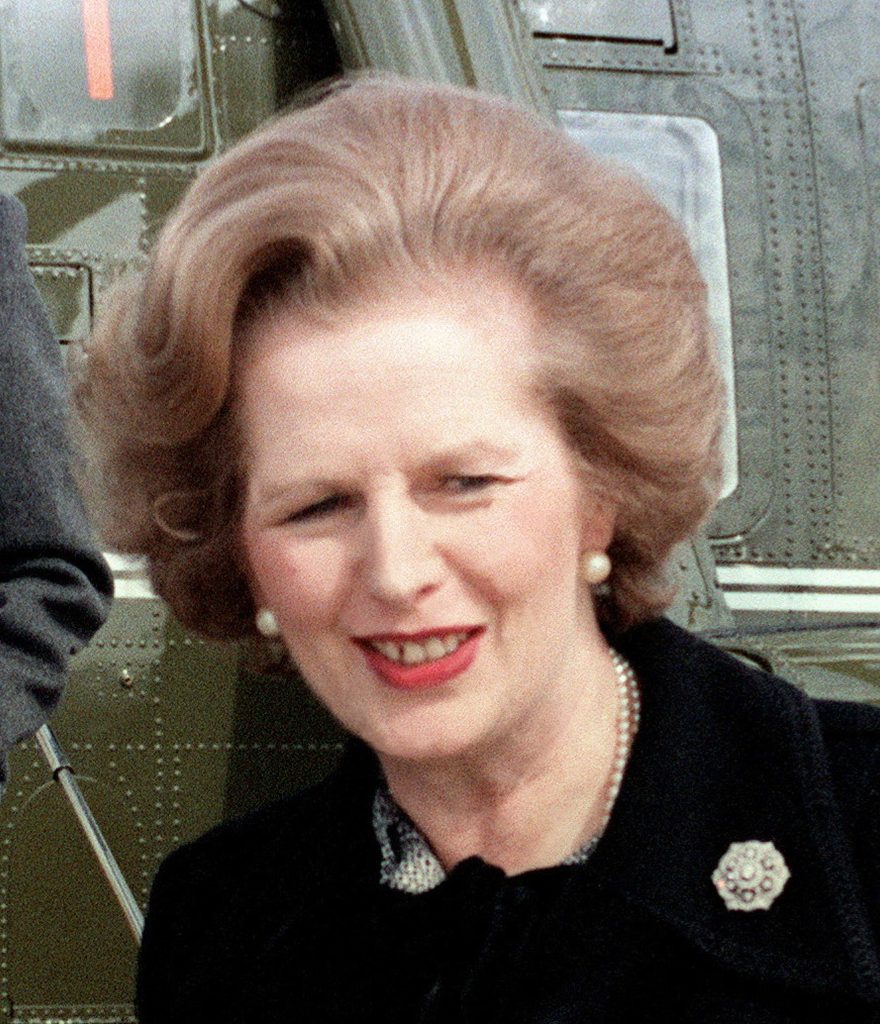
Tory Prime Minister 1979-1990
[photo – wiki commons]
But there remains a bitter irony. At precisely the moment Britain was receiving an extraordinary natural-resource windfall, many of its traditional industrial communities were being devastated. And Britain did not create a permanent national investment fund that might one day help regenerate those communities.
Now look across the North Sea. Norway faced the same fundamental problem. It had discovered something enormously valuable. But every barrel could only be sold once.
Norway’s response developed differently. The Norwegian state maintained substantial involvement in petroleum production, including through Statoil, established in 1972 and now known as Equinor. It also taxed petroleum profits heavily. Then, in 1990, the Norwegian parliament established what became the Government Pension Fund Global.
It is important to get the chronology right. Norway didn’t discover oil and immediately put billions into a sovereign wealth fund. The fund was established in 1990. The first money was transferred into it in 1996.
That matters because Britain cannot simply excuse its decision by saying Norway knew something in the 1970s that nobody else knew. The Norwegian model evolved. But Norway eventually made the decision Britain never did. It began converting a finite natural resource into permanent financial assets.
What did Norway do?
Norway sold oil and gas. The state collected petroleum revenues. Instead of allowing all that wealth to be absorbed into ordinary domestic spending, the state invested its petroleum wealth internationally. Shares. Bonds. Property. Infrastructure.
In other words, Norway gradually exchanged something temporary beneath the seabed for something capable of generating wealth long after the petroleum had been extracted.
The principle is almost beautifully simple. Turn oil into ownership. And look at what happened. As of 30 June 2026, Norway’s Government Pension Fund Global was worth 22.683 trillion Norwegian kroner. Let that number sink in. 22,683,000,000,000 kroner. The fund owns equity interests in around 7,100 companies. Its investments stretch across the world.
More extraordinary still, more than half of the fund’s value now comes from investment returns rather than the original government deposits. By the middle of 2026, investment returns accounted for around 15.2 trillion kroner of its value. Net government inflows accounted for about 5.5 trillion kroner.
That may be the most important statistic in this entire article. The money didn’t merely sit there. It reproduced. The oil wealth created investment wealth. And the investment wealth created more wealth. That is the power of preserving capital across generations.
There is another misconception worth correcting. Norwegian politicians cannot simply treat the entire fund as an enormous current account.
Norway operates a fiscal framework under which transfers from the fund to the government budget should, over time, follow the expected real return on the fund. The fiscal rule was introduced in 2001. The expected real return was initially estimated at 4 per cent and was subsequently reduced to 3 per cent.
There is flexibility, particularly during economic shocks, but the central philosophy remains. Don’t consume the inheritance. Use its sustainable returns. That is the difference between owning wealth and merely spending money.
Britain and Norway very different
I don’t want to write a fairy tale in which Norway got everything right and Britain got everything wrong.
The countries were very different. Britain had a much larger population. It had an ageing industrial economy. It faced serious inflation, unemployment and public-finance pressures. Norway had different political institutions, demographics and economic circumstances. Norway itself waited years before establishing its fund.
So anybody claiming that Britain would definitely possess a two trillion pound sovereign wealth fund today if Tony Benn had won every argument is speculating. Nobody can know that. Governments might have raided it. Investment performance could have been different. Britain might have deposited far less of its petroleum income.
But none of those qualifications destroys the central argument. Because Norway has demonstrated what happens when a country treats natural-resource wealth as capital rather than simply income.
And here is the part that is hardest to swallow. Britain subsequently privatised enormous parts of its economy: energy; water; telecommunications; transport infrastructure.
Other countries accumulated national investment funds. Those funds, pension schemes and state-backed investors then acquired investments around the world, including investments in Britain.
Think about the irony of that. Britain possessed its own extraordinary natural-resource windfall. We chose not to create a large permanent national investment fund from it. Other countries did. And international state-backed investors can now use their accumulated wealth to own assets and businesses elsewhere. Including here.
You couldn’t invent a better illustration of the difference between selling an asset and building an inheritance.
Too easy to just blame Thatcher
The more I have looked into this, the less I think this story should simply be that Tony Benn and Labour were right and Margaret Thatcher was wrong. That is too easy.
The Labour government itself considered a separate North Sea oil fund and rejected it in 1978. Thatcher then accelerated Britain in a radically different direction: privatisation, reduced direct taxation and a retreat from state participation in industry.
Different governments made different decisions. But all of them failed to do something that Norway eventually managed spectacularly well. They failed to convert enough of an exhaustible natural resource into a permanent national financial inheritance. That failure belongs to more than one politician.
Imagine standing on the North Sea coast in 1975. Somewhere beyond the horizon, platforms are drilling into rock that has been sitting beneath the seabed for millions of years. The oil comes up. A tanker takes it away. Money comes back.
What happens next? That was the choice. Spend it today? Cut taxes? Support public expenditure? Invest in industry? And put some of it away and say: this doesn’t belong only to us, some of it belongs to people who haven’t been born yet. The Norwegian government eventually chose the last option. British governments largely didn’t.
Half a century later, Norway possesses a sovereign investment fund worth more than £175 billion. Britain cannot go back and pump the same oil out of the North Sea again. It has already been extracted. Already sold. Already taxed. Already spent and absorbed into the economy.
And perhaps that is the real tragedy of Britain’s North Sea Oil story.
We didn’t fail to find the treasure. We found it. We knew it wouldn’t last forever. The Labour government even discussed saving some of the proceeds. Then subsequent governments, including Thatcher’s, allowed one of the greatest natural-resource windfalls in British history to pass through the nation’s finances without creating anything remotely comparable to the permanent inheritance that was eventually built in Norway.
In Norway oil was turned into ownership. In Britain much of it was turned into revenue. And once the oil is gone, that difference lasts for generations.
[Featured photo – North Sea Oil rigs off coast of Scotland – wikicommons]
Sources and further reading
UK Parliament, Hansard, 30 April 1975, Petroleum and Submarine Pipe-lines Bill. Labour minister’s detailed explanation of BNOC, state participation and the government’s intention that the public should benefit as an owner as well as through taxation.
Petroleum and Submarine Pipe-lines Act 1975. The legislation establishing the British National Oil Corporation and National Oil Account.
Hansard, Lords Chamber, 21 March 1978, North Sea Oil Revenues (Statement repeating the Prime Minister’s Statement on the White Paper, The Challenge of North Sea Oil). Confirms the Labour government’s description of North Sea oil as a valuable but temporary bonus and records the government’s own words: that it had “very carefully considered a proposal to create a separate fund for North Sea oil revenues and expenditure” and rejected it because there was “no satisfactory way of separating and identifying the public spending and the tax reliefs specifically made possible by North Sea oil.”
Oil and Gas (Enterprise) Act 1982. The legislation that enabled the restructuring of BNOC and subsequent transfer of its oil-producing operations.
Hansard, 27 October 1982, Britoil. Government statement announcing the planned sale of 51 per cent of Britoil.
UK Parliament historical income-tax statistics. Records the reduction of the basic income-tax rate from 33 per cent in 1978 to 79 to 30 per cent in 1979 to 80 and ultimately 25 per cent in 1988 to 89, with the highest earned-income rate falling from 83 per cent to 60 per cent and then 40 per cent.
Office for Budget Responsibility, “The rise and fall of oil and gas revenues.” Confirms UK oil and gas receipts rose 420 per cent between 1979 to 80 and 1984 to 85, reaching £12.0 billion, equivalent to approximately 3.1 per cent of GDP, in 1984 to 85.
HM Treasury and OBR historical UK Continental Shelf tax receipts table. Official annual breakdown of petroleum revenue tax, royalties and corporation tax from North Sea oil and gas, 1979/80 to 1986/87, confirming cumulative revenues of approximately £57.8 billion over the period, and indicating North Sea receipts formed a substantial share of Consolidated Fund revenue at their 1984 to 85 peak.
Norges Bank Investment Management, Government Pension Fund Global. Official history and financial statistics for Norway’s sovereign wealth fund. The fund was established by legislation in 1990 and received its first capital transfer in 1996.
Norges Bank Investment Management, Half-Year Report 2026. Records a fund value of NOK 22.683 trillion at 30 June 2026, including NOK 15.210 trillion attributable to investment returns and NOK 5.509 trillion in net government inflows.
Norwegian Ministry of Finance, The Norwegian Fiscal Policy Framework. Explains the mechanism through which petroleum revenues enter the fund and the fiscal rule governing transfers from the fund into Norway’s national budget.
Alexander Kemp, The Official History of North Sea Oil and Gas. A detailed academic history of the development, taxation and regulation of Britain’s North Sea petroleum industry.












Excellent analysis. On ‘the Dutch disease’, the economist Nicholas Kaldor argued at the time that by not expanding the economy to accommodate the new resource, the Thatcher government ensured that oil would merely displace existing manufacturing industry via an overvalued exchange rate – all exacerbated by the monetarist anti-inflation strategy of high interest rates. In the 79/81 recession, we lost almost a fifth of our manufacturing. So GDP was also significantly less than it might have been. As Kaldor put it, ‘It was a national tragedy that Mrs Thatcher and North Sea Oil came on stream at the same time’.