By Andy Ford, Unite NHS rep
Obesity is one of the major causes of health problems in Britain, Europe and the USA, and many countries around the world. The fact that it co-exists with malnutrition and actual starvation just underlines the insanity of modern capitalism.
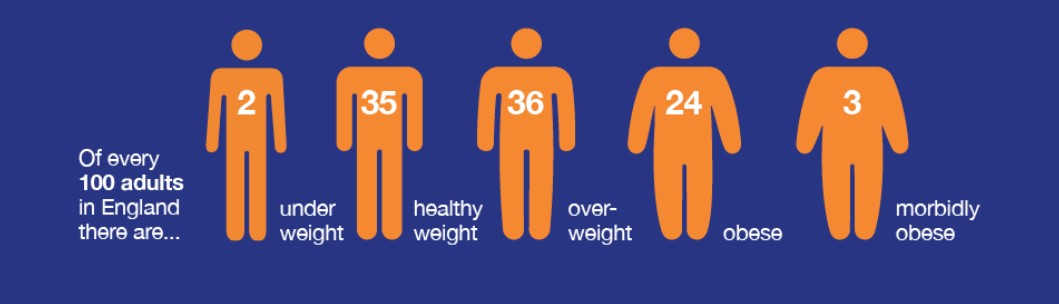
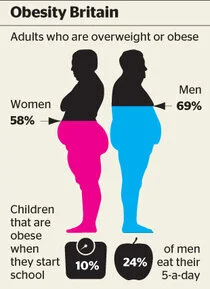
In 2023, one quarter of UK adults met the criteria for obesity; in the US the figure is one in three. As we know, obesity has major impacts on health, with links to heart attacks, strokes, diabetes and bone and joint problems like osteo-arthritis. Obesity is also statistically linked to cancer, although the exact mechanism is unclear.
The causes of obesity are to be found in modern settings that combine sedentary lifestyles, and highly automated work, with processed and ultra-processed foods, pumped full of fat and sugar, and lacking in fibre. Human beings evolved as hunter-gatherers in an environment where they walked on average around 18 miles a day. They rarely consumed sugar or any ‘neat’ carbohydrates, and mostly sustained themselves on a diet of roasted tubers, fruits and grains, with meat only a part of a diverse diet [See The Evolution of Diet – National Geographic].
Humans and pre-modern humans were hunter-gathers for maybe a million years; yet agriculture was adopted 10,000 years ago, and the modern industrial diet appeared only 200 to 25 years ago, depending on where people live. It is the way we now live and what we eat that creates obesity. Our bodies are simply not equipped to deal with it. [Food, health and politics, part 2: deadly sugar – Left-Horizons]. As for the UK, it is the only country in Europe where on average more than half of the calories consumed come from ultra-processed foods.
The obvious solution would be for government and public health authorities to help people live healthy lifestyles by providing free gyms, and access to the countryside; and also setting and enforcing high standards for healthy foods and banning adverts for sugar-filled drinks. Not much of that is likely to happen outside a socialist government.
Unfortunately, experience shows that any changes to food labelling, advertising, or sugar content will come up against the serious opposition of food industry lobbyists and the corrupt corporate media. The food industry is dominated by a handful of giant companies who spend tens of millions on lobbying and ‘buying’ politicians.
Obesity is a class question, as it is linked with poverty. It is the cheapest food that is highest in fat, sugar and additives; and which is low in fibre and fresh ingredients. And any working-class family who buy fresh fruit, vegetables or salad will have to consider outdating and potential waste, satirised here in the Daily Mash.
This is why, a the government’s own data shows, rates of obesity map closely to maps of deprivation and poverty, with the highest rates in Hartlepool and Stockton-on-Tees, and the lowest in Islington and Hammersmith.
While a quarter of UK adults are obese, another 40% are overweight, meaning that in total nearly two thirds of the population are overweight to some degree. And yet there is a cult of thinness coming from another arm of corporate mass culture – media, fashion, clothing and cosmetics – which particularly impacts on women and girls.
Eating disorders affect around 3% of young women and anorexia has the highest death rate of all mental illnesses, with 5% dying within four years of diagnosis.
Into this crossfire have stepped the new weight loss drugs: Wegovy (from Denmark) and Mounjaro (from the USA). Both are given or self-administered by injection. And the science shows that they do work.
A recent article in the British Medical Journal pointed out the impending dangers of two-tier access to these ‘weight-loss jabs’. “We are left with a medical option to treat obesity.” The author of the article writes, “Weight loss drugs challenge the idea that we can tackle obesity by focusing on societal issues and behaviour alone. The drugs are an intervention that the public broadly wants and is in high demand”.
For now, NICE (the organisation that licenses and allows drugs to be prescribed) has validated the drugs only for the most obese, who must also have at least one related serious health condition. Due to tight finances in the NHS, the official plan is that the mass roll out by the NHS of Wegovy and Mounjaro will take place over a period of the next twelve years.
But millions of people are overweight or obese right now, and are subject to ‘fat shaming’ by much of the mass media and fashion industry. The ‘weight-loss jabs’ are also the subject of almost daily articles in the mainstream press.
Demand is high and will only get higher. Those who can afford it – at around £150 a month – will buy the drugs themselves, hopefully from reputable suppliers, but also, inevitably, from the internet where the product may not be pure or even as advertised. It is also very likely that internet fraudsters will be selling desperate people vials of saline solution for slightly less, as a ‘bargain’ at £100. A quick internet search for either medicine pulls up literally dozens of ‘sponsored links’ offering the drugs.
In the words of the British Medical Journal, “It seems clear that access will be available only to a chosen few.”
The position adopted by NICE – under government pressure – makes no sense even in financial terms. Weight-related health conditions are going to cost the NHS a lot more than £150 a month per person in the future. York University estimated that diabetes alone cost the NHS £14bn in 2022. That would pay for around 10 million courses of either Wegovy or Mounjaro.
Everyone talks about “moving from treatment to prevention” but when it comes to it, the money is simply not being provided. Just like adult social care, Wes Streeting has kicked the can down the road. Another ‘hard choice’ ducked, even though it will cost a lot more in the long run.
[Feature picture from UK government website, here, showing proportion of obese adults in UK].