
By Joe Langabeer
Last week, Jeremy Corbyn hinted on ITV’s political show with Robert Peston that he was considering setting up an “alternative” grouping – something akin to a new party to challenge Labour – framing its focus on tackling poverty and inequality, as well as supporting a foreign policy based on peace, not war. The day after the show aired, Zarah Sultana announced that she had resigned from the Labour Party after 14 years to co-lead this grouping, or “party”, with Corbyn.
What followed was a flurry of briefings reported by The Sunday Times, in which Corbyn and his team were said to be angry about Sultana’s announcement explicitly linking her to the creation of a new party with Corbyn, an announcement Corbyn and his wife, Laura Alvarez, reportedly hoped would be deleted.
Accusations and counter-accusations from the different camps
It was supposedly Hiram W. Johnson, a US senator in 1917, who said, “The first casualty when war comes is truth.” Well, the same could be said for setting up “political alternatives”. In an interview with Novara Media, Jamie Driscoll suggested that the briefings reported by The Times were fabricated, hinting that journalists might have invented their sources, as he claimed they had done in the past. Jamie Driscoll was formerly the metro mayor for the North of Tyne, but was blocked by Labour from being their candidate in the North East mayoral election. He stood independently but was defeated by the official Labour candidate. He is now a leading proponent of independent alternatives to Labour.
After the interview, Novara co-founder Aaron Bastani refuted Driscoll’s claim and suggested that individuals intent on sabotaging the project from within Corbyn’s team were leaking information to the press; and that these individuals should be removed from the team. We are now in a lull, with Corbyn making a lukewarm announcement that an alternative foundation for a party will form and be co-led with Sultana. But we remain none the wiser as to when it will be launched, who will be involved, or whether it will be a party at all—perhaps it will be an alliance of various groupings and movements.
The communications have been botched
What we can say for certain is that this whole botched announcement has become a bit of a farce. There seems to have been little communication between Sultana and Corbyn over this—otherwise, the announcements would have been co-ordinated. Most reports—be it The Times, Novara, or even a report from Weekly Worker a year ago—suggested that meetings had been held over a long period of time to develop a new party, but nothing came to fruition until now.
And yet, still, nothing has really come to fruition, because no one seems to know what the project actually is. Will it be a party that stands candidates? Or is it a project that will organically develop into a party, one that recruits and trains candidates to form their own initiatives? From Driscoll’s perspective, referring back to his interview with Novara, it seemed like the latter. He wanted to see more “community-based” politics—something less tied to a formal party structure and more focused on engaging local communities and building policy around them.
Disillusionment with Starmer’s right wing policies
Whilst I speculate in jest, merely because it seems so confused in what it wants to be—I do sympathise with why these three have wanted to form an opposition to the current Labour leadership. Starmer and his cronies have long been capitulating to capital and have had one of the most terrible years I’ve seen politically in my lifetime, with damaging policies that will leave many people feeling the same as they did under the Tories during the austerity period—or even worse off, with further cuts to the welfare state.
His flip-flopping policies and virtue signalling over the atrocities and ethnic cleansing in Gaza have been nothing short of cynical – where he and Wes Streeting say they want to “stand up” to Israel, while the UK flies fighter jets, alongside pouring in heaps of cash for Israel’s military arsenal. From the freebies scandal to the cuts in winter fuel allowance, and the very minor “sticking plaster” policies that will do nothing to truly generate wealth for workers, you can understand the justified hatred and frustration directed at these careerists, who only seem to serve their own interests and those of their corporate allies.
You can also understand why these three—Sultana, Corbyn and Driscoll, have a personal bone to pick with Labour. All three have been treated appallingly by the party’s internal machinery in a bid to cleanse any decent left-wingers from the party. Sultana in particular has been treated with venom by the Labour right.
Sultana and Corbyn have taken a clear stand on many issues
Sultana had the whip suspended for voting against the two-child benefit cap, and whilst others were allowed to have the whip reinstated, Sultana’s suspension was sustained, with the party offering the pitiful excuse that it was investigating “other matters”, without elaborating further. It was clearly a tactic—much like what they tried with Diane Abbott before the general election to run down the clock, hoping the person in question would simply leave the party and spare them the bother of coming up with some poxy excuse for not reinstating them.
We don’t need to rehash the abuse Corbyn received during his time as leader and post-leadership—including the false smears of antisemitism—especially as his comments on Israel have proven to be more accurate than ever. But the point is, it’s entirely understandable why he and others would feel this way about the Labour bureaucracy and want to challenge it. I don’t agree with their tactics, but I do understand their frustrations. The same goes for ordinary people who are excited and hopeful about the idea of a new party. There are many decent socialists disillusioned with Starmer’s government, much like the general public who are crying out for an alternative that Labour is simply not offering at this point in time.
I was invigorated by politics when Jeremy Corbyn appeared in 2015, the jam man in a knitted sweater, who spoke out about the issues I cared about while I was at university. Policies like abolishing tuition fees, building more social housing, tackling homelessness, and stopping the invasion of foreign countries – these policies motivated many young people like myself. I see some commentators on the left now suggesting that Corbyn was a “blip” in the political system. But he wasn’t. He proved to me, and to many other young people, that politics can be a force for change and for good. That early exposure to socialist ideas will always be important to me—and that is why, despite his flaws, he remains a central figure in the modern Labour movement, particularly among young people.
The Labour movement is the key
But the socialist movement does not live, nor does it die, by Corbynism. It is the Labour movement, and the Labour movement alone that determines its destiny. Through the trade unions, the workplaces, and the working class, it looks overwhelmingly towards one party to represent them: the Labour Party. Even if it is currently hemorrhaging much of its base.
According to a poll by More in Common, while Corbyn’s new party could take three points away from Labour, it would hit the Green Party harder causing their support to fall from 9% down to 5%. Whilst there are many decent socialists who would sign up to the project and want to see it succeed electorally, the figures show that the majority of the working class would still stay with the Labour Party. It is their party, and they continue to see it as such, even if they are disappointed by its policies.
And this is where I would question Sultana’s decision. At this very moment, when the party has seen a massive rebellion against welfare cuts, essentially watering it down to its most barebones form, alongside PLP members actively briefing the press that Starmer could be ousted within months, according to Sky News—she now decides to step away from the fight. This is the moment to start applying pressure within the party: through CLP meetings, by putting forward motions, and galvanising the party base to take on the leadership; through conferences and coordination with trade unions to challenge the leadership on policy.
Signs of growing opposition within the Labour Party
We are now hearing reports, according to The Guardian, that Labour MPs are also unhappy with ministers over potential cuts to special educational needs for children. This could spark another rebellion, and there are only so many rebellions and political upsets the Starmer project can withstand. Sultana has a decent following, with many young people who would listen to her if she chose to organise against Starmer. And now, just as the battle begins for the soul of the party, she will have no way to fight within it.
We live in an age of political volatility, brought on by the crisis under capitalism. There are sharp swings and sudden movements—something often noted in the editorials of Left Horizons. In these times, it is very easy to be swept up in the energy of a potential new grouping that presents itself as an alternative to that volatility. When the ‘official’ announcement—whatever this project turns out to be finally materialises, we may see influential figureheads on the left join and announce their support, possibly alongside a trade union that offers lukewarm backing for the programme. We might see a few trade unions support it, though so far, there has been no indication of that.
We, as socialists, do not have a crystal ball through which to see these events, and we cannot predict the outcome of what this new project might bring. But from the way we observe the material reality of the here and now, it seems clear that this new project will not break into the mass consciousness of the working class at the present time. Workers, begrudgingly, still see Labour as their home.
A stormy period ahead
With the current state of this Labour government, and the ensuing battle that is about to commence, I would urge socialists to be patient and not to jump the gun. Socialists should stay in the Labour Party, keep the pressure on for socialist polices now, and prepare for bigger fights to come—when the conversation around socialism re-emerges, and the forces of the working class begin to move once more to transform the Labour Party and return it to its roots: founded by the labour movement and the trade unions.
It should be the task of all socialists to do this work: Take back the Labour Party, as it is the party of the workers, not the party of the capitalists.
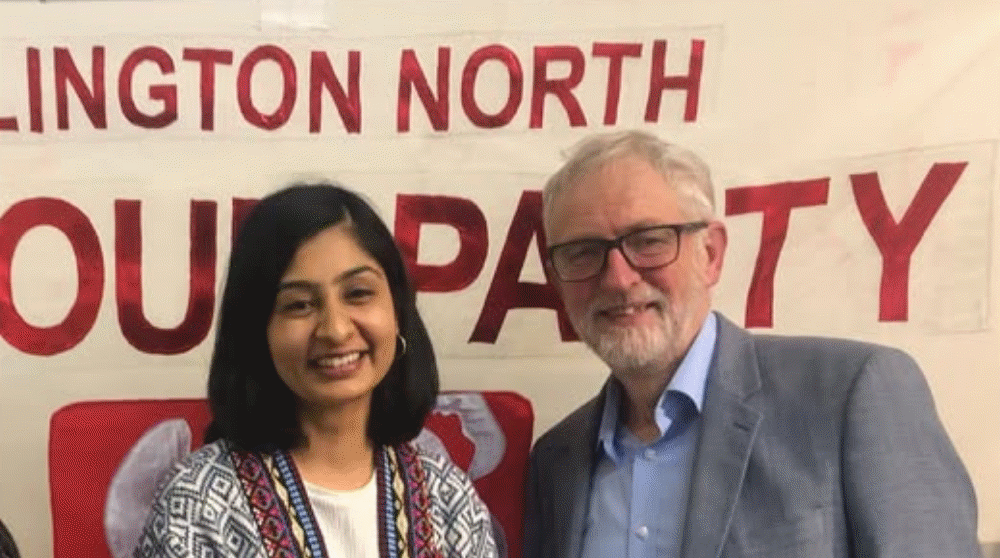
The featured image at the top of the article is from the facebook account of Zarah Sultana. The post in November 2020 called for the reinstatement of Jeremy Corbyn into the Parliamentary Labour Party.











Your sarcastic tone doesn’t do you any favours, Jim. You may find it regretful to admit it, but even the ‘worst’ polling (from Starmer’s point of view) doesn’t show a theoretical ‘new’ party overtaking Labour, as right wing as they are. We have to describe things as they are, not as how we’d LIKE them to be. There is a thirst for something new and different among workers and some of that thirst is expressed in support for Reform (unfortunately), some in a hope for a new party and some – yes, it is still there – for a change in the Labour leadership. We don’t have a crystal ball and we can’t see how it will pan out, but those who want a ‘new’ party are making heavy weather of it so far.
“But from the way we observe the material reality of the here and now, it seems clear that this new project will not break into the mass consciousness of the working class at the present time. Workers, begrudgingly, still see Labour as their home.” Oh Really said O’Reilly! Workers, begrudgingly, still see Labour as their home? Don’t make me laugh and madness is voting for the Labour Party time and time again – expecting a different result (towards socialism) but always defending the capitalist system. I myself can’t wait to vote for an alternative to Right Wing Labour and somebody needs to take on Farage and Reform.