By Jokin Mendizabal
And so Cristina Fernández de Kirchner was convicted. Finally, on June 10, the Supreme Court of Justice of Argentina ratified the long-awaited sentence of the well-known “Highway Case”.
Long announced by Cristina Fernández. As she said, “the sentence has been written for a long time“, intensely worked on and demanded by the mainstream media and, as is public knowledge, also worked in different ways by [Former president] Mauricio Macri, [current president] Javier Milei, and of course by the big Argentine and international businessmen. The sentence consists of six years in prison and disqualification from running for public office for life.
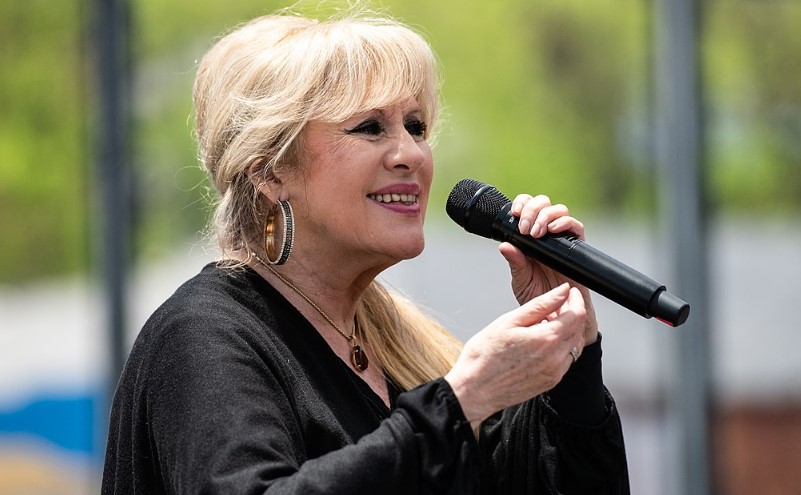
Days later, the Federal Oral Court granted the former president house arrest, having a very difficult time putting her behind bars. With the true intention of humiliating her, the judge ordered she have an electronic ankle bracelet – implying that there was a possibility that she could escape – have limited visits. And something that is not done in this type of arrest, and the most ridiculous thing, judge forbade her to go out on the balcony to greet the thousands of followers who passed under her home every day, chanting slogans in support of her and protesting the arrest.
Historically, Peronism built enormous support among the workers from its origin, thanks to the enormous concessions that Perón had granted to the working class as Secretary of Labour, even before becoming president in 1946. It was a support so great that it would allow him to become president of Argentina on three occasions.
Peronism was going to change the socialist, communist and anarchist tradition of the working class, not on the basis of empty words but thanks to very important concessions made to the workers. In the course of the years that gave rise to this movement, there had been a political agreement between the masses and Perón.
In both parts of the agreement there was an express interest: “we support you but you defend us from the bosses and the oligarchy by granting us the social rights we need“.
On Perón’s side, the message was: “I grant you decent wages, labour and social rights, vacations, education up to the university degree, public and free, quality health care with free hospitals for all, etc., but you support me and vote for me in every election.”
It was a state of well-being in the style of those established in Europe after the Second World War. This is how the agreement that was forged between Perón and the workers worked, one that would lead to the majority of the unions becoming Peronists, to part of the socialist bases voting for Perón, creating a real schism within the Socialist Party, from which not a few leaders would go over to the ranks of Peronism.
Today, that pact between the leaders who succeeded Perón and the working class is in crisis. It does not mean that Peronism cannot re-emerge with renewed strength; in fact it is most likely. The questions are when and how.
After a year and a half of Milei, things are worse than at the beginning.
The policies of brutal attacks on the working class are destroying hundreds of thousands of jobs, lowering the purchasing power of the vast majority of wage earners, and reducing retirements pensions to starvation levels for the majority. But there is a paradox in the fact that this has ended up provoking a more rapid disaffection of at least certain sectors of workers and young people from working class families who gave Milei their vote in October 2023.
It is true that opinion polls in recent months are showing a gradual drop in support for Milei, but it is striking that with such a savage ‘adjustment’ that this government introduced has not provoked a wave of strikes and mobilisations stronger than the current one, which, although important and increasing, are still insufficient. Why is this?
The key to everything is in the leadership of the [trade union federation] CGT. The causes of the current situation are multiple. How did it go from a workers’ and popular movement capable of fighting against the dictatorship of Videla and the other military juntas in the late 70s and early 80s, to the point of causing its fall in just 7 years?
Thousands of pages of books and articles have been filled trying to explain how we got here. Of course there are many different views, but all those who analyse the last few years from the perspective of what is called here the “national and popular camp” agree on the same thing: too many years of falling real wages, as a result of persistent inflation which ended up in 2023, the year in which Milei won the elections, at a rate of 211 per cent.
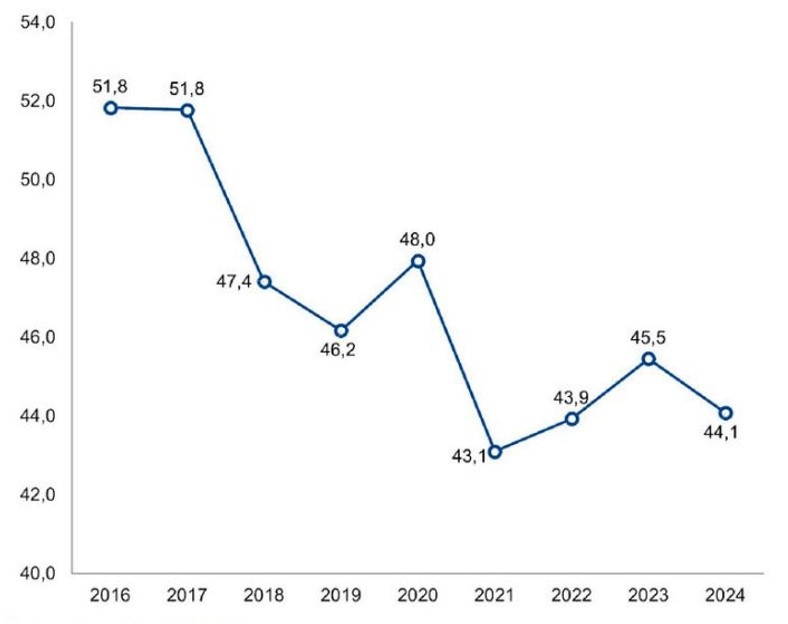
Inflation is still persisting. Argentina is a country with endemic inflation. The point is that sometimes we have inflation but wages grow faster and increase workers’ purchasing power, which happened during ‘Kirchnerism’. After the 2001 crisis it led to workers enjoying 51% of GDP.
And there are also periods when wages lag behind inflation and purchasing power falls, such as in the last three years of Cristina Fernández’s government, from 2013-2015. Now the workers’ share of GDP is 44%.
What is the role of the General Confederation of Labor (CGT)? This question deserves a much broader answer than is possible in this article, but we can say that for many years the CGT leadership has ceased to represent the workers and their interests. Every call they have made in recent decades has been tail-ending the demands of the workers, where they would have been left with their asses in the air, if they did not call either a mobilisation or a strike.
For some time now, there have been not-so-underground movements among the rank and file and among leaders of the different unions to remove the old bureaucrats of the CGT and impose new, better and more combative leaders. Such is the case with the Metalworkers Union (UOM) which since 2022 has proposed opposition leaders against the old bureaucrats.
In October, there will be a congress of the CGT, and there will be interesting changes in the leadership, since the current triumvirs (the three co-leaders), will not be re-elected. There are several unions that are preparing to fight at that congress.
The first battle for the improvement of workers’ living conditions has to be fought within the CGT, whose current leadership is a real barrier in any defence of workers’ interests. All the most class conscious Argentine workers know this and that is why they have a very better attitude towards these leaders from whom they expect nothing.
In some demonstrations where one of these leaders dares to appear, the rank and file shout abuse and call for the leaders to set the date for a general strike. The atmosphere in the trade unions is getting hotter and hotter, and there are many pockets of struggle in different unions and workplaces.
But in general the struggles are being called by the leaders of these separate sectors and not by the CGT, which makes it harder for these struggles to achieve victory. The government has slowed or obstructed the agreements reached on some occasions where rises have exceeded the ceilings imposed by Milei, and which have had the effect of pushing down the purchasing power of workers.
Milei and his cronies do not stop shouting that the economy is “doing well”, that retirees are paid more in dollars, that the fiscal deficit and inflation are under control. But among many of his followers and those who voted for him, he has lost credibility. Yet the atmosphere is still unclear ahead of the next mid-term elections, due to be held in October.
The ground is moving under Milei’s feet.
The ground is moving under Milei’s feet. The political environment is one of tremendously polarised. On Thursday, July 10, Milei suffered a monumental defeat in the Senate, where four laws were approved by a very large majority. These determined that pensions would be increased by 7.2%, and that an emergency payment would be sent to the city of Bahía Blanca, (of 200,000 million pesos), which Milei had vetoed. In addition, the Senate agreed to subsidise people with different abilities as well as payments to all provinces of a part of what the national state must distribute among the provincial governments.
Milei has said that he is going to veto all these laws and if Congress rejects his veto, he will make sure these laws are not implemented. This threatens to make the political situation even more tense in these areas and among those voters affected.
As a result of these parliamentary battles, Milei has turned against the governors of all of the Argentine provinces, leaving him very isolated, especially since Milei has the presidency, but due to the nature of Argentine elections, has very few deputies and senators.
In the economy, the peso has suffered an fall against in the dollar, which if it persists will put it at serious risk of imploding the government’s ailing economic plan. We will see how this evolves, but for now it has launched new government bonds in pesos with very high interest rates, 40%, so that investors do not go to take refuge in the dollar.
JP Morgan sent a circular to its investor clients in Argentina advising them to stop investing here. The multinational supermarket company Carrefour has publicly said that it wants to leave Argentina and is looking for a buyer. To make matters worse, the agricultural producers are angry with the government because it had “gifted” them a tax cut to sell the harvest, which means fresh dollars for the government, but now it raises taxes again to the previous level and farmers are snorting.
Milei publicly admonished by his vice-president
In Milei’s Argentina everything is creaking, including the government. There has also been a clash between Vice-president Victoria Villarruel and Milei over the July independence celebrations. Milei refused to attend San Miguel de Tucumán, where the “Declaration of Independence from Spain and from all foreign powers” was drafted.
Milei found out that all the governors were going to stand up to him at the celebration of Argentine independence, and that he was going to find himself completely alone. He made the excuse that he could not fly to Tucumán because of fog, but next day the Vice President was able to get on a plane and be on time at the celebration. She publicly told Milei to “grow up”.
Now she is meeting secretly with Miguel Angel Picheto, who was a Peronist senator for 17 years. He flirted with Macri and was part of the ticket in his second presidential election, when he was defeated by Peronists Alberto Fernández and Cristina Fernández. If there is one thing that characterizes the “political caste” in Argentina today, it is its ability to switch parties.
The political situation is tremendously volatile. Someone once said that Argentina produces more news than it can digest and this has an effect on workers’ ability to understand the political process even those who read newspaper and analyse politics. Then, the majority of people do not even read newspapers.
By the way, a very high percentage of the political statements of Milei and his supporters on social media are made with the sole purpose of entertaining, distracting, or sometimes harassing, persecuting or threatening journalists and politicians. There is even a case already where the President is being taken to court after having harassed an autistic child and his parents.
Rosario, a light
On Sunday, June 29, two provincial elections took place that, in the midst of the chaos that dominates the Argentine political environment, have become a powerful beacon for the construction of an alternative to the government of the Milei brothers. These were the elections in the provinces of Formosa and Santa Fe.
In Formosa, Peronism triumphed, winning 67% of the vote. The Peronist leader here, and governor of the province, Gildo Insfran, has developed a policy of strong state intervention and that was why he achieved a high level support that has lasted since December 1995.
After this victory in which Peronist representatives were also elected to a constituent assembly to reform the provincial constitution, the Minister of Security, Patricia Bullrich, who has opposed Insfran’s re-election for years, spoke on election night.
“I am neither Minister of the Interior nor Chief of Staff” she said, “my personal opinion is that Insfrán is directly challenging the Supreme Court, passing it over and that is a cause for intervention. This fact is an act of extortion of the Court’s decision.” With the constitutional reform, Insfran will be able to continue to be elected, something that Minister Bullrich tries not to happen.
But what in my opinion constitutes the most interesting point at this time, for what it implies about a renewal of Argentine and Peronist politics, is in Rosario, the third most populous city in the country. Rosario is also the most important port in Argentina. It is a city that has literally been taken over by drug traffickers, and where life has become very complicated in recent years.
Stunning victory of Cuidad Futura
The real political surprise in Rosario – which will surely have national significance – was the stunning victory of the candidacy of Cuidad Futura [‘Future City’] headed by Juan Monteverde, as a result of thirty years of militant work within the Peronist base and among a group of young people from the city.
Monteverde, got just over 30% with his list alone, but added to the other Peronists who ran, it exceeded 40% of the votes, winning the current mayoralty of the city and the governorate.
On election night, when Juan Monteverde was making his winner’s speech, none of the mainstream media came to hear, yet many already glimpse him as a leader with great national potential. Monteverde never tires of explaining that the key to his victory lay in the political militant work through which, for example, they rescued a dairy company, which effectively became a cooperative.
They also founded schools in neighbourhoods where the state had not entered for 14 years and according to the latest data they are the schools for young people and adults with the highest number of graduates in the entire province. Monteverde explains that “another society is possible” and that they are “explaining it” by building small pieces of that society like companies and schools that work better than private ones, and with the participation of workers in the management.
Now Monteverde has set out to extend his Future City proposal to Buenos Aires and I have the impression that he is going to be very successful. There has been great sympathy shown in many militant sectors above all there is a great need to fill a void in politics and push towards the formation of organisations of this new type, where participation is greater and is promoted among militants.
We have to keep our eyes on this new formation which is already capturing the attention of activists and sectors of workers who are not yet activists, but would be with an organisation like this. Juan Monteverde joins the list of new leaders beginning to set the pace in this time of tremendous crisis in Argentina.
[From the website, porelsocialism.net]
[Feature picture (Cristina Fernandez) and insets, all from Wikimedia Commons]