Part II: From ‘Best Blue’ to Red Air Force
The final part of an article by By CAIN O’MAHONY. The first part can be read here
On a night in late January 1946, around 800 RAF airmen quietly gathered in the middle of the night on the football pitch at the Drigh Road RAF base near Karachi. Whispered instructions were to look straight ahead and not to say names when speaking.
The need for secrecy was paramount. It was unclear whether they were under wartime or peacetime regulations – if wartime, they could be shot for this mutinous act, and if peacetime they could still face hefty jail sentences.
There were also rumours that a few weeks earlier, airmen at the Jodhpur RAF base had refused orders, but their Commanding Officer had called in the Indian Army, and the men were forced back to their duties at bayonet point.
The Drigh Road airmen were there to agree on what action to take the following day. There had been the simmering resentment in South East Asia that the military authorities were delaying the demobilisation of servicemen, and the RAF in particular, to use as a military force to reimpose the British Empire’s colonies.
Before the war, very few servicemen had left the shores of Britain, and had only a picture-book image of the ‘benevolent’ British Empire. Now they had seen its reality, of oppressed and exploited masses by a pampered elite.
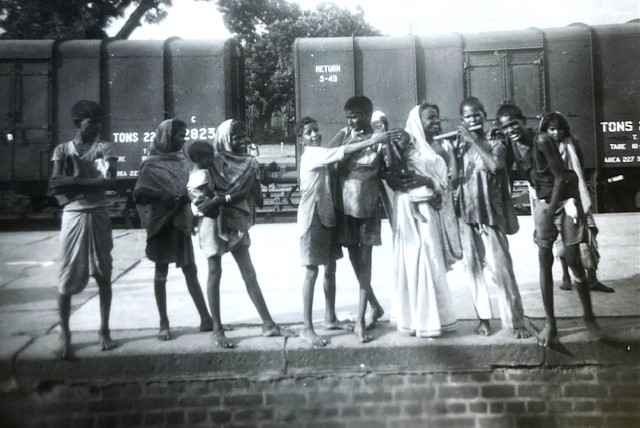
The soldier photographer wrote on the back:
‘They may look happy but they have a rotten life of no food’.
[photo – LSgt Bob Wade, Royal Signals (1944-47)]
They had sacrificed all to fight fascism. Now the war was over, and they had done their bit. It was time to go home, not to fight new imperialist wars.
Resentment
This had been the backdrop to their resentment. But at Drigh Road this simmering pot had been brought to the boil by the ‘station orders’ issued during the day – that tomorrow, there would be a full scale parade, with kit inspection, not in their combat fatigues, but in the full ‘Best Blue’ uniform of the RAF.
In the searing Indian heat, it was felt this was a ridiculous order. Airman David Duncan said:-
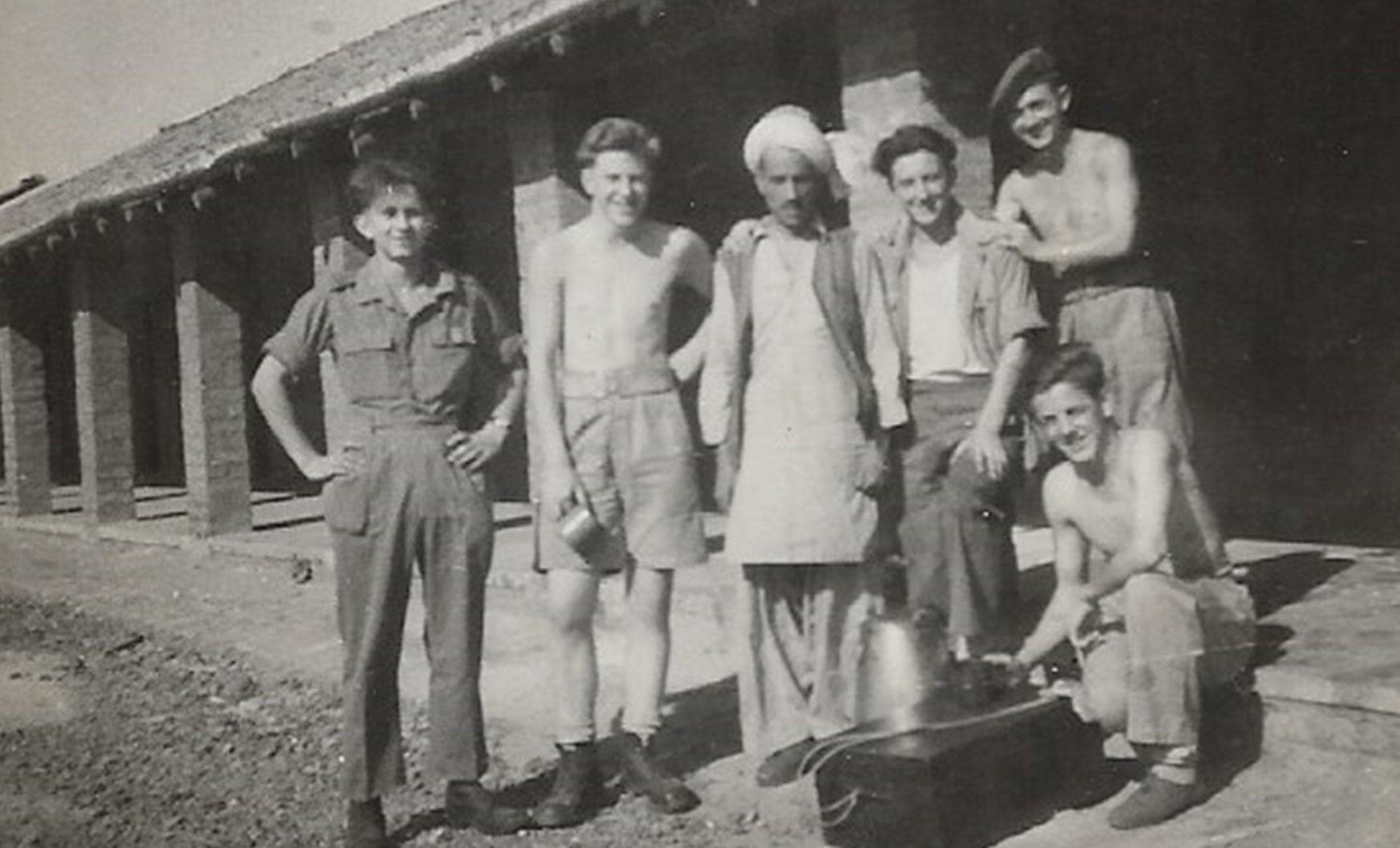
“Our dress usually consisted of an open neck khaki shirt and equally lightweight shorts or trousers, with socks and sandals. It was too warm, even in January, for anything more. Being in best blue was something different. It meant a tie, putting on heavy woollen uniform of tunic and trousers – clothing designed for warmth in the British winter. And in preparation, buttons and footwear would have to be polished and trousers pressed.”
It was not just the unnecessity of it all, it was the symbolism it represented. Duncan again:–
“All this was infuriating in itself, but behind it lay something else. We could no longer pretend to be civilians waiting to go home. Suddenly we were involved in the bureaucracy and bullshit of the peacetime forces. The men could not accept that “
(Mutiny in the RAF – the Air Force strikes of 1946, Socialist History Society, 1998).
RAF Strike action
At Drigh Road there was a small Communist Party (CP) cell amongst the RAF and its leader, Arthur Attwood helped organise the mass meeting into a semblance of order, and get the agreement for strike action the next day.
The next morning the men assembled at the parade ground in khaki. It was a disciplined meeting, and the men informed the officers of their complaints and the demand to speed up demobilisation.
While at Drigh Road base there had been a small CP cell, there was a radical outlook at all RAF bases, where Labour Party, CP and even Trotskyist groups were organised. Equally, the vast majority of RAF ground crew had come from engineering backgrounds, and were experienced in industrial trade unionism.
While RAF command began negotiations with the Drigh Road strikers, news of the strike rapidly spread. A key tactic for the strikers was to organise amongst Signals personnel, so news of the strike could be communicated to other bases.
The next largest walkout was at the Seletar air base in Singapore. After a mass meeting in the canteen, 4,000 RAF personnel went on strike, including some officers.
The largest strike was at Cawnpore, the largest RAF base in India – 5,000 went on strike, despite a personal visit, and negotiations with the Strike Committee, by Air Marshal Sir Roderick Carr, the Chief of Staff in India.
At Kallang air base, six strikers were arrested, but a deal was struck with High Command that if they were released without charge, the base could return to normal. SEAC backed down and released the prisoners.
The strikes, which were called for two or four day periods, were disciplined and well organised. All air-sea rescue and medical operations were maintained. Strike Committees were formed. Former journalists, now in uniform, were drafted in to produce strike bulletins.
From January through to the Spring, the strike ran like an electric current throughout SEAC and beyond – from South East Asia and India, through the Middle East, and from Cairo through North Africa, with walkouts even as far away as Gibraltar. At its height 50,000 RAF servicemen were on strike.
Strike leaders arrested
The voices of reaction at home were furious, with the Daily Mail (then as now) baying about a ‘communist conspiracy’ and claiming the Soviets had placed “airman-agitators” amongst the RAF Signals corps. SEAC moved to quell the strike. Two strike leaders – Arthur Attwood at Drigh Road and DC Brayford at Manipur – were arrested, picked out of the 50,000 strikers, to be made an example of.
Far from this quelling the strike movement, it began to spread to other arms of the military. In Singapore harbour, HMS Northway refused orders. More alarmingly for SEAC, the strike tactic spread to the Army, and naturally to the regiment with the most contact with the RAF.
In May 1946, the Parachute Regiment rebelled in Malaya. Again under the new peacetime regulations, a kit inspection and parade had been called. But spit and polish was impossible in the jungle mud. The Paratroopers held a mass meeting and twice refused to obey orders. 258 were arrested and taken to Kluang airfield for a ‘mass trial’ , some appearing in handcuffs. Over 240 of them were sentenced to between three and five years prison.
When news reached back home, there was outrage that the heroes of the ‘Forgotten War’ were being treated in such a way. There was a huge campaign amongst the labour and trade union movement, and Attwood, Brayford and the striking Paratroopers were soon released and convictions quashed.
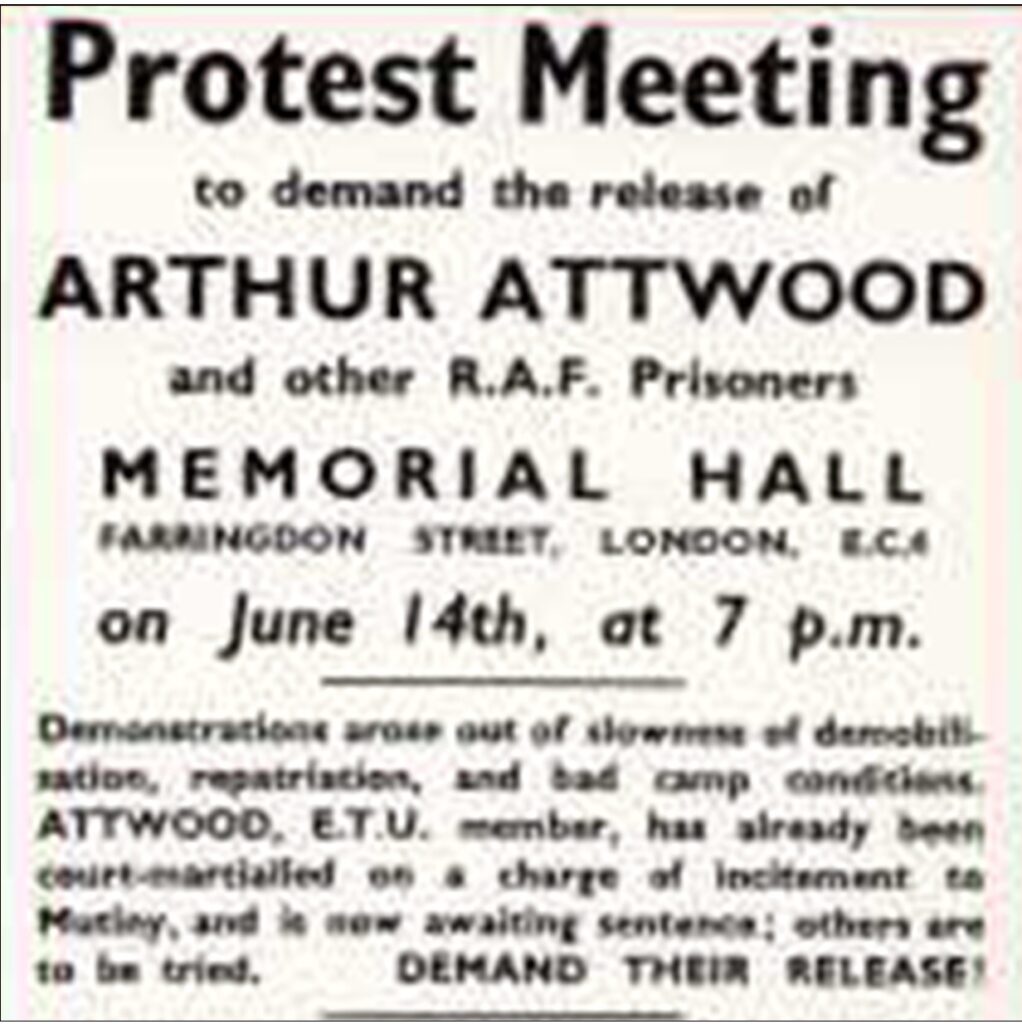
[image from Socialist History Association website
British imperialism realised the game was up. With SEAC high command now dubbing the RAF as the ‘Red Air Force’, troublesome regiments and squadrons were rapidly deployed out of South East Asia, and the demobilisation process sped up – in the next few months, over 100,000 RAF personnel were released.
Final nails into British imperialism
However, the British Empire had not just lost its own home-grown ‘armed bodies of men’. The final nails were being driven into British imperialism when the strike movement spread to the Indian armed forces, sometimes resulting in bloody clashes. For Indian servicemen was the added desire for independence.
As the strikes and mutinies rapidly spread amongst the Indian forces, the Viceroy of India, General Wavell, fumed to Mountbatten:
“I am afraid that the example of the RAF, who got away with what was really a mutiny, has some responsibility for the present situation”
(Forgotten Wars, C Bayly & T Harper, 2008).
However, even if a disciplined imperial army could have been maintained, with airpower superiority, they could not have halted the forward march of the colonial revolution, as US imperialism was to discover over the next 30 years. But the actions of the rank and file British servicemen did speed up the process.
As Ted Grant, at the time, one of the leaders of the Trotskyist group, the Revolutionary Communist Party, would later comment:-
“…in 1945, Britain had drawn the conclusion from the revolt of the Indian people, of the necessity to arrive at some sort of compromise with the Indian bourgeoisie and landlords. Partly this was due to the impossibility, because of the radical mood of the soldiers of Allied imperialism and the working class in Britain, of waging a large scale war of conquest or re-conquest of India, and partly for fear of the upsurge of the Indian people”
(The Colonial Revolution and the Sino-Soviet Split, 1964).
In South East Asia, it was game over for the old Imperial order.
[Featured photo – by LSgt Bob Wade, Royal Signals (1944-47). For both Army and RAF servicemen, the heat and humidity meant ‘uniforms’ were a motley assortment of khaki fatigues. The decision to enforce peacetime ‘Parade’ uniforms infuriated them.]