Gray Allan, Falkirk East & Linlithgow CLP
Friday February 27 in Scotland was a bright winters day, dazzling sunshine but bitterly cold in the shadows. A meteorological metaphor for Scottish Labour’s Spring conference held in Paisley near Glasgow. In the Paisley Town Hall, the public show of Scottish Labour was dazzlingly optimistic, but, in the shadows, there was the ice-cold winter wind of reality.
Scottish Labour’s annual conference is always held in early spring. Which means that every four years the conference falls at the start of the election campaign for the Scottish Parliament elections in May. It is usually held in the Central Belt. In those years, the conference is in effect an election rally, not a business conference. No motions are debated and no business is transacted. There are speakers on selected topics and contributions from delegates are taken. Most of the speakers are however prospective candidates.
Attendance is not normally as high as at a full SLP Conference. Many CLPs choose not to send delegates especially where an overnight stay would be needed. The question is whether the turnout at Paisley was even lower than what would be normally expected for a pre-election rally. It was. There were big empty spaces in the hall at the start of conference, and this continued all forenoon.
Four line whip for Anas Sarwar’ speech!
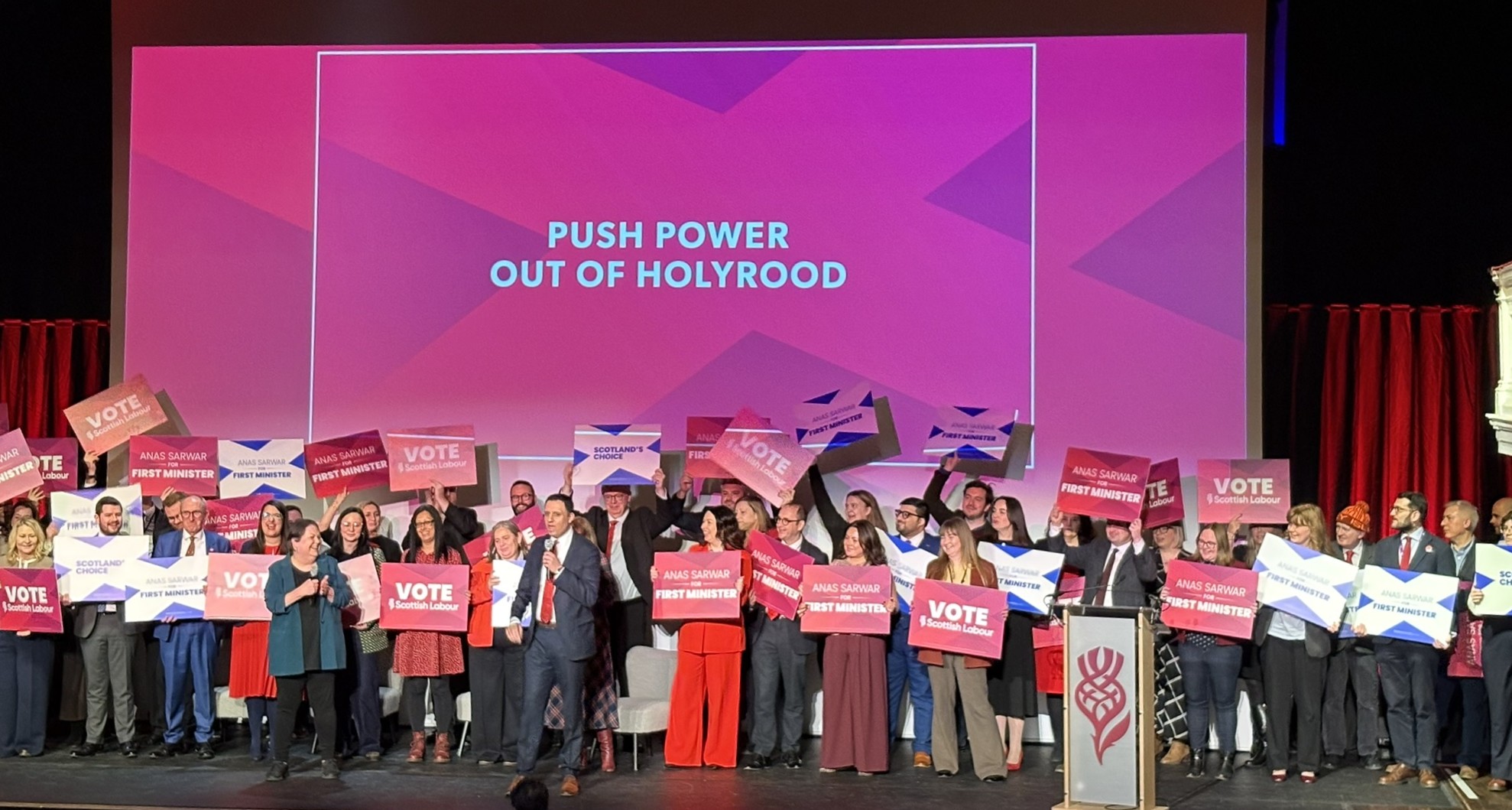
As normal, the hall was rammed full for Anas Sarwar’s speech, with staffers, Party candidates and faces not seen earlier in the day and disappearing shortly after the speech. Again, not unusual. There is always a push to makes sure that the Party is not embarrassed by empty rows of seats to be picked up by the TV cameras during the Leader’s speech. In the background was Sarwar’s call for Keir Starmer to resign, not to be repeated in Paisley
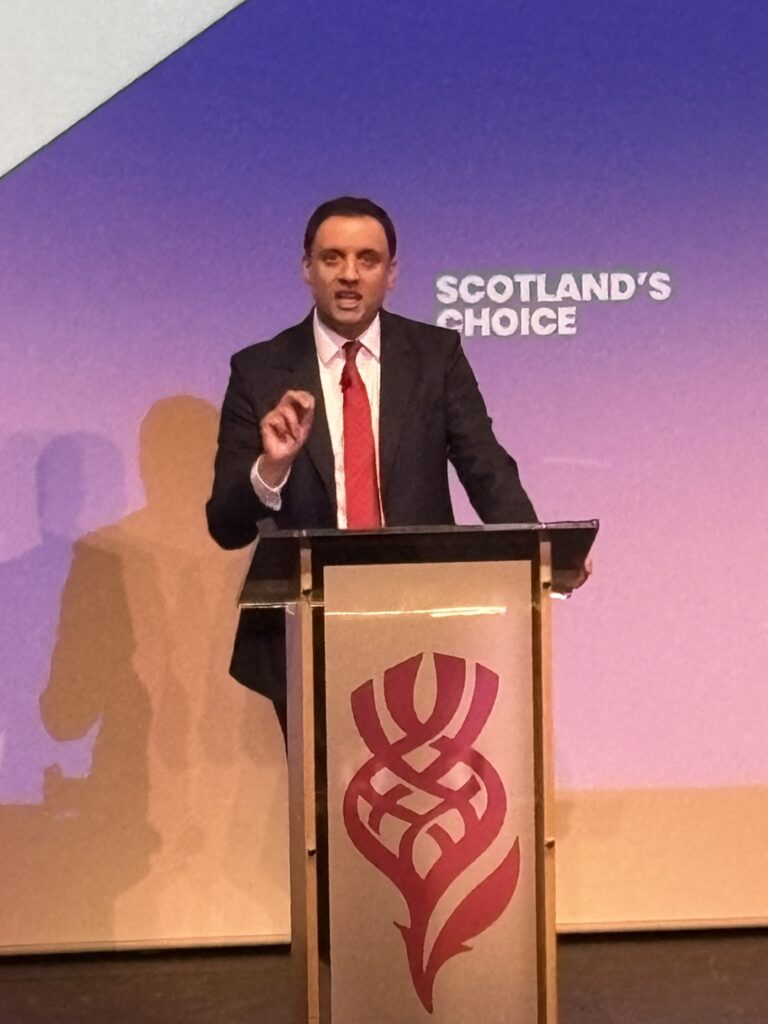
As an election rally, the main event as always was the leader’s speech. Unlike Keir Starmer, Sarwar can speak, and has a certain charisma about him. True to form he delivered a competent performance, a mixture of “Nat Bashing” and a long wish list of populist policies to be implemented by a Labour Scottish Government.
He did his utmost to raise a firewall between the UK Labour Government’s performance and the Scottish Parliament election “This election is not about Westminster” he said, “but about who governs Scotland.“ After 20 years of the SNP, do voters go for more of the same or change under Scottish Labour?
Some of the populist soundbites in the speech raised more questions than answers. For example, the call to scrap failing Health Boards and “give the NHS back to patients and staff” sparked a round of applause, but means exactly what? Anas tore into the SNP structure of 133 quangos costing £6bn a year. Echoing David Cameron’s bonfire of the quango’s speech in 2010, Sarwar promised to scrap them. But what happens to the employees? What happens to the functions these organisations were set up to carry out?
The NHS front and centre of Scottish Labour’s programme
The NHS featured large in both Sarwar’s speech and in the speech of the depute leader, Jackie Baillie, later. This was to be expected, as the Scottish Government is entirely responsible for the Scottish NHS. Everything from waiting lists to the scandal of the Queen Eizabeth University Hospital in Glasgow, opened too soon and resulting in deaths due to poor infection control.
Sarwar pledged Scottish Labour to declare a waiting list emergency. Everyone on the list is to be treated wherever there is capacity in the National Health Service or in the private sector. Once more another populist electioneering soundbite. The devil is in the detail. Scotland is a large place, over 40% of the UK land mass. “Wherever there is capacity” potentially means patients in Shetland being transferred to Glasgow or Edinburgh for treatment with all the consequent travel problems for family.
The rest of his speech had delegates springing up like jack-in-the-boxes; ban mobile phones in schools, breakfast clubs in all schools, restore community policing, 9,000 new apprenticeships, tens of thousands of new homes to be built. But to deliver these modest reforms Scottish Labour has to win the election on May 7.
By the time depute leader Jackie Baillie stepped up to the rostrum, the hall was half empty again. Had they stayed, they would have heard Baillie attack the SNP record on the health service. She reminded delegates that Scotland has the lowest life expectancy in Western Europe, with up to 25% of this down to the level of health care provision.
Demand for health care is actually static in Scotland, according to Baillie, so pressures are due to SNP failings in the organisation of the NHS. Scotland has fewer family doctors now, than when the SNP made the promise to increase numbers.
She said that if Labour won the May election there would be a return to the family doctor model of delivery. Labour would make it easier to access healthcare, make and change appointments. There is a functional NHS app in England and Wales, which the SNP refuse to adopt because, true to form, they must have an independent stand-alone Scottish app, which they have yet to develop.
What Baillie failed to mention was the effect of poverty and social inequality on health. Probably because she has no view on how that can be changed, other than echoing Rachel Reeves call for “growth” in the economy, thereby generating more tax income.
The elephant in the room – Gorton & Denton
There was no avoiding the elephant in the room. Never mentioned from the platform or by any delegate speaking at the rostrum: the shadow of the Gorton and Denton by-election result hung heavy over the Conference.
Amongst the left delegates there was ice-cold fury. Fury at Starmer. Fury at the clique in Number Ten, whose “blue Labour” dogma is seen as the cause of the desperate polling figures and the electoral disasters of recent by-elections. There had actually been a general welcome for Anas Sarwar’s call for Starmer to go. Irrespective of his motivation or whether he was the fall guy for a failed coup.

The cry from the Right is “Don’t Panic” They point to the by-elections at Rutherglen & Hamilton West in 2023 and in Hamilton, Larkhall & Stonehouse last summer. The polling and the pundits had Labour losing both heavily but Labour confounded all by winning both.
It is argued that the political situation in Scotland is quite different from England and Wales. In Scotland the SNP is the establishment now. In power for nearly twenty years, a long list of policy failures can be laid at their door.
The Scottish Greens are independent of the Greens in England & Wales, Zack Polanski is not the leader of the Scottish Greens. They are pro-independence and have had an unhappy experience in government with the SNP. Despite this they are still polling well.
Reform UK is poised to overtake Scottish Labour. This is a conundrum, given their hostility to Scottish independence, and indeed, their hostility to devolution. They still have to announce their list of candidates, which is anticipated will contain a few horrors. So, a lot of water is still to flow under the bridge before Reform get to polling day.
As for Scottish Labour, the most hopeful sign was the warm reaction to the Unite delegate Lynne Davies. Slamming the blind faith in the ‘free market’, which carried out blatant industrial sabotage, she demanded that Labour be bolder. In Scottish industry, 34% of jobs are in businesses owned abroad.
A directive by government requires buses for public bodies to be ordered from bus manufacturer, Alexander Dennis. All bus services should be municipalised and at the very least Labour should demand that public procurement should come with conditions, such as trade union recognition and social benefits.
If there is any hope for Scottish Labour it must turn to the left. Sarwar’s call for Starmer to resign may be a straw in the wind but much more is needed. With polling day now just six weeks away it may already be too late.