By Cain O’Mahony
It is fitting that the 90th anniversary of the abdication of King Edward VIII falls as another errant prince is currently bringing disgrace and public revulsion upon the British monarchy.
The difference between today’s former Prince Andrew and the Prince of Wales of 1936 is that the crisis caused by the latter marked a split within the British ruling class over whether the British state should go over to an authoritarian government to crush the working class.
The Prince of Wales had taken the throne as King Edward VIII after the death of his father in January 1936. It began 12 months of crisis, as the bachelor King declared he wanted to marry his mistress, the US citizen and divorcee, Wallis Simpson. At this time, the Church of England (of which Edward was, as King, the head) did not allow its flock to marry divorcees.
This is the story we have been told over the decades, and no doubt we will hear the heart-rending fairy tale again in this anniversary year, of ‘the king who gave up his throne for love’. In reality, the 12 months’ struggle was over whether the British state wanted a fascist on the throne.
Capitalism feared for its survival
In the 1930s, British capitalism feared for its survival. The Wall Street Crash had wrecked the economy, unemployment had rocketed to three million, and the labour movement was on the advance. Their fear was that this era of capitalism in crisis would push a Labour government, under pressure from the masses, far to the left and they would introduce socialist policies.
In this growing instability, British capitalism looked with envy to the ‘firm hand’ of Mussolini in Italy and Hitler in Germany in crushing the labour movement. And then, in early 1934, they had seen the conservative Chancellor of Austria, Englebert Dollfuss of the Christian Social Party, decide to take the road of dictatorship, liquidating the Austrian Social Democratic Party in a short but bloody civil war.
Perhaps Britain’s new breed of fascists, the newly formed British Union of Fascists, led by Oswald Mosley, could achieve the same for Britain?
In 1934, large sections of the Conservative Party – as they spun around in a panic after the Wall Street crash – openly toyed with the idea of using Oswald Mosley’s British Union of Fascists party to crush the labour movement and impose a dictatorship.
However, Mosley shot himself In the foot with a display of thuggery at his mass rally at Olympia on 7 June 1934. Then, in the same month, Hitler carried out the ‘Night of the Long Knives’ when he brutally liquidated not only the leadership of his paramilitary wing, the Sturmabteilung, but also all those right wing Conservatives who had helped him climb to power.
The national and provincial leaderships of both Catholic Action and the Catholic Centre Party were wiped out, their bodies turning up in ditches across Germany. Both organisations dissolved themselves on Hitler’s orders a few days later. As if to underline the threat, the Conservatives’ role model, Englebert Dollfuss was also assassinated by Nazis in Vienna a month later.
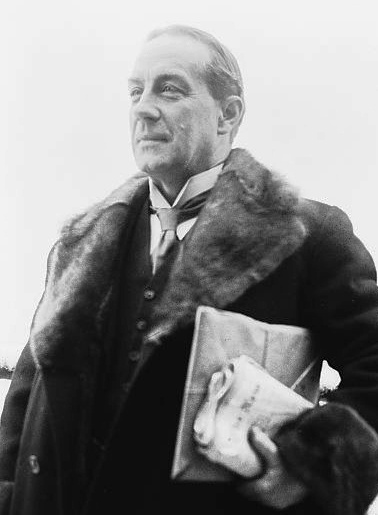
[photo – US Library of Congress – wikicommons]
Fascism – a bulwark against revolution
The majority of the British ruling class realised the fascists were untrustworthy and dangerous partners. So it abandoned the project of fascism at home. The new strategy now was to help build fascism in Europe as a bulwark against the Soviet Union and the threat of revolution, and then set them at each other’s throats.
These days, I’ve heard the expressed above being described as a ‘Marxist conspiracy theory’, but it was actually mainstream thought at the time. I recently found a copy of a popular publication produced in World War II, which sold in its tens of thousands. Produced by Odhams, it gave a pictorial progress at the end of each year of war.
The first edition, produced in September 1940, declares in its introduction:
“(Hitler) worked up a campaign of hatred against Russia and set himself up as the saviour of Europe against Bolshevism… He persuaded the people of Britain and France that war between Germany and Russia was inevitable, and under this influence of this belief the democracies were content to let events take their course…”
(The War in Pictures, Vol. 1, Odhams Press Ltd, 1940).
For ‘people’, read ruling class of course.
This certainly typified the outlook of the National Government, led from 1935-37 by the Conservative Prime Minister, Stanley Baldwin. But there was still the legacy of open support for authoritarianism amongst a substantial section of the British establishment, with the new pro-Nazi king at its pinnacle.
Edward and Simpson admired Hitler
Edward had long been an admirer of Hitler, which had only been reinforced by his new relationship with the equally pro-Nazi Wallis Simpson. She was very much within the milieu of the European fascist movement, having had an affair with Count Ciano, Mussolini’s Foreign Minister, and also – while she was having the affair with Edward – with Nazi Germany’s Ambassador to Britain, Von Ribbentrop. She was considered such a security risk that both the British Special Branch and (when she was back in the US on visits) the FBI put her under surveillance, concerned that any ‘pillow talk’ secrets with the King were going straight back to Berlin.
Neither did Edward accept the constraints of being a ‘constitutional monarch’ only. There was a famous outburst demonstrating his overblown view of himself, when he met with his old friend, the Nazi Duke of Saxe-Coburg, who had been sent to London by Hitler, to see if Edward would help them set up a meeting between the Prime Minister and the Fuhrer. An indignant Edward retorted: “Who is the King here! Baldwin or I? I myself wish to talk to Hitler, and will do so here or in Germany.” (Martin Pugh, ‘Hurrah for the Blackshirts’, 2005)
The Baldwin government decided to act. They told Edward that he could not marry Simpson and remain King. Edward refused to back down, knowing if he went ahead with the marriage, the Baldwin government would have lost authority, and Baldwin would have to resign and his government fall. The battle lines were drawn and it was a case of who blinked first.
As the crisis unfolded throughout 1936, there was a clear alliance building amongst a section of the rich and powerful, in support of pro-fascist Edward.
It was unofficially dubbed the ‘King’s Party’. At its head was Winston Churchill: he may be canonised today for his leadership during World War II, but in the 1930s, before his ‘road to Damascus’ transformation as a champion of democracy, he was a virulent anti-socialist and sympathetic to the fascist dictatorships in Europe.
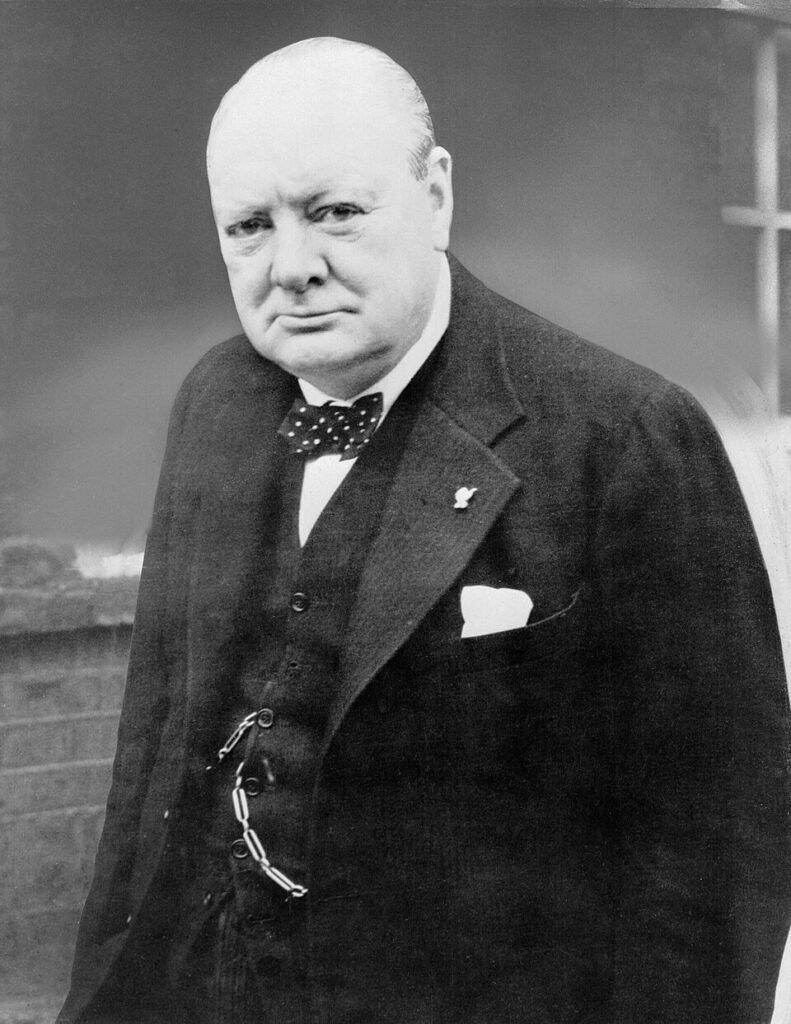
strong supporter of the King
[photo – Imperial War Museum – wiki commons]
Behind him were the leading Conservatives, Duff Cooper, Lord Lloyd and Walter Monckton; Oswald Mosley and the BUF, and most importantly the media barons Lord Rothermere and Beaverbrook. Supporting them were the ‘Imperial Policy Group’ of over 40 Conservative MPs, who went as far to declare they would take up arms in defence of the King.
Car boot full of cash
Meanwhile, the multi-millionairess Lady Houston bank-rolled the new formation by famously sending her chauffeur around to Edward’s residence, Fort Belvedere, with a quarter of a million pounds in cash in the boot (the equivalent of £23 million in today’s money) – she certainly trusted her chauffeur!
In turn, Baldwin approached the Labour Party, who assured him that should he resign, Labour would not form an alternative administration as they did not want to serve under a fascist monarchy, but would join Baldwin in fighting it.
With Rothermere and Beaverbrook in tow with the King’s Party, the main tabloids of the day – the Daily Mail, Daily Express, Daily Mirror and News Chronicle – bombarded the public with editorials in support of the King, while gushing articles rebranded Wallis Simpson as a doe-eyed innocent (unlike the US media which still referred to her as ‘the King’s Moll’).
Mosley mobilised the street thugs of the BUF who chalked the slogan ‘Stand By The King’ with the BUF’ lightening flash’ insignia, all over walls and pavements.
The crunch came at the beginning of December. Edward demanded to be allowed to address the nation to put his case to continue as King via the BBC on 2 December. Baldwin refused.
Infuriated, BUF and Royalist mobs took to the streets around Westminster. From Buckingham Palace they marched to Westminster and then attempted to storm No 10 Downing Street, carrying placards (similar to their latter-day counter-parts of the January 6 assault in Washington) declaring ‘Flog Baldwin’. The police pushed them back into Trafalgar Square.
Mobs attack Downing Street
A day later the same mobs attacked Downing Street again, as Baldwin was holding a crisis meeting of the Cabinet with the spiritual leader of the Church of England. The Ministers slunk out of the back door of No 10, but the combative Archbishop of Canterbury, Cosmo Lang, strode out the famous front door, not believing these ‘fellow Christians’ would assault a man of the cloth. He had to be rescued by police from the mob, and jostled into a car that sped him away.
The tumultuous week reached a pinnacle on the Thursday, when Oswald Mosley addressed a rally in Victoria Park, in east London, attended by several thousand.
As Parliament closed for the weekend, the crisis reached fever pitch. Duff Cooper said he had spoken to Cabinet Ministers who told him they “… thought a coup d’etat was not impossible” (ditto).
And then… nothing happened.
Over the weekend in stately homes, mansions and country houses across the land, the heavy weights of the British ruling class weighed into the King’s Party renegades, warning them that if the blinkered King continued to push forward, it would unleash the wrath of the working class.
[photo – Richard Allen – wikicommons]
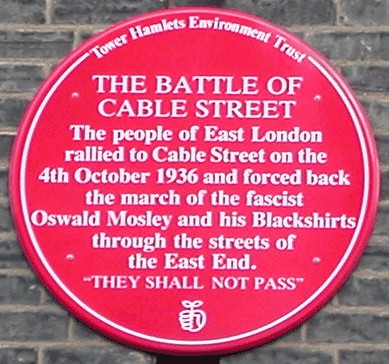
In 1936 there had been huge street battles against the BUF at Cable Street and Bermondsey, when the labour movement turned out in its masses to defend their communities. There was also wide support amongst the workers for the new Republican Spain and – at the time – the revolution underway there. Did the renegades want Republican Spain to come to England?
Equally, given the antics of Mosley’s fascists, some of the King’s Party were getting cold feet. As Martin Pugh put it: “Indeed, the eruption of support for the King by fascists and others may have been counter-productive in that it demonstrated how dangerous Edward VIII would have been on the throne” (ditto).
Today we accuse many politicians of living inside the ‘Westminster Bubble’. It was the same in 1936. They had thought the dramas around that little section of London alongside the newspaper editorials were the ‘real world’. When the MPs returned to their constituencies for the weekend, they re-connected with reality. Their constituency officers let them know in no uncertain terms what the general public thought of Edward and Wallis Simpson.
Edward forced to abdicate
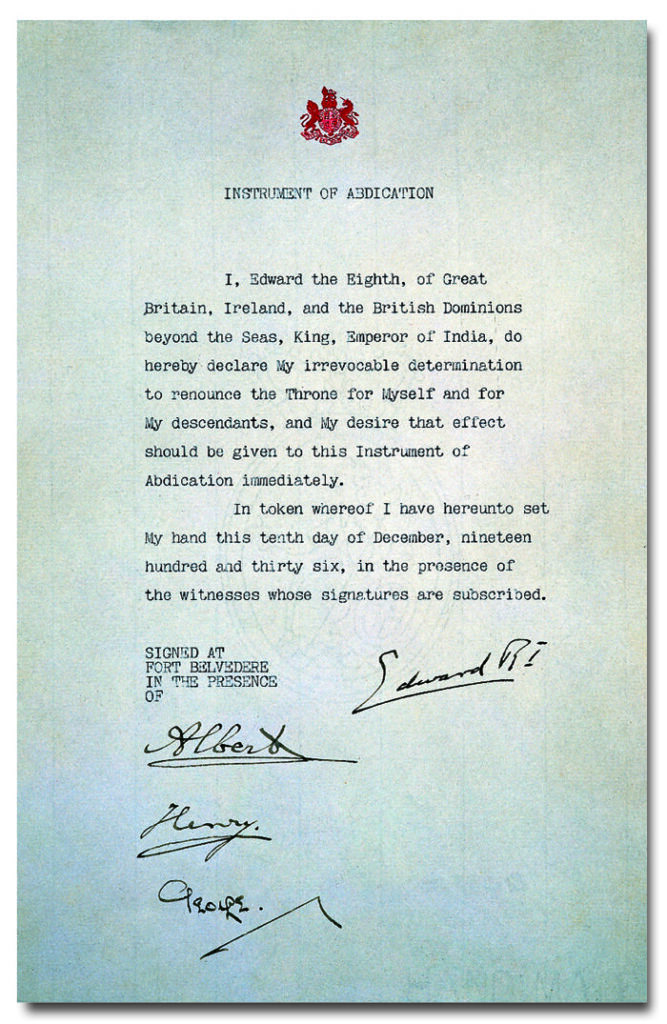
It was therefore a totally different atmosphere on the Monday when MPs returned to Parliament. When Churchill rose to speak he was howled down. The King’s rebellion was over. The next day, Edward sheepishly accepted the ‘Instrument of Abdication’.
[photo National Archives – wikicommons]
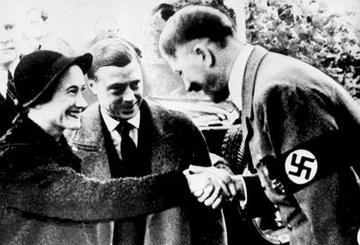
As if to confirm everybody’s fears, Edward and Simpson celebrated their marriage in the new year with a grand tour of Nazi Germany, staying with Hitler at Berchtesgaden, inspecting SS troops and giving the ‘Sieg Heil’ salute to all and sundry.
Unlike the former Prince Andrew today, who has been stripped of all titles, Edward was still made the Duke of Windsor. This was not so much the usual case of the ruling class looking after their own, no matter how disgraced they were: retaining Edward as a member of the Royal Family meant he could not stand for election, and be a rallying point for British fascism, as the ruling class feared.
Indeed, with the outbreak of World War II, Edward was hurriedly ‘exiled’ as far from Europe as possible, being made Governor of the Bahamas. It was known that had Nazi Germany crushed Britain, Hitler would consider making Edward head of a puppet government.
So, we have a warning from the 1930s. We should never assume that future Royal families will forever accept their benign role as an ornament from history. And it should be noted that, technically, Andrew Mountbatten-Windsor could now stand for Parliament – not that anyone would touch him with a barge pole.
But then again, we live in strange times. There is a new ‘king over the water’ – King Trump of USA – who seems to believe it is him and him alone who has the divine right to decide who should run a nation, no matter where in the world, whether it be Venezuela, Ukraine, Greenland, Gaza or Iran.
[Featured photo – Duke and Duchess of Windsor meet Adolf Hitler – wikicommons]