
By Greg Oxley
Every passing day brings a new complicating twist to any attempt to appraise the US-Israeli war on Iran. Warfare by its very nature is chaotic and unpredictable. And the erratic, contradictory, and often nonsensical ramblings of Donald Trump do not help.
Nonetheless, we must try to see beyond the confusion of claims and counterclaims and try to assess the situation and its future implications for the peoples of the Middle East and indeed of the entire world.
Both the United States and Israel were preparing for this full-scale war against Iran for decades, and yet when they decided to launch it, they clearly underestimated their enemy. According to practically all historians and war specialists, this is one of the costliest and most dangerous mistakes that can possibly be made. So far, almost a month after the war began, it has not gone as Trump and his administration expected.
Militarily, the Iranian regime has proved to be no match for the destructive power of the United States and Israel, but neither did it expect anything different. No one can deny that Iranian military capabilities have been seriously depleted. Trump repeatedly shoots off his mouth about how many Iranian military bases, ships and aircraft have been destroyed by air strikes, but they have not, as Trump has repeatedly claimed, been completely obliterated.
The official justification for this war and the stated war aims change practically every day. Initially, the aim was “regime change”, suggesting that high intensive bombing would somehow “open the door” for the Iranian people to overthrow the government. Then Trump shifted his position, claiming that the “change” in question had been achieved by killing off dozens of leaders. But those leaders were simply replaced by others, and the regime is still in place.
Straits closed to all but selected allies
Trump has repeatedly claimed that the war is “over”, that the US is victorious, yet Iranian missiles are still being fired into Israel and many targets in the Gulf states. Most importantly, the threat of Iranian firepower has effectively closed the Persian Gulf and the Straits of Hormuz to all but selected allies.
The Straits is one of the most important trade routes on the planet, for oil, liquid petroleum gas, helium, fertilisers and many other crucially important products.
Iran’s navy has been massively depleted, but Iran does not need a navy to close the Straits. The mere threat of drones, mines, and missile-carrying speedboats are enough for that. The Iranian threat to shipping may well be as powerful and dangerous a weapon as anything the US-Israeli aggressors can use against Iran. This has radically modified the stakes involved in the war.
Many commentators have wondered why the war plans of the American administration did not take this vital strategic factor into account. After all, the Straits have been a major consideration in previous Middle Eastern conflicts, such as the “tanker war” which was part of the war between Iran and Iraq in the 1980s.
Trump has given a strong clue as to how this happened. He recognised that he had been told about the possibility of Iran closing the Straits but ignored the warning because he expected the regime to quickly collapse and therefore be incapable of taking such action.
It seems that Trump imagined that the attack on Iran would not be much more difficult than the operation against Venezuela, where Delsey Rodriguez, having been involved in the preparations for the invasion and the abduction of Maduro, basically stepped into the latter’s shoes, and is conducting a purge of the armed forces and Venezuelan officialdom to facilitate the plunder of the country’s natural resources by American big business.
Trump surrounded by ‘yes men’
This easy victory went to Trump’s head, and nobody amongst the camarilla of obsequious “yes men” around him was capable or willing to tell him otherwise. Hence his demand for immediate and unconditional surrender by the Iranian regime, without which, he said, there could be no question of any “deal”, to use Trump’s terminology.
But things have turned out very differently, and the Trump administration will have to pay a heavy price for this gross miscalculation. The Iranian regime has been expecting this war. For decades, since the very inception of the present regime, the entire philosophy of Iranian military planning has been based on the inevitability of a major military confrontation with Israel and the United States. Their military apparatus and strategic priorities were carefully structured to deal with this eventuality.
Iran is a regional power whose state apparatus involves a dense web of political and military institutions. The Iranian Revolutionary Guard Corps, with hundreds of thousands of men under arms, and in parallel with a massive regular army, are there to protect the regime from internal and external threats, a mission which they have ruthlessly carried out time and time again over almost 50 years.
The Iranian state is no one man show, destined to collapse because of “decapitation” by a foreign power. The failure to appreciate this reality and the subsequent closure of the Straits have now placed the United States in an extremely dangerous predicament.
The present situation can be summed up in the following way. The focal point of the war has shifted. The fundamental and overriding consideration, from the point of view of the American command – and indeed of the whole western world – is the now the imperative need to reopen the Straits of Hormuz.
A war of ‘choice’ has become a war of ‘necessity’
This means that whereas many politicians and commentators have referred to the war as a “war of choice”, it has now become a war of necessity. The idea that Trump could just declare victory and walk away from the conflict – which might have been a possibility earlier, is no longer valid. The ‘TACO’ option (Trump Always Chickens Out) can apply to things like tariffs that the president can switch on and off at the stroke of a pen, but it is not valid in the case of war.
From the point of view of US and western capitalism in general, the Straits of Hormuz absolutely must be reopened, but it was Iran, not the USA, that closed them. Trump cannot stop the war – whether he “feels it in his bones” or not – until this problem is resolved.
This raises the question, given that the Iranian regime has not collapsed and that it must be dawning on even the most stupid members of Trump’s cabinet that it is not likely to do so in the foreseeable future, of how this can possibly be achieved.
The Straits cannot be reopened from the air. Nor can it easily be achieved by the US Navy, with or without support from other countries. To have huge, lumbering tankers, loaded with highly explosive materials, being slowly escorted by warships, under constant danger of attack, is not a viable solution.
Shippers, insurers and crews will be asking whether a ship can be safely loaded and then sailed through the Straits in these conditions. It would only require one or two tankers to be hit to convince them otherwise.
Issues are concrete – the Straits are either open…or not
For as long as the Iranians control the Straits, they have a chance of winning the war, or at least, of preventing a plausible claim to victory for the USA and Israel. Trump seems to be looking for an ‘off-ramp’, but boasting and false claims can only go so far. The issues here are concrete. Either the Straits are open or they are not.
Basically, for the invaders, winning what has now become a “war of necessity” comes down to two options. The first is that in place of demanding unconditional surrender, negotiations begin with the existing Iranian regime to lift the threat against shipping. According to Trump, such discussions are already underway with unnamed “important people”, although the truth and substance of this assertion are open to question.
In any event, any negotiations are highly unlikely to lead to Iran agreeing to Trump’s draconian demands, which would amount to a social, economic, and military disaster for Iran, leaving it defenceless against further attacks by Israel or United States. On the other hand, ending the conflict without satisfying these demands would look very much like failure for the Trump administration.
The second option, and the only one which has any chance of opening the Straits by force, is that of a massive deployment – probably thirty to forty thousand – of ground troops, whose task would be to occupy not only the Iranian coast across the Straits of Hormuz, but possibly the entire 500-mile Iranian coastline on the Persian Gulf.
It would be one thing for the US to occupy this area which has a population of close to 2 million people – and that would involve a major ground war comparable to the Iraq war – but quite another to defend it. However daunting or “insane” this option might appear, it is a possibility that cannot any longer be completely discounted.
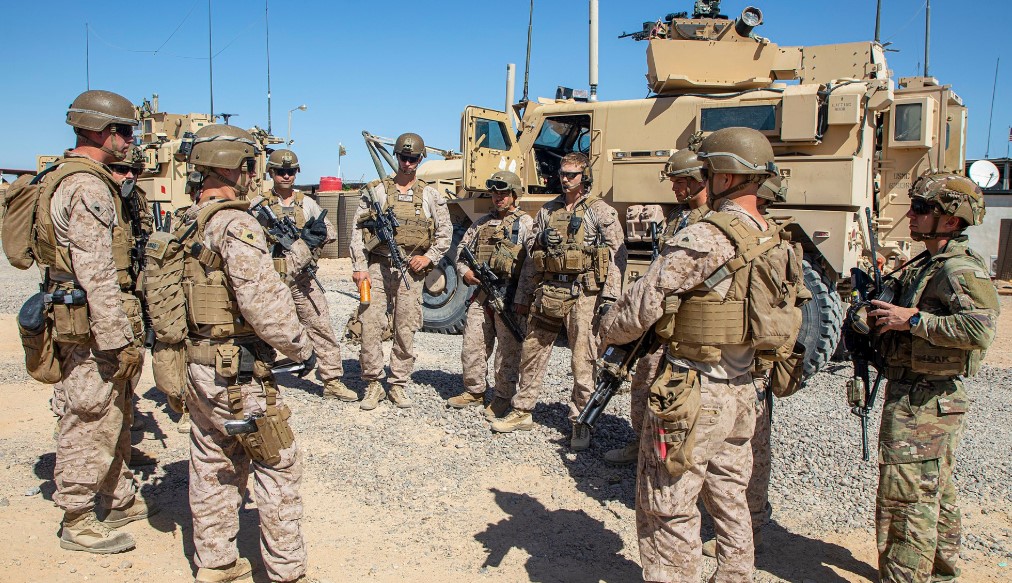
Trump already has some 50,000 troops stationed in the region, now being joined by another 2,500 marines and additional warships. He is also demanding from Congress an additional budget of $200bn, which is equivalent to the annual cost of the war in Iraq.
Wars take on a momentum and logic of their own
This cannot be for purely decorative purposes. It is to provide options in a war which is spinning out of control. The experience of previous wars in the region shows that they take on a momentum of their own, and a “logic of escalation” that can go far beyond the initial intentions of the belligerents.
Clearly, massive troop deployment on Iranian soil would be not just an escalation of the war, but a qualitative transformation of the nature of the conflict, turning it into a ground war of attrition. It would probably mean thousands of casualties on both sides in a desperate struggle that could go on for months or even years.
The American administration is therefore on the horns of a terrible dilemma. Napoleon Bonaparte, who knew a thing or two about war, said, “in politics and in war, there are situations where whatever you do is a mistake”. We must, of course, be very cautious about any firm predictions of how the present war will unfold, but it certainly seems that the United States is getting into one such situation, despite having the deadliest and most proficient military apparatus in world history.
Trump is facing this dilemma against a background of worsening economic and social conditions in the United States. Most American workers are struggling with the soaring cost of health, childcare, rents, education and petrol. Outside the maniacal MAGA supporters, the war was very unpopular in America from the outset. Opinion polls indicate a considerable decline in support for Trump and for the Republicans. If troops are deployed on Iranian soil, opposition to the war will greatly increase.
The scaling back of war aims, backing down on threats and ultimatums, and the lifting of sanctions on Russian and Iranian oil are signs that the administration is thrashing about, grasping at straws to alleviate the pressure on oil prices. If the war drags on, the “home front” will become the Achilles’ Heel of an administration which, behind all the bravado, is increasingly alarmed.
US service personnel will ask questions
Social and economic pressures at home are also likely to fuel “mission creep” in the armed forces. Why are our lives being put at risk? How is all this death and destruction in Iran helping America? How did we get to a situation where the main issue in the conflict is the closure of the Straits of Hormuz? – when it wouldn’t have been an issue in the first place if Trump had not started the war!
Trump says America has already won, and yet wants more troops and money. He says he doesn’t want a ceasefire but doesn’t want regime change either. What exactly is our mission here? American soldiers may be extremely well trained and courageous in combat, but they need to know and believe in what they are fighting for.
Pressure is mounting on all sides as the Trump administration tries to find a solution to a problem of its own making. The war has already had major consequences in the sphere of international relations. After having berated and insulted NATO allies, slapped massive tariffs on practically all its trading partners, and even threatened to invade and annexe the Danish territory of Greenland, Trump now desperately needs their help, despite occasionally denying this to save face.
If none of the major powers are prepared to commit to any significant involvement, it is not only because of the insulting, erratic and treacherous behaviour of the US president. It is because they understand that this war will not end well for them, for the world economy, and world stability.
From a military point of view, countries such as South Korea and Japan cannot devote assets to an open-ended conflict in the Middle East without detracting from more immediate strategic challenges close to home.
Easy prey for intimidation and invasion
This war was never really about an Iranian nuclear threat. Its purpose was to bring about a decisive shift in the balance of power in the Middle East, in favour of Israel and the Gulf states aligned with the interests of US imperialism. Israel wants to be surrounded by disarmed and vulnerable states, reduced to easy prey for intimidation and invasion.
Corruption is also a factor in the war. American politics – on the Republican and the Democratic sides – are awash with money from Israel and the Gulf States. Above all, however, the real rationale for this war is that the “Greater Israel” agenda aligns with the economic and military strategic interests of American imperialism.
The war is a huge gamble that could backfire on the United States. So far, the main beneficiaries of the war, in terms of their world position, are China and Russia. While destabilising international relations and the world economy, the USA and Israel are increasingly isolated in the world arena, politically, diplomatically and economically.
Whether the conflict ends soon or drags on for some time to come – and the latter scenario now seems to be more likely – the repercussions for the world economy, including that of the United States, will further undermine living standards and increase international tensions and the threat of further wars in the future.
Imperialist rivalry, unleashing terrible violence to redraw frontiers and spheres of influence for the sake of profit and resources, is a threat to the entire human race, to world civilisation. The innocent children being burned by American and Israeli bombing campaigns, the unspeakable suffering and destruction inflicted of the peoples of the Middle East, are part of the price humanity is paying for the insatiable greed of the ruling classes.
Greg Oxley is editor of the French Marxist website, La Riposte, here.
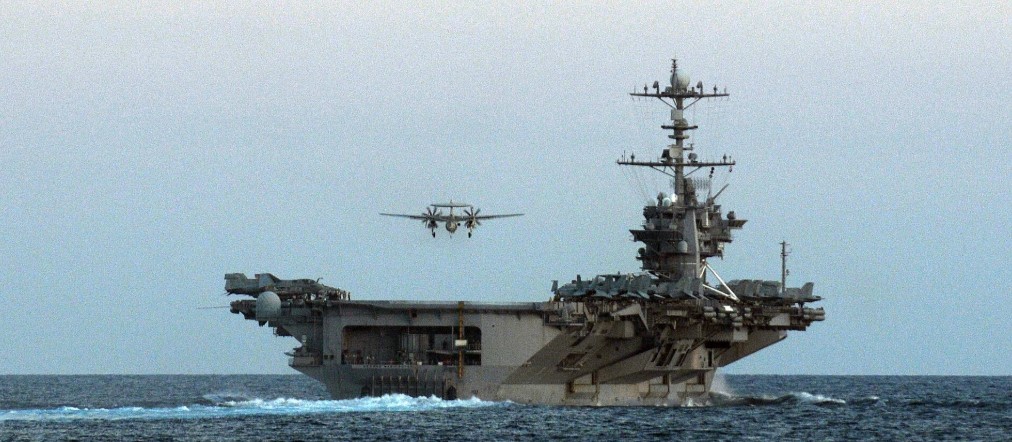
[Feature picture of aircraft carrier USS George Washington, from Wikimedia Commons, here]











If I were a poet: I would pen a poem
Of capitalisms’ death and destruction
Wrought by a corrupt and putrid ruling class
But borne by those of the working class
If I were a poet: The last lines of that poem would be
Workers of the World wake-up to the reality
Realise your power and set yourselves free.