Part I: the ticking time bomb
In a three part article, CAIN O’MAHONY, who has worked in the Chernobyl Exclusion Zone, looks at the world’s worst nuclear disaster, and whether, forty years later, lessons will ever be learnt from it. Part two can be read here and part three here.
A slogan in the Soviet Union of the time, celebrating the achievement of harnessing nuclear energy for domestic consumption, was: “A peaceful atom into each home”. The slogan had a new, horrific irony after the Chernobyl disaster of 26 April 1986.
To explain how such a disaster could occur – beside all the technical causes – the stifling political and social culture of the Soviet Union needs to be understood. Stalin may have been dead for over three decades, but the control of the Soviet state by the bureaucracy modelled on his method and image, not only remained, but had expanded to become a burgeoning weight on the whole of Soviet society.
By 1986, the Soviet Union was groaning under the weight of massive arms expenditure, a failed war in Afghanistan and growing economic collapse. Yet still the party line of the ruling Communist Party of the Soviet Union (CPSU) was that the ‘socialist’ society they had created was the pinnacle of human development, demonstrating that the leadership of the Party was Infallible.
From this viewpoint, if everything was perfect, then if there was a problem, it must be the failing of an individual – either through incompetence, a ‘mistake’ or even sabotage: it must be you, comrade, because the Soviet State is never wrong.
Absolute deadweight of bureaucracy
While the bureaucracy, and lack of any workers’ democracy, had previously been a relative fetter on the development of the state-owned economy, by the 1980s it had grown to be an absolute deadweight. Being a top bureaucrat meant privileges – which they jealously guarded against all-comers, while they began to grow old and grey, with moribund ideas, a living example of a society in decay.
This smothering of society – which Mikhail Gorbachev later called the ‘era of stagnation’ – stretched across all sectors, including science.
Amongst the top Soviet scientists was Valery Legasov, who became one of the heroes of Chernobyl but also its victim. He later said:
“Science organisations began to weaken, not strengthen. Slowly, one of the most powerful in the country, they began to lose the standard of modern equipment. The staff began to age. Fewer young people joined. New approaches were not welcomed… Excessive hierarchy has always been contraindicated for science, it stifles it.”
(newspaper interview with Legasov, Izvestia, 1987).
The Soviet Union still presented itself as a world leader in nuclear energy. The Soviets pointed, with a heavy sigh, at the calamitous failings of nuclear power in the West, at Windscale (now known as Sellafield) in 1957, and at the US following the Three Mile Island partial core meltdown in 1979.
This was a pretence. Every report they filed to the International Atomic Energy Agency (IAEA) was false. The Soviet Union had actually suffered, up until Chernobyl, the world’s worst nuclear accident. But no one knew about it.
1957 Kyshtym nuclear disaster
On 29 September 1957, the Kyshtym nuclear disaster occurred with a massive explosion at the Mayak plutonium production site at Ozyorsk, 1,000 miles east of Moscow. It blew a 160 tonne concrete lid into the air above a radioactive waste storage tank. There were no emergency plans in existence at the site for a nuclear accident, and initially staff did not know what they were dealing with (until they started bleeding and vomiting).
Shrouded in secrecy, the Soviet Union slowly worked out a response. Soldiers used shovels to dispose of the remains of the radioactive waste tank into a swamp. Local women and children were directed to harvest the produce in their fields but then throw them into freshly dug pits. Cows were herded into pits and shot. Over the next two years, 10,000 people were evacuated from the area. Details of the incident did not leak out until 1976. A subsequent study in 1992 estimated that 8,015 people had died as a result, particularly those soldiers and peasants sent in to ‘liquidate’ the disaster.
But rather than learn lessons from it, the Soviet leaders hushed it up. So, given that the Soviet nuclear industry was ostensibly ‘perfectly safe’, there was no need for training the emergency services or the public about the dangers of a massive radiation leak. To suggest the need for such was considered, at best, panic mongering or worse, borderline treachery.
[photo – IAEA wiki commons]
Thus any ‘Chemical, Biological, Radiological and Nuclear’ (CBRN) training for the military and emergency services was focussed on dealing with fall-out from a nuclear bomb. There are big differences between dealing with the ‘prompt fission products’ that result from a nuclear attack in a limited geographical area, to an out of control reactor pumping out radiation across whole nations (Hiroshima was made safe after 2 – 3 months: the Chernobyl Exclusion Zone will not be safe for at least 2,000 years).
Equally, there were no evacuation plans or basic safety education for the public that lived in the vicinity of a nuclear plant, in particular the 50,000 strong new town of Pripyat, especially constructed to house the Chernobyl workforce.
Cut-price unsafe nuclear programme
This decay of Soviet society was also the backdrop that led the Soviet Union to equipping itself with a cut-price, unsafe nuclear programme, with everyone too terrified to question it. The time bomb had been ticking for some time and was about to go off.
There were four RBMK1000 model reactors built at Chernobyl, the first opening in 1977, and the No. 4 Reactor – the scene of the disaster – opening in 1983. By 1986, the plant’s Reactor No. 4 had been in operation for two years. It was unsafe from the start.
Nuclear reactors need cooling, and the cooling pumps need electricity to operate – in the event of power failure, diesel powered generators need to take over within 15 seconds, or the situation gets critical. The three diesel generators at No.4 however, were taking 60 – 75 seconds to get up to speed. The Soviet authorities knew this, but put the plant into operation anyway. None of this was reported to the IAEA. Wracked by a combination of fear for their international prestige and bureaucratism, the Soviet authorities simply hoped for the best.
Under pressure from Moscow to ‘fix the problem’ before the IAEA found out, the Chernobyl operators thought they could rectify the situation by squeezing that crucial missing 60 seconds of power from the turbine itself as it wound down to idling, to fill the gap before the diesel pumps were fully operational.
Tests to rectify the situation were held in 1984 and 1985, but both failed. On 26 April, 1986, they were ordered to try again. To make matters worse, the exercise was delayed by 10 hours, so it fell to the night shift to carry it out. Because of the hierarchies within this bureaucratised sector, it was the younger, less experienced workers who drew the short straw for night work. In addition, they had not been prepared for, or even knew about, the drill they were now ordered to carry out.
[photo – author]
Individuals scape-goated
It is still debated as to what happened, mainly because the subsequent Soviet ‘investigation,’ as ever, scape-goated individuals, rather than the failings of their ‘superior’ technology.
But clearly, the exercise went wrong as the reactor rapidly began to heat to 10 times above safety levels. This is where the design fault of the RBMK1000 reactor came into play. The next line of defence in cooling an overheating reactor is to insert Boron rods to ‘turn off’ the neutrons. But on the RBMK1000 design, the rods were not only three feet shorter than what they should have been (allowing more room for water to collect) but were crucially tipped with graphite, which ‘turns on’ neutrons. Bang.
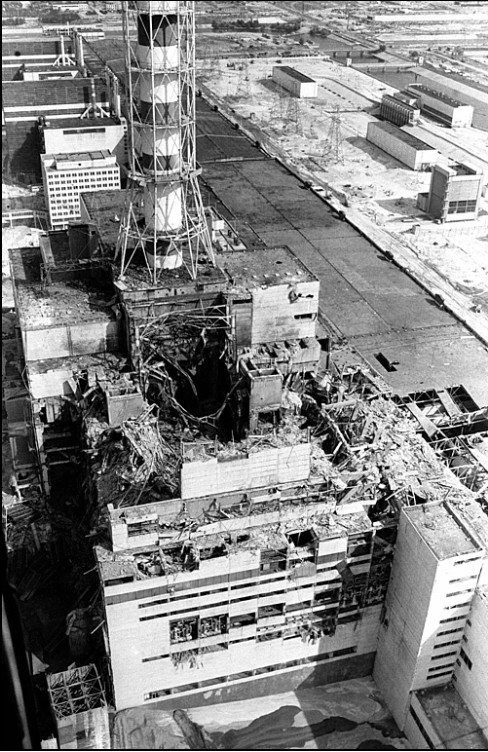
The water flashed into steam causing the first explosion, which lifted the 2,000 ton metal plate covering the reactor up into the air, then casting it aside like a dead leaf, leaving a big hole for all the radiation to escape.
The second explosion was the reactor core itself, and around a ton of highly radioactive material was dumped around the plant, while much more became a fine aerosol that began to spread across Europe.
Heroes
The immediate response demonstrated the lack of preparedness for such an eventuality. The first heroes of Chernobyl were the firefighters. They knew radiation would be an issue, but had no understanding of what lethal levels they were facing. They fought and brought the initial blaze under control, and curtailed the disaster from being even more catastrophic. But many perished from radiation exposure very soon after.
In Pripyat, far from the population evacuating, many gathered on the railway bridge between the town and the plant, to watch the spectacle. Many were either dead or seriously ill within four hours. The bridge is still known locally today as the ‘Bridge of Death’.
The adjacent forest, at the height of Spring, went through ‘Autumn’ overnight because of the intense radiation, to become known as the ‘Red Forest’.
It has never been successfully ascertained how many died. 50 were killed in the initial blast and amongst the firefighters, while 4,000 of what would become the ‘Liquidators’ and the local population died very quickly from exposure. A further 5,000 people died shortly after in Ukraine, Belarus and Russia. Of the people who subsequently died slowly across the region from thyroid cancers, the World Health Organisation has put the figure at anywhere between 16,000 – 60,000.
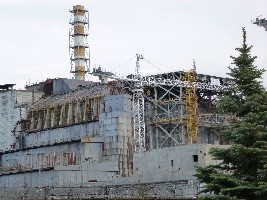
[Featured photo supplied by the author. The stricken No. 4 Reactor plant in 2016. It had been covered in concrete after the disaster to contain the radiation, and was known as the ‘Sarcophagus’.]