
Part III: Have lessons been learnt? A resounding no!
In the final part of a three-part article, CAIN O’MAHONY, who has worked in the Chernobyl Exclusion Zone, looks at longer term consequences and whether any lessons will ever be learned from it. Part one can be read here, and part two here.
In 2016, I was in an international team about to begin work in the Chernobyl Exclusion Zone. In the pre-entry Risk Assessment, we asked the Ukrainians if the war with Russia at that time raging in the east would be an issue we should consider? They laughed, telling us: “These days Chernobyl is probably the safest place in Ukraine!”
No one thought Russia would ever be mad enough to invade Ukraine from the north, ‘protected’ as it was by a highly radioactive land belt. Thus there was disbelief in 2022 when the Russian tanks rolled through the region.
The Soviet bureaucracy may have gone, but the new gangster-capitalist state that Putin has modelled is still very much in its image. True to his Stalinist training in the KGB, Putin has retained the methods of secrecy and viewing his own people as mere cannon-fodder, expendable for the ‘greater cause’ of Mother Russia. Few of the Russian troops that occupied Chernobyl were even told where they were, let alone given the most basic measures to protect themselves from contamination.
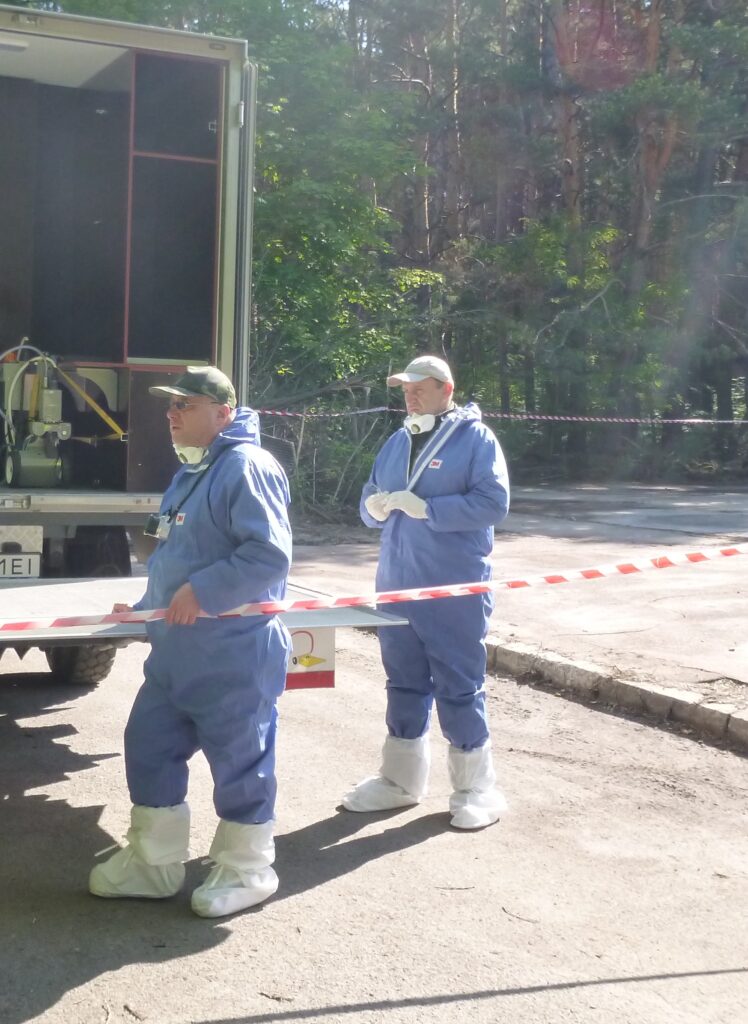
When we worked in the Exclusion Zone we would wear head to toe PPE. We would work in the Zone for a maximum of two hours at a time, or even less if our Personal Dosimeters beeped ‘over 15’. We were trained to avoid ‘hotspots’ such as mud and moss, which retain contamination.
The Russian soldiers, who stayed in the Exclusion Zone for over a month, had no PPE, certainly no dosimeters, their tanks churned up radioactive topsoil – they even dug trenches into the highly radioactive mud.
Russian soldiers – new ‘Christmas Island’ generation
In the fog of the current war, there is no sure way to obtain accurate figures of cases of radiation exposure. But there is no question that a few years down the line, if not sooner, these soldiers will develop radiation related illnesses. They will be the ‘Christmas Island’ generation of the current war.
So clearly the Kremlin has learnt nothing, other than to repeat the ordeal of the Liquidators in 1986: send in the cannon-fodder to achieve your objective, and shroud the threats to them in secrecy.
Nor have military chiefs learnt anything, whether in Russia, Ukraine, Iran, Israel or the USA.
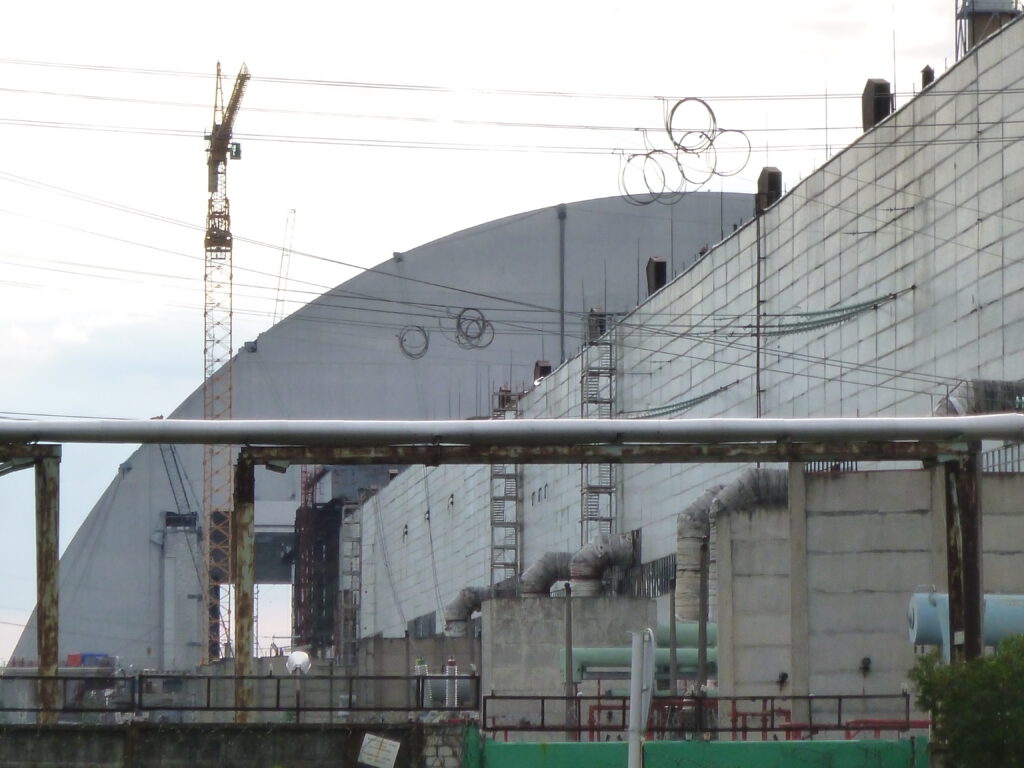
In the Ukraine war, there has been ordnance flying around both Chernobyl and also the Zaporizhzhia nuclear plant. At the beginning of last year, the ‘New Safe Confinement’ (NSC) structure was hit.
The NSC is a marvel of human engineering, weighing 36,000 tonnes and standing 355 feet high. In 2016, it was rolled over the stricken Reactor No. 4 to seal in radiation, as the Soviet’s previous ‘Sarcophagus’ cover of concrete was beginning to crumble. It is designed to last 100 years, which hopefully would have been enough time to dismantle and dispose of the highly radioactive No 4 plant.
Blight on humanity
Yet now it has a gaping hole in it, which cannot be repaired until peace returns. That is the blight on humanity today – examples of the incredible creativity of the human race ruined in an instant by the ruling cliques in pursuit of new markets and power.
The current conflict in Iran is becoming even more serious. On 21 March, Israel and the US bombed Iran’s Nantaz nuclear installation used for the enrichment of uranium. In retaliation, Iran attacked the town of Dimona, home of Israel’s Shimon Peres Negev Nuclear Research Centre.
And then, in April, Iran’s only functioning nuclear plant, the Bushehr power plant, came under repeated attacks, raising fears of a possible nuclear incident that could prove catastrophic across all Gulf countries.
That is the madness of today’s belligerents. The IAEA has repeatedly stressed that armed attacks on nuclear facilities should never take place, warning they “could result in radioactive releases with grave consequences within and beyond the boundaries of the State attacked.”
The International Campaign to Abolish Nuclear Weapons say: “Any attack near a nuclear facility is playing roulette with civilian lives. Nuclear risks are not theoretical — they are immediate and human” (ican.org, 23.03.26). So Washington, Tel Aviv and Tehran have learnt nothing too.
Nuclear fission is not safe
But all the world leaders too have not learnt the most basic lesson of Chernobyl – nuclear fission as a source of power is not safe.
There are three basic reasons: Three Mile Island, Chernobyl and Fukushima. The point is, all three plants operated under totally different economic models – unbridled free-market US capitalism, Soviet state control, and a public-private sector project in a country, Japan, with a high reputation for safety regulation. Yet all failed.
Indeed, Fukushima is the most worrying, as it was proudly held up as ‘fail safe’, being totally earthquake proof. But for all that, they hadn’t factored in a tsunami.
Nor, anywhere in the world is there any evidence that the nuclear fission sector has considered climate change. All sane people today understand that climate change is real, and is resulting in rising sea and water levels. Nuclear fission needs vast amounts of water, so plants are all based on the coast or by huge water systems, like Chernobyl by the Dnieper river. Fukushima demonstrated what happens when a nuclear fission plant is flooded. But do you see any mitigation work going on anywhere to factor this in?
Here in the UK, nuclear fission is even presented as part of the battle against climate change. The government issued a very self-satisfied press release on 13 March headlined: “Overhaul of nuclear system to speed up building and cut costs”, to announce the latest nuclear plants to be built (why do the words ‘speed up’ and ‘cut costs’ worry me?). And all to be built on the coast, of course.
Nuclear energy could be the panacea for the world’s energy needs – however, not fission but fusion.
Nuclear fusion
Nuclear fusion is a far safer method to create nuclear energy. Fission smashes atoms apart and produces loads of highly radioactive waste. Fusion brings hydrogen atoms together, so is a ‘more benign’ (less explosive!) process, and produces low level radioactive waste.
Fusion has been studied for 70 years. The problem was that it ‘worked’, but you needed to put in more energy than you got out. However, there was a massive breakthrough on 5 December 2022, when the National Ignition Facility in the US succeeded in producing more energy than was put in – true, it was only enough to boil six kettles of water, but it’s a start! It should now be a question of scaling up.
If you ask anyone involved in the research of nuclear fusion and ask what the main problems are, they all give the same answer – funding.
The massive fossil fuel lobby and the nuclear fission industries focus on profits first, and profits now. They have little interest in long term planning for a safer future for mankind, and even less for an energy source that would take away their business.
Thus nuclear fusion will remain the poor relation when immediate profits for shareholders are the priority, despite the horrific lessons of 1986. No lessons have been learnt from Chernobyl at all.
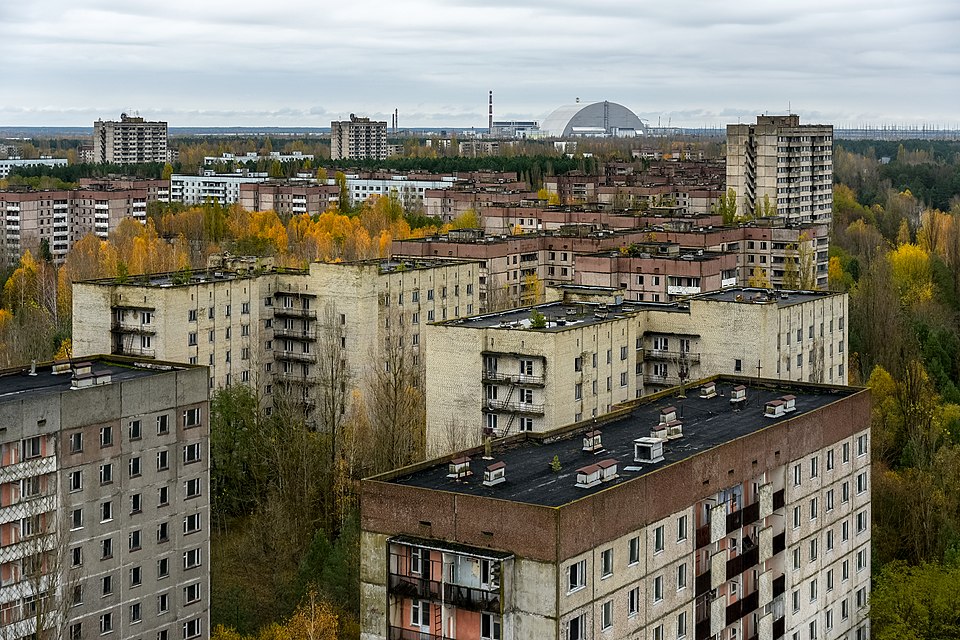
[Featured photo – The ghost city of Pripyat. In the distance can be seen the Chernobyl plant and the massive ‘New Safe Confinement’ structure – now punctured by a missile – photo from wiki commons]
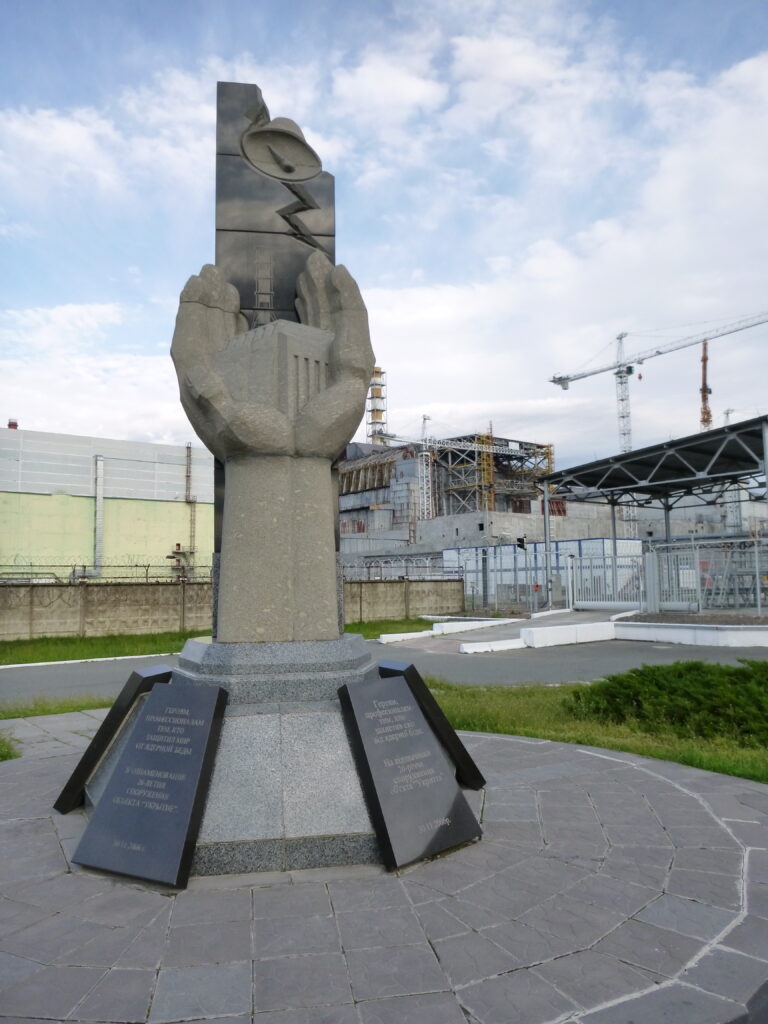
[All other photos – the author’s own]











.jpg)