Part II: Heroism, half-truths and cover-ups
In the second of a three-part article, CAIN O’MAHONY, who has worked in the Chernobyl Exclusion Zone, looks at the response of the Soviet authorities to the world’s worst nuclear disaster, Part three will look at longer term consequences and whether any lessons will ever be learned from it. Part one can be read here and part three here.
The initial response of the Stalinist bureaucracy was one of paralysis. The hierarchical structure saw time wasted as first the local CPSU leadership tried to minimise the scale of the danger from the Party bosses in Moscow, and then wasted even more time kicking the problem up and down the chain of command, more worried about protecting their jobs and privileges, than addressing the calamity facing the population. The HBO series Chernobyl (still available on streaming services) gives an accurate depiction of the buck-passing that went on, all the while valuable time was being lost.
It took them 36 hours before they realised they needed to evacuate Pripyat promptly or thousands would be threatened. But again, the order was still swathed in half-truths and secrecy. Having cut off all telephone connections to Pripyat from the outside word, broadcasts announced:
“For the attention of the residents of Pripyat! The City Council informs you that due to the accident at Chernobyl Power Station in the city of Pripyat the radioactive conditions are deteriorating. The Communist Party, its officials and the armed forces are taking necessary steps to combat this… Please keep calm and orderly in the process of this short-term evacuation”
(‘Seconds from disaster’, National Geographic Channel, 17.08.04).
They were told they would only be gone for three days. There is still resentment in Ukraine about the lie of the ‘short-term’ evacuation. As instructed, people left behind their pets – these were subsequently slaughtered in their thousands, piled in pyramids at road sides, and then buried in pits. If you recall the images of the Ukrainian refugees fleeing from the Russian invasion of 2022, many clung grimly onto their pet cats and dogs, not trusting the authorities and fearing a repeat of 1986.
Typical Soviet military approach
When the Soviet bureaucracy finally accepted that they had a major disaster on their hands, they adopted the typical Soviet military approach of just throwing manpower at it, regardless of the dangers, to ‘liquidate the problem’.
What they didn’t have was accurate readings of just how high the radiation levels were. The first attempts to take readings were suicidal. Yaugen Ryzhykau was a Senior Officer in the Red Army’s Task Force for Nuclear, Biological and Chemical (NBC) Defence. He recalled:
“The Supervisors and Commanders issued orders that were at times bordering on the idiotic. For example, one officer from the 122nd Mobile NBC Defence squad was obliged to climb up the staircase to the roof of the third block to measure the level of radiation on the fourth ‘smoking’ block using a five-metre rod with a radiation indicator on the end.
“Had his commanding officer really failed to understand that the level of radiation there was lethal? After completing his task, the officer lay motionless as a vegetable for two days in a tent, without any treatment, and was only later removed to hospital. It is painful to remember his deadly tired eyes and his pale face that was as white as a sheet”
(Taming the Monster, Resilience magazine, Summer 2016).
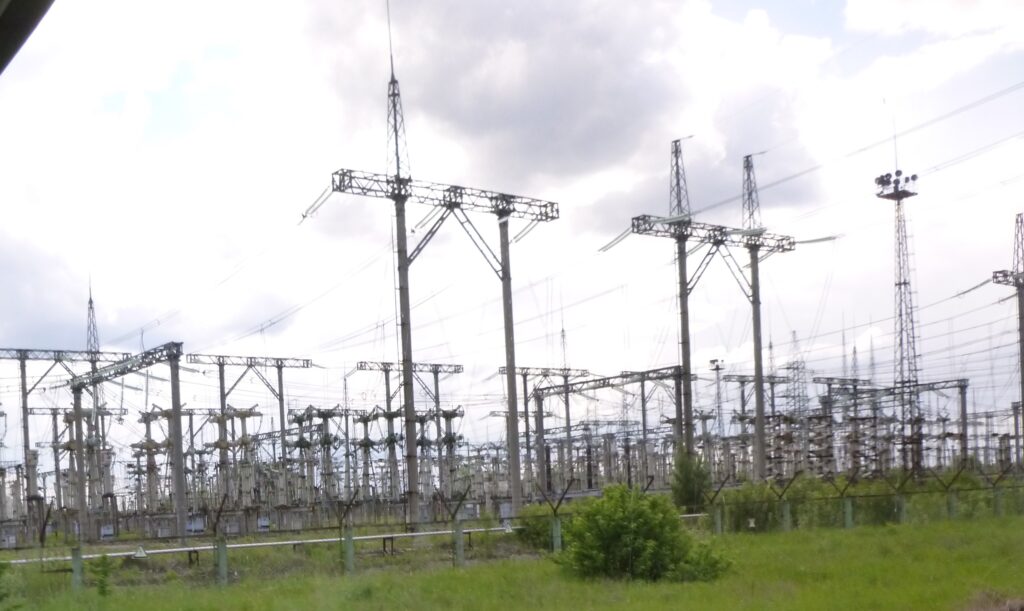
The initial thinking was to ‘plug’ the gaping hole in the roof of Reactor No 4 with sand, lead and Boron compounds, to seal in the radiation. Helicopters were used to drop in the materials – aside from the radiation, it was an extremely hazardous site for obstacles, not only was there the plant’s distinctive red and white ventilation stack, but the whole area was a forest of pylons.
Radiation dangers for pilots
Fortunately, the pilots were veterans of the war in Afghanistan and had perfected the ‘Afghan Turn’, a sharp banking manoeuvre to avoid groundfire during combat. Unfortunately, there was another Afghan legacy – the helicopters had no side doors (to allow rapid deployment of troops when under fire), so even less protection from the radiation for the crews.
And there were other perils too. Yaugen Ryzhykau was assigned to one helicopter to take arial samples:
“The pilot performed such a steep Afghan Turn we almost fell out the gap – there are probably still scratch marks on the wooden seats in the cabin”
(‘Taming the Monster’, Resilience magazine, Summer 2016).
While experts like the NBC troops understood the dangers they faced, thousands of other ‘liquidators’ were kept in the dark, as the Soviet authorities attempted to shroud the whole operation in secrecy.
Sergiy Vygivskyy was an engine driver’s assistant at Korosten railway depot. He said:
“Bringing the train to the 30-kilometer zone, everything I saw looked like pictures from the movies about World War II. Interminable columns of cars and military vehicles were moving along the road, people in civilian and military clothing, masks or simply in gauze bandages. The roar of helicopters in the sky. Everything looked unusual and incomprehensible. I felt fear and curiosity at the same time.
“We delivered loaded trains to the nearby area of the Chernobyl power plant and brought back empty ones. And this was repeated throughout the month. But the main and the most important thing was that we couldn’t see or feel or taste it – radiation, the threat that surrounded us: with no protection other than gauze dressings.
“Sometimes we did something wrong, not understanding that later it would influence our health. We would sit on the grass which was contaminated, we went to the ‘Red Forest’ where the level of radiation was extremely high, but we didn’t realize and didn’t know about the scale of the catastrophe and the level of radiation”
(‘Caught in the whirlwind’, Resilience magazine, Autumn 2014)
With experts like Valery Legasov now brought in, it was realised that the attempt to ‘plug’ the gaping hole had become counter-productive. This just reduced heat loss through the surface. With the energy trapped inside, it caused temperatures to rise to 3,000 degrees. By 5 May, radioactivity actually increased to the level it had been on 26 April.
Another massive explosion possible
The radioactive fuel had melted and flowed into the sub-reactor structures, but had not yet penetrated the pressure-suppression pool below the reactor, where there was a lot of water. If it did, another massive steam explosion was possible. If that happened it could see the highly radioactive water enter the local water course and radiate the River Dnieper, that flowed through the whole of Ukraine to the Black Sea. This would be catastrophic. The Dnieper water system served an estimated 30 million people.
Miners were brought in to dig a tunnel underneath the stricken plant, to protect the water course. This was completed heroically by the miners, all the time breathing in radioactive dust. They would not live long lives.
Another important attribute was Dr Rimsky-Korsakov of the Leningrad Radium Institute, whose team finally achieved the goal of obtaining accurate readings on radiation and heat levels. Through this, it was finally understood that the solution would be to pipe liquid Nitrogen via the miners’ tunnels to rapidly cool the core. The nuclear beast was at last tamed.
While the contribution of the ‘Liquidators’ reached new levels of sacrifice and heroism, all the Soviet leaders could think of was protecting their own careers from internal and external scrutiny and judgement. Those who did know the full facts sent their children to distant summer camps and stocked up on Iodine tablets.
Throughout, the watchword of the Soviet leadership was secrecy and cover up. The world would not discover what had happened until two days after the disaster.
[photo – author]
On 28 April, 1,000 km away in Sweden, the radiation alarms went off at the Forsmark nuclear power plant. With no leaks there, the puzzled Swedes asked the Soviet Union if they had had any nuclear incidents. At first they denied it, but when Sweden said it would report the incident to the IAEA, the Soviet leadership finally had to admit to the world there had been a disaster – but even then they gave false, lower figures on radiation.
Shroud of secrecy
The shroud of secrecy descended on the Liquidators themselves. There were just expendable cannon-fodder to the Party bosses in Moscow. The KGB were sent into Chernobyl – not to assist the colossal recovery operation, but to ensure the down-playing of actual radiation levels.
The Liquidators each had an individual radiation indicator, which read the dose received in a day. At the end of the working day, they would go to the doctor, who would record the readings in the log of radiation received. Yet again, these were falsified.
Yaugen Ryzhykau said:
“But even here there was chaos of a kind, regulated chaos, or more simply a cover-up. The doctors, under the unsleeping eyes of the KGB, would reduce our received doses in order not to disobey the instruction in accordance with which the maximum cumulative radiation dose should not exceed 25 R (0. 25 Sv) for the whole working period and, preferably, should not exceed 1 R per day. That way, the truth was hidden. For these bureaucrats, the instruction was more valuable and important than human life”.
(Taming the Monster, Resilience magazine, Summer 2016).
Even after Chernobyl had been contained and the decommissioning begun, for the ‘Chernobylists’ the nightmare continued. Their own personal medical records which showed the true levels of radiation poisoning they had received were declared State Secrets, never for them to see.
The subsequent witch-hunt to find someone to pin the blame on was again true to the methods of the Soviet bureaucracy. The lower rank plant director and local Party officials were prosecuted in a show trial. Valery Legasov became a ‘non-person’ too. During the trial he pointed out the failings of the RBMK reactor, to the anger of the Party bureaucrats. Afterwards, he was increasingly removed from various positions he had held, while at the same time succumbing to the effects of radiation. Two years later he would hang himself.
The self-satisfaction of the bureaucrats in passing the buck and dodging the Chernobyl bullet was, of course, short-lived. The parasitic, self-serving bureaucracy would spiral into chaotic collapse in a few years’ time. Many argue – including Mikhail Gorbachev – that Chernobyl delivered the final nail in the coffin.
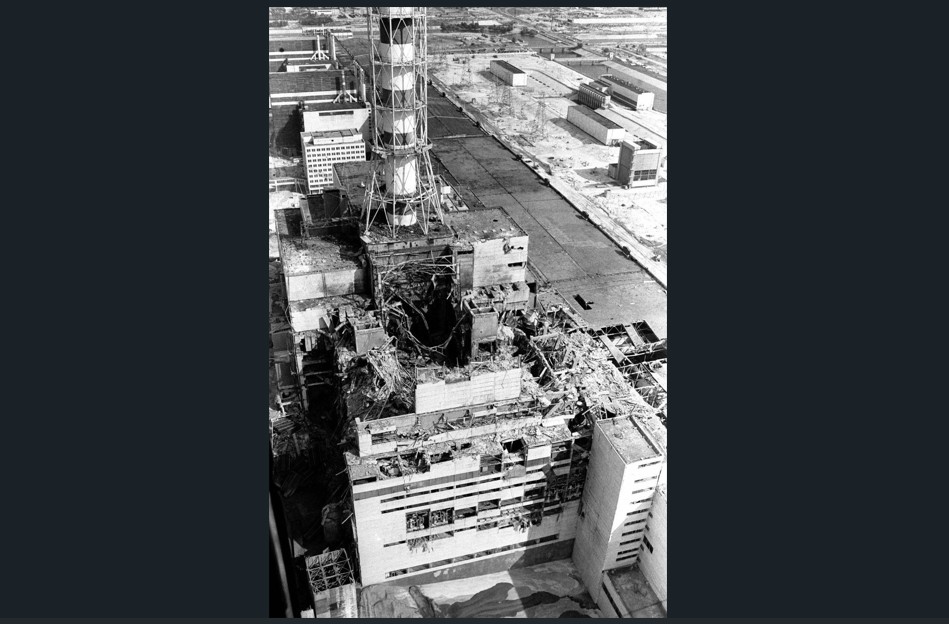
[Featured photo (top) – The stricken No. 4 Reactor in 1986. The gaping hole in the roof saw radiation pump out across Europe. Photo IAEA – wiki commons]