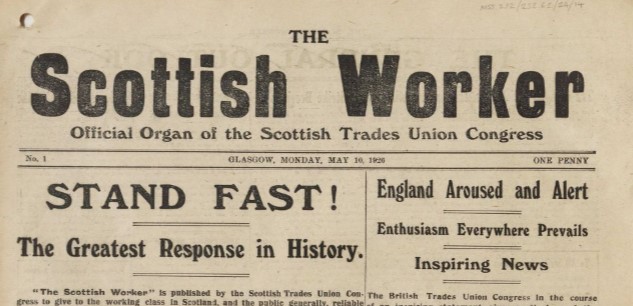
Continuing the theme of the General Strike, which lasted only nine days, from May 3 to May 12, GRAY ALLAN looks at the bulletin produced by the Scottish TUC, the Scottish Worker, and some of the reports it contained
The Scottish Worker reported that coal miners had been locked out for refusing pay cuts and increases in working hours by mine-owners who were amassing huge fortunes and paying out record dividends to their shareholders.
In Scotland, the bulletin reported, transport ground to a halt, steel-making, ship-building and engineering all were strike-bound. The strike was not total as businesses and trades essential to safety or life were exempted. But despite these concessions, everyday life was greatly impacted by the strike.
The General Council of the Trades Union Congress only very reluctantly called the strike – it was hardly ‘leadership’ because they couldn’t call if off quickly enough. (See earlier article on the lessons of the strike). Bounced into action by the coal owners’ lock-out and under pressure from the National Minority Movement the TUC called workers out on strike from the May 3.
But, viewing it as a simple trade dispute, the TUC persisted with futile negotiations with the Tory Government of Stanley Baldwin until the Government slammed the door in their faces and refused further talks until the strike was called off. That triggered a complete climb-down by the TUC, calling off the strike and leaving the locked-out miners to fight on alone for months.
Ruling class saw General Strike in a different light
Baldwin’s government and the whole ruling class saw the General Strike in a completely different light. Far from being a trade dispute, the Government saw the strike as a revolutionary challenge to parliamentary democracy and acted accordingly. A state of emergency was declared. The strike breaking Organisation for the Maintenance of Services (OMS) was set up and recruited over 100,000 volunteers. Police harassment of strikers and mass arrests began. Troop were deployed to London, Newcastle and Glasgow.
The Government also began publishing the British Gazette, a propaganda sheet edited by Winston Churchill, and in response the TUC began publishing their own spreadsheet, The British Worker with the first edition coming out on May 5.
This was not without difficulty however, because their offices were raided by police and steps were taken by Winston Churchill to cut off the supply of newsprint paper, so the British Worker was restricted to four pages.
The Scottish TUC followed with the publication of The Scottish Worker on May 10. A further five issues came out with the last on the May 15. Printed in Glasgow, it followed the style and layout of the British Worker.
The TUC Publications Committee were actually opposed to the publication of a Scottish paper just as they resisted regional papers in England, fearing that without TUC control “rash statements” would be published! Delays in starting production of the British Worker on Clydeside allowed the STUC to step in with their own paper.
The British worker at times sounded almost apologetic
Whereas the British Worker at times sounded almost apologetic for the strike, the tone of the Scottish Worker was a wee bit more upbeat. However, in the main, it followed the call for ‘respecitability’ coming from the TUC in London and in issue one it was made crystal clear where the leadership of the Strike lay
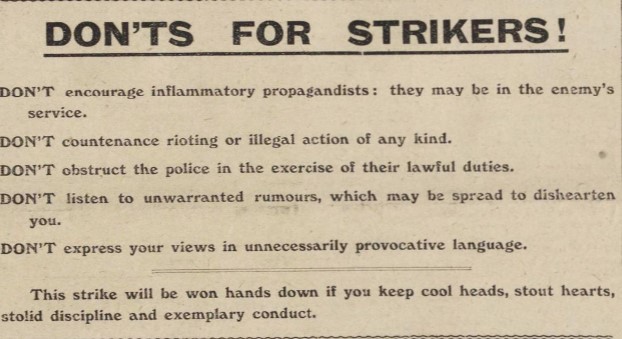
“It is not our function to decide policy or to discuss the general situation”, it said. “The strike is under the control of the British TUC General Council who are solely for the direction and control of the strike”.
The first edition of the Scottish Worker was distributed through local strike committees and it was also sold by some newsagents. With the Scottish Worker in production, no reports of activity north of the border were carried by the British Worker. On the other hand, the Scottish Worker did carry or reprinted reports from the British Worker of developments in England;
“London reports are thoroughly satisfying. Both Regents Park and Victoria Park have been closed to the public and are in occupation by the military authorities” Why the reporter found this huge military show of force to be “satisfying” is entirely unclear!
The Baldwin Government strained every sinew to undermine the strike. Central to this was the OMS, which recruited volunteers mainly from the student body and the middle and upper classes to act as strike breakers. This meant clueless volunteers taking on driving and technical tasks for which they had little to no training.
“From all quarters” the Scottish Worker reported, “…details are being received of the failure of the OMS to cope adequately…in some centres it has ceased entirely to be a vital unit in the maintenance of commercial needs”.
Students were heavily involved in the OMS. The student body in 1926 was entirely different from that of today, being almost exclusively composed of the sons (and a few daughters) of the middle and upper classes. But even then, there were marked differences. In Edinburgh University there was strong recruitment into the OMS and such strong anti-strike sentiment that students in support of the strike were chased from the campus.
Glasgow students more supportive than Edinburgh
At Glasgow University however, out of a student body of over 5,000 only 300 joined the OMS, despite evidence of threats from their professors who were trying to whip up support for the Government. The Labour Club, with 490 members, actively supported the strike and here, the Student Union declared itself a neutral party. When a contingent of strikers marched to the University to protest, they were met with speakers from the Labour Club who convinced the strikers of their solidarity.
Another notable incident of strike-breaking took place in Dundee. The Scottish Worker reported that a group of fascisti from St Andrews unloaded a cargo of sugar from a steamer at the docks. Numbers were not reported but it must have been a significant number.
Police harassment was regularly reported. In Coatbridge the police raided the offices of the Strike Committee while they were dealing with transport permits;
“The police asked those present to stand and give their names address and ages They requested the Committee to give the authority for their actions. The reply was “the General Council of the British Trades Union Congress”. The police then stated that in all probability the members of the Strike Committee would be charged with sedition or with a contravention of the Emergency Powers Act”.
Rioting was reported in Glasgow East End, with the police reporting that most of those arrested were “irresponsible youths” who are in no way connected to the strike. During the strike some strike committees were co-operating with police to control anti-social behaviour, but this did not stop the police acting brutally against strikers:
“The trouble originated at Ruby Street (tram) car depot near Bridgeton Cross, early on Thursday morning. A contingent of Cambuslang miners marched (presumably for picketing purposes) through the night to Ruby Street, which is a blind alley. When the men arrived, the car depot gates were opened and forth came a large force of police. Batons were used”.
Despite provocations the STUC continued to stress through their bulletin that the strike was purely ‘industrial’ and calling for restraint by the workers. In the end, the STUC leadership echoed the policy coming out of the General Council in London and the miners were left in the end to fight it out alone.