By Cain O’Mahony
A hundred years ago, just before midnight on May 3, began the biggest movement of organised workers in British history. It became the most titanic industrial struggle in British history and although it was potentially a revolutionary conflict, in the event it lasted only nine days and ended in defeat. Here, Cain O’Mahony looks at the background to the 1926 General Strike, its outcome and the political lessons we can draw.
……………………………………………………………………………..
On July 31 1925, the front page of the Daily Herald, a Labour-supporting daily newspaper, rejoiced with the headline: “RED FRIDAY!” The Tory government led by Stanley Baldwin had backed down in their attempt to slash miners’ wages, after the TUC had threatened that all trade unionists would come to the miners’ support in a General Strike.
The headline represented the workers’ long-awaited revenge for the “Black Friday” of 1921. Then, the TUC’s had promised that a “Triple Alliance” of transport workers and dockers would come to the aid of miners in the dispute of that time. But the Triple Alliance collapsed, after the betrayals of the right wing leaders of the TUC, leaving the miners to lose their fight at that time.
The working class had felt betrayed. After the appalling sacrifices of the 1914-18 War, they had been promised “homes fit for heroes”. Instead they got Black Friday – wage cuts, unemployment and slum housing. They had watched a revolutionary wave spread across Europe inspired by the workers’ revolution led by the Bolsheviks in Russia. They asked, when was our time coming? Hence the euphoria over Red Friday. The fight was back on.
‘free coal’ for Italy from German mines
In 1925, British capitalism had been hit by a new crisis, incredibly one of its own making. As part of the post-World War One reparations, Britain agreed that France and Italy should receive “free coal” from the German Ruhr region. This naturally pushed down the price of coal in Europe.
Winston Churchill, then Chancellor of the Exchequer, reintroduced the ‘Gold Standard’ for the economy, increasing the value of the pound, making it too strong for the export market, including coal. In addition, the Royal Navy – at that time still the largest in the world – was transferring from coal to oil power. The price of coal slumped. To protect their profit margins, the coal owners declared that they would cut the wages of the miners – yet again – and make them work longer hours.
The miners terrified the ruling class. Coal was the primary source of power in Britain, so it controlled all means of production. There were 1.2 million miners, organised into the most powerful union in the country. That was why British capitalism continually attempted to smash any attempt of collective action in the coalfields.
Equally, other workers understood that if the miners went down, it would be pay cuts and longer hours for everyone else. Indeed, Baldwin had made clear that this was the Tories’ plan to alleviate the current economic woes of the government. Austerity all round. Then as today under capitalism, it is always the working class that must carry the burden of economic failure, while the bosses defend their profit margins.
Buying time to prepare
But in 1925, the Tories were not ready for a fight, and hence at that time, they backed off. They agreed to commission an inquiry (sounds familiar?) led by Sir Herbert Samuel, into the crisis in the mining industry. For the duration of the inquirty, the government said it would subsidise miners’ pay. Hence, as the Daily Herald headline suggested, it appeared to be a great victory for workers.
But in reality, the British ruling class were just buying time to prepare. They knew that a general strike was a struggle that could spill over into a political mass movement that could spell the end of capitalism and their profit system. Unlike the TUC leaders, the strategists of the Tory Party and British capitalism understood that this was a potential fight to the finish. For them, therefore, there was no room for compromise, half measures or fudged settlements.
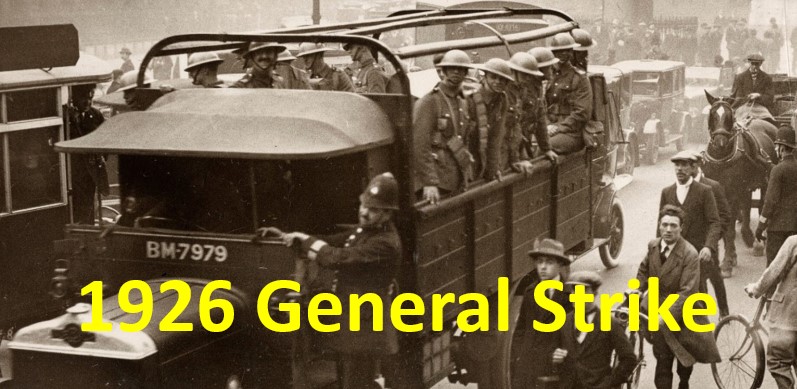
The government used the temporary respite of the Samuel Commission to stockpile coal and key supplies. They also turned their attention to the “armed bodies of men” they would need to break a general strike. It was only eight years since the horrors of the World War : many of the men who would be on picket lines would have served in the forces, and many soldiers put in front of them would therefore be looking at old comrades from the trenches.
Indeed, it later transpired that soldiers in the Welsh Guards, and the Bedfordshire and East Lancashire Regiments did make it clear to their officers that they would refuse to be sent to mining areas.
OMS an auxiliary force
The government, therefore, would need a new auxiliary force, just as they had had to employ the Black and Tans a few years earlier in the attempt to suppress the Irish national liberation uprising.
An Organisation for the Maintenance of Supplies was formed, and 240,000 were sworn in as Special Constables, the vast majority from the upper and middle classes, mainly professionals and many who were university students. But while the ruling class understood that this would potentially be a revolutionary confrontation, that was not true of the leaders of the TUC.
The TUC leadership had a class-collaborationist outlook from the outset. They naively believed, especially after Labour’s first election victory in 1924, that they could use the industrial might they controlled to simply lever reforms out of capitalism, without the need to overthrow it.
The TUC General Council was dominated by the likes of the NUR leader Jimmy Thomas and the TUC General Secretary Walter Citrine, who saw their task as policing the trade union movement, pleading to the bosses they were ‘responsible people’ who restricted their actions solely to trade disputes.
At the same time, they feared trade disputes as much as the capitalists, because all large struggles develop a momentum of their own, opening up the eyes of workers involved and raising their consciousness. Any mass strike throws up the question of leadership, posing such a challenge to the meakness of the unionleaders that it could topple them from their privileged positions and the head of the unions.
Already, in response to the Black Friday betrayal, there had been the formation of the Minority Movement, the ‘Broad Left’ of its day, where left wing trade unionists began to organise to get class fighters into leading positions in the trade union movement. Numbering around one and half million members, they succeeded in getting the left winger Arthur Cook as leader of the Miners Federation of Great Britain.
Threat of strike was only a bargaining chip
Responding to this pressure from below, and anticipating greater pressure to come, the General Council of the TUC adopted a left veneer, using radical rhetoric to keep the rank and file on board. Throughout the nine months of the Samuel Commission Inquiry, the TUC leaders used the threat of a general strike as merely a bargaining chip, confident the Tories would back down once more.
But a general strike is more than that. As Leon Trotsky explained:
“A general strike is the sharpest form of class war. It is only one step from the general strike to armed insurrection. This is precisely why the general strike, more than any other form of class struggle, requires clear, distinct, resolute and therefore revolutionary leadership. In the current strike of the British proletariat there is not a ghost of such a leadership”. (Problems of the British Revolution, 1926)
Incredibly, having threatened a general strike, the TUC did not get around to organising it until only six days before the mass strike was called.
The newly formed Communist Party of Great Britain must also share some of the blame for building illusions amongst left workers in the credibility of the TUC. In its defence, the CP was relatively new, inexperienced and numbered only around a few thousand, and as part of Baldwin’s preparations to smash the trade unions, the government had already imprisoned the CP leadership.
The problems did not lie with the relatively raw rank-and-file Communist Party members, who in the main were among the most solid class fighters of their locality and, indeed, the experiences of the strike and miners’ lock-out would result in an increase in CP membership. They lay with the failure of its leadership, especially internationally.
Soviet state had huge stature among workers
The British Communist Party were badly advised by the Communist International (Comintern), which still had huge stature in the eyes of workers around the world, but in which the bureaucratic methods of Zinoviev and, increasingly, Stalin, were beginning to take hold. Hoping for better trade relations between the Soviet state and Britain after they had begun under the short-lived first Labour government of 1924, Comintern leaders, and after them the British CP, built up the trade union tops as ‘leaders of the proletariat’.
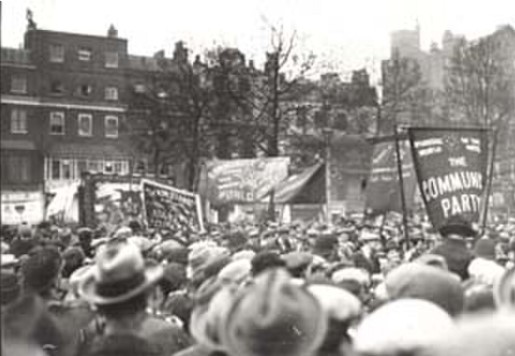
They pursued the mistaken idea was that if they built a ‘United Front from above’ with the trade union leaders (regardless of their wretched personal politics), the mass of their rank and file members would automatically follow. Hence the CP’s slogan of the time of “All Power to the General Council”, which was a limp echo of the “All Power to the Soviets” during the Russian revolution.
In his history of the British CP, Hugo Dewar commented: “Whatever the original intention may have been in the consciousness of the Communists, this alliance became an attempt to find a short cut to the masses by winning over their leaders, thus skipping the spadework of winning over the rank and file to the revolutionary cause.” (Communist politics in Britain: the CPGB from its origins to the Second World War, 1976.)
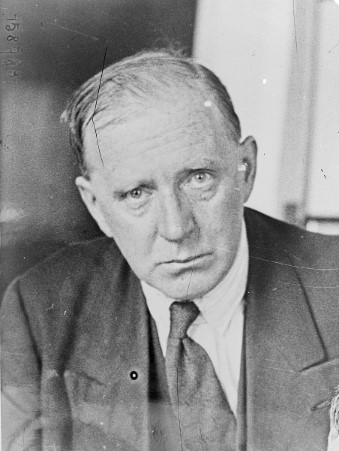
Thus the CP played a part in building up the authority of a right wing TUC, when a much sharper critique was needed. The lefts on the TUC general council, like Arthur Cook, the Miners’ Federation leader, were sincere in their aim to fight for their workers, unlike the right wing leaders. But they, too, failed to criticise the role of the TUC and effectively provided a ‘left shield’ for a failing TUC leadership.
Some had a clear understanding of coming battle
Fortunately, there were some who had a clearer understanding of the battle about to take place. The leader of the Minority Movement in Scotland, miner William Allan, stormed: “The capitalist is an enemy to be fought, not merely a misguided fellow-citizen to be placated… it is this blind and foggy-minded leadership which constituted one of the gravest dangers to the workers in 1926.” (John McLean, The 1926 General Strike in Lanarkshire, 1976)
To the horror of the TUC leaders, after nine months, the Samuel Commission concluded its findings, and the Baldwin government declared that the subsidy to the mining industry was over, and that the miners would have to face a reduction in pay of 13.5 per cent and, what was more, work longer hours.
Trapped by their own empty rhetoric, the TUC now had no option but to call the General Strike and the decision was made on 1 May 1926.
For the big majority of organised workers, the news was greeted with wild enthusiasm. That day saw the largest May Day parades the country had ever seen. In London, the demonstration filled Hyde Park to overflowing. In Birmingham, the parade stretched for two miles, the largest protest the city has ever seen (although unfortunately led by a new Labour Parliamentary candidate, one Oswald Mosley). In Manchester, an equally huge protest agreed the following resolution: “He who is not for the miners is against the working class.”
Then on 3 May, the General Strike began. A mood of communal solidarity and the real hope for a new world swept across the country. In Manchester, Stella Davies recalled: “The mill chimneys ceased to smoke and the wheels ceased to turn. Over Gorton, Openshaw, Clayton, Newton Heath and Collyhurst the air grew clearer: the hills which ring the east of Manchester could be seen with unusual sharpness.” (Andrew Rooves, The 1926 General Strike in Birmingham, historywm.com)
Different sections to strike at different times
The TUC’s ‘tactic’ was to bring out different sections of the movement at different stages to put pressure on the government, as though they could turn the movement they had unleashed on and off like a tap.
But the genie was out of the bottle, and millions took to the streets and formed mass pickets. Many went on strike even in non-organised factories and services. It shows, as socialists have always argued, that when the official labour movement is seen to take a strong lead, many sections of society will follow the call. In all, over four million came out on strike.
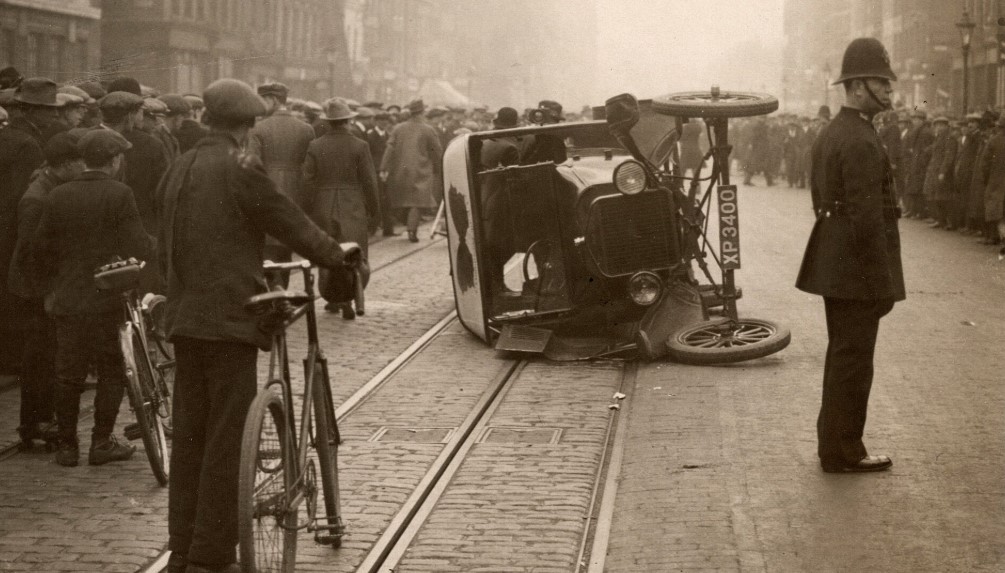
The strike was in the main peaceful, but there were inevitable clashes, with buses overturned in Glasgow, while in Preston 5,000 workers stormed the police station to release a striker who had been arrested.
Councils of Action – the British version of Russian soviets
The actual leadership in the conduct of the strike was rapidly transferred from the TUC to localised ‘Councils of Action’, with around 150 being formed across the country; many local Trades Councils were revitalised. These councils co-ordinated the strikes, pickets and demonstrations, and most importantly decided on ‘TUC Permissions’ on which essential services would be allowed to operate. In Edinburgh for example, pickets impounded vehicles that did not have the correct paperwork.
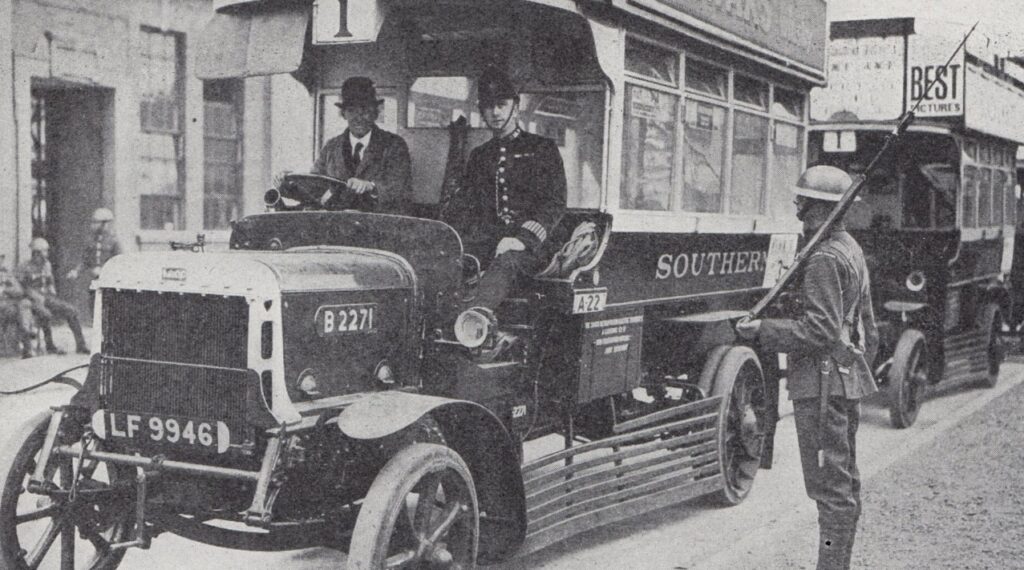
The power of the Councils of Action demonstrated in stark reality the old adage that not a wheel turns, not a light bulb shines, without the permission of the working class. In many areas of the country, like in 1917 Russia, there was ‘dual power’ where the state continued to try and operate, but the real power was in the hands of the Councils of Action.
In terms of the OMS actually ‘maintaining supplies’ it was little more than a propaganda exercise, and not very effective. It turned out that those menial jobs that the ‘little people’ do were actually quite skilled. In Manchester, NUR pickets at a station watched with amusement as a gilded youth driving a train overshot the platform, and then made a complete hash of trying to back the train up. “Any fool can start a train” one picket shouted, “…when you’ve learnt to stop it where you want, you can join the union!”
Letting down bus tyres
The main role of the OMS was to intimidate. In Birmingham, a mass picket had stopped seven scab buses, letting their tyres down and leaving them stranded. In the next attempt, the bus company, Midland Red, drove out a convoy of 30 buses, accompanied by sixty cars filled with steel-helmeted Special Constables, a mobile ambulance and 20 police officers. As the pickets wryly pointed out, the only thing they didn’t seem to have were any passengers.
The determination of the strikers was typified by those in Cramlington, Northumberland, who, on May 10 derailed the famous Flying Scotsman, the London to Edinburgh passenger train. It had been their intention to stop a coal train, not a passenger train, but in the event only a minor injury was reported. (See report of The Cramlington Train Wreckers, here)
But despite the grim determination of the strikers, from the beginning, the TUC was desperately trying to wriggle out of the political volcano they had set off. They were ever hopeful of some finding some sop that they could use to pretend they had a ‘victory’ and and an excuse to turn off the action.
But the Tories, on behalf of the capitalist class, were to give no quarter. The only ‘offer’ they would countenance was unconditional capitulation by the TUC. The TUC leaders’ ‘left’ rhetoric of Red Friday quickly evaporated.
“Their bluster deserted them”, Hugo Dewar wrote, “their hearts turned to water. Rumours were circulating: they would all be arrested, trade union funds would be impounded… Trilbies in hand, they went to No 10 and abjectly surrendered.”
And so on May 12, just as another 100,000 workers went on strike, and more were waiting to follow, the TUC General Council called the strike off. On the day the strike ended, there were more on strike than on the very first day, and others were waiting their ‘turn’. In Manchester, only 29 tram drivers reported for duty on 12 May: the other 5,000 surrounded the depot, and then marched on the city centre in protest.
Bosses sought revenge on striking workers
The TUC leaders also left a whole series of local rearguard battles against victimisation, as bosses exacted their revenge on strikers and sought to weed out trade union activists. In Birmingham, there were lock-outs at Great Western Railways, Dunlop, BSA and Tangyes & Avery, all trying to force workers to sign new contracts on worse terms and conditions.
In Manchester, 25,000 rail workers remained on strike, with solidarity action by the dockers, when they faced enforced new contracts.
Overall, the 1926 General Strike was a total defeat. It was as if an army in the field, with high morale and a willingness to fight to win, was suddenly abandoned by its generals and its leadership. The General Council walked away, abandoning those workers who were victimised and leaving the miners to fight it out alone.
In the tradition of the miners’ union, 1926 was not so much the year of the General Strike as the year of the Great Lock-Out. The colliery owners had locked out the the miners because they refused to work longer hours for less money. But in the end, in late November, the lock-out ended. Stanley Baldwin and the mineowners, like Margaret Thatcher and the NCB would do nearly sixty years later, starved the miners into submission, into accepting harshly lower wages and longer hours.
The defeat paved the way for even more vicious anti-trade union legislation. The 1927Trade Disputes Act banned sympathy strikes, outlawed strikes that could be characterised as attempting to coerce government, restricted picketing, and forced union members to “contract-into” political levies. It prohibited civil service unions from affiliating with the TUC. Yet it could have been so different.
The subjective factor was absent
While the objective conditions for a revolutionary change were there in 1926, sadly, the subjective factor – a leadership prepared to see the fight through to the finish – was not. What was offered by the gentlemen of the TUC General Council was the opposite of ‘leadership’.
Had there been a labour movement leadership with a steel backbone and a clear perspective for socialist change, the processes that were beginning to play out would have followed an entirely different course. One incident in Scotland, on the last day of the General Strike, demonstrated what could have happened had the strike continued for more than nine days,
On May 11 in Airdrie, a mass of pickets, with wives and children blockaded the main street after a fleet of scab buses arrived. The police read the Riot Act, saying they must disperse by the time the buses were due to return to Glasgow. Nobody moved. At 3pm the police baton-charged the crowds, and “men and women were smashed at random”.
Pacifist approach shouted down
That night, at the local Council of Action meeting, those who attempted to defend the pacifistic approach of the TUC were shouted down. It was agreed to form a Workers’ Defence Corps, and miners and railway workers armed with sawn-off billiard cues began to patrol the streets. They were ready to take on the forces of the state, baton for baton.
This was no isolated mood. Had the strike continued, such incidents could have been replicated across the country. In the hearts of minds of the majority of British workers in that strike in 1926, there were revolutionary aspirations that only need a party and a movement that could have led them to victory.
It is important for socialists and trade unionists today to study and learn from the events around the 1926 General Strike, the most titanic struggle in the history of British capitalism. The lessons of the defeat need to be absorbed, not because 1926 is an interesting historical narrative, but because it presages in both its scale and intensity the character of the class struggles that we will face in the coming years. The need for leadership will be no less important in the future as it was in 1926.
[General strike pictues from Wikimedia Commons here. Picture of AJ Cook also from WC here]