
By Michael Roberts
In just over 200 years after winning independence from the British empire in 1776, the United States had become the most successful capitalist state, leading the major economies in national output, income per head, labour productivity, financial dominance and military power.
That hegemony in global capitalism was established by the end of WW2, which left Europe and Japan in ashes, Britain heavily indebted, and much of Asia, Latin America and Africa in poverty. Only the Soviet Union remained as a military rival to the US — but not in industrial output, trade or financial power.
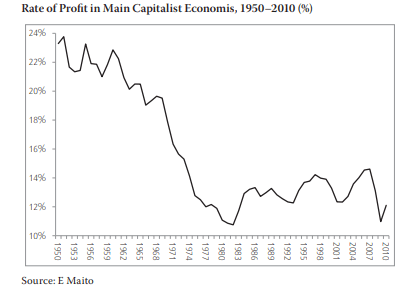
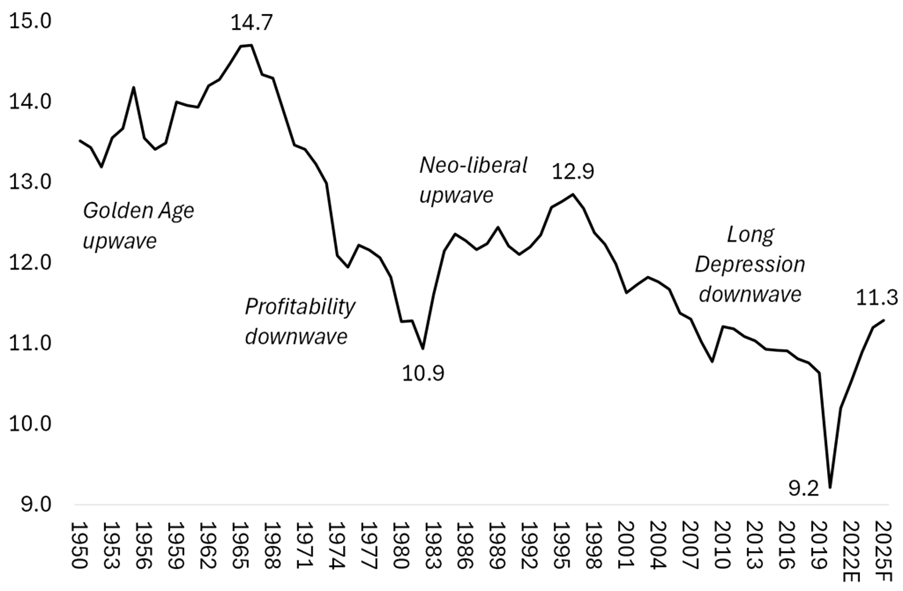
From 1945 to the mid-1960s came the Golden Age for the major capitalist economies, as cheap, plentiful post-war labour combined with the spread of technologies developed before and during the war. The profitability of capital was high, and even rising, through the 1950s and 1960s, especially for US capital.
First post-war crisis
But this was not to last. Marxist theory argues that, as capitalists invest ever more in technology to cut production costs and boost labour productivity, overall profitability tends to fall because profits come only from labour.
If investment in labour power declines relative to investment in plant, equipment and technology, profitability will eventually fall. And so it did, sharply, from the mid-1960s, generating the first simultaneous international slump in 1974-75, followed by the deep manufacturing double recession of 1980-82.
Signals of decline
During this period, the first signs of declining US hegemony appeared. European industry, built on cheap labour, American credit and the latest technology, began to gain global market share from US industry. In the 1970s, Japan also started eating into US manufacturing’s global output and export share.
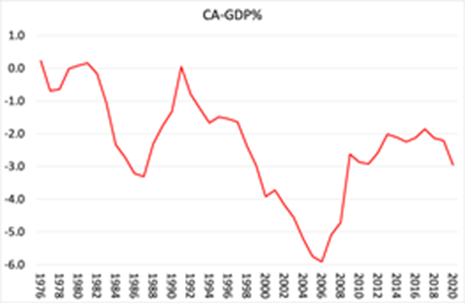
Politically, America’s defeat in Vietnam and the fall of Saigon weakened its international dominance. Throughout the 1960s, the US current account surplus was gradually eroded until, by the early 1970s, it had become a deficit. The US began to leak dollars globally not only through outward investment, but also through excess spending and imports as domestic manufacturers lost ground.
US current account balance to GDP (%), 1976-2020
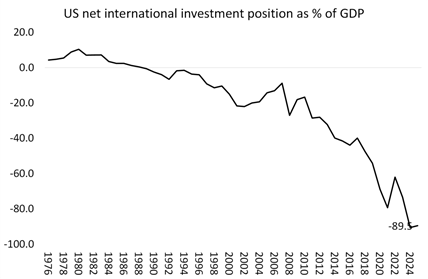
The US became reliant for the first time since the 1890s on external finance for the purposes of spending at home and abroad. By the 1980s, the US was building up net external liabilities that have now reached 90% of US GDP.
From Bretton Woods to neoliberalism
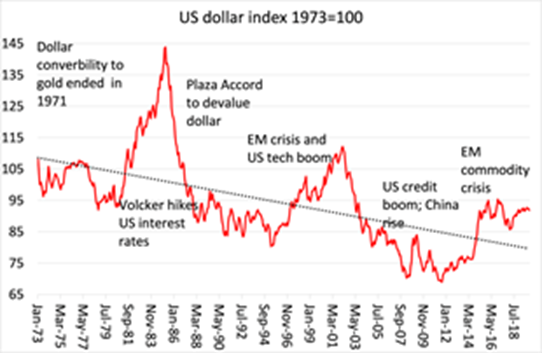
In 1971, President Nixon announced that the US was going to devalue the dollar and end its peg to the gold price. In effect, this was the end of the Bretton Woods agreement that had established a framework committing all to fixed exchange rates for their currencies and set in terms of the US dollar. With Nixon’s announcement, the US abandoned Bretton Woods and, with it, the whole post-war Keynesian-style international currency regime.
The fall in profitability in the major economies, the stagflation of the 1970s and the slumps of the early 1980s led to a complete shift in economic policy. From the 1980s, in the so-called neoliberal period, capitalists ended macroeconomic management and moved to cut public spending, privatise state assets, deregulate finance, weaken trade union power and, above all, shift manufacturing out of the US into Asia, especially China, to exploit cheap labour.
US imperialism had overseen the collapse of the Soviet Union, but by the 1990s it was losing ground in trade and output relative to other major economies, especially China. Europe had integrated further into the Eurozone and expanded eastwards, drawing on cheap labour there. The Asian tigers leapt forward with new technologies. China emerged as the global manufacturing and trading power, partly driven by US multinationals that had located there in the 1980s.
These neoliberal policies helped raise the profitability of capital in the major economies, including the US, for nearly two decades, as computers, digital software and eventually the internet boosted productivity. But again, Marx’s law of profitability exerted its downward pressure and, by the end of the 20th century, all the major economies struggled to sustain the growth rates of the 1990s, let alone the 1960s.
They entered what I have called a Long Depression, especially after the Global Financial Crash and the Great Recession of 2008-9. In the first three decades of the 21st century, the major economies have seen slowing growth, falling investment and weak productivity growth, along with the two largest slumps in the 250 years of US capitalism: 2008-9 and 2020.
G7 rate of profit on capital (%)
The dollar’s continuing privilege
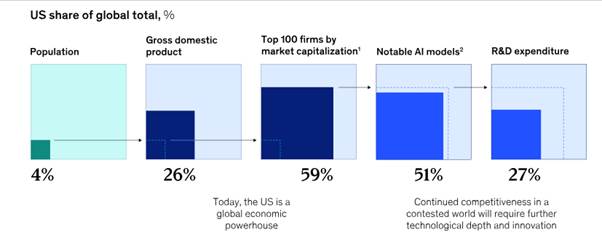
But at 250 years old, the United States still generates 26 percent of global GDP and is home to 59 of the world’s top 100 firms.
The US dollar remains the main international reserve currency. Roughly 90% of global foreign exchange transactions involve a dollar leg; about 40% of global trade outside the US is invoiced and settled in dollars; and almost 60% of US dollar banknotes circulate internationally as a store of value and medium of exchange. More than 60% of global foreign exchange reserves held by central banks and monetary authorities remain denominated in dollars.
Having said that, the underlying relative decline in US competitiveness has gradually worn away the strength of the US dollar against other currencies, as the supply of dollars outstrips demand internationally. Since Nixon’s momentous announcement, the US dollar has declined in value against other currencies by 20% – a good barometer of the relative decline of the US economy.
China as the new challenger
In the 21st century, the US empire faces a far more dangerous rival to its hegemony than the Soviet Union, Japan or Europe. China began expanding industrial capacity in the 1980s, then ramped it up in the 2000s, surpassing the United States’ share of global manufacturing output in 2010. China is now the world’s manufacturing superpower.
Its production exceeds that of the nine next largest manufacturers combined. It took the US the better part of a century to reach the top in manufacturing; China took about 15 to 20 years. In 1995, China had just 3% of world manufacturing exports. Now its share has risen to well over 30%. While China runs a surplus on payments and receipts with other countries of around 1-2% of GDP a year, the US runs a current account deficit of 3-4% of GDP.
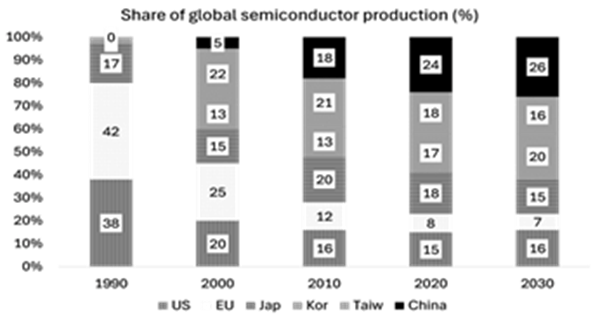
Attempts to restrict China’s expansion into tech products and semiconductors have failed miserably. China is catching up in the ‘chip war’ and has launched its own ‘open source’ AI models, including DeepSeek, seriously undercutting America’s costly AI models such as ChatGPT and Claude.
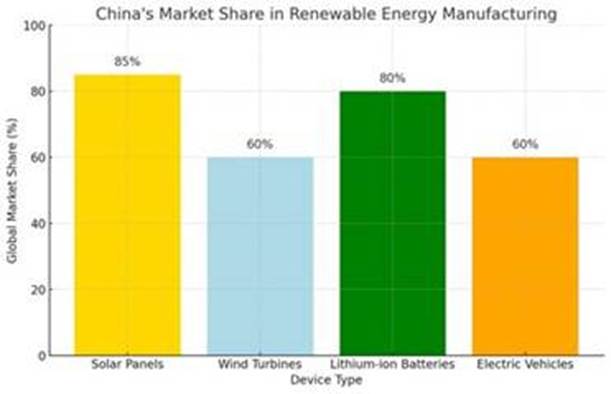
China also dominates the entire range of renewable energy manufacturing.
China also leads by far in the use of robots, with installations rising 7% a year while in the US they are falling 9% a year. China now has more industrial robots than the rest of the world combined.
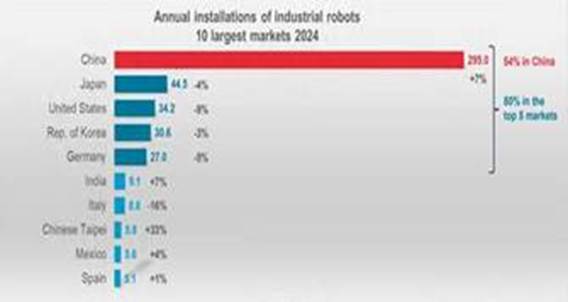
Source: International Federation of Robotics
There is still a long way to go before the mighty US economy is on its knees. It may have the largest net liabilities globally, but it can manage them because it is the only country that can issue dollars — and the dollar remains the international currency for trade, investment and reserves. Trade-surplus nations such as Germany, Japan and China must use most of their dollar earnings to buy dollar assets. So the dollar’s ‘exorbitant privilege’ keeps the US empire ticking over.
Moreover, while US investments abroad may be worth less in value than foreign investment into the US, creating a negative investment position, foreigners earn less income on US assets than US investors earn on foreign assets. So there is a net income surplus for the US of at least 0.5% of GDP on average since 2008, adding to its domestic economy. The US has not yet reached a ‘tipping point’ where its net liabilities to foreigners are so high that its net income surplus disappears.
Geopolitical clashes with China
In the 21st century, geopolitics increasingly boils down to a battle between a weakening hegemon, the US, and a rising economic giant, China. The US still dominates militarily, spending more on its armed forces than the rest of the world combined.
It runs nearly 800 foreign bases worldwide; China has one. But even here, the war in Iran has exposed the inability of the US military to impose its will on a third-level economy and state without nuclear weapons — shades of Vietnam more than 50 years ago.
For the US ruling elites, China is the ultimate enemy and threat to global hegemony. That applies both to the MAGA wing supporting Trump in the White House and to the ‘globalists’ in America’s ‘deep state’ and ‘neo-con’ circles.
The policy difference is that the Trumpists want to concentrate US power in the Western hemisphere before taking on China across the Pacific, just as America did with Japan in the 1930s. For the MAGA crowd, Europe can deal with Russia and Ukraine on its own, and Israel can deal with the Middle East on its own.
The globalists, by contrast, still have serious ambitions to dominate worldwide. They want the war with Russia to continue until Russia is brought to its knees and there is ‘regime change’; and they aim to back Israel and participate militarily until Iran’s regime falls. Trump vacillates between the two policies, currently swinging to the globalists over Iran. But both wings agree: China must eventually be ‘dealt with’, weakened economically and forced to accept Western policies and control.
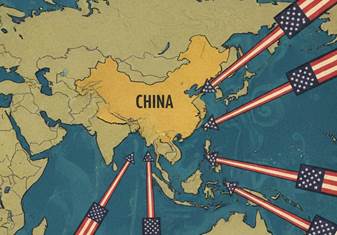
A MAGA strategy
The US empire has no official emperor, although Trump is increasingly trying to establish himself as one, riding roughshod over Congress, the courts, financial rules and the electoral process.
But the US empire is in trouble. That is why a significant section of America’s ruling elite is prepared to accommodate Trump and his MAGA supporters in trying to Make America Great Again: by ending international free trade rules and resorting to protectionist tariffs; sharply increasing military spending; and cutting taxes for the rich and mega companies while reducing healthcare and public services for the rest. The rich get richer and the rest get poorer.
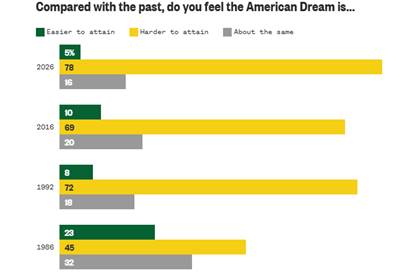
No wonder Americans now have a bleak outlook on the nation’s future after 250 years, with most saying the US has already seen its best days and a record-low number saying they are extremely proud to be Americans.
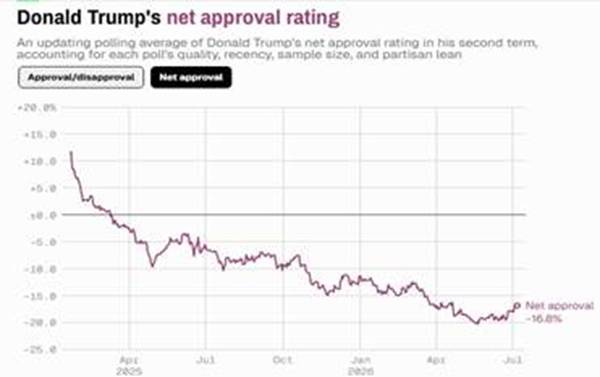
President Trump has the lowest approval level of any president. But he rolls on regardless towards the mid-term Congressional elections.
He kicked off the 250th birthday weekend with an attack on what he called the “communist menace” in America, framing its supporters as “the enemy of July 4th, 1776”. He was speaking in the Black Hills, Dakota, which the US government illegally seized from the Sioux Nation in 1877 after Congress forced the tribe to cede land guaranteed under treaty.
Apparently, communism is a greater threat to American liberty than both world wars, including the defeat of Nazism, and the September 11, 2001 terrorist attack, carried out by Islamic fanatics previously funded by the US to defeat Russia in Afghanistan. Trump argued that communists do not love God or religion and have no respect for law, justice, principle, tradition or God-given rights — looking in the mirror here.
“You can be loyal to Karl Marx or you can be loyal to America. You can be a communist or you can be a patriot. You cannot be both.” Pledging to “vanquish communism quickly” and “send them into exile”, he told a cheering MAGA crowd: “We will send them quickly away, and we will continue to build our country bigger and better and stronger than ever before. America will never be a communist country.”
Decline of an empire
The ancient Roman republic was the model adopted by the Founding Fathers for the US constitution. But its ‘checks and balances’ were abandoned when one member of the elite achieved total power and Rome became an empire, with an emperor, around zero BC.
The empire reached its pinnacle some 200 years later, then began to decline through a combination of internal contradictions in its slave economy, with no more slaves; widening inequalities, with land concentrated in the hands of an aristocratic elite; and, externally, a weakening ability to police resistant forces, including German tribes.
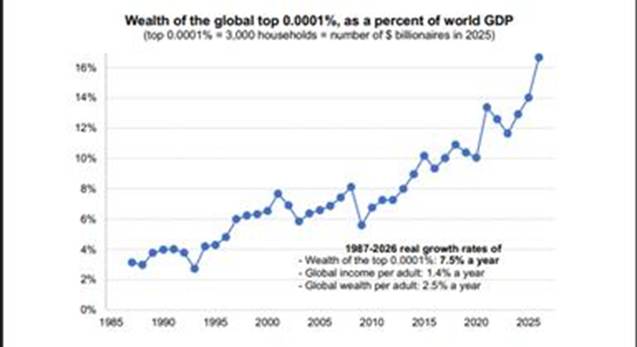
The same trends exist now for the US empire. Its capitalist economy is no longer a powerhouse of prosperous expansion; inequalities of income and wealth have never been so extreme in 250 years and are worsening. The US has increasingly lost its power to police the world, as Vietnam, Iran, Ukraine and China show.
Rome took two centuries to decline and fall. It will not be so long in the modern capitalist world. The US might yet become a communist country before the end of this century — or we shall all be driven into the dark ages, as the world was when the Roman empire collapsed, this time by climate catastrophe or nuclear annihilation.
From the blog of Michael Roberts. The original, with all charts and hyperlinks, can be found here.
The feature image for this article is a photograph by Daniel Torok of Donald Trump at an event in the White House in 2025. The image was sourced from Wikimedia Commons and can be found here.