
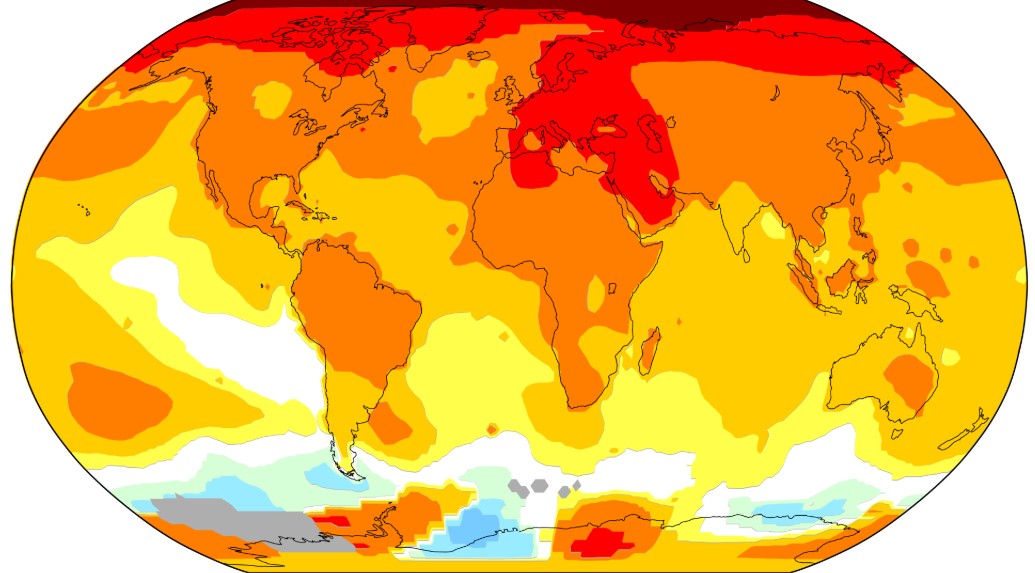
It is hard to get away from the issue of global warming at the moment. South East England is suffering its fourth heat wave with temperatures soaring above 30 degrees for several consecutive days. Although some workers may have air-conditioning, there are many who are obliged to be at work who do not, including the drivers of trains and buses and many who work in public services like the NHS and local government. Many commuters are forced into overcrowded and overheated public transport
There are many people who are suffering in their own homes, completely at the mercy of the heat because of poor ventilation. British homes, by default, are built without air-conditioning so the very young, the sick and the elderly have found it hard to cope.
In May and June alone there were an estimated 2,700 ‘excess’ deaths over the expected number for those months, deaths which can therefore be attributed to the heat. When the figures for July are released, there will no doubt be a further jump.
As bad as it might be in southern England, the situation in France, Portugal and Spain is much worse and there has been an estimated 10,000 excess deaths in Europe. There is much focus, naturally, on the wildfires in Spain and France, where more than a third of a million people have been evacuated.
The wildfire In Spain, in the Sierra Oeste region west of Madrid, has been described as a “monster” and the largest ever in Spain, but other regions that have suffered drought are on a watch-list for possible new fires. Just as big have been the fires in south west France near the city of Bordeaux, where temperatures are currently around 40o Celsius.
Firefighters losing their lives trying to save communities
Such wildfires are not unique to this part of the world, and there are regular incidents elsewhere in the Mediterranean basin, including Greece, Crete and Italy. For several years running there have been wildfires in the USA, principally in California. Many of these fires have led to the deaths of heroic firefighters, who have risked their lives trying to save local communities.
It is perfectly clear to anyone who has even vaguely kept up with the news that climate change is the major causal feature of the heat waves and wildfires. Not only were records broken in Britain in the June heatwave, where we had the highest-ever recorded temperature for June, but that was also true in other European countries.
Historic records were broken in Germany (41.5°C), the Netherlands (39.4°C), and Denmark (37.0°C), to name only three. In France, the average annual number of wildfires between 2008 and 2015 was only fifteen. This year, there has been over 300, well ahead of last year, which was itself a new record.
What is absolutely disgraceful is the fact that so many of the mainstream media report on the heatwave and the wildfires, but they deliberately – and it has to be a matter of editorial policy – play down or even fail to mention the root cause: climate change. In fact, they are happy to rail against any policy that is linked to ‘net zero’, that is to the elimination of carbon fuels in favour of renewables.
Astonishing how little climate change is linked to the heat wave
Earlier this month, the Energy and Climate Intelligence Unit (ECIU) published a report on the treatment of the heat wave by the media. It was astonishing how little coverage was given to climate change explicitly. “Almost three quarters (72%) of articles in national newspapers which referred to “heatwave” or “extreme heat” during last month’s record high temperatures” the report says, “didn’t include a reference to climate change…”
Just to be clear, the ECIU were not making up the link between the heatwaves and climate change. They quoted a study by World Weather Attribution (WWA) that found climate change was “unequivocally to blame” for June’s hot conditions. The WWA report stated: “In 1976, when some of the previous European records were set, the 2026 temperatures would have been virtually impossible to occur in June, while also highly unlikely at any time of the year.”
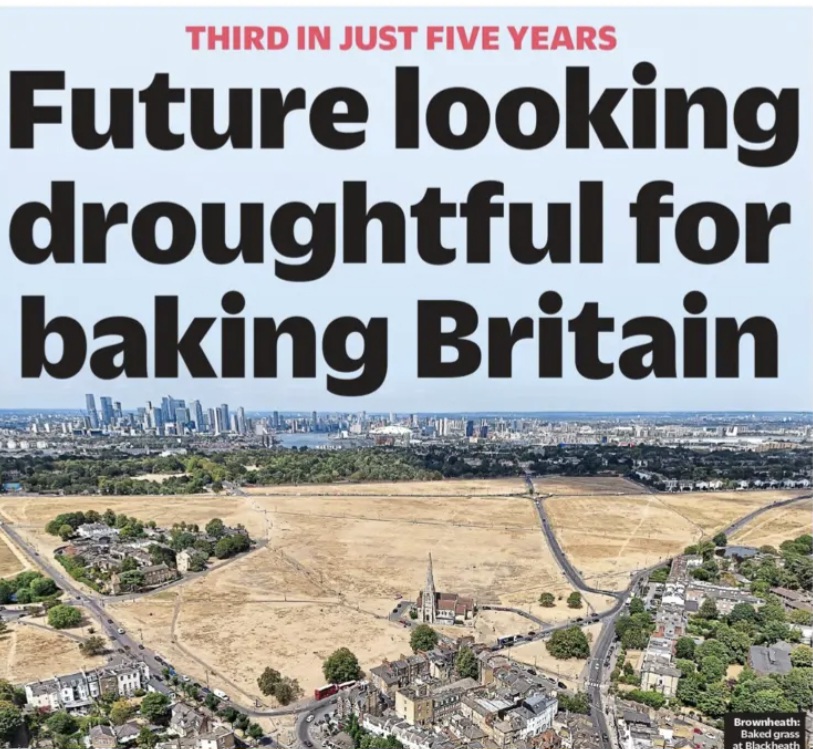
Yet, here we are, exposed to the effects of climate change now – not decades into the future – and still political representatives of capitalism, and their kept press, are trying to shuffle the issue to one side. You can see the difference between the more serious newspapers of capitalism and the gutter press by the contrast found between the Financial Times and the Sun. Whereas the FT mentioned climate change in 64% of its articles that dealt with the weather, for The Sun it was only 6%.
Scientific evidence of global warming is there to see
For anyone who takes the time to look at the scientific evidence of climate change, it is all there to see: average temperatures, average sea temperatures, the melting of Greenland ice, the absence of Arctic ice, and so on, and so on. So much warming is now ‘baked into’ the future development of the global climate that even if coal, oil and gas use was all stopped tomorrow, global warming would still be rushing towards us, and in the eyes of most climate scientists, at a faster pace than originally expected. What we have seen so far this year, scientists are warning is before the full effects of the cyclic el Niňo effect globally.
The threat in coming centuries is so severe that it poses questions even about the very existence of human civilisation. But short term – in the lives of most of the present population of the planet – there will be potentially devastating effects. It will impact on living standards in a concrete manner, in taxation to pay for infrastructure damage and mitigation of effects, and in higher insurance premiums, for example.
Socialists have to support the move of governments across the world towards ‘zero carbon’, towards investment in renewables and a moratorium on all new oil, coal and gas field developments. This ‘Labour’ government, far away from traditional labour movement values on so many issues (the Gaza genocide, privatisations, growing disparities in wealth, income and taxation, etc) has at least paid lip some service to the idea of zero carbon.
That is something we should support wholeheartedly. If Andy Burnham wanted to cement the new uptick in public support, he should put more emphasis than ever on government investment in renewables. We should not, however, be in the business of destroying jobs without alternatives available, and a Labour government cannot treat oil and gas workers in the same way that Margaret Thatcher treated coal-miners and mining communities.
The trade union movement has rightly argued that climate change investment should involve a “just transition” – and that has to mean the provision of new investment, new jobs and the retraining and redeployment of fossil fuel workers workers into new industries, without loss of pay and livelihood before existing jobs are phased out. The nuclear power industry has no connection with climate change, but it is one with equally intractable problems for future generations, and one whose workers need to be treated the same way.
There needs to be a national plan for investment, training and redeployment into renewables like solar, wind, tidal and geothermal energy where it is viable.
There is a ‘Climate Change Committee’ buried somewhere deep within the upper echelons of the Civil Service, although one could be forgiven for not realising it even existed. In the foreword to its latest (May) report, it noted, “The public is concerned that we are unprepared [for climate change]…What governments have been doing on adaptation clearly isn’t working. It is time for change.” Change, indeed. But the only meaningful change is a change in the economic system, from one based on greed and profit, to one based on need.
If Andy Burnham wants to spend more on “defence”, he needs to put money where there is a real threat, not an imaginary one. How much better would his legacy be, if, instead of throwing money at the manufacturers of tanks, aircraft and submarines, he invested in the future of young people.
The argument needs to be made on an international level, but let us start at least with the British economy. The industrial, scientific and technological resources of the country – still the sixth richest on the planet – need to be taken out of the hands of those who only live for their own personal, short-term enrichment. Publicly-owned, democratically managed and scientifically planned, the economy could effectively mitigate the longer-term effects of climate change. There is no other way of dealing with the issue and that, moreover, would be a legacy for which it would be worth fighting.
[Feature picture is a graphic from Wikimedia Commons, here]