By Joe Langabeer
On August 26, a vast section of a Himalayan glacier collapsed and crashed into Nepal’s Langtang National Park. At first, the event was so catastrophic that it was mistakenly reported as an earthquake. The US Geological Survey later confirmed that a tremor had been triggered by the force of the falling rock and ice, measuring 5.2 on the Richter scale, comparable to some of the most destructive quakes in recent memory.
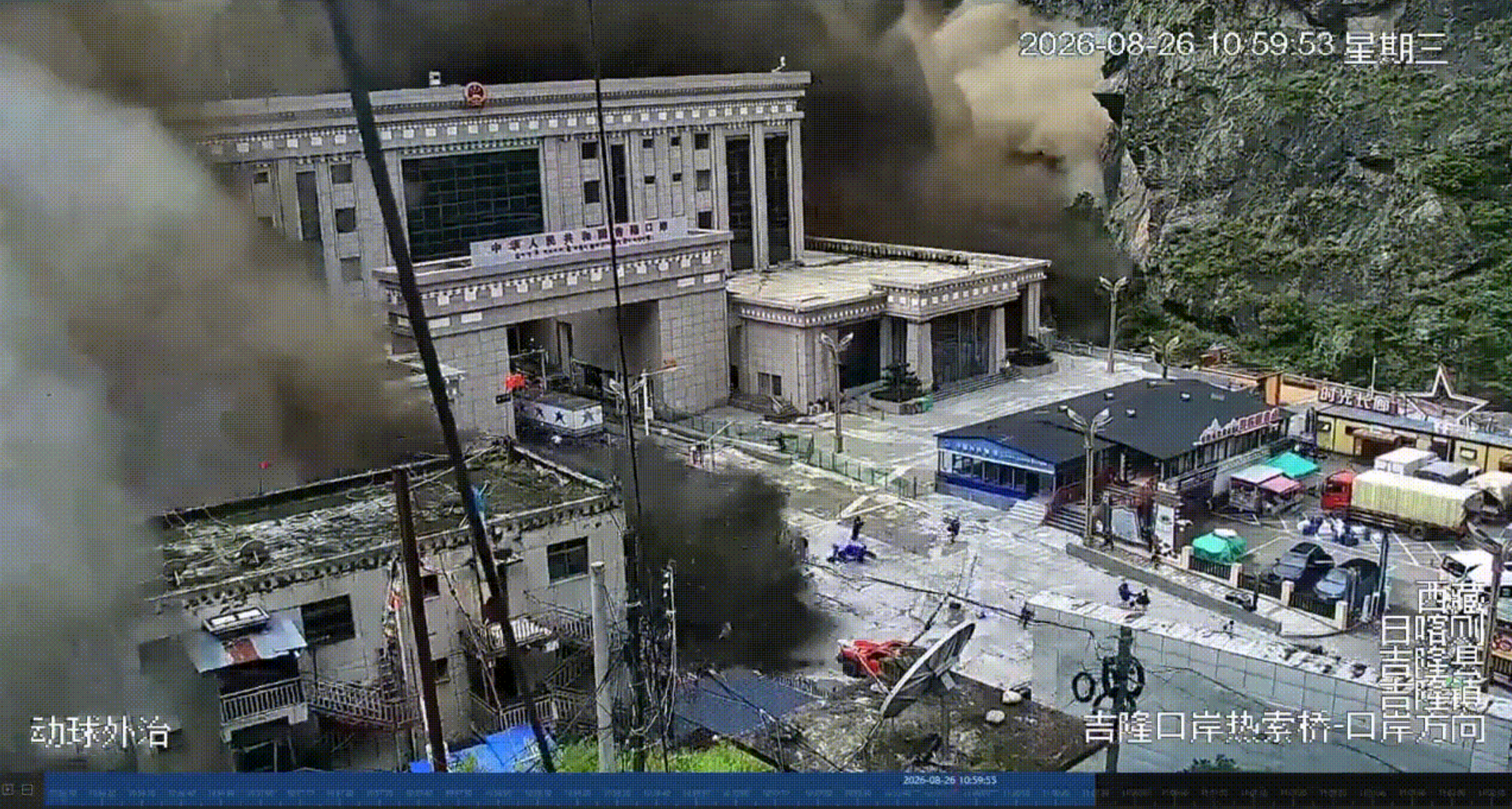
The collapse unleashed a surge of water, rock, and ice that tore through mountain valleys and into river systems, generating flash floods that devastated towns across northern Nepal. Many of these communities are well‑known pilgrimage and tourist destinations, now left unrecognisable.
Images and videos broadcast by outlets such as the BBC and The Guardian looked less like real life and more like scenes from the wave of disaster films released in the early 2000s. Movies like The Day After Tomorrow warned that human‑driven climate change could trigger catastrophic upheaval, warnings that continue to bleed into our present reality.
Current estimates suggest the floods have killed at least 1,200 people across Nepal and Tibet, but over 5,000 remain missing, with families still searching through the ruins of homes and buildings. Even for those who survived, everything – possessions, workplaces, entire communities – have been obliterated.
Sumnima Udas, a member of Nepal’s Parliament, wrote in Time magazine that this disaster is a direct consequence of climate change, and that without urgent action, Nepal’s fate will become a global one. Her warning is stark, and it is accurate. Yet it is poorer countries like Nepal, those least responsible for pumping greenhouse gases into the atmosphere, that will bear the heaviest burden of the climate crisis.
Warning signs
However, whilst there might be some faux shock and pity for the people of Nepal from Western leaders, the climate catastrophe we witnessed in Nepal has been a long time coming. In a 2020 report from Germanwatch, an organisation that researches climate change and its effects on society, Nepal was ranked as the 9th most affected country by climate catastrophes. Death tolls, GDP losses, and a high number of events make it a highly affected area for climate change impacts.
Another report from 2018 by the Nepalese Ministry of Forests and Environment found that more than 80% of property loss was due to disasters from man-made climate hazards. Floods and landslides were particular causes of the property loss, and those same floods have taken the lives of more than 300 people annually.
Climate change in Nepal has been studied since 2000, with Western Nepal particularly affected by worsening winter drought conditions starting that year, culminating in severe droughts later on. Droughts have been a significant problem for Nepal, as 33% of its GDP heavily depends on the country’s water sources, according to research published in the Journal of Climate in 2013 by the American Meteorological Society.
What is worse is that the warning signs about retreating glaciers, the cause of the recent disaster in Nepal, were noted over two decades ago. A 2001 report by climate researchers in Nepal found that these glaciers had been retreating, which would not only cause fresh water shortages—a problem since the glaciers are a renewable source for drinking water and energy—but also flash floods or catastrophic events downstream along rivers.
The report also argued that these glaciers are being eroded due to climate change, which is now the definitive cause of the recent flash floods in Nepal. While the Nepalese government has attempted to address some climate change issues, most efforts have focused on the agricultural sector, prioritising an economy that benefits the government rather than the people, who ultimately sustain their economy.
A country of poverty
Of course, the climate crisis is compounded by the fact that Nepal is a poor country, with over 25% of its citizens living below the poverty line, as reported by the World Bank Group in 2023. Many of these problems of poverty are interwoven with the climate crisis, and events like these will make it much worse.
For instance, much of the poorest areas in Nepal are in remote mountain communities, where children have to walk several hours a day to get to school, many of which are under‑funded, as reported by the United Nations Children’s Fund. These walks are often on narrow, hazardous roads where, if there is heavy rain or storms — or worse, where roads are obliterated under landslides of mud and rock — many of these children will either be killed or protect themselves by dropping out of school and working for their families.
As mentioned earlier, Nepal also has a continued problem with droughts, which means that farms struggle to grow crops and produce the food needed to make a living. There have been long‑term plans to mitigate the droughts by the Nepalese government.
However, much of this relies on improving water‑control systems from places like glaciers, which are eroding and causing damaging events such as the flash floods seen in Nepal. It seems like former and current Nepalese governments are content with ripping a plaster off one creaking roof, only to stick it onto another one whilst the first bursts open.
In response to Nepal’s continuing poverty, much of it caused by climate change, the IMF boldly stated no answers to the climate crisis and instead insisted that Nepal should focus on “job‑creation” under the guise of fiscal stability. That is not a solution to this crisis. The task should be how to prevent climate disasters such as the one we have just witnessed in Nepal, whilst developing green industries that will mitigate the climate impact.
The IMF obviously do not want to suggest those measures, because they are the mouthpiece of the capitalist class, who would rather ignore the climate crisis and instead profit from it. In a socialist society, under a publicly owned democratic economy which favours people over profit, we would be able to shift our industries quickly into green industries.
We would be able to build necessary measures, such as dams and water‑flow systems, to stop events like flooding destroying our lives. But we can only do that if it’s in the hands of the people affected by it, and not the billionaires who are happy to see these types of catastrophes, as long as it doesn’t affect their profits.
Climate unrest
It should be noted that Nepal has had its own political turmoils prior to this climate disaster, where young people rose up against their leaders after the son of a provincial minister flaunted his wealth on social media. As a result of this, the then‑prime minister KP Sharma Oli resigned. Since then, Balendra Shah, the world’s youngest state leader, was elected into office due to his rise to prominence for being heavily involved in the protests.
Unfortunately, much of his policies are a sticking plaster over the economic woes of Nepal. At worst, he has some fairly reactionary views, such as forcibly moving squatter settlements and banning political activities and organisations from both public and private sectors of work. In his eyes, he sees this as stamping down on corruption, but it also seems like he is repeating the actions of the leaders he once helped to depose.
When it comes to the floods, he has been fairly silent, only addressing it on his own social media channels. He does not engage with the established media in Nepal, arguing that they are untrustworthy. Like governments prior to Shah, he initially declined support from China and India, but later in the week after the floods accepted it, in a bid to get much-needed aid to those people who have lost their livelihoods.
What he does next will be telling, in whether he is truly a “man of the people” as he claims. So far, the Nepalese people have supported him, but that can change when it appears that there is little difference in their lives. If he is unable to truly fix the climate crisis currently afflicting Nepal – and it is a crisis he never seemed to mention a lot since taking office – then support for him will drain away.
The problems that Nepal faces are problems for us all, and the effects of climate change are bearing down on us. After the heatwaves that engulfed Europe over the summer, we are expecting this year’s El Niño effect in the Pacific Ocean to be a significant event that will bring heavy rainfall and flash floods, possibly lasting until next February.
As the secretary-general of the World Meteorological Organisation, Celeste Saulo, stated recently, “We are already seeing disruption and devastation from droughts and floods, and we expect these impacts to increase as El Niño intensifies.”
Much of the right‑wing press are still in climate change denial, with outlets such as GB News hysterically suggesting that climate change predictions are all conspiracy theories. But they do this because, in cases like Nepal, it is only the poor who are affected. For us, the struggle against climate change – or to mitigate the worst effects of climate change – is a class struggle. Only a socialist economy, in the hands of its workers, can fully reverse the impending catastrophes we face.
[Feature picture shows footage from a security camera capturing the moment when the flash flood hit a factory and surrounding buildings. It can be found on Wikimedia Commons, here]