By Greg Oxley
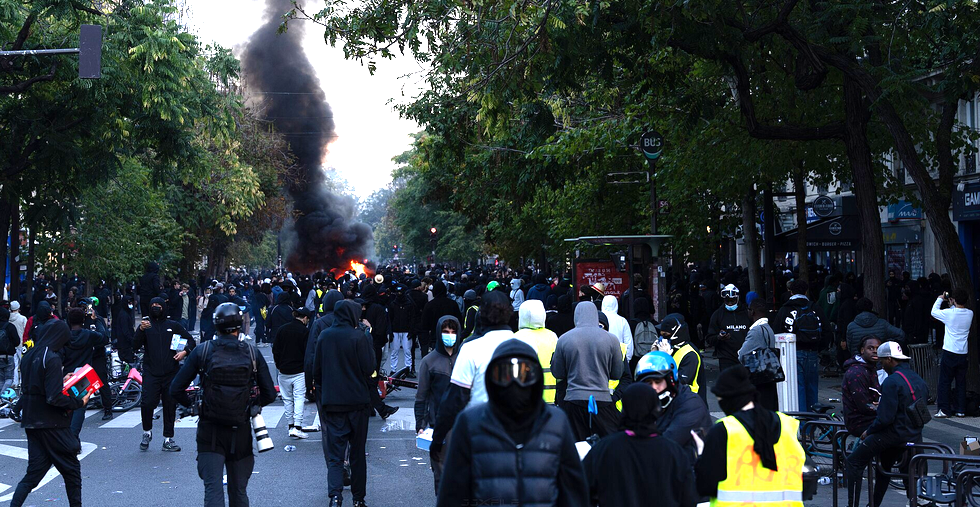
This weekend just gone saw some of the biggest demonstrations in France for many years, primarily of high school students and staff, but often supported by trade union members. Nearly a million took part in demonstrations in cities and towns the length of France.
The violence, not least on the part of the French police, and by provocateurs, has created a political crisis for the government. Here, Greg Oxley, writing before the weekend’s events, describes the grim economic background to the current unrest.
……………………………………………………………………………………………..
The demonstrations by high school students and trade unions since the beginning of the school year have put hundreds of thousands of people on the streets to denounce the drastic budget cuts planned by the government. Teachers, health workers, civil servants, firefighters, fishermen, high school and university students can no longer tolerate Macron’s austerity policy, and their disastrous consequences.
The social malaise runs deep. Education, health and all public services are sorely lacking in resources. High school students have highlighted the dilapidated state of school buildings and the numbers of unfilled teaching positions. Since his arrival at the Élysée in 2017, Macron has cut more than 10,000 teaching jobs. The start of the 2026 school year was marked by the axing of 1,891 statutory teacher’s jobs and more than 4,000 teaching positions in total, according to the SNUIPP teacher’s union census.
Rather than responding to the legitimate demands of the high school students, Macron chose to inflict brutal police repression on them. Several young people have been mutilated. Since September 18. The report of the Ministry of Justice shows that more than 8,000 people have been taken into custody, 86% of whom are minors. On the October 1 alone, there were 1,949 arrests – an historical record. The 8,000 arrests are twice as many as in the first month of the Yellow Vest movement in 2018!
These events are taking place in the context of growing social tensions. Low wages and inflation are constantly wearing down living standards. Handouts to the rich and big business have plunged the country deeply into debt, and the financial markets and the government want to make young people, workers, pensioners and the unemployed pay the consequences. Clearly, we are living under a system that only exists to increase the wealth and power of a capitalist minority.
Unemployment is on the rise again and now affects 2.6 million people, or 8.1% of the working population. 15 to 24-year-olds are particularly exposed, with an unemployment rate of 19.8% in 2025 and 21.5% in 2026, which is more than double the national average. For a long time, employers have favoured longer working hours and temporary work over proper contractual jobs. However, today, even temporary employment is declining. It has fallen by 6% in over the last year, which portends a further deterioration of the labour market in 2027 and beyond.
Under the sway of the capitalists, the economy is stagnating and falling apart, while stock market profits are reaching record levels. According to the World Bank, GDP growth slowed from 1.4% in 2023, and then to 1.2% in 2024 and 0.8% in 2025. It is expected to be below 0.9% in 2026. At the same time, business bankruptcies have risen sharply, reaching around 60,000 per year, compared to 35,000 during the Covid crisis.
Accelerated industrial decline
Information technology, and particularly AI, is attracting massive investment, but traditional industry is being abandoned. Michelin is throwing 1,254 employees out of work in Cholet (Maine-et-Loire) and Vannes (Morbihan). ArcelorMittal is cutting more than 600 jobs in the North (Dunkirk, Florange, Basse-Indre, Mardyck, Mouzon, Desvres and Montataire). Vencorex, the world’s second-largest manufacturer of industrial hardeners, was sold off and then effectively destroyed, leading, as is often the case with the closure of major industrial sites, to further job losses at the suppliers and customers of the companies concerned.
In almost all sectors of the economy, hundreds of companies have been liquidated, leading to massive job losses. In July and August 2026 alone, a long list of closures and restructuring operations made the headlines.
Among the companies threatened with closure or that have already disappeared are OPmobility (automotive equipment), Verallia (bottles), Heidelberg Materials (cement), Refresco (juice), Schneider Electric (energy and automation), Cofigeo (agri-food), Legrand (electrical equipment), CellforCure (biomedicines), Aqua-Valley (water), Lippi (gates and fences), Greenwood Atlantic (sawmills), Emerson-Aventics (pneumatic systems), Limatech (aeronautical batteries), Fibre Excellence (paper pulp), Reden (solar panels), Darquer (lace), Daregal (aromatic herbs), Safran Electronics & Defence (electronics)…
The deindustrialisation of France is gathering speed. The dramatic social consequences of the closures for the communities that depend on them do not matter to the capitalists. For them, only profit counts.
Public debt and financial speculation
This industrial crisis is combined with a crisis in public finances. France’s government debt has now reached a critical threshold. According to Emmanuel Moulin, governor of the Bank of France, the reaction of the financial markets to the size of the debt is “serious and worrying”. He warns that, whatever the outcome of the elections in 2027, the incoming government will have to impose a sharp reduction in the public deficit and deal with very high interest rates. The French debt now stands at €3,500bn, or nearly 120% of GDP, well above the eurozone average.
Financial speculation has been operating not only against the financial position of the French state, but also, by extension, against the European currency, whose international exchange value depends in part on France’s financial health. The euro has fallen to its lowest level in 17 months against the dollar, while the yield on French ten-year bonds is at 5%. This means that the government must now borrow at this rate to meet its needs and devote more than €90bn to interest payments alone in 2027. By way of comparison, the national education budget for 2026 is around €64.5bn!

The payment of interest on the public debt is now the second-largest item of expenditure in the State budget. The largest item, which costs more than €200bn, is that of public aid, free of charge and with no conditions attached, to large private companies. This sum represents 30% of the total state budget, and nearly three times the education budget. This €200bn, paid in various forms (direct state subsidies, deliberate tax loopholes, reduced taxes, exemption from social security contributions) would be better spent on public services, rather than inflating the profit margins of large companies and boosting stock market dividends.
President Macron and his Prime Minister, Lecornu, hammer home the need to reduce deficits to justify austerity measures, but seem to forget that the state needs money when it comes to making their capitalist friends pay. Thus, as Le Canard Enchaïné pointed out, when Vivendi (controlled by the Bolloré group) was found to have underpaid taxes to the tune of €2.4bn, the Ministry of Finance simply crossed out the penalty fine of €320mn!
To calm speculation on the bond market and against the European currency, Macron has insisted that Lecornu must carry out major cuts in social expenditure. He wants to reduce the public deficit by attacking national education, public services, pensions, social benefits, health and social security. If resistance in the streets and the weakness of his position in the National Assembly prevent Lecornu from achieving this, it is almost certain that the financial markets will unleash a further offensive to raise the yield on bonds beyond 5%. Financial speculation is worsening the public debt and then the speculators themselves demand even harsher budget cuts to repay it.
The way Macron and his ministers present the issue of public debt is completely twisted. They want to manipulate public opinion to justify the dismantling of what is left of public services and social protection, while preserving the massive transfers of public money to big business. The economy is stagnating and public money is pouring into the coffers of capitalists to increase their profits despite this stagnation.
Authoritarianism and racism to impose austerity
The financial markets and big capitalist corporations have so much power that they can shape the policy of governments in all fields, including public finances. The capitalist class is pushing for public “aid” and significant tax concessions, while insisting on a more aggressive austerity policy against public services, education, health care, pensions, social security and social benefits.
The brutality of this policy is likely to provoke massive popular resistance, especially in a context of inflation and mass unemployment. It is to overcome this resistance that a growing fraction of the ruling class is actively supporting the Rassemblement National (RN) and Le Pen’s presidential campaign, to install an authoritarian and repressive regime.
Authoritarianism and strategies of division have always gone hand in hand. Scapegoats must be designated, hatreds must be stoked up and minorities must be persecuted. Marine Le Pen’s economic and social policy will lead to a marked deterioration in the living conditions of most of the population, accompanied by persecution of people of Muslim culture and “migrants”. The net result of this policy will be to further increase the wealth and power of those who already have too much, to the detriment of the rest of society.
To curry favour with the financial markets and the big capitalist groups, Marine Le Pen has promised €125bn in budget cuts over five years and a reduction of the public debt to 60% of GDP, which is half of its current level. This objective is incompatible with her promise to sharply reduce VAT on energy and food. Such “populist” measures, therefore, will be abandoned, to the dismay of those who are gullible enough to believe in them. While the populist demagogy of Le Pen and her deputy, Bardella, castigates “the elites” and flatters “the people”, the RN is in fact a party of big capital par excellence.
The left parties fail to present a clear alternative
It must be recognised that one of the greatest assets of the Rassemblement National has been the inability of the left-wing parties to present a clear alternative to capitalism and its disastrous social consequences. For decades, the Socialist Party (PS) has reconciled itself with the capitalist system, to the point that its policies are hardly distinguishable from those of the right, as evidenced, for example, by the presidency of François Hollande from 2012 to 2017, of which “Macronism” was only an extension. The PS is a “reformist” party without reforms, or more precisely, a party of counter-reform in the interests of the capitalists.
As for the party of Jean-Luc Mélenchon, La France Insoumise (LFI) and the Communist Party (PCF), despite differences that exist on certain issues, they both defend similar programs of social and political reform but have difficulty in convincing most workers that they would really be able to improve living conditions. The workers’ scepticism is not only due to the memory of previous left-wing governments, but it also stems from their sense of reality, from their experience of capitalism.
This is because all workers understand all too well who has the power in France, whether in the workplace or in society in general. They know that a policy that attacks the profits of the bosses, of the capitalists, is a very risky policy. It is the bosses who largely decide their fate as workers. Workers are constantly reminded that if the ‘profitability’ of the company is ever compromised, the company itself will cease to exist. This is the ABC of how capitalism works, where the justification for all economic activity is profit and profit alone.
Workers fear economic dislocation
Therefore, for many workers, when they hear that LFI or the PCF want to increase taxes on profits, increase wages and take a series of other measures, that will necessarily lead to a drop in profitability, they think that this is likely to lead to job cuts or even the closure of their company. If the worker is at the mercy of the bosses, what is the point of beating them up? This reasoning, that of fear of those who have power, is quite “logical” in the mind of a worker, especially if the left does not open up any perspective to put an end to the power of the bosses.
In the PCF’s program, as in that of LFI, there is nothing that would prevent the bosses from reacting in this way. Hence the idea, widespread among working people, that the demands of the left and the trade unions are good in themselves, but not realistic and potentially dangerous.
At the level of national politics, the programme of the left suffers from the same deficiency. Certainly, it stands for an “anti-capitalist” policy in the sense that its program runs counter to capitalist interests, but it leaves intact the capitalists’ power to strike back. Where does this power come from? From the capitalist ownership of companies, of the “means of production”.
It is impossible, in our time, to implement a consistent and lasting policy of social reform if it is not linked to the economic disarmament of the capitalist class. If the Left’s program does not indicate how to carry out this disarmament, it is necessarily incomplete and fundamentally flawed.
Concretely, how is it possible to put an end to the pressures of the financial markets without freeing the economy and public finances from their grip? Any attempt to implement a policy of radical social reform, such as that proposed by LFI and the PCF, would be met with opposition and a strategy of relentless sabotage on the part of the ruling class.
The last time a left-wing government tried to implement a substantial policy of social reform was in 1981 with the Socialist-Communist government of the time, under the presidency of François Mitterrand. The reaction of big business and the financial markets was extremely ferocious. They did everything they could to scuttle the reforms: there was a massive flight of capital, an investment strike, company closures and relocations, rising unemployment, speculation against the French franc. It took only 12 months to force the PS-PCF government to abandon its reform plans and adopt austerity policies.
A left wing government would have no room to manoeuvre
Almost half a century later, capitalism is much more powerful than it was then, so that a left-wing government acting against the interests of the capitalists would have even less room for manoeuvre. This does not mean that a policy of social reform is impossible. It only means that it is imperative to link this policy to a strategy of expropriation of the capitalists, by means of the nationalisation of all the major capitalist groups, to place the productive, distributive and financial resources of the country under public and democratic control.
It is only through public ownership of the major levers of the national economy that it will be possible to guarantee employment and incomes to the working people, prevent job losses, finance services that meet real social needs, build homes, abolish poverty, reduce inequality, eliminate discrimination, and protect the environment. We must free the economy from the law of profit and thus lay the foundations for a new era of social progress.
Huge struggles lie ahead, both for the final months of Macron’s presidency and after the elections of 2027. But no matter how many strikes are waged, however many demonstrations are held, we will not be able to defeat the system until we can mobilise the mass of the population around a programme that is capable of putting an end to it. That is our most important political and strategic task in the years that lie ahead.
Greg Oxley is the editor of the French Marxist website, La Riposte, which can be found here
[All pictures from October 17 in France, from Wikimedia Commons here]