By Paul Atkin
Paul Atkin made an excellent guest presentation at a recent Left Horizons Zoom discussion on climate change. He graciously agreed to turn his presentation into a guest article, which we are publishing in two parts, the first of which is here…
…………………………………………………………………………………………………………
I am involved in the NEU Climate Change Network, which is a semi official union NGO set up in 2014 when a group of us at NUT conference thought that it was ridiculous that the union didn’t have a climate policy or regular debates on it. So we set up an email network among a small group of delegates. This has grown to a mailing list of about 400 colleagues across England and Wales.
We have managed to get motions to and through union conferences every year since – so that’s before and since the merger with the ATL to become the NEU, so we have pretty good up to date policy to pressure the government. Our aims are:
* To properly review the curriculum to prepare our students – and colleagues – for the world we’re going into, properly implementing Article 12 of the Paris Agreement, which calls for wholesale education across society, so people understand climate change and are mobilised to deal with it – which all signatories are committed to but no one fully implements – which at the least requires a more thorough review of the schools curriculum so climate change is front and centre
* To campaign for the school estate to be future-proofed by 2030, so buildings are retro-fitted to a zero carbon standard, are properly insulated and cooled naturally as far as possible, with as many solar panels on as many roofs as possible and for grounds to be greened with more trees, planters etc.
Union ‘green’ reps
We work very closely with the Union’s Health, Safety and Environment team at Hamilton House. There is now union green reps training, which also feeds into increased climate-related training for Health Safety and Environment Reps. We have stimulated a common front of education unions into the DFE NZ strategy and will be doing so again as it is reviewed.
For the last four years, the NEU has provided one of the two UK based ITUC delegates at the COP conferences and has funded a teacher trade unionist from the Global South (Zimbabwe). The other delegate has come from UNISON, another union that takes a lead on this issue.
We meet once or twice a term, to further develop policy and organise to implement it. Another commitment we have got through is for the union to de-carbonise its own operations by 2030 as much as possible by e.g. Regional Officers being supplied with EVs and not diesel vehicles, having mostly plant-based food at conferences, etc.
This is still very much a work in progress. If any readers are in the NEU and would like to know more or get involved please email us atneuclimatechangenetwork@gmail.com
The Greener Jobs Alliance (GJA) was set up in 2008, initially by people with an environment/climate brief, working for trade unions and the TUC, to campaign particularly for the trade unions to develop the capacity to fight for the just component of ‘just transition’ and for the transition itself.
There is no separate ‘green economy’
This comes with a view that there is not a “green economy” that sits as a sub-set of a broader economy that remains unchanged, but that the whole economy, and therefore society, and therefore politics, has to be green too.
So “green jobs” are not simply jobs building windfarms or retrofitting or constructing homes to zero carbon standard. Education jobs become green jobs in so far as we are educating the population for the society we need, not reproducing the unsustainable society we have. Transport jobs become green as, for example, the rail network gets all electric, diesel buses are replaced by electric buses.
Car workers green as they make EVs not internal combustion engines vehicles. Not just cars either: in the global south especially, electric Tuk-Tuks and mopeds are far more significant. Town planners become green in so far as they plan for cities with integrated green spaces, all essential amenities to be within walking distance and public transport links organised so as to minimise car dependence to get farther afield. Farmers become green in so far as they use sustainable farming practices. And so on.
A large part of this is based on the recognition that the transition is not simply a technical matter that is done to people, but a bottom line is that it has to be done with them to make it work. I’d also argue, as an extension of that, that, since the ruling class is failing the test, its up to the working class to lead on this; and that includes the countries that might see themselves as being in the process of constructing a socialist society.
A lot of the work of the Greener Jobs Alliance work has been educational, with online courses on climate change just transition and clean air on our website, and a lot of input into TU educational courses. But also we are campaigning, like being active participants in the model motion that we got through several unions and the TUC last year, affirming that climate change is a working class issue. While we got this through, this is still a contested area in the unions, of which more later.
We produce a monthly Newsletter with a lot of information that campaigners will find useful, an annual TUC supplement looking at motions sent to Congress that have a climate dimensions (and some that don’t but could and therefore should) and a couple of blogs every month to try to take up debates.
I edit the Newsletter and act as the NEU liaison on the steering group, which also has regular attenders from PCS, TSSA, UCU and UNITE Community – though Unite proper dropped us like a hot brick once Sharon Graham was elected – as well as Friends of the Earth and the Green Party TU group. We also have good relations with SOSUK, Unison, Greenpeace, the Scottish Just Transition Partnership, Possible, Platform and others.
Wider support across the unions
The GJA has also been instrumental in setting up the Trade Union Clean Air Network, which has much wider support across the unions than GJA itself and, in the same mould, is currently promoting work on trade union adaptation responses to immediate climate impacts, like overheated workplaces which, in the case of bus workers in North London and Essex this Summer, has led to the first successful climate driven strike action to get AC in cabs.
If any readers are interested, please sign up for the Newsletters – they are free online here.
As both these organisations are quite broad, what I’m writing here is in my personal capacity, because discussions are more interesting that way. One of the things we’ve been trying to do with the GJA blog is to get debates in the movement, on contentious issues, that get beyond the traditional reflex to shut down real contradictions in the interests of unity and, if you can’t keep a lid on them, split instead. Usually with much vituperation.
People who disagree on particulars, even important ones, can also work together if the overarching issue is important enough, and on whatever particulars they agree on.
Other issues that need to be dealt with are:
1. A debate on the science; where we are likely to be heading, based on UN and other climate projections
2. To go beyond the technical shifts to social and political shifts, including the geopolitics that will determine whether we get through or fry, and to look at some of the divisions in the movement in that context.
What the science and data tells us about climate change
The new modeling now being used by the UN Panel on Climate Change to map possible futures has shifted its methods.
The key differences are that the old “no action” baseline projection of what would happen if nothing was done about climate breakdown at all has been dropped, on the grounds that some action is being taken and will continue to be. That means that the points of comparison now are between the consequences of sticking with the current level of action, and advancing (ie improving) or retreating from it.
The overall effect is to remove the highest, most damaging scenarios, as fossil fuel use is peaking – despite Trump – and these sources can no longer be considered the most dominant future energy source. This reflects the partial success of actions to date.
There have been the inevitable claims by Trump and his acolytes that the removal of these projections is based on what would happen if the “drill baby drill” polices they advocate were universally applied, and that this ‘proves’ that climate change is “a hoax”. But this argument isbeyond surreal.
To spell this out: if the world were to act with blithe unconcern and just double down on fossil fuels in the way that Trump wants to do to secure “US Global Energy Dominance”, the worst case scenario would be back with a vengeance. In fact, if “every last drop” of fossil fuels on the planet were to be burnt, as they advocate, that would drive a rise in temperature of 16C.
On the contrary, this removal of the worst case scenario from predictions is a sign that the world is not being completely bullied into its own self destruction. As there is now $2 trillion a year invested in renewable energy (double the current level of investment in fossil fuels) even in the US, and even in Texas, most energy is now being provided by renewables. They are now too cheap to be replaced by coal.
But, still, $1trillion is being invested in fossil fuels annually, because the rate of profit on the investment is four to five times greater than for investment in renewables. So once again, the search for profitable returns is risking all our futures.
‘best case scenarios’ revised upwards
Dropping the worst case scenario has come in for criticism, because it replicates at international level what the Trump administration is trying to do to the still legally mandated US National Climate Assessment. In so doing, it implies that the worst outcomes are not possible – which it would be rash to assume – and that therefore taking action has less urgency – which is dead wrong.
This is particularly true as the ‘best case’ scenarios have been revised upwards, reflecting the rapidity with which the average global temperature is going up – implicitly highlighting the inadequacy of the measures taken so far to stop it.
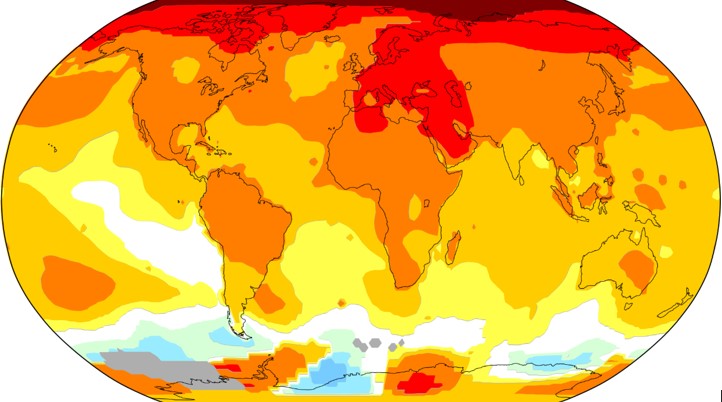
The headline from all of this is that the 1.5C target rise will be overshot. Although the IPCC only counts a threshold being passed after a ten-years average, we are evidently already there, or thereabouts with 1.4C this year and possibly 1.7C next. Again, this has been seized upon by climate deniers to argue that “the battle” that they didn’t want us to engage in in the first place “has been lost”; so we’ might as well just give up and adapt to the ‘new normal’.
The problem is that a new normal of unchecked climate breakdown is not a slightly balmier set of stable conditions, in which Yorkshire becomes like Tuscany, but it means a state of spiralling crisis, weather whiplash between extreme droughts and torrential rain, failed harvests and hunger. And the more we put off action the worst it will get.
The UN has noted that even a temporary overshoot will do “irreparable damage”. Battles are only lost if we give up, and every tenth of a degree is a front line. The deeper point about “overshoot” is that we’ve been overshooting since we passed 350 parts per million (ppm) of CO2 in 1986, so everything we are now doing is about damage limitation. We are now at 430ppm, and rising.
The possible futures the UN scientists spell out are clear and make it clear that what happens next depends on what we do, and don’t do, now.
The possible futures mapped out
The new assessment puts forward by the UN are a range of seven scenarios from high to low emissions trajectories. In these scenarios the range of possible heating lies between 1.6C and 3.3C by the end of the century.
* The highest scenario envisages emissions of greenhouse gases of 55bn tonnes a year, significantly up from the 38bn tonnes now. This gets us to 3.3C by 2100.
* The medium scenario, based on existing polices, projects 34bn tonnes a year, a minimal reduction. This gets to 2C by 2050, 2.9C by 2100 and 3C by 2150.
* The low scenario based on accelerated action cuts emissions to 9bn tonnes, but temperatures still rise to 1.8C by 2050 and fall back to 1.5C by 2100.
* The old baseline warning of the likely consequences of no action – the policy favoured by Trump, Reform UK, and now the Conservative Party (which has banned anyone who takes climate change seriously as a possible Parliamentary candidate) – was a possible rise of 4.6C to 4.9C by century’s end, and more beyond. Meltdown, basically. If these kind of people win in enough places, that is temperature rise is back on the table.
As “there are no good outcomes above 1.5C” we are in for a lot of trouble, at least for the rest of this century. This is why it is so mind-bogglingly idiotic for the BBC to post a story entitled “what will you tell your grandchildren about the summer of 2026?”, as if what we have just experienced is a one off, a weird anomaly after which we get back to normal, when in reality it was a warning of summers to come, during which we may well reminisce fondly about how relatively ‘cool’ it was just to have 35C heatwaves.
The second part of Paul’s article will be published tomorrow.
PAUL ATKIN is a retired teacher and convenor of the NEU climate change network, and he also edits the Greener Jobs Alliance Newsletter.