By Ray Goodspeed.
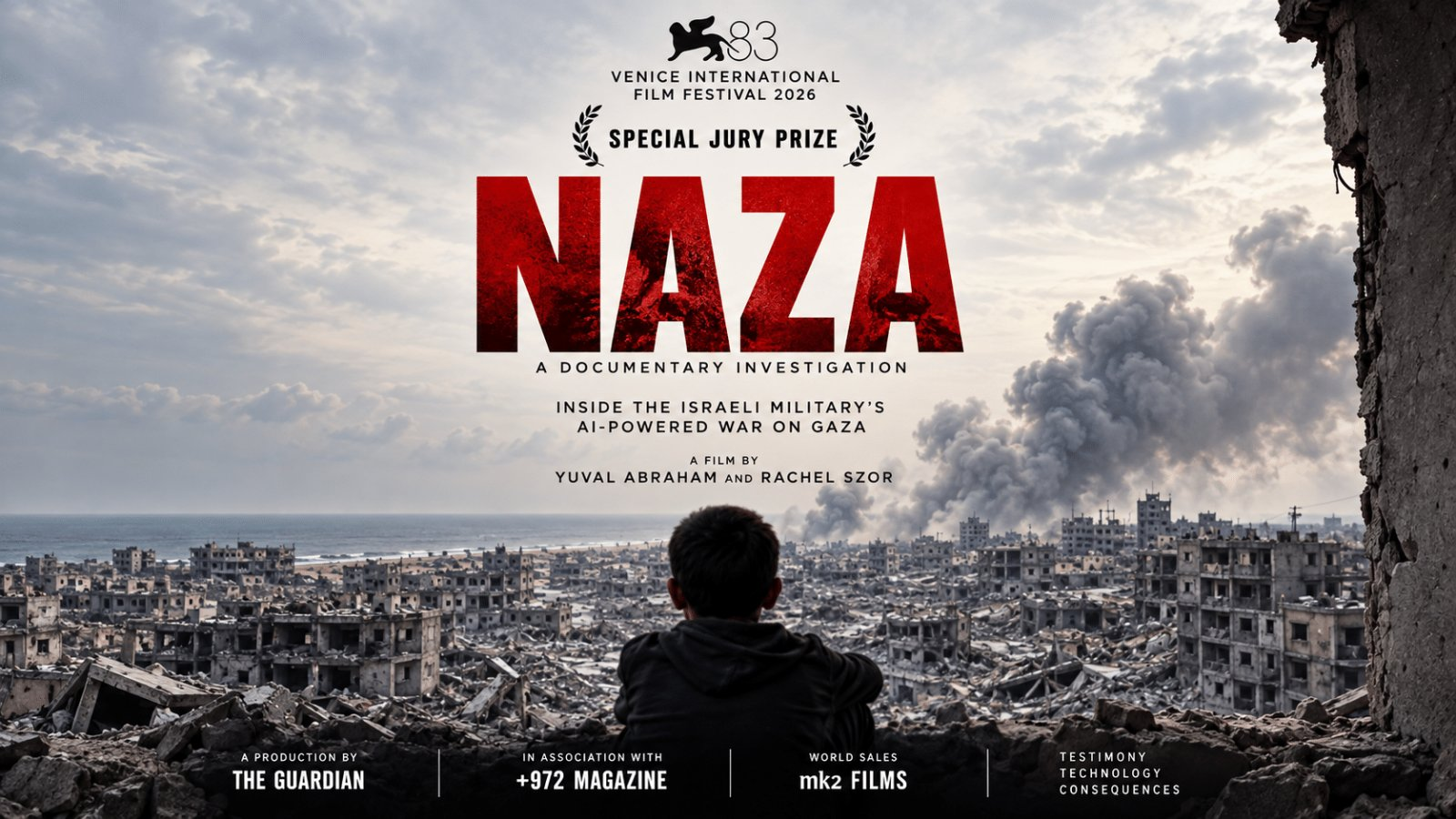
Last Friday, I went to see the documentary film “NAZA” in a small cinema in Hackney, East London. It was an unforgettable, emotionally devastating and utterly enraging experience. Many people were in tears, and a few were audibly sobbing. As we all, in our distress and fury, emerged from the very small screen room in which it was shown and were pushing past those trying to enter a bigger auditorium to watch some other, more mainstream movie, I felt like I wanted to stand on a table and scream at them to watch NAZA instead.
I know it is often said in reviews, but everyone should watch this film. Many should be forced to. It is currently being shown in cinemas, but from late November, it will also be available to watch for free on the Guardian’s website. It is a British documentary film written and directed by Yuval Abraham and Rachel Szor, which consists of a series of interviews with members of the Israeli military – the so-called Israeli Defence Force (IDF) – in which they set out, in response to calm, neutral questioning, exactly how the people of Gaza were systematically and deliberately murdered, using various forms of advanced technology as well as more traditional weaponry.
I don’t want to set out all these methods in detail; I could not do the subject justice – that is why everybody should see the film for themselves. But I will make some more general points.
Firstly, it is clear that the level of surveillance of the people of Gaza, millions of them, packed into a small strip of land, had reached levels of detail and sophistication that most people would find unimaginable. This was true long before the October 7 2023 attacks carried out by Hamas and others. Military personnel had access, via mobile phones and other devices to every microscopic detail of daily life, including the routines of family life, of virtually every citizen of Gaza, whether or not they were involved with Hamas at any level or not at all. Every address was listed and the occupants noted.
Dehumanising euphemism
Israeli military operatives could sit in an office in Tel Aviv, sixty kilometres along the coast, and plan the death of anyone they wanted, and then carry it out. NAZA is the word they use for “collateral damage”, itself a dehumanising euphemism for civilians killed in the course of a military action. These operatives, interviewed by the documentary makers, could watch and listen to the families of those they wanted to target and then calmly execute them when the main target got home. This procedure was named “Daddy’s Home”. Sometimes this would also include several other families in the same apartment block – dozens or even hundreds of people. They were no longer people – just NAZA.
In the light of this it is truly astounding that Hamas was able to plan and execute a break out from Gaza of many armed men, using stream-rollers, other vehicles and hang-gliders, seemingly without the Israeli military or security services knowing anything about it. In 2018, when the Gazans peacefully approached separation fence they were executed by Israeli snipers from hundreds of meters away, yet this time the fence was breached in several places.
The interviewees also carefully explained how whole buildings in a wide radius could be destroyed on the basis of an alleged target chosen by AI from lightning fast analyses of mobile phone data. Such targets may, in reality have had no connection to Hamas at all.
Then, as the people of Gaza were chased from one part of the territory to another, to concentrate them into an ever-smaller area, it was clearly a deliberate and explicit policy to destroy the houses and flats they had fled from in order to prevent them from ever returning. Anybody who had not left those apartments were killed as the buildings were flattened by massive bombing.
A later section of the film deals with the shootings of civilians, including children, by snipers, seemingly at random and unrelated to any perceived threat. This included those running towards food distribution points or those simply crossing a line that they did not even know existed. All this is patiently explained by the officers, with the aid of drawn pictures.
It is when the documentary focuses on the reality, the consequences for Palestinians, that it becomes almost unbearable to watch, and deeply distressing.
Unspeakable horror
Beyond the unspeakable horror of the events described, you cannot fail to be struck by how these young men and women are not, on the face of it, uniquely evil or psychopathic killers, at least not at first. They are the product of an ideology and a society and a system of military training and discipline and that has weakened or destroyed their normal human instincts. And when the October 7 attacks occurred, it was easy for political and military leaders and a savage, racist mass media to manipulate them into becoming even more ruthless.
The German Jewish historian and philosopher Hannah Arendt coined the often quoted phrase “the banality of evil”, where dull, routine bureaucratic or technological systems can induce people to commit appalling atrocities. The Palestinians are simply targets, devoid of any humanity. Their execution is simply a job, one that you have been trained for and that you can take pride in doing well. The intelligence officers who carry out these atrocities are highly qualified, elite recruits, well-educated and often from those communities in Israel considered more “liberal”. They could carry out mass murder from an office chair, and then go for a drink after work with their friends in a Tel Aviv bar.
It is certainly true that some of these officers will be deeply psychologically damaged once they are taken out of the excitement being involved in this killing machine but that will be of no consequence at all to their victims or their loved ones or to Palestinian society as a whole.
I once reviewed the autobiography of Chelsea Manning [here], a famous US-military whistleblower relating to her time serving in Iraq doing a very similar job. But she could not stand it, walked away, and released hundreds of thousands of secret documents to Wikileaks and paid a severe personal price.
These interviewees do not seem to be motivated in the same way. Some of them expressed a level of regret or questioned what they had done, others were simply business-like, or neutral or even proud of themselves. Their motives for taking part in the film are not explored and remain unclear. The film makers have been criticised for promising anonymity to them all, in spite of what they confess to. I can understand that criticism. By the end of the film I was burning for revenge.
But in publicising these interviews, all the lies and evasions of the official spokespeople of the “IDF” or Israeli politicians and their cringing apologists in the media are exposed. That is important. The Israeli makers of the film have, of course, been victimised by the Israeli government, who are furious that these allegations have been confirmed by serving IDF officers. Also, other personnel may also be encouraged to go on the record.
Who knows – those guilty of genocide, not just individual soldiers but those giving out the orders and fomenting such hatred, may be brought to justice in some other way in future.
I hope so.
[Featured image – the official poster for the film]