By Boris Campos – La Riposte, and secretary of the PCF in Lorient, Brittany.
The bad days will end
And beware of revenge
When the poor rise up
[The Bloody Week, by Jean-Baptiste Clément, 1871]
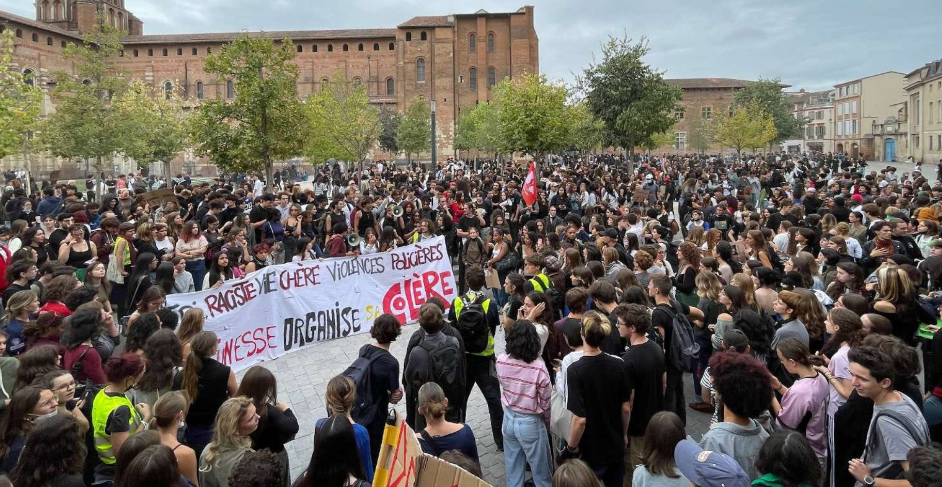
A massive mobilisation led by young people
October 17, 2026, brought together nearly a million people in more than 1,700 rallies across the country. This protest is one of the most important in numbers and especially in intensity over the 10 years since Macron came to power. It began at the start of the school year, in September. by young people in high schools, starting with those in working-class areas, and then spread to university students and other categories of the population, including trade unionists, political activists, former Yellow Vests [Gilets Jaune], and many angry parents.
The revolt of young people reflects a deepening social crisis. The anger has its roots in the hopeless future that today’s ruling class offers to youth: an ever more unequal educational system; a jobs market largely saturated with dead-end contracts; retirement age being pushed further back; an election presenting the victory of the far right as inevitable; in an international context where we must be prepared for war; and a planet at +4°C. The government has no political response, and to grant any concessions would amount to going back on the counter-reforms over the last 10 years.
This protest arises from the contradiction between the needs of the great majority of the people and a policy that sacrifices work, public services and the climate to the profitability of capital. The youth have chosen to struggle against this impasse, and the communists must be at their side in this.
Who are they to give lessons in democracy?
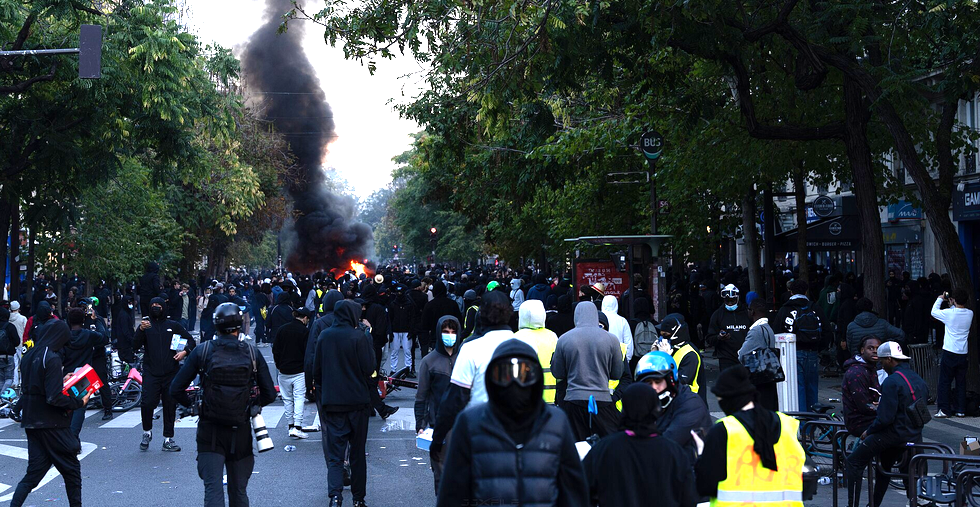
This explosion of anger on the 17th was spectacular in its form, with images of barricades, broken windows, and vehicles and buildings in flames. More than 1500 shops were reportedly broken into and pillaged.
To justify the repression, the government seeks to divide the movement between “good” and “bad” demonstrators. This is a trap: let’s not forget that those it would like to classify in the category of “peaceful demonstrators” are ignored anyway, just as much as the others. Their demands are neither heard, nor satisfied. The supporters of capitalist democracy close their eyes to this simple fact: the usual democratic paths have been stifled by Macronism. And this is one of the reasons that explains the forms of action we saw on this day.
A simple look back is enough to be convinced: in 2019, the more than 200,000 contributions of the “Cahiers de doléances” [a list of complaints, a tradition going back to before the French Revolution], following the Yellow Vests movement, were buried. In 2020, the same was true for the report of the Citizens’ Convention for Climate. In 2023, the massive demonstrations against pension reform did not prevent its adoption under Article 49.3 [a constitutional clause allowing a government to bypass parliament].
In 2024, the legislative elections put the New Popular Front in the lead, and yet a series of right-wing prime ministers were appointed. In 2025, more than two million signatures against the Duplomb law [authorising poisonous insecticides in agriculture] did not, for the most part, prevent its adoption. Further back in time, the majority “no” vote in the 2005 referendum on the Treaty of Maastricht was bypassed in 2008 by parliamentary means. And these people give moral lessons on democracy and the right ways to make oneself heard?
The institutions of parliamentary democracy of the 5th Republic are designed to protect the power and interests of the ruling class. When neither street demonstrations, nor petitions, nor votes carry weight, we must conclude that the bosses will always apply strong pressure to impose policies in their own interests.
This trend towards authoritarian power is therefore not simply due to Macron’s personality. It finds its material origin in the contradiction of contemporary capitalism: the rate of profit can only be maintained to the detriment of the social conquests of the past, by reversing the concessions made to the working class. The application of the bosses’ programme leaves no room for “social dialogue” but is achieved through force.
Under these conditions, whatever government is in power, protecting capitalist interests will increasingly require making use of the repressive components of the state, namely the police and the army, and special laws. Hence the need for a revolutionary transformation: of society. To free the working people from the pressure of the bosses and permanent austerity, it will be necessary to seize economic and political power.
“But do you condemn the violence?”
The government and the mainstream media focus the debate on “violence” to divert attention from the causes of the anger and discredit the movement. The demonstrations that took place were mostly peaceful. But many cities were, to some extent, witness to rioting, clashes with the police, smashed windows, and vehicles and buildings set on fire.
Is it violence? Let’s not forget that the ruling class is accustomed to abuses of language. Strikers being accused of taking the public “hostage” is just one example of this.
The term “violence” is politically charged. Who exercises it, who suffers it, and who defines its content are questions of political power. The term makes it possible to describe very different acts with a single word. They can be grouped into two basic categories: damage to property and attacks on people.
What they call violence is, in most cases, damage to property, which can be targeted as being a symbol of the system. What is presented as attacks on people are most often acts of defence against heavily armed and aggressive police forces. To reduce these actions to delinquency, or to the work of “thugs”, is a convenient way to avoid having to think. It would be a mistake to underestimate the weight of the police and its agents. Obviously, the police infiltrate the movement and stir up violent actions. But when the same actions are occurring on such a large scale, they must be seen for what they are: acts that necessarily have social and political significance.
To understand them and take a correct position, we must know how to ask the right questions. To ask whether one is “for or against violence” in the abstract is absurd. We can and must disagree with some of these methods. It is not a question of abstract morality or of making concessions the government’s panic. It is because we believe that they lead to a strategic impasse. It is on this political level that we must engage in dialogue with those who use them, as far as possible.
Depending on the context, the same action can be relevant or counterproductive. To cite just a few examples: barricades can be useful to protect a march. Urban equipment can be used to build a barricade, even in flames. But the strategy of systematic confrontation with the police which we have become accustomed to in recent years often has the effect of trapping the demonstration behind barricades, whereas mobile, moving demonstrations have the advantage of being more unpredictable and difficult to manage for the police.
The destruction of bus shelters and urban equipment that mainly benefits the young and the poor, is devoid of any purpose for protesters. Smashing of shop windows and seizing goods are actions that can easily be used by the ruling class to discredit the movement. But in some cases, the ransacking of a Louis Vuitton store or other luxury brands reserved for the ultra-rich might sometimes gain some sympathy from the population.
Deep – rooted social distress
As for the day of September 17, it seems that some actions unnecessarily exposed demonstrators to arrest, especially those with little experience, and offered the government a pretext for increased repression, while weakening public support for a legitimate revolt. Actions of this type are rarely the result of a deliberate and coordinated strategy. They are merely the expression of deep-rooted social distress.
This situation can be explained, at least in part, by the weakening of the trade union and political organisations of the workers’ movement and the failure of the forms of mobilisation of previous years to achieve any tangible results, combined with the accumulated anger of years of contempt and racial discrimination; ferocious repression against school students over the last month; and the reality of daily life for a growing number of people who feel that their backs are against the wall, that they have nothing left to lose.
From this point of view, to condemn all violence en bloc as the government asks us to do is to condemn the movement. This is why the government insists so much: it would like to see us ask for forgiveness for the disorder, forgiveness for the revolt. Claiming to be revolutionary militants doesn’t mean that we have to approve of all the acts carried out during a revolt. However, this claim does require us to help it move towards victory, and therefore not to turn away from it on the pretext of impurity. The important thing is the continuation of the movement: we must help it to advance as far as possible by providing a genuinely socialist programme.
Therefore, we do not have to condemn the “violence” of the demonstrators as a whole, nor do we have to call for a return to calm. For many people, this means a return to daily humiliation, to the everyday violence of deprivation and poverty, to the “calm” of suffering endured in silence.
What we condemn, on the other hand, is the violence of capitalism and its supporters. We condemn the hypocrisy of those who shed an indignant tear in front of a burning garbage can but who relay speeches that aim to prepare us for war; or that justify the violence of the genocide in Gaza; ignore the deaths at work; carry destructive and carcinogenic environmental policies; encourage police violence; and support a system that carries with it exploitation, war and devastation of our ecosystems. These people attribute more value to commodities than to those who produce them.
A government in need of scapegoats
Television and social networks are full of conspiracy theories presenting the “ultra-left” and La France Insoumise [LFI] members as the great organisers of “chaos”. Some politicians such as Retailleau [of the Républicains] go so far as to call for the banning of Jean-Luc Mélenchon’s movement. According to witness accounts collected by Mediapart, the government has given instructions to the intelligence services to incriminate LFI for the ongoing “disorder”. This is seen as a means for the political majority in power to absolve itself of its responsibility for the current crisis, while seeking to weaken the opposition.
Communists will not be surprised by any of this: 40 or 50 years ago, it was the PCF that would have been targeted. We must be in solidarity with the LFI militants involved in the struggle who are facing these disgraceful attacks. By targeting them, the government is targeting the organised left as a whole.
Keep up the pressure, build towards the strike on November 5.
We must come to terms with reality as it is, and not as we want it to be. Does the day of October 17 not correspond to the image we have of the strikes of 1968, of 1936, the insurrection of 1871, the barricades of 1848? The fact is that the collective memory of these events has been idealised and purified. We tend to make myths of these events with their heroes and villains. In truth, revolutionary upsurges are contradictory. They carry within them the beauty of what people want to happen and the ugly characteristics of the society that made them emerge. One cannot go without the other. There has never been and never will be a “pure” mass movement.
Everyone knows the oft-repeated chant: “Share work, share the wealth, or else things will explode!”. Well, we cannot hope for the storm without the attendant thunder. October 17 was a serious explosion, a threat for some, but a hope for many others.
But explosions are not enough. The movement started by the youth has opened a breach. It has brought public anger into public debate. It has put the government in serious difficulty. What explosions of anger cannot do is to stop the machinery of capitalist exploitation. Those who produce wealth, the working people, have the power to do this. A truly general strike could paralyse the economy and create a balance of power much more favourable to the movement. This is why our task is twofold: keep up the pressure, and to build towards a general strike.
The inter-union coordination is calling for a general strike on November 5, against the budget cuts of 54 billion euros planned by the government. Let’s give it objectives that will help unite our struggles and widen the field of possibilities.
- Down with Macron, his government and the system they serve!
- Resources for schools and public services, not for the army or private companies!
- For an immediate end to repression and police violence: disarmament of the police, ban on grenades!
- No to the increased retirement age. The right to retirement for all at 60!
[This article first appeared in La Riposte here. It has been translated and slightly amended to assist British readers]
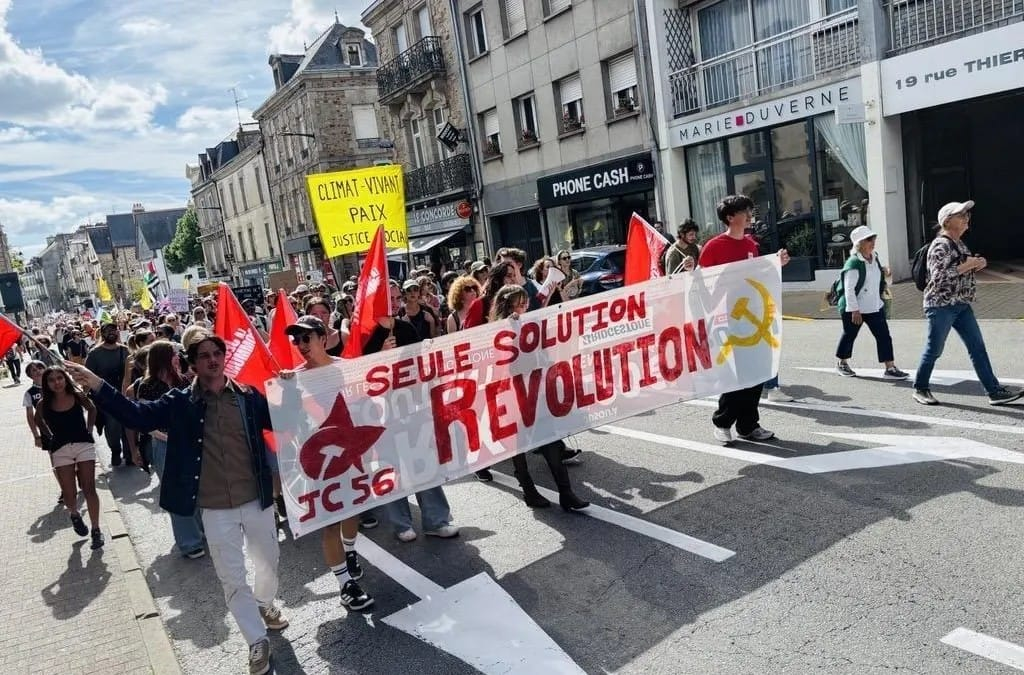
[Featured photo – Jeunesse Communiste banner at a protest in Lorient from “Révolution Permanente”]