

 Aberfan remembered, sixty years on
By John O’Brien
Sixty years ago, on Friday October 21, 1966, children across the small Welsh mining village of Aberfan got out of bed, had their breakfast, said goodbye to their parents, and walked to school. It was an ordinary Friday morning, the last day before the half-term holiday. Some would have been excited about playing out with their mates, while others simply looked forward to a week away from lessons. At home, mothers and fathers went about their daily chores, expecting everyone back round the dinner table by late afternoon. Nobody could have imagined the horror heading their way.
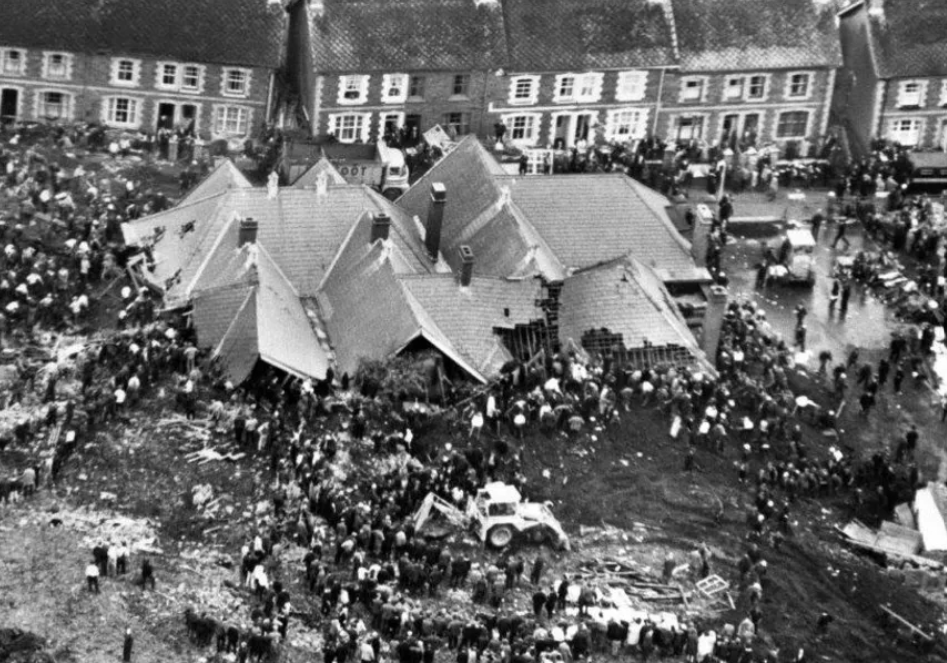
At roughly 9.15am, a colossal mountain of colliery spoil collapsed on the sodden hillside above. Thousands of tonnes of mining waste, slurry, and fractured rock tore down into the valley, slamming straight into the houses and Pantglas Junior School. In seconds, full classrooms vanished beneath a violent wall of black sludge. Children were pinned at their desks. Teachers were buried where they stood.
When the slide finally stopped, 144 people were dead: 116 schoolkids and 28 adults. It remains one of the darkest days in British history, made infinitely worse by one brutal reality: it was completely preventable.
For years, the National Coal Board had piled industrial waste high on the mountain above Aberfan, right over known natural water springs. The towering black tips became part of daily life. Families raised their children under their shadow, and generations of men dug the coal that kept Britain running.
These were decent, hard-working people, who trusted that the people running the pits knew what they were doing. They did not. Water pooled inside and underneath that loose muck for years, turning it into a ticking time bomb. Local people had raised alarms, and the spoil heaps had slipped before, yet the NCB waved the warnings away. When days of relentless rain hit the valley, the inevitable happened.
Clawing through filthy slurry
The rescue effort was harrowing. Colliers who spent their lives hewing coal underground suddenly found themselves clawing through filthy slurry with their bare hands, frantic to dig out their own children. Distraught parents gathered at the edge of the ruin, waiting against hope for good news.
The rescuers worked through terrible conditions, shifting sodden muck while terrified that the rest of the tip might collapse down their necks. The last living child brought out of that school, seven-year-old Jeff Edwards, was pulled clear around 11am, just two hours after the slip. Nobody else came out alive.
For dozens of families, there were no miracles. Just empty bedrooms, school uniforms hung up for good, untouched toys, and quiet spaces around the kitchen table. When people quote the figure of 116 children, the human reality can get swallowed up by the statistic. They were not numbers. They were little boys and girls with their whole lives ahead of them. Each one had a name, a grin, and a future.
Five days later, the government set up an inquiry. When the tribunal reported back in August 1967, its verdict was scathing. The blame lay squarely with the National Coal Board, which was slammed for gross negligence, ignoring direct warnings, and treating public safety with contempt. It was not an act of God. It was sheer corporate carelessness.
Not one NCB boss went to prison
Yet when it came to accountability, the system closed ranks. Not a single person faced criminal charges. Not one NCB boss went to prison. Lord Robens, the arrogant NCB chairman who initially lied by claiming the disaster was caused by unknown underground springs, went through the motion of offering his resignation, but the government refused it and kept him in his post.
How does an official inquiry prove an organisation caused the deaths of 144 people through sheer negligence, yet nobody takes criminal responsibility? In my eyes, that remains a national disgrace.
The cruelty did not stop there. The way the authorities treated the families afterwards was shameful. The NCB originally insulted grieving parents by offering a measly £50 payout, eventually pushed to £500 only after public outrage.
Worse still was the scandal around the Aberfan Disaster Fund. Ordinary people from all over the world sent in donations out of pure love and solidarity, raising millions to look after the community. In an act of unbelievable callousness, the government forced the charity to hand over £150,000 of that public money to pay for clearing the remaining dangerous spoil heaps.
Think about that: a devastated village was made to pay for clearing the very muck that had just slaughtered their children because the state refused to foot the full bill. It took until 1997 for the government to finally repay that money, three decades too late.
There has also always been the question of the Queen. She took eight days to visit Aberfan, despite Prince Philip arriving the day after the disaster. People made excuses at the time, arguing a royal visit would tie up emergency services and get in the way of the rescue work.
That may have been the official line, but to a village that had just seen an entire generation wiped out, an immediate visit would have shown that the country truly shared their grief. The Queen herself later admitted that staying away for so long was one of the biggest regrets of her entire reign.
I have stood in Aberfan Cemetery myself, and I can tell you it is one of the hardest things I have ever done. You can watch the television footage, read the history books, and look at the black-and-white pictures, but nothing prepares you for standing in front of row upon row of small white arches. Seeing so many children buried together hits you right in the gut. They should have grown up, started work, fallen in love, and built lives. Instead, everything stopped on an ordinary Friday morning.
When you’re only six, the whole world is an adventure
Standing there, I could not help thinking about my own six-year-old grandson. He was not with us on that visit, but whenever I watch him running around, full of mischief and curiosity, my mind goes straight back to the children of Aberfan. At six, the whole world is an adventure. As a grandad, I love watching him find his feet, making friends at school, and discovering what he likes doing. I live for those everyday moments.
The grandparents in Aberfan had those exact same hopes. They looked forward to family birthdays, Christmases, and seeing their grandkids turn into young men and women, maybe walking them down the aisle one day or putting great-grandchildren into their arms. That was ripped away from them in a few minutes of terror. How any parent or grandparent found the courage to get out of bed each day after that, walking past an empty bedroom, is something beyond my comprehension.
What have we learned over these past sixty years? Yes, Parliament passed the Mines and Quarries (Tips) Act in 1969 to inspect and manage spoil heaps. But the deeper disease persists. It is the arrogance of institutions who think they know best, brushing aside the genuine fears of ordinary folk until a catastrophe forces their hand.
In my years working in welfare and disability advocacy, I see this attitude time and again: ordinary people forced to battle bureaucracies, submit paperwork, chase deaf ears, and jump through hoops just to have basic safety or basic rights respected. Too often, safety changes only come after people have already suffered.
On October 21 2026, Aberfan marks sixty years. For some, it is a chapter in a school history book. For the surviving families, the pain has never left. We owe those 116 children and 28 adults far more than wreath-laying and polite speeches. We owe them an absolute intolerance for institutional neglect, and a system that actually listens when people shout that something is wrong.
Above all, we must remember those little boys and girls who skipped off to school that morning with their bags packed for half-term, never to return home.
May they rest in peace. They were loved, they mattered, and they will never be forgotten.
[Feature picture from Wikimedia Commons here, showing rescuers searching through the demolished school after the disaster]
 Carlisle cost of living rally: solidarity and coordinated action needed - Report from David Niven An enthusiastic Cumbrian rally on the cost of living crisis, which took place in Carlisle last Saturday, was attended by around
- Get ready for Rishi to rinse you - By Rhys Jameson The Tories continued commitment to Neoliberalism cannot be faulted. Not content with driving down wages and conditions for the working class, they
- Editorial: Rishi Sunak steadies the ship…until the next storm - The records continue to crumble. After the shortest period in office for both a chancellor and prime minister, we have the youngest prime minister in
- Truss Tory Turmoil: all the runners and riders - By Rhys JamesonIt was supposed to be an end to the chaos of the British economy caused by coronavirus and the Ukraine conflict, not to
 Al Jazeera ‘Labour Files’ – exposing the smears and tricks of the Labour right. - Ray Goodspeed (Leyton and Wanstead CLP) reviews the four programmes in this explosive series. During recent Labour Party conference, many members of the Labour Party