

 Labour’s share
By Michael Roberts
This blog was originally published by Michael Roberts on Thursday, 1 October 2026. Although we are late in republishing it, we think it gives a really important analysis of how the share of national income has tilted towards profits and away from wages. The original article can be found here.
**************
In a recent post, I pointed out that US corporate profit margins (that’s profits as a share of national income) had reached record levels, 19.4%—the highest recorded in the US since the 1940s!
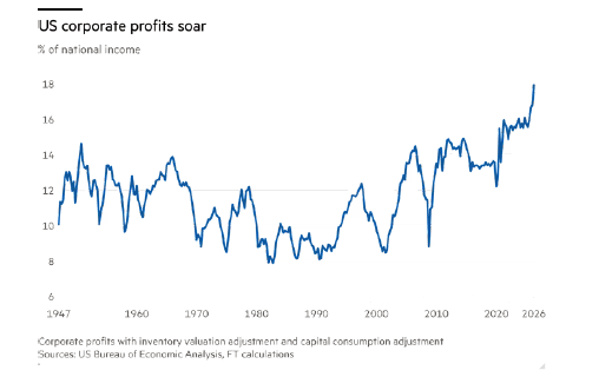
The converse was the case for labour’s share which had fallen to a new low.
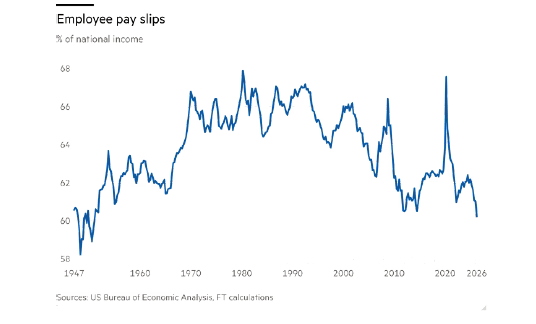
A clear increase in the rate of surplus value
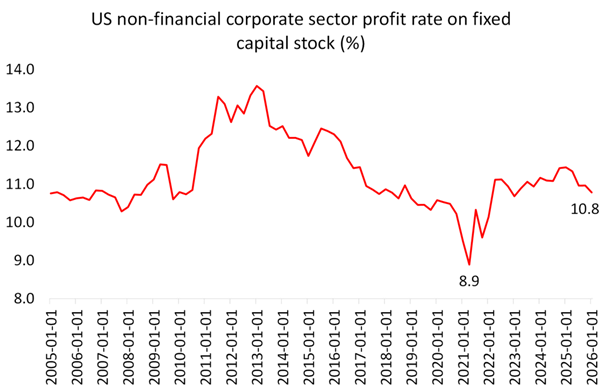
If we measure the ratio of profits to wages in Marxist terms, namely as the rate of surplus value, we find that it has never been so high and thus an important counteracting factor in driving up the US rate of profit (that’s surplus value divided by the stock of the means of production plus employee compensation), particularly visible since the end of the pandemic.
The Tax Foundation has produced alternative figures
However, these measures of shares of profits and wages in US national income have been challenged by the Tax Foundation. The Tax Foundation considers itself as the world’s leading nonpartisan tax policy think-tank. “For over 85 years, our mission has remained the same: to improve lives through tax policies that lead to greater economic growth and opportunity.” The TF argues that it is incorrect to use the gross national income measure to gauge the share going to profits and wages. And contrary to the conclusion above, it is not true that that capital is taking an ever-increasing slice of the economic pie or that labour’s share has fallen from nearly two-thirds in the 1950s to about half today.
Why are these conclusions wrong? As the Tax Foundation correctly points out, total national income is not made up just of profits and wages received but also from depreciation. Depreciation is the amount of national income that companies must take into account as investment to replace obsolete and used up machinery, plant and tech etc i.e. not investment in new means of production. So depreciation must be deducted from the profit that companies make from sales. In other words, the share going to profits or wages should be measured against net total income ie after depreciation is deducted.
When this is done, then labour’s share is not at all-time lows, according to the Tax Foundation: “labor’s share is both higher and more stable than the BLS series suggests.” On this net measure of national income, labour’s share was about 69% in the late 1940s, rising to about 75% in the 1970s, and is now 68.3% today – hardly any different from the 1950s. “Labor share, in other words, is not at a “never before seen” level”.
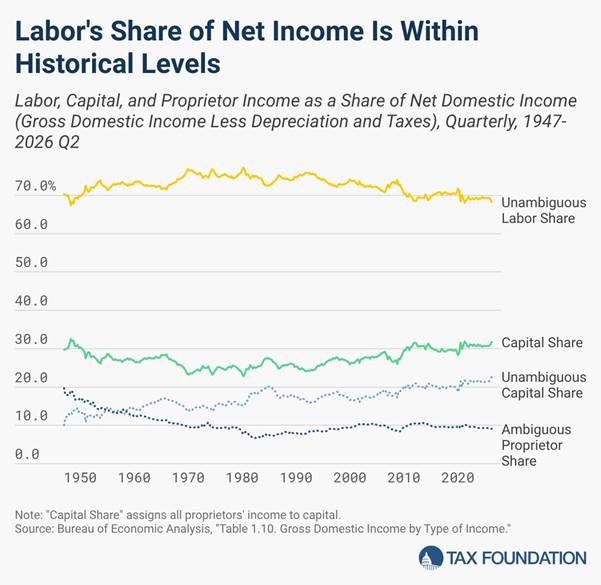
Even the Tax Foundation figures show the lowest labour share since 1948
But a closer look at the data and time series provided by the Tax Foundation produces a more accurate conclusion, in my view. First, let me say that ‘depreciation’ is an accounting deduction from gross profits. It is still value that has been appropriated by capital from the exploitation of labour. If gross profits are reduced by depreciation, so must the value of the stock of fixed assets, so that net profits are measured against the net stock of capital. Ceteris paribus, the rate of profit on capital will thus not be reduced by deducting depreciation from national income.
As for shares of national income, even if we use the Tax Foundation’s measure, the previous claim that labour’s share is at all-time low is nearly confirmed. That figure of labour’s share of US national income at 68.3% in 2026 was still the lowest since 1948 and correspondingly the profits share was also near its highest since 1948.
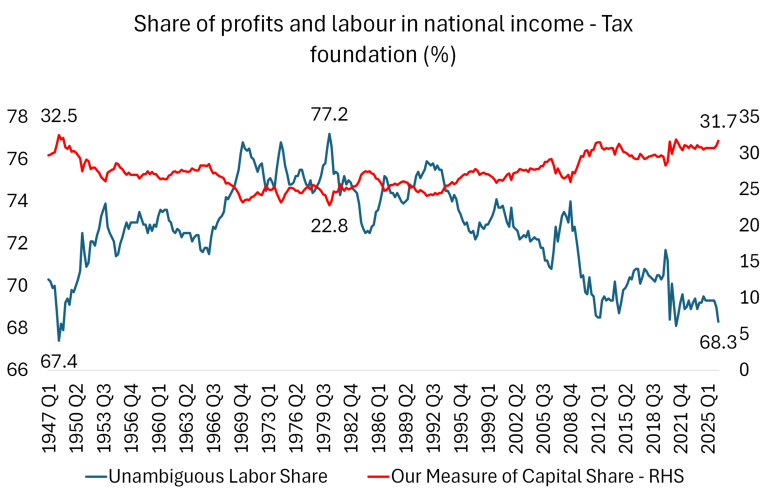
So the claim that labour’s share is at an all-time low is only a slight exaggeration and the Tax Foundation is making much ado about not very much. More important, the graph above reveals that it was at the end of the 1970s that labour’s share peaked. From the 1980s, labour’s share fell and correspondingly the share going to capital rose. This was the start of the so-called neoliberal period of attacks on trade union rights and organisation, privatisation, cuts in benefits and public services and the shift of manufacturing jobs to the cheap labour areas of the world. This enabled a rise in the overall profitability of US capital.
Using Marxist economic categories to interpret the figures
Moreover, if I convert the Tax Foundation’s share measures into Marxist categories, the rate of surplus value has risen 57% since 1980 and since the end of the Great Recession by 32%, and since the end of the pandemic by 17%, to reach near the immediate post-war peak.
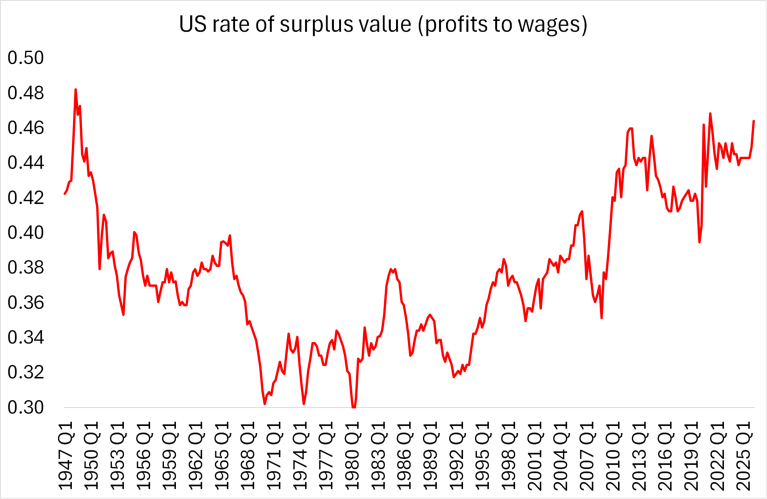
This increase has been a key counteracting factor to Marx’s law of the tendency of the rate of profit to fall, leading to a rise in US profitability in the neo-liberal period (1982-2000), then after the end of the Great Recession and in the last five years since the end of the pandemic.
The concentration of recent profits in finance, tech and energy
But there is a caveat. The vast bulk of these increased profits have been accumulated in just a few key sectors of the economy. In the last year to mid-2026, US corporate profits in domestic industry (ie excluding profits made by US companies abroad) reached $4.4trn. That’s up $738bn, a huge 17.7%.
Of that rise, the finance sector (based on the stock market boom) contributed $185bn, or 25%. The energy sector (riding high on sharply rising energy prices) contributed $135bn, or 18.2%. But it was the technology sector (software and hardware) that led the pack, contributing $214bn of the $738bn profits increase, or 29%. If you exclude finance, and just consider the non-financial sectors, the energy share of the profits increase rises to 24% and tech sector to 39%. So nearly two-thirds of the rise in non-financial sector profits in the last year comes from just two sectors.
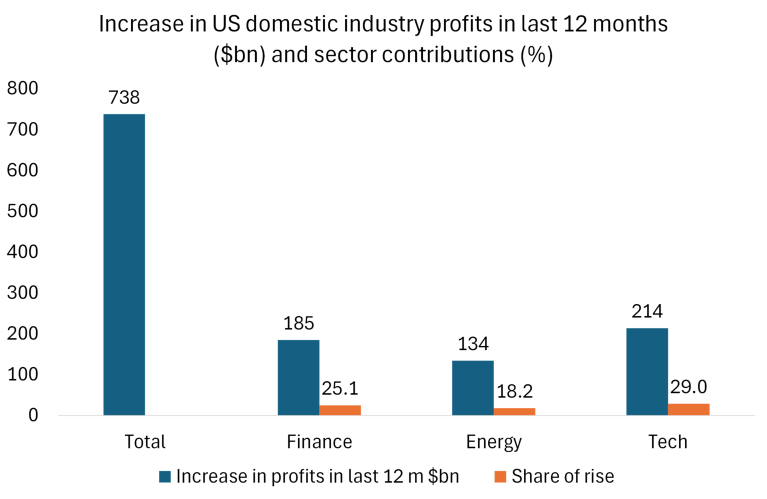
This suggests that if there is any decline in tech profits from a bust in the AI-driven stock market, overall US profitability will dive, triggering a recession.
From the blog of Michael Roberts. The original, with all charts and hyperlinks, can be found here.
- Gaza and Northern Ireland, part 2 - By Mic Craig, in Northern Ireland After my initial article in Left Horizons, a reader sent in a comment, to which I am responding here.
- Peru: a crunch election - By Michael Roberts Today, 25 million Peruvians vote in the second round of a crucial Presidential election. The voters are being asked to choose between
- Gaza and Ireland parallels - By Mic Craig, Northern Ireland On reading the Left Horizons review of the book, A Rebel In Gaza, I recognised a scenario a bit closer
- The productivity crisis - By Michael Roberts It has been the historic mission of the capitalist mode of production to develop the “productive forces” (namely the technology and labour
- Exterminate all the brutes! - Documentary Review by Mark Langabeer (Hastings and Rye CLP) This four-part documentary, available on Sky, gives a good account of colonialism and the super exploitation