

 Hungary 1956; the battle for workers democracy
In commemoration of the 70th anniversary of the Hungarian Uprising of 1956 we are re-publishing an article by Ed Waugh, which first appeared in the “Militant” newspaper in 1986.
THIRTY YEARS ago, the valiant Hungarian working class rose up and threw off the Stalinist bureaucratic elite of Gero and Rákosi. They bravely defied the overwhelming might of an armed Russian intervention. In the space of just three weeks, they organised two insurrections and two general strikes. Like the Paris Communards eighty years before they attempted to storm heaven. All their accumulated hatred of the privileged caste of officials, managers and their secret police henchmen, and their burning sense of indignity at Russian Stalinist domination, bubbled over in the revolutionary struggle of 1956. In addition, the death of Stalin in 1953, Khruschev’s secret speech to the twentieth party congress admitting many of the crimes of the Russian bureaucracy (while laying the blame for all the excesses on Stalin as an individual) had begun to undermine the confidence of the regimes of Eastern Europe. By May 1956, 800 were attending the meetings of the intellectual opposition grouping, the Petofi Circle, founded by the Hungarian Young Communists and the Writers’ Union. In June this had risen to 6,000, calling for political freedoms. In Poland too the workers were taking action, with strikes in June 1956. Many leaders were arrested and their trials took place in early October
The Petofi Circle called for a demonstration on 23 October in support of the Polish workers. As the 23rd approached, the bureaucracy flinched. First, they granted permission for the demonstration, then they cancelled, but matters were no longer in their hands. Students had produced leaflets and visited factories calling on the workers to join the demonstration. Party officials were bypassed in the factories and reduced to mere onlookers as the youth addressed the workers directly. The Students and Writers’ Union demanded:
- Workers to run the factories;
- Peasants to decide their own fate;
- For socialist democracy.
- The removal of Rákosi’s clique and the reinstatement of Nagy as Prime Minister.
Imre Nagy, a ‘liberal’ bureaucrat, was a former Prime Minister, who had been ousted by the hardline Stalinists, and so attracted a wide following initially. By 6pm on the 23rd between 200,000 and 300,000 people had converged on Parliament Square. They were unsure what was going to happen. They started to chant for Nagy. At 9pm, Nagy who had refused to partake in the demonstration, now appeared to try to disperse this mass movement that had passed way beyond his limited intentions. “Good people”, he appealed, “be patient, the Central Committee will take care of everything”. His speech was met in silence. Then word spread that the hated secret police, the AVO, were shooting demonstrators at the radio buildings. First Secretary Gero had made a speech on radio denouncing the people’s demands. At this a section of the crowd had moved from
Parliament Square to the radio buildings insisting that their demands be broadcast. There 500 heavily armed AVO were on hand to meet them. The authorities agreed to allow in a delegation to negotiate with the director. Their demands were turned down point blank. An hour and a half passed and still there was no sign of the delegation. Rumours abounded that they had been arrested. The thousands at the back began pushing and forcing their way forward. Those at the front were projected onto AVO lines. Tear gas was thrown at the crowd followed by a volley of police machine gun fire. Up to this point the people of Budapest were attempting to appeal to the authorities, not overthrow them, but the gunning down of unarmed people set into motion the Hungarian political revolution.
Barricades
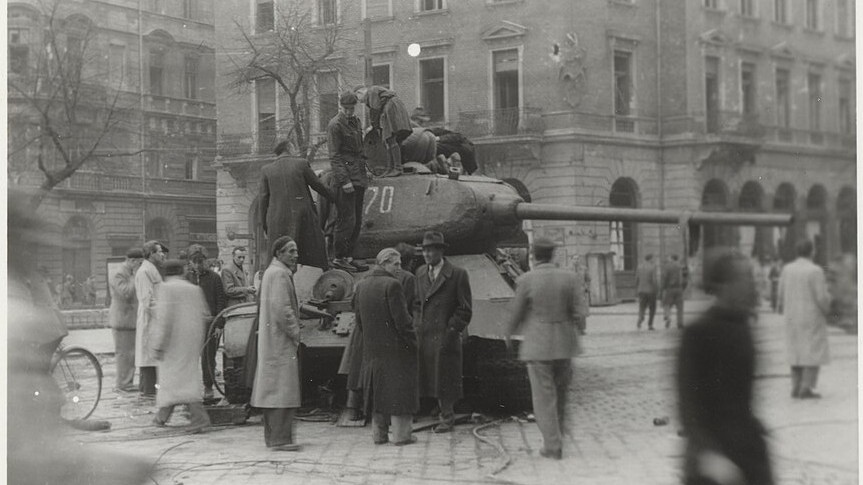
Word of the massacre spread like wildfire around the city. Sports clubs were raided and guns taken. The workers instinctively armed themselves. Barricades were thrown up and by 1 am the workers had control of the main streets and squares of Budapest. The important radio building fell to the insurgents after an initial stand by the AVO, but the seizure of the party paper’s offices, the district police stations and CP headquarters was relatively easier, in some cases being taken without a fight. The state apparatus was collapsing. In desperation Nagy was again made Prime Minister. A day later Gero was dismissed and Jandros Kadar, a leader of the party in the 1940 s who had suffered torture and imprisonment at the hands of Rákosi, accepted the position of First Secretary. But time was slipping away from the bureaucracy. At 8am on 24 October, the new government introduced a curfew and martial law. Russian tanks, stationed in Hungary under the Warsaw Pact, had been ‘invited’ into Budapest to restore order and defend “socialism and the people’s democracy against a fascist uprising.”
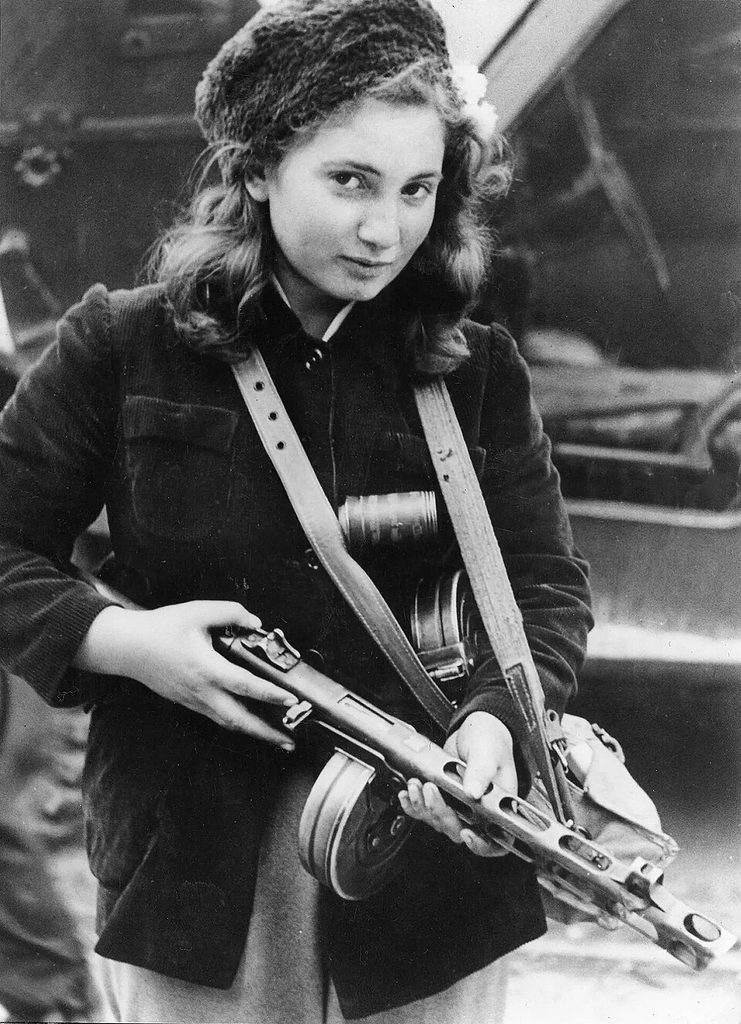
As the tanks flooded in, they were met by the determination of the masses. Molotov cocktails, home-made petrol bombs and hand guns were pitted against the mighty tanks of the Red Army. But the most effective weapon of the Hungarian workers was the class appeal. Not one Hungarian unit fought against the revolution. Colonel Pal Maleter took the soldiers of the Killian Barracks over to the side of the revolution. The same applied to Colonel Sandor Kopacsi, Chief of the Budapest Police, who, after noticing arrested “fascists” were ordinary working people as he had once been, ordered the police on to the side of the revolution. But the Russian troops were also affected. Men, women and children approached the invaders asking why the armed incursion into a strange country. In Debrecen in East Hungary, Russian soldiers withdrew after the meeting with workers’ representatives. There had been no major strike movement in Hungary for 25 years, but by the 25th strikes started in Budapest against the Russian invasion, within two days a general strike gripped the country. As in the Russian revolutions of 1905 and 1917, the workers instinctively established organs of their new found power. The first workers’ council was set up in the United Lamp Factory in Budapest on the 24th. By the 26th they had mushroomed throughout the whole of Hungary, based on factories, mines, hospitals, government buildings, state farms, the armed forces and colleges. The old apparatus relinquished its grip on the running of factories, the distribution of food and the publication of newspapers. Millions of workers were directly represented by these committees and immediately set about formulating demands. The Budapest Lamp factory issued a ten-point declaration calling for an end to bureaucratic mismanagement and for the establishment of workers’ councils at every level, led by a factory workers’ committee which would direct the entire enterprise. The demands ended with the appeal to workers to “show that we can manage things better than our blind and former bosses”.
Workers’ councils
A worker described the council at his factory. “We elected a workers’ council consisting of approximately 25 members and immediately resolved to strike because, owing to the confused decrees it issued, we refused to recognise the lmre Nagy government …: each shop elected two or three delegates onto the council and so did the administrative departments. As a result, 19 or 20 of the 25 council members were workers”. On 26 October, the National Council of Trade Unions issued a joint economic and political programme which brought together the demands of the councils nationally. Effectively, these demands were the programme of the political revolution, as anticipated by Leon Trotsky in his fight against Stalinist degeneration in Russia. Apart from the basic demands of the revolution: increased pensions, family allowance, house building etc, the main demands were as follows:
- “That a broad government comprising representatives of trade unions and youth, be constituted with Imre Nagy as its President.
- That to maintain order, the police and army be reinforced by a national guard composed of workers and young people.” (On 31 October, 250 rebel army officers met to elect a Revolutionary National Defence Committee. This incorporated the Hungarian People’s Army Revolutionary Committee, a national guard comprising the armed peoples’ militias.)
- That the new government start immediate negotiations for the withdrawal of Russian troops from Hungarian territory.” The Revolutionary National Defence Committee was to restore order after the Russian withdrawal.
- “Constitution of workers’ councils in all the factories to establish A) Workers’ management, and B) a radical transformation of the system of central planning and direction of the economy by the state”. The councils were adamant in their opposition to a one-party totalitarian state and included in their lists of demands, freedom for all political parties to exist which accepted a workers’ state.
The Budapest Council formulated nine points which included:
- “The factory belongs to the workers and is to be controlled by the democratically elected workers’ councils.
- The director is to be elected by the workers’ councils and is answerable to that body in every matter concerning the factory”
Real power now rested with the workers. The CP in fact ceased to exist. A party that five days earlier boasted 800,000 members disintegrated. The lower ranks sided with the revolution. As Trotsky predicted, in the political revolution, once the workers overcome their sense of helplessness in the face of the apparently all-powerful regime, once they move into action and become confident in their own strength, the lower levels of the bureaucracy and the ordinary soldiers can be drawn behind them, leaving the pampered top bureaucrats suspended in midair, with no social support outside of the brutalised secret police.
Hunting down
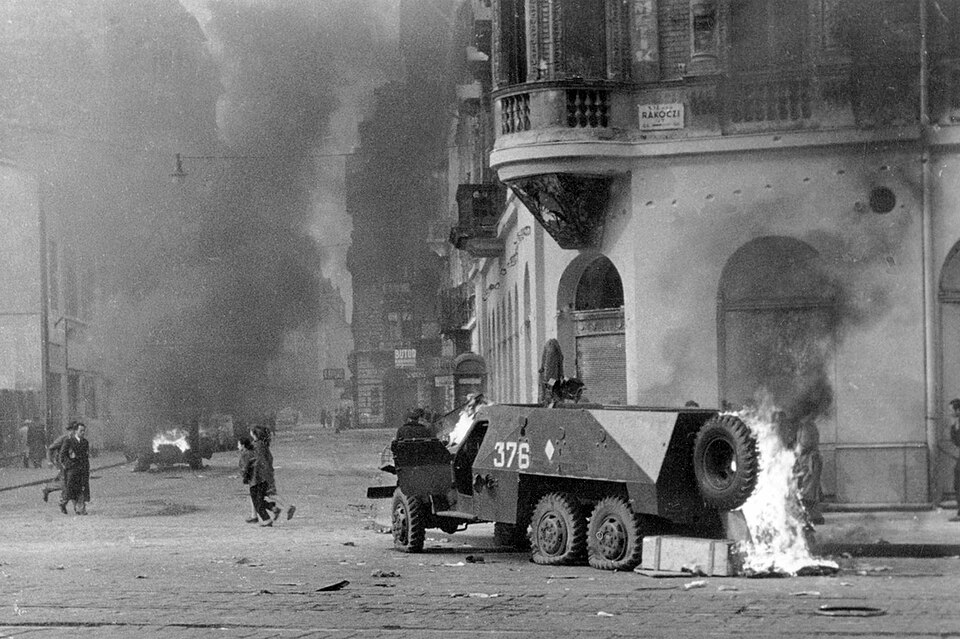
Many workers wreaked vengeance on the AVO for the crimes they had committed. They were hunted down, thrown from windows, hung from lamp-posts, shot and beaten to death by irate crowds. In the face of this mass revolutionary pressure Nagy disbanded the AVO and promised free elections for all political parties. Negotiations were underway for the complete withdrawal of Russian troops. But workers were uneasy. New Russian troop movements into the country were being reported to the workers’ councils. Workers’ fears were well founded. On Sunday 4 November, Budapest was awoken by the sound of artillery fire on the city outskirts. Minutes later Russian tanks flooded into the main streets, taking the insurgents’ strongpoints and indiscriminately levelling buildings. The Nagy government collapsed immediately but popular resistance did not. Nagy was replaced by Kadar who boasted that he had called in Russian tanks to “fight the counter revolutionary danger” and defeat “fascism and reaction”. But there was no question of pro-capitalist reaction. The Budapest Council declared, “We shall defend our factories and our fatherland from feudal and capitalist restoration, if necessary, at the cost of our lives”. Heroically, the working people fought this second wave of Russian troops and tanks. The workers of the main industrial complexes led the resistance, Ujpest, Kobanya, Soroksar, and Csepel Island continued the fight until 11 November. In Csepel, posters mocking Moscow’s lies appeared: “The forty thousand aristocrats and fascists ·of the Csepel works strike on”. But whole areas were laid waste and reduced to rubble by 600 Soviet tanks. 20,000 Hungarians died before “order” was restored
As in all revolutionary struggles, it was the youth who proved to be the most fearless class fighters. Young workers, apprentices, students and school students rushed to take up arms. 80-90 per cent of those treated for injury in hospitals were young workers. The Soviet troops involved in the second invasion were different to those withdrawn after the first wave. They were mainly from Mongolia; many were illiterate and had been told they were in Berlin fighting Nazis. Hand to hand combat was completely avoided for fear of fraternisation as witnessed in the first wave a week earlier. Hence the brutal utilisation of sealed tanks. The workers may have lost the battle for the streets in the face of Russian military superiority but they still had their traditional class weapon, the strike. There followed the most united and total general strike. Initially spontaneous, it was rapidly consolidated into a centrally controlled strike, organised by the workers’ councils at every level, of the factory, district, city and eventually country wide. Despite attempts by Kadar to undermine the workers’ councils by arresting the leaders, the movement continued. 500 delegates from the workers’ councils in Budapest met on 13 and 14 November to establish the Greater Budapest Workers’ Council. Half of the delegates were aged between 23 and 28. The President was a 23-year-old toolmaker, Sandor Racz. The energy and dynamism of youth was added to the experience of older workers. Each delegate had to spend the working day on the factory floor, had to report back after every session and was subject to recall at any time. The demands formulated by this body included:
- “The withdrawal of Soviet troops from Budapest and the whole country.
- Free elections in a multiparty system.
- Socialist ownership of the industries.
- The maintenance of workers’ councils and the restoration of free trade unions.
- The right to strike and to assembly, freedom of the press and religion, etc. “
The delegates to the Greater Budapest Workers’ Council (Central Workers’ Council) saw as their next step the necessity of establishing a National Workers’ Council. On 21 November a conference of delegates from workers’ councils nationally took place with the aim of establishing a “Parliament of workers’ councils”. Here in this national organisation of workers’ representatives was the framework for a healthy workers’ state. A 48-hour general strike was called to support the National Workers’ Council and against Soviet repression. How could the one-party totalitarian state tolerate the continued existence of a rival authority, in the shape of the workers’ councils. And the bureaucracy had behind it the armed might of the Russian forces. It responded with increased repression. It decreed that all councils above factory level were illegal and wholesale arrests of militant leaders took place. On 11 December 1956, 30 days after its formation the Central Workers’ Council of Greater Budapest, was arrested en masse, in an attempt by the government to thwart the proposed general strike for 11 and 12 December. But the strike went ahead as arranged, and even continued in some areas as a protest at the arrests. A state of emergency was declared. All meetings and demonstrations were banned, detention without trial for up to six weeks was introduced and ‘special’ courts were established. Despite intimidation workers organised occupations. Sporadic strikes and demonstrations continued, but faced with increased terror and overwhelming military might, the workers’ courageous resistance began to fade.
Councils dissolve
The government had succeeded in breaking the backs of the workers’ councils. It had attempted to subvert the councils and turn them into government institutions. Rather than allow the councils to be used against them the leading workers dissolved their councils and announced their resignations. But sporadic strikes continued throughout 1957. It was not until November of that year that the government finally dissolved the other remaining workers’ councils and thereby crushed for the foreseeable future, independent and autonomous organisations of the working class. However, it was not able to assert its authority by repression alone. It was forced to grant concessions. Many workers were paid for the period of the general strike. By January 1957 overall wages were 22 per cent higher than the previous year; production norms were suspended and 10,000 new homes were built for miners. But Imre Nagy and Pal Maleter were arrested and later executed by the bureaucracy. Thousands more were executed, tens of thousands imprisoned, and many escaped into exile. The Hungarian workers had written in blood one of the most heroic chapters in the history of the international working class. Thirty years later we salute them. For a week after 24 October, they had confronted Russian troops militarily and with strike action. For a week after 4 November, they had faced a second wave of Russian tanks. They had struck from 4 to 19 November, 21 to 23 November ‘and 11 to 13 December. Their tenacity and preparedness to struggle cannot be questioned. And this without a prepared and organised leadership!. They confirmed in action Trotsky’s picture of what the political revolution would look like. In the streets and in the meetings of the workers’ councils they filled in the details. Even in defeat they handed on a legacy to workers fighting for socialist democracy against Stalinist, one party dictatorship. Now more than in 1956, crises and upheavals loom in ·all of Eastern Europe and Russia simultaneously. The hesitation of the Russian bureaucracy to militarily intervene against the Polish workers in 1980, showed their fear of the contagion spreading to their own armed forces and thence to the Russian working class. The mole of political revolution is burrowing away in the Stalinist states. It will be the programme instinctively developed by the Hungarian workers that will again be taken up- an end to the bureaucracy, the creation of nationally co-ordinated genuine soviets, with all the democratic safe-guards of election, right of recall over officials and their wages to be tied to average earnings, and an international appeal, first and foremost to the other workers of the Eastern bloc. It is the responsibility of Marxists to do all in their power to assist the most advanced and class-conscious groups of workers in Eastern Europe to ·appreciate and clarify this programme, and to make ready for the coming battles of the political revolution.
Images from Wikimedia Commons
- Measuring Global poverty - This article is from Michael Roberts’s blog The Next Recession and can be seen here. [featured photo from https://pppp.my/extreme-poverty.html] ******** To track progress towards its
- USA – why did the dockworkers’ strike end? - By Richard Mellor in California This was a question some workers asked me and it’s a good question indeed. Firstly, they didn’t end the strike
 Marx’s theory of value: collapse, AI and Petro - By Michael Roberts A site called Marxism and Collapse (M&C) has conducted a ‘dialogue’ with an AI model called Genesis Zero (GZ) that includes “an
- October 7 and Israel’s “forever war” - By John Pickard Many politicians will mark October 7 as the ‘beginning’ of the Gaza war, but that is a measure of their one-sideness and
 Why the far right are gaining in Europe - By Greg Oxley of La Riposte In the recent regional elections in Germany, the far-right nationalist AfD made significant headway in Thuringia and in Brandenburg.