

The ‘cockroach’ uprising: India’s youth rebellionBy Umar Shahid
The morning of July 20 brought disturbing scenes from Jantar Mantar Delhi, where tens of thousands of students, parents, retired professors, and professionals had gathered, despite heavy rain. The ongoing sit-in (dharna) of the “Cockroach Janta Party” (CJP) turned into a battlefield between protesters and police.
When the protesters attempted their “Sansad Chalo” (March to Parliament), the state responded with a full arsenal: tear gas canisters, baton charges that left head wounds and broken bones, barricades sealing off access to Parliament House, metro stations shuttered and mobile internet suspended. Police in riot gear entered Jantar Mantar and announced that protesters no longer had permission to remain, pushing people back and dismantling their tents.
The police crackdown reveals the state’s true character. It is the “armed committee” of the capitalist class, tasked with maintaining conditions for capital accumulation. However, the young people present refused to leave the place and the sit-in continued.
On June 6, the CJP had started the peaceful dharna at Jantar Mantar. Sonam Wangchuk, a social activist and education reformer, also joined protest and along with others started a hunger strike at the dharna. For over a month, the CJP peacefully agitated and Wangchuk’s 21-day hunger strike continued, yet the Indian media completely ignored any news about it. CJP activists and young people started mobilising through social media and many leading celebrities joined the protest to pressurise the government to accept the demands of the protestors.
Response of capitalist class has been predictable
Their basic demands were the resignation of the education minister, Dharmendra Pradhan, compensation of 10mn rupees for each student suicide victim (see below), abolition of the national testing agency and withdrawal of the National Education Policy 2020.
The response of the capitalist class has been predictable. Prime Minister Modi’s silence speaks volumes. When the leader of the world’s largest “democracy” has not been able to face a press conference for twelve years; when he cannot directly address young people, we see the decay of capitalist democracy and its transformation into naked authoritarianism.
The ‘cockroach’ party: from insult to identity
The CJP began as satire, but has become the most serious challenge to Prime Minister Narendra Modi’s government in his third term. It takes its name from an attack on young people in May, by India’s Supreme Court Chief Justice Surya Kant, when he compared unemployed young people to “cockroaches” and “parasites” who attack the system when they have “no place in profession”. Although later he claimed that his remarks were misunderstood, the damage was done.

Abhijeet Dipke, a 30-year-old Dalit with a master’s degree in public relations, seized on the insult and launched a satirical online post: “What if all cockroaches came together?”, he asked. Within 24 hours, over 30,000 people signed up. Today, its Instagram following has over 23 million, more than double that of the Modi’s ruling party, the Hindu nationalist BJP. The movement is already exposing deep fractures in India’s education system, soaring youth unemployment and the erosion of instructional accountability.
Despite its humorous origins, the CJP quickly became a lightning rod for disaffected young people in India, where there is high youth unemployment. Its birth was not an accident but the living expression of a generation that has been systematically betrayed by the India’s comprador capitalist class, and it is a rebuke for the bankruptcy of Indian ‘communist’ parties who offer nothing and have left a vacuum. It has also revealed the deepest fear of the ruling class: that the dispossessed will begin to recognise their collective power.
An exam leak was the spark for movement
The National Eligibility cum Entrance Test (NEET) is an important milestone in any Indian student’s life and the immediate trigger for the movement was the leak of a NEET examination paper. This leak worked as catalyst to bring to the surface resentment against decades of neoliberal restructuring in education, alongside the exploitation and deprivation of youth.
Like the ‘All India Senior School Certificate Examination’ (or 12th-grade exam) it is essential to pass the NEET exam to gain admission to medical universities. In countries like India, doctors, engineers and IT specialists are relatively highly paid and respected professions. Many parents try to get their children into prestigious medical universities.
Entrance examinations have become a billion-rupee business
But due to the scarcity of resource and limited admissions, the NEET system has become a billion-rupee business. The 2.28mn students who sit for medical entrance examinations are not seeking individual advancement alone; they represent the aspirations of a middle class for which the Indian state has promised mobility, but delivered only precarity.
So coaching centres, leaked examination papers, cheating, fraud and manipulation to get high grades in NEET is often carried on by rich and powerful people. NEET had previously encountered controversy in 2024, following reports of paper leaks from various states. After several candidates received abnormally high scores, many parents and students questioned the results.
In 2026, the NEET issue has become more serious because the Supreme Court intervened and instead of a fair investigation, the government announced the cancellation of the examination. This led to frustration, particularly among many poor and very academically gifted students – those who were unable to pay high fees to coaching centres.
Following the leak, up to twenty young people committed suicide. Every one of these deaths is a indictment of a system that values profit over human life, which reduces young people to units of human capital to be discarded when they fail to yield surplus value.
Youth unemployment: the structural crisis
The current movement’s broader appeal stems from a deeper crisis that India is failing to create jobs for its youth – the largest age cohort in the world’s most populous nation.
According to the Indian Ministry of Statistics and Programme Implementation’s Periodic Labour Force Survey (PLFS) report of May 2025, “Overall unemployment rose to 5.6% from 5.1% in April. Youth unemployment (15-29 years) reached 13.7% in rural areas and 17.9% in urban centres” and its annual data report of 2025 notes that, “Youth unemployment improved slightly to 9.9% from 10.3% in 2024, but this still masks severe graduate underemployment”.
Only 23.6% of Indian workers are in regular wage or salaried employment. The remainder exist in the informal sector, in precarious, unregulated work, without rights or social security. This is not so much a labour market as a system of super-exploitation.

Economist Rosa Abraham, of Azim Premji University, points to a more alarming figure, “around 40% of university graduates under age 25 are unemployed—among the highest rates in decades. Even when graduates find work, entry-level salaries have declined in real terms compared to a decade ago. Many are forced into casual labour in agriculture or construction, where income is precarious”.
Already in a report Abraham warns: “We are sitting with a generation of the most educated group of youngsters we’ve ever had in the country. If they are not given the means to utilize this education, that’s going to lead to frustration, which can come out in different forms of unrest”.
Youth unemployment is a huge issue
Political scientist, Bhanu Joshi, notes that successive governments have addressed unemployment primarily through welfare benefits rather than structural job creation. “It’s like saying, unemployment is a huge issue, “he says, “but I cannot solve it. Let me give you 1,500 rupees and take care of your grievance”. Modi’s economic policies have been serving to the narrow interests of monopoly capital and a highly privileged upper-caste minority, while dressing itself in the garb of welfare for the masses.
The statistics are damning. By 2023, the top 1% of the population controlled 40.1% of the nation’s wealth and captured 22.6% of the national income –levels of inequality unmatched since the colonial era and among the highest in the world. This is the logical outcome of a regime that has slashed corporate taxes for the ultra-rich, written off massive loans for billionaires like Adani and Ambani, and reduced capital gains taxes for the wealthy, while the real incomes of the peasantry and the working class have stagnated or declined.
The state showers subsidies on big business, yet when it comes to the basic needs of the people education, healthcare and employment, it is perpetually “underfunded,” with a paltry $24bn allocated for job creation over five years, a figure that is an insult to the 12 million young people entering the labour market every year.
The contradictions of Indian left politics
The Indian left has extended its support to the CJP. Three ‘communist’ parties: the Communit Party of India (Marxist), the CPI, the CPI(Marxist-Leninist), as well as Liberation, and the All India Forward Bloc have organised protests demanding Pradhan’s resignation and the rollback of the NEP. The general secretary of the CPI(M), MA Baby, and other leaders joined the Jantar Mantar protest.
However, we must be clear about the Indian student movement. The so-called left parties and student organisations like the Student Federation of India (SFI) and the All India Student Association (AISA) have largely degenerated into electoral machines, and they contest union elections with the same cynicism as their capitalist counterparts. The leaders of these organisations then often migrate to the Congress Party when opportunities for careers arise, and it reveal their true character.
In 2012, the Democratic Students’ Federation (DSF) emerged from principled opposition to the capitulation of the CPI(M) to the Congress Party, and this represents a healthy tendency toward some ideological clarification. But we must not romanticise it. The DSF itself operates largely within the confines of elite institutions like the Jawaharlal Nehru University, and is largely disconnected from the vast masses of unemployed youth in Bihar, Uttar Pradesh, and rural Maharashtra.
Another important – and backward development – is the rise of the Akhil Bharatiya Vidyarthi Parishad (ABVP) student organisation, which is affiliated to the Rashtriya Swayamsevak Sangh (RSS) a right-wing Hindu communalist organisation. It has unfortunately made some inroads into historically left campuses, which shows some failure on the part of the organised left to offer a compelling alternative to the youth.
Left has abandoned serious education and organisational work
If the ABVP wins Punjab University, it is not because students have embraced Hindu nationalism, but because the left has abandoned serious political education and organisational work. The student politics in India today is a mirror of the broader crisis, of a comprador capitalist class and a left that has become an appendage of the Congress-led opposition, rather than an independent revolutionary force based on the working class.
A recent example of the failure of the left to provide an alternative was the elections in Kerala. Here, The Congress-led United Democratic Front (UDF) secured a sweeping majority, gaining 88 out of 140 seats, ending five decades of continuous rule by left parties and marking the first time since 1977 that no Indian state is governed by the left.
A similar pattern was observed in Tamil Nadu, where instead of left parties, the new populist film actor Vijay able to form a government. In West Bengal, which has been a traditional stronghold of the left, the BJP is now able to form a government.
The youth of India now do not trust the traditional parties anymore and this explains the rise of the cockroach party. In an answer to question. the CJP founder Abishek Dipke said, “There is no point in making it a political party when the elections are fixed and the results are already pre-decided.” This reflects a profound disillusionment with electoral politics, a disillusionment that is objectively correct, but strategically limiting.
What next for Indian youth?
The CJP is a spontaneous movement which has exposed fragility of the Indian ruling class. The state’s repression, combined with token meetings, reveals a regime that has lost its capacity to simply domineer the opposition. The bravery and determination of Indian youth is admirable. Through different videos circulating on social media, and despite the repression, the use of thugs and threats, young people continue the fight.
The structural crisis of youth unemployment will not be resolved within the confinement of capitalism. The 300 million young people, most of whom face a precarious future, are posing a serious question, not only to the India state, but to the whole world. A cocktail of education without jobs, aspirations without opportunities, and democracy without participation is explosive.
The Indian ruling class has made a fatal miscalculation. They thought they could insult the youth and beat them into submission. Instead, they have awakened a consciousness that may prove impossible to suppress. After repression there are reports that farmers from neighbouring states, like Punjab and Haryana also joined protests. In different parts of India: Asam, Bengaluru, Lucknow and elsewhere, spontaneous protests have been seen. But still, no major trade union organisation, including the largest trade unions alliance, the Centre of Indian Trade Unions, CITU, has given any call to support and or has expressed solidarity with the students.
The Cockroach Janta Party represents a moment of awakening. The Indian youth have been insulted, exploited, and abandoned and they have responded with defiance. This is the beginning, not the end. The frequently heard chants of “Modi, your dictatorship, won’t last” suggest a deepening consciousness.
If the movement persists, it may evolve into a more some kind of political formation. The Indian working class and youth have learned difficult yet decisive lessons during the twelve years of Modi’s rule.
Dress rehearsals for the upcoming Indian revolution
General strikes, the JNU student protests, the Citizenship (Amendment) Act (CAA) protests of 2019 and mass farmers movements are all dress rehearsals and warnings for world capitalist class for upcoming Indian revolution. Now the CJP protests are the voice of a generation economically suffocated and politically silenced yet refused to be defeated. This is also a continuation of the process of rebellion which erupted in many parts of South Asia recently: Sri Lanka, Bangladesh, Nepal, and Kashmiri Pakistan have all seen tremendous movements
Everywhere, the fundamental question of revolutionary leadership is being posed, but has yet to be answered. The flammable material is there, and it has shown its spirit, energy and potential. But the need of the moment is a revolutionary leadership that can channel these energies into a positive direction: towards a socialist revolution that can be the foundation of a South Asian Socialist Federation.
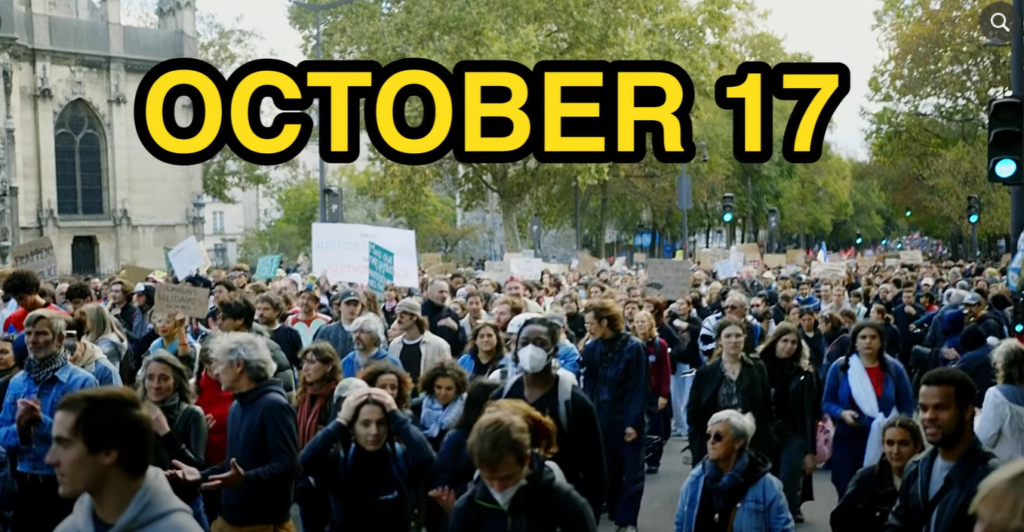
[Feature photograph shows a CJP demonstration, including a slogan of Bhagat Singh, an Indian revolutionary. From Wikimedia Commons, here]
- UNISON young members’ conference calls for Gaza cease-fire - By Left Horizons correspondents Last Sunday, at the UNISON young members’ conference in Newcastle, the following emergency resolution was passed overwhelmingly: The National Young members

- Young members of UNITE move resolution on Palestine - By Steve McKenzie, Unite Community member Resolution number 44 on the agenda of the Unite policy conference (beginning next week) is from the National Young
- Student clubs protest against Labour bureaucracy - By Left Horizons reporters [Editorial note: the text of the statement below, initiated by Durham University Labour club and signed by fourteen more student Labour
- What lies behind schools protests - By Andy Ford, Warrington South CLP The outbreak of school student protests across England and Wales in early this month shows the level of volatility
- Labour NEC elections – Setbacks for the left while turnout tumbles. - By Ray Goodspeed (Leyton and Wanstead CLP) [full internal Labour Party election results are available here] The recent elections inside the Labour Party for various