Town halls up and down the country are now going to be flooded with Reform UK councillors: a surge of racists, xenophobes, transphobes, homophobes, anti-trade union Thatcherites and bigots of all kinds.
It is working class people, many of whom were conned into voting for this poisonous party, who will suffer the consequences where Reform has captured control of local authorities. Services like housing, roads and planning will be drastically impaired by a drive to cut back what Reform considers ‘too large’ a public sector. Expect worse provision of services, higher council taxes and big increases in council rents.
Day-to-day essential services, like waste-collection, education and social care will be squeezed, not only in terms of the service provision, but also in the rights and living standards of local government workers.
The surge of Reform councillors – they gained 1,451 across England – will have lowered a pall of despondency over many on the left. Labour lefts, Your Party (YP) members and some Greens will not only be despairing of the immediate effects of Reform’s march into the town halls; they will be fearful, and with good reason, of the same process being repeated at the next general election. We cannot run away from the truth and at present, polling shows that Nigel Farage, that arch snake-oil salesman, will be the next Prime Minister.
Kemi Badenoch’s Tory Party lost a huge number of seats, 563 in England, making them an irrelevancy in many parts of the country. In county councils that were once their main base, they have lost scores of seats, 53, for example, in Essex alone.
But other than the Reform surge, the real story of these elections has been the utter destruction of the Labour base in the Senedd in Wales and in town halls up and down England and their retreat in Scotland. Left Horizons readers can find the details themselves on the BBC website, but a few salient figures should be cited. In areas that in the past were solid Labour areas, this is what happened:
- Newcastle, until recently, Labour controlled, 46 Labour councillors reduced to 2
- South Tyneside, including Jarrow, 28 Labour councillors reduced to 1
- St Helens: 27 Labour, reduced to 2
- Wakefield: 57 Labour, reduced to 1
- Birmingham, England’s ‘second’ city: 59 Labour, reduced to 18
- Hackney, 50 Labour reduced to 9
- Kirklees: Labour lost all of its 34 seats and now has none
These are a few of the worst results in England, but there are many other local authorities where Labour collapsed dramatically. In some councils in the north west the picture would have been far worse had it not been for the fact that only a third of seats were up for election. Labour would have likely lost control of the city of Manchester, for example, where it lost 24 seats, 17 of them to the Greens.
It is astonishing that Starmer has not thrown in the towel and it is surely only a matter of time before there is a revolt of Labour MPs against him. The BBC reports that as many as thirty Labour MPs have called on Starmer to stand down or announce a timetable for a leadership election. Catherine West, a former minister, has thrown down the gauntlet and will formally propose a challenge next week, when parliament resumes.
Starmer seems delusional. He has appointed former Labour leader Gordon Brown as a special adviser on global finance and Harriet Harman, another Labour ‘grandee’ as an adviser on tackling violence against women and girls.
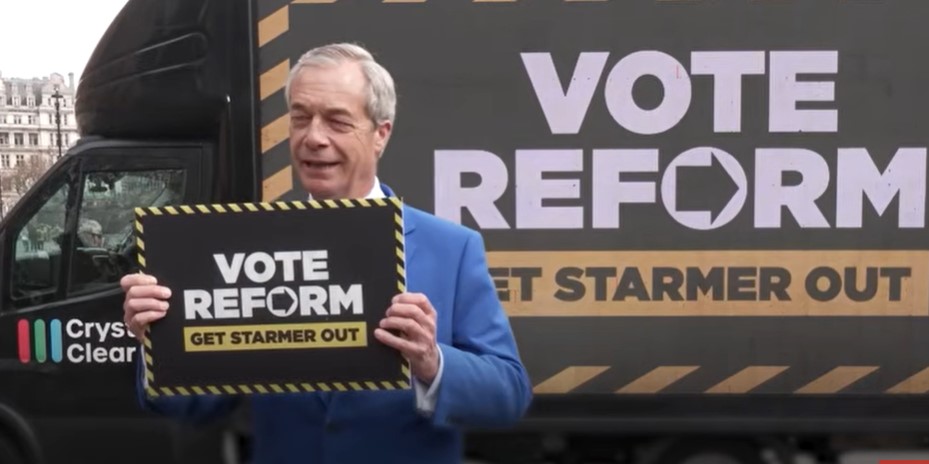
These appointments, and yet another “reset” of his premiership – about the fifth that we can count – will make no difference at all to his unpopularity. Reform was even able to capitalise on Starmer’s unpopularity, by using the slogan “Vote Reform, Get Starmer Out”. The paradox is, that Keir Starmer is Nigel Farage’s greatest asset.
A large part of the collapse of the Labour vote was due to a turn towards the Green Party, particularly in London and larger cities. The Greens gained 441 councillors in these elections and won 548 councillors in England. In London, they made dramatic, sweeping gains, to win control of such Labour strongholds as Hackney, Lewisham and Waltham Forest and took dozens of seats in other boroughs, depriving Labour of a majority. They also took control of Hastings and Norwich outside London
Professor Sir John Curtice, a polling expert, made an interesting comment based on the BBC’s “key wards” analysis. The loss of 1,496 Labour councillors in England, and the increase in Reform councillors by 1,451, by no means implies a straight switch from Labour to Reform.
“A sharp fall in Labour’s performance”, he wrote in a post on X, “is accompanied more often by an above average Green performance than it is by a strong Reform performance. Meanwhile, it is the Conservatives who appear to be suffering most where Reform is advancing most”.
Reflecting the perversity of the first-past-the-post system, he adds, “It should be remembered that Labour may often lose seats to Reform because it is losing votes to the Greens, while the Conservatives are losing votes to Reform. The net effect can be that Labour end up losing a seat to Reform.”
Out-of-touch Starmer government
As we argued in our last editorial, published the day before the election, many former Labour voters were so utterly fed up with the out-of-touch and ‘non-Labour’ policies of the Starmer government that they were expected to switch to the Green Party and that proved to be the case. They saw the Greens, under the leadership of Zack Polanski and with policies not dissimilar to those of the Corbyn Labour Party, as the ‘real’ Labour Party. But notwithstanding this, in many former Labour heartlands like Barnsley and Tyneside, there must have been a lot of straight switching from Labour to Reform.
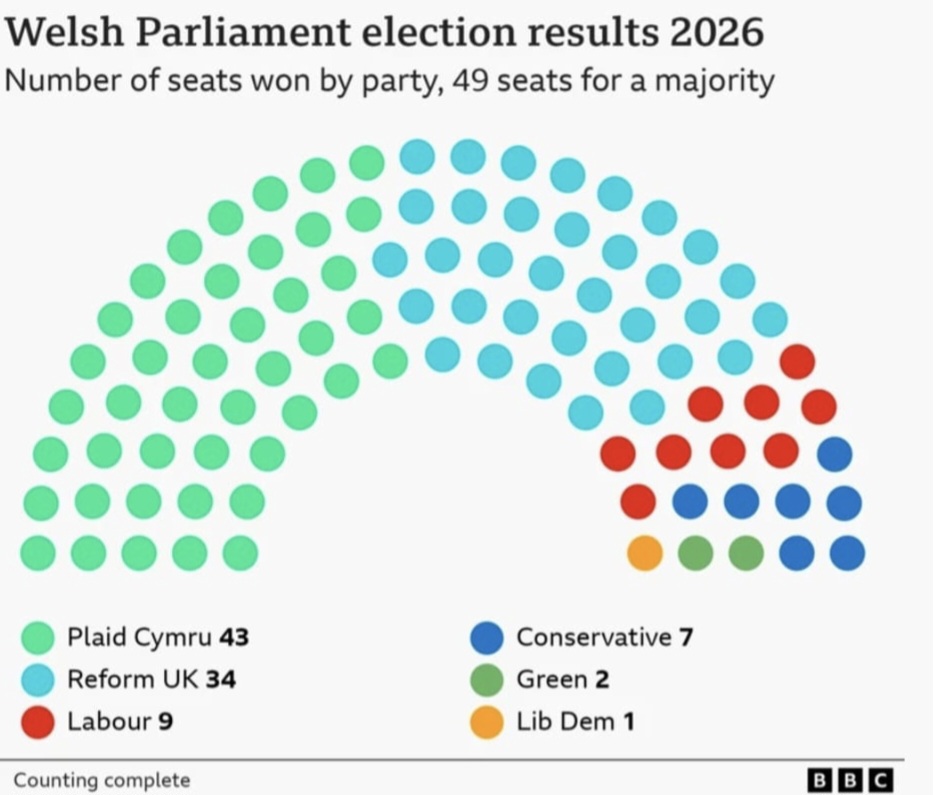
Labour suffered big losses in Wales, where it has been the biggest party for over one hundred years, but is now reduced to just 9 seats out of 96 and 11% of the vote – 25% down from the last election. Plaid Cymru will form the next administration in the Senedd as the largest party, but with no overall majority. It was notable that when she accepted defeat, the Labour former Welsh first minister Eluned Morgan called for Starmer’s government to “go back to being the party of the working class”. There must be millions of voters who think the same.
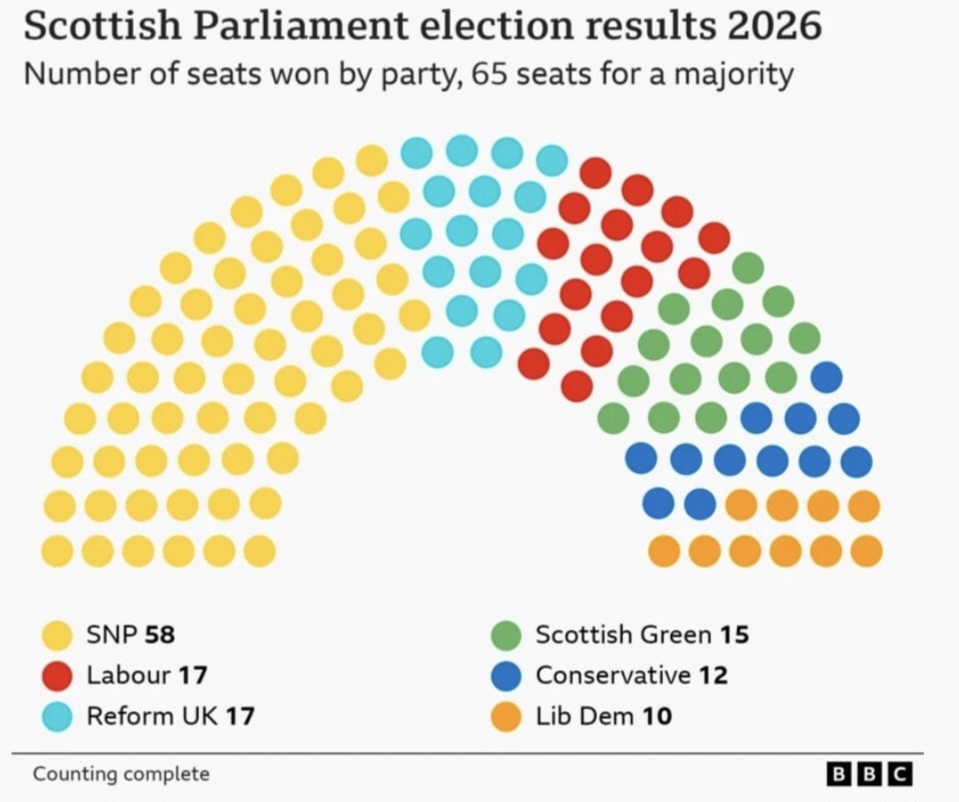
Similarly in Scotland, where Labour was thought even recently to be in a position to challenge the Scottish National Party (SNP), it has fallen back and is now the joint second-largest party in the Scottish parliament, with 17 seats, the same as Reform. Gains were also made by the Scottish Greens, so as to give a majority to pro-independence parties.
The gloom among Labour MPs was made apparent by the comment of another MP, Ian Lavery, who said “Keir Hardie started the Labour Party. It could be another Keir — Keir Starmer — that could end the party forever.” On current trends, three quarters of Labour MPs will lose their seats in three years’ time.
Although, incredibly, there are still supporters of Starmer who imagine that the government can ‘turn things around’ in the next three years – and that is certainly Starmer’s view – they are living an illusion. It can only be a matter of time before blind panic begins to set in within the parliamentary party.
The key to developments in the Labour Party now are the affiliated trade unions. Apparently the leaders of Unison and the GMB are demanding an “urgent change of direction” and a meeting with Starmer after these “catastrophic” results. It has only been the acquiescence of big union leaders – including those of the GMB and Unison (under its previous general secretary) that has allowed Starmer to move the Labour Party so far away from its grass roots support. But the worm may be turning.
The pressure for the trade unions has to be increased, and soon. If there were decisive moves within the organisation of affiliated unions – TULO – it could have a meaningful impact on the Parliamentary Labour Party and give some backbone to otherwise apparently spineless MPs. Once the ice is broken and Starmer is dumped – then the entire atmosphere in the Labour Party will begin to change, and for the better.
It is not, of course, only a matter of who leads the Labour Party; it is a matter of what policies and programme the Labour Party advances. The political leadership of Reform are confidence tricksters; their councillors are mostly a rag-taggle of obnoxious former Tories and Thatcherites, mixed in with far-right racists.
But much as we can despise these political charlatans, we do not and should not have the same attitude towards those who were persuaded to vote for Reform, either former Tories or former Labour voters. There really are important issues that blight the lives of working class people and inject fear and a sense of insecurity and uncertainty.
The NHS, as it is experienced by most people is getting worse. Housing is becoming less affordable with each passing year. Schools are strapped for cash and local government services are shrinking. People are ripped off week in and week out by privatised water and energy companies. Take home pay is not keeping pace with prices, especially rents.
In a nutshell, working class families are running hard just to stand still. It is a crime for Reform to point the finger of blame at migrants for the failures of capitalism, but those failures are real, nonetheless, and Keir Starmer has no intention of challenging a system so completely rigged against working class people.
The onset of Reform government at local level will usher in a period of industrial struggles as local authority workers – like the refuse workers in Birmingham – fight back against attempts to cut their wages and conditions. But a fight has to be waged as well inside those trade unions affiliated to Labour, for a socialist programme that includes policies in the interests of the working class.
Problems of daily life
The failure of the Labour Government to solve the problems of daily life of workers, or to deal with the inequality and hardship, or offer a clear alternative to shrinking living standards and cuts in services, will simply pave the way for a Reform government. We are in a dangerous moment. Only class-based policies can cut across the xenophobia and racism peddled by the far right.
The privatised utilities should be brought back into public ownership and managed democratically in the interests of consumers, not shareholders. A massive house-building programme could be initiated by taking development land out of the hands of speculators and nationalising the top six building companies. Rents should be controlled or private rented housing brought into the public sector.
Banks, finance and the money markets would react to any change of Labour leadership in the same way they did to Liz Truss’s premiership. The only way to forestall being dictated to by the ‘money markets’ is for a Labour government to break the power of private finance and the banks by public ownership of the banking sector and the implementation of cheap loans to local authorities to build homes and develop services.
It is working class people who are going to pay the price for the surge of Reform. Socialists, whether in the Green Party, Your Party or in the Labour Party have to stand shoulder to shoulder with workers fighting back against Reform. But they also have the duty and responsibility to fight across all three parties for common ground in struggles and campaigns and, above all, for support for real socialist measures as an answer to the problems that workers face.
Feature picture shows a still from a Reform publicity video. Inset graphics showing balance in the Senedd and Scottish parliament are BBC graphics