by Pablo Híjar
The following interview, of the Bolivian economist and trade unionist, René Behoteguy, was published in Por el Socialismo in Spain. It analyses the causes and perspectives of upswing in mass protests in Bolivia
We have the privilege of being able to chat regularly with René Behoteguy and the events that Bolivia is experiencing at the moment made us pick up the phone to ask him three questions. We wanted to know the causes of the important movement of popular protests, their perspectives and their influence on the American continent, or Abya Yala, as our interlocutor prefers to call it.
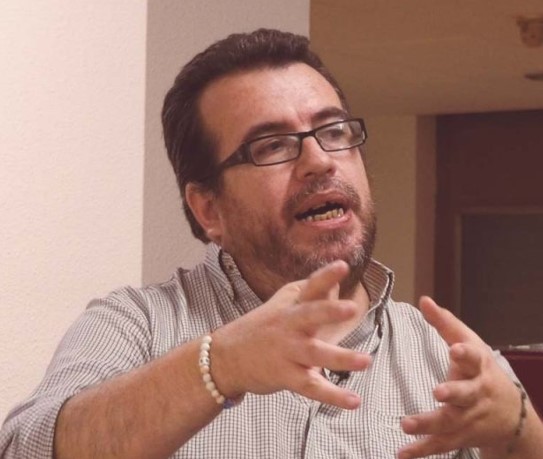
René Behoteguy is a Bolivian economist and trade unionist based in Vitoria-Gasteiz who, on several occasions, has allowed us to get closer to the Latin American reality and beyond. We hope that this concise interview will be useful for the readers of por elsocialismo.net, who share our admiration for the infinite capacity for organisation and struggle of the working class of Bolivia.
What are the causes of this social and political explosion, not long after the arrival of the new right-wing government in Bolivia?
I think that the main background that must be taken into account is that, although from the beginning it was known that it was going to be a right-wing government, the truth is that, in the face of the two strong candidacies of the right – that of Tuto Quiroga and that of Samuel Doria Medina – and in the face of the proscription of Evo Morales, the popular sectors, especially urban ones, and a good part of the rural popular sectors of Aymara and Quechua origin opted, in the first round, to give the victory to Rodrigo Paz, especially because of his candidate for vice president, Edmand Lara, who is closer in origin and discourse to the popular sectors.
In the second round, when Evo stopped calling for abstention, Rodrigo Paz won overwhelmingly, but he won with the vote of the popular and indigenous sectors, and that is the key. It was hoped that, especially by his vice president, Edmand Lara, he would respond in some way to the agenda of the popular and indigenous social sectors.
What has happened? That Rodrigo Paz has formed a cabinet with people from the parties that lost the elections and has begun to take measures that fundamentally favour the most affluent sectors of society and, especially, the agricultural sector of the East.
First he removed the tax on large fortunes; then, in the face of the real shortage of gasoline, he eliminated the subsidy on hydrocarbons. He wanted to raise prices a lot and, to make matters worse, the gasoline that entered the market, managed by YPFB, was of poor quality and has ruined thousands of cars.
Therefore, gasoline is more expensive, there is still a shortage and, in addition, what there is is of very poor quality and is destroying vehicles. That was generating a new social unrest. When he approved the decree to remove the gasoline subsidy, he also included another that allowed him to handle state contracts quickly and without going through Parliament, in order to be able to deliver natural wealth to foreign companies, which generated a first popular reaction and a mobilization of the COB that forced him to back down.
At that time it was agreed to maintain the elimination of the subsidy because there was really hope that this would solve the fuel problem, but the truth is that right now there is not enough gasoline nor is the one that is available good. And the government continues to govern in favor of the interests of the wealthiest.
In fact, the last issue to spur the struggles was a land law that allows small properties to be converted into medium-sized properties susceptible to acquiring bank loans. In the end, what is sought is that the people of the countryside, in a critical situation, sell their lands or mortgage them and end up in the hands of the landowners.
This also generated a large indigenous march. Not only from Aymara and Quechua, who are usually the most mobilised, but also from the Amazon jungle and the eastern sectors of the country.
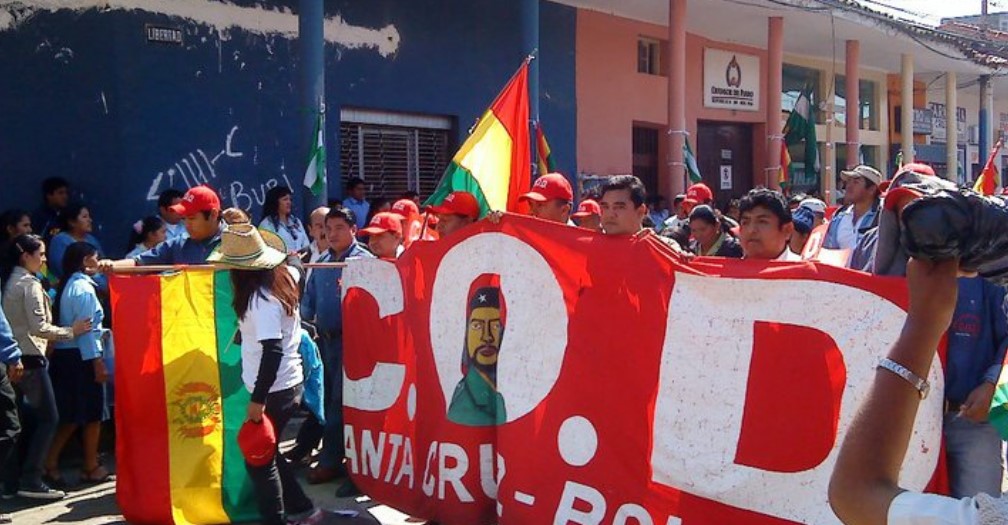
So, in the face of this scenario of defaults, a growing crisis and galloping inflation that, far from improving, has worsened due to the lack of fuel; in the absence of solutions and, above all, in the face of a government that has also fought to the death with the vice-president and has broken off any dialogue with the popular sectors, the Bolivian Workers’ Central, in a town hall held on May Day, demanded that, if the government was not going to fulfill the promises to raise salaries and improve the conditions of teachers, miners and workers, then his resignation had to be considered directly.
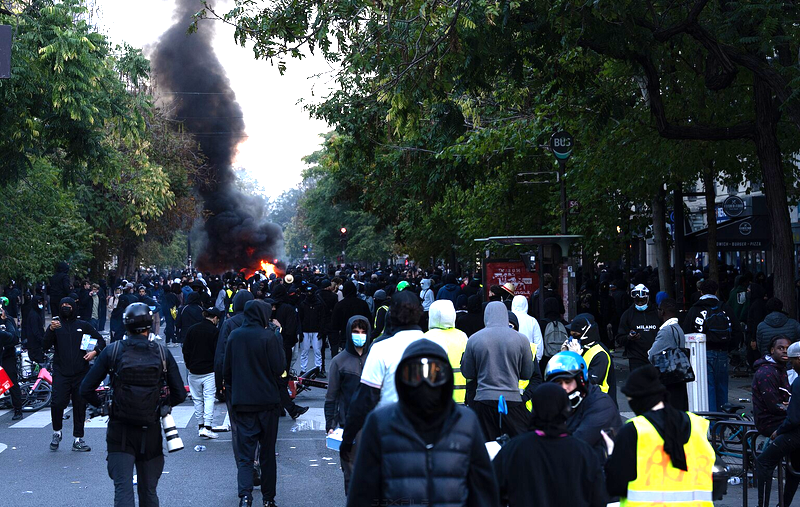
There began to converge a very strong mobilisation of the Workers’ Central, with the miners, the urban and rural teachers, and also the peasants, who began to block roads. Added to this are the residents of El Alto, who until then had remained more passive.
There are currently more than a hundred blockade points in Bolivia and the seat of government is totally surrounded by social movements. The government is absolutely suffocated.
What’s the outlook right now? Can the government fall? Can there be a bloodbath?
There is a key there, and that is the attitude of the government. He is clearly pointing to drug trafficking and Evo Morales as those responsible for financing this mobilisation. But we must be clear: although Evo supports and is part of the mobilisations, he is not the one who organises them, or their leader.
Second: there is no financing of drug trafficking or anything like that. Indigenous popular organisations have an enormous capacity to convene and organise themselves. In addition, they are the ones who produce a large part of their own food, so they can endure a very long time in a situation of blockage.
Those who suffer the most from these situations are the urban middle class sectors, especially in La Paz. That’s when a significant asphyxiation begins to be felt and, obviously, the middle class is against the blockades, but also against the government, which they consider incapable of solving the situation.
The government believes it can win by attrition, something that seems unlikely. Nor does it have much capacity for dialogue or negotiation. It is repressing and trying to unblock roads, but it has not been able to. Even soldiers and police have been trapped in some blockades.
Unable to resolve the situation, the two solutions appear to be either a negotiation, likely linked to the president’s resignation, or an escalation of repression. But there are serious doubts about whether the army and police would agree to engage in a violent exit at this point.
I don’t think they would. So the government is in a very big deadlock situation. We cannot guess what will happen, but the capacity for resistance of the indigenous and popular movement, of the peasants and the residents of El Alto is enormous and they are determined. So yes, the fall of the government could very well occur.
The problem is that, once the government falls, the vice president would have to call elections and there is still no popular unity sufficiently articulated to guarantee an electoral victory. The risk is that something similar happens in Ecuador: right-wing presidents fall and then another right-wing government enters.
If the popular sectors also manage to articulate themselves in this later scenario, a very interesting stage could open. But what has become clear is that the Bolivian popular sectors are not willing to give up what has been achieved during these years. They are not willing to return to a colonial and racist state built only for the benefit of the white elites and where the indigenous do not count. They are not going to accept that.
I believe that the background of the mobilisation is not only the concrete measures of Rodrigo Paz, but the struggle against that model of an exclusionary country to which they are not willing to return.
Even if Rodrigo Paz were to overcome this crisis and stay in power, he would be so weakened that his future would remain uncertain.
What influence are events having on a continent that, on paper, is experiencing a reactionary wave? Because one of the things that is surprising about this mobilisation is precisely how it arises in that context.
That’s the interesting thing. At a time of retreat of popular movements, this is being seen as a hope and an anchor. It is interesting to see people mobilized in Argentina saying on networks: “Let’s follow the example of Bolivia.”
I think that in Argentina it is having a very clear effect of signalling that this is the way to confront Milei. Leaders such as Myriam Bregman or Juan Grabois have already raised it openly.
This may push towards a major escalation. In addition, a conflict has been generated with Colombia, because Petro offered to mediate and Rodrigo Paz responded by expelling the Colombian ambassador.
Rodrigo Paz is receiving support even in the form of gas and riot control material from Argentina, because there is a real fear of contagion. There are fears that this path of mobilisation – road blockades combined with constant mobilisation in the streets – could be replicated in other countries, especially in Argentina and Peru, where a similar scenario would be perfectly possible.
That could completely change the dynamics of rightward shift that the continent is experiencing.
From the Spanish socialist website, Por el Socialismo, the original here.
Feature picture of an earlier Bolivian workers’ demonstration is from Wikimedia Commons, here.