We republish here a long post taken from a private Facebook group for trans people and their supporters, and used with permission but anonymously. It sets out in moving detail the effects on the life of one trans woman of the Supreme Court Judgement of April 2025 and the subsequent guidance produced by the so-called Equalities and Human Rights Commission. It is a copy of a letter to the EHRC and asks a number of questions, to which it requires answers.
The response from the EHRC was a standard reply from “the correspondence team” full of weasel words about the importance of the “dignity, privacy and right to participate equally in society” still being protected in law, while in fact banning trans people from using facilities appropriate to their gender and forcing them into facilities for their “biological sex” or even banning them from those! It suggests instead using separate facilities which may or may not exist or those for disabled people – in any case having potential for exclusion, humiliation, and outing as trans (see here and here for more detailed articles).
It says that “Nobody should be discriminated against when using any service. But that does not necessarily mean that service providers must treat everybody in exactly the same way.” Yet forcing people to use “separate but equal” facilities is in itself discriminatory.
It accepts that “The Gender Recognition Act 2004 (GRA) says that a Gender Recognition Certificate (GRC) changes a person’s gender for all purposes, unless otherwise intended by other legislation.” And then blithely declares that the Supreme Court judgement says that the GRA no longer applies to the entire Equality Act of 2010, the bedrock of all legal rights for oppressed groups, as only “biological sex” counts.
It fails to answer the questions regarding medical issues, saying that everyone has the right to be treated, whereas the issue raised was one of treatment on a male ward. And the answer regarding sport says that the new judgement only applies to “competitive sport” – well that’s OK then!
On one point the EHRC is partially correct – only the government through Parliament can change the Supreme Court decision, and Labour government’s betrayal of trans people on this issue will not be forgotten. But the EHRC itself was captured under the Tories as senior staff known not to support trans people were inserted by the Tories in the early 2020s and their interpretation of the law very much reflects that. Over 160 MPs called for the guidance to be withdrawn, around half of those Labour MPs, but the government looks set to plough on and implement the new guidance in full.
Too often, this “debate” is framed as one between competing ideologies and the reality of the effects on real trans people is marginalised. Indeed the Supreme Court itself did not allow any witnesses from the trans community to be heard in considering its decision, which has effected trans people more than any other group. Far from the trans community dominating the discussion, in actual fact, their voices are rarely if ever heard.
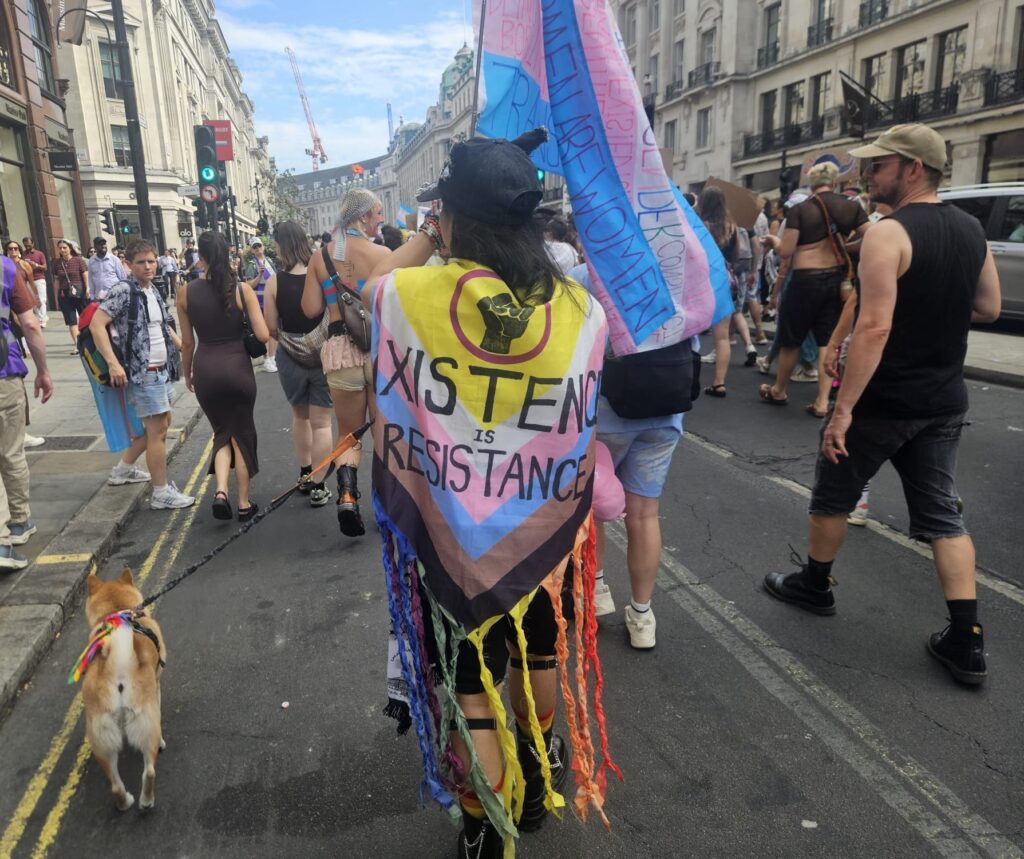
– photo Left Horizons
Today (25 July) is London Trans Pride, which remains a protest – unlike the main London Pride ‘Parade’ with its corporate dominance, dodgy sponsors and shameless marketing opportunities. It preserves that anger born of constant demonisation, harassment, prejudice and discrimination that trans people face every day and which, under the current Labour government, is getting much worse than before.
But the trans community and even the wider LGBT community cannot fight back against these legal changes alone. It is essential that the labour and trade union movement support trans workers and the trans community as a whole. Most unions have good or reasonable official policy on the issues and this must be turned into an active campaign to support those who refuse to comply with these discriminatory new policies.
******
Dear Dr Mary-Ann Stephenson, Chair of the Equality and Human Rights Commission
I would be grateful if this correspondence could also be shared with the Commissioners, as it concerns the practical impact of the EHRC’s proposed Code of Practice and the Commission’s role as the United Kingdom’s National Human Rights Institution.
I am writing as a transgender woman with a Gender Recognition Certificate, but first and foremost as someone who has spent almost twenty years building an ordinary life.
I am a professional manager trusted to lead people and support vulnerable individuals, breaking down unconscious bias and lifting women into senior positions. I am a homeowner, a wife and someone who has always tried to contribute positively to my community. This includes coaching kids of all genders, abilities and disabilities to play basketball, some who now represent England at the national level. For more than twelve years I played women’s basketball without complaint, incident or safeguarding concern and no biological advantage. I demonstrated through my actions that inclusion could work.
I did everything my country asked of me. I followed the law. I completed the legal process to obtain a Gender Recognition Certificate. I changed my legal documents. I built my career. I lived openly, honestly and respectfully as the woman I am. I believed that by doing so my country had recognised not only my legal status, but also my dignity, privacy and right to participate equally in society.
Today, I no longer know how the EHRC believes I am supposed to live.
Over the past two decades I have built a life that I was proud of. I have built a successful career, a loving marriage, lifelong friendships and a respected place within my community. I have lived openly and honestly as a woman, contributed positively to society and tried to leave every place better than I found it.
Grief
Today, I feel as though much of what I have spent twenty years building is slowly being dismantled. It is difficult to describe the grief that comes with feeling that your place in society is being taken away, not because of anything you have done, but because of who you are.
The EHRC’s Equality Impact Assessment acknowledges that transgender people are likely to experience adverse impacts as a result of the proposed Code of Practice. I want you to understand what those impacts look like in real life because we are already feeling it.
I no longer leave my home without considering whether I will need the toilet or if I’m going to come across someone critical of my existence. There are occasions where I deliberately avoid drinking for several hours because I fear needing to use public facilities. Something as ordinary as drinking water has become something I have to think about because I am frightened of being challenged, humiliated or excluded simply for needing the toilet. In other instances I have been so frightened to go to the loo nature has taken over! Leaving me more embarrassed than any time in my life.
The greatest loss has not been my legal status. It has been my confidence. I now assess risk before carrying out ordinary activities that most people never think about. Can I safely use the toilet? Will I be challenged? Will I be humiliated? Will I be made to leave? Will I still be treated as the woman I have lived as for almost twenty years?
Living with that constant uncertainty has changed how I experience the world. One of my greatest fears now relates to healthcare. I have recently discovered a lump in my natural breast tissue. Yes I have a full C-cup.
At a time when my only concern should be whether I have breast cancer, I instead find myself overwhelmed by another fear: whether I will be treated with dignity if I require hospital treatment. If, at one of the most vulnerable moments of my life, I were placed on a men’s ward, I believe it would strip away that dignity.
I have lived as a woman for almost twenty years and am lucky enough to have “passing privilege” so in all aspects of my life I move look and sound like a woman. Being placed in a men’s environment would immediately identify me as transgender in circumstances where I would be at my most vulnerable. My concern is not simply embarrassment. It is the loss of privacy and dignity, together with the fear of being exposed to hostility, intimidation or threats at a time when I should simply be concentrating on my health. This is real, as I experienced this before the 2010 act was published.
Frightened of seeking treatment
Hospitals should be places of safety. Instead, I now find myself frightened of seeking treatment. No patient should have to carry those fears into hospital. The emotional impact extends far beyond healthcare.
Basketball has been one of the greatest joys of my life. For more than twelve years I played alongside women without issue. I built friendships, supported women and girls, encouraged participation and showed through my actions that inclusion could work. I never became a safeguarding concern. I never caused problems. I simply belonged.
Today I have lost that community. I have lost friendships. I have lost a place that gave me purpose, confidence and belonging. The loss is far greater than simply not being able to play basketball. It represents the loss of part of my identity.
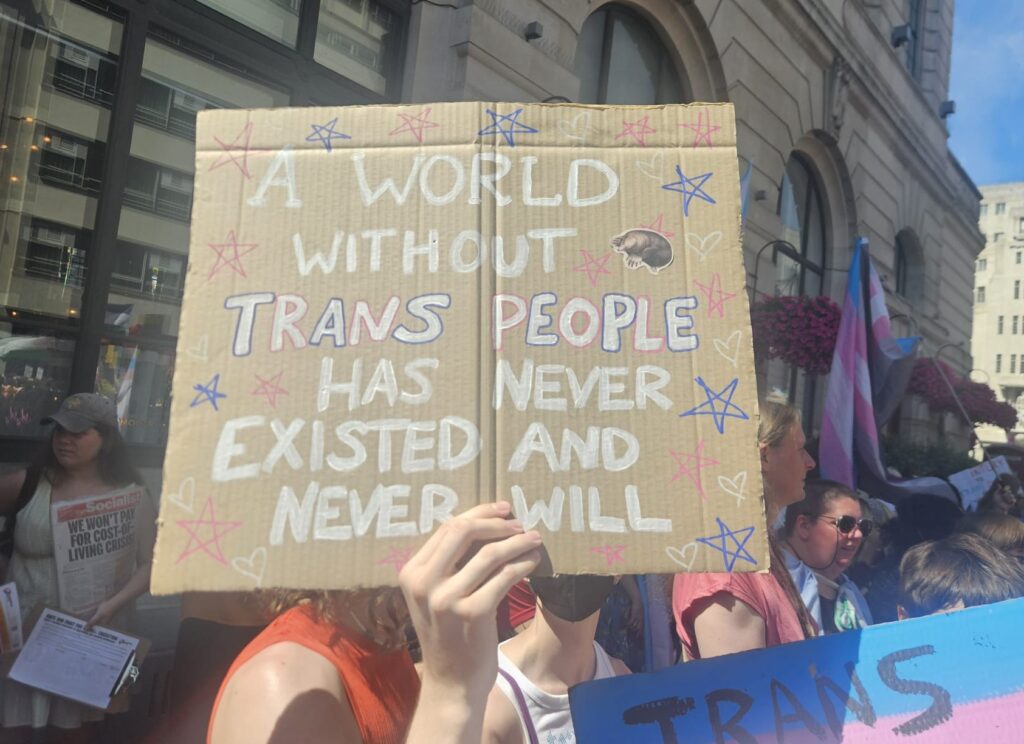
[photo – Left Horizons]
I have also become increasingly anxious about my future employment. Whether or not my transgender status is the reason in every instance, I no longer have the confidence that opportunities will be judged solely on my ability and experience. That loss of confidence is itself deeply damaging because I am now starting to see this play out in practice. I have a mortgage and life to fund and will be put in a place when I will have to rely on the state.
I have spent years trying to change minds through education, community work and sport. I have always believed in bringing people together rather than dividing them. Today, I increasingly feel excluded from the very society I have worked so hard to contribute to.
Against that background, I would appreciate answers to the following questions that I would respectfully ask the EHRC
1. How does the EHRC expect a person with a Gender Recognition Certificate to live in practice under the proposed Code? I am legally recognised as a woman. My passport and other official documents reflect that status. How does the EHRC expect me to live authentically, safely and with dignity if I increasingly feel unable to access services, public facilities and everyday spaces as the gender in which I am legally recognised?
2. How does the EHRC believe its current approach reflects the purpose of the Gender Recognition Act 2004, which followed Goodwin v United Kingdom and sought to provide legal recognition, dignity, privacy and certainty for transgender people?
3. As someone who holds a Gender Recognition Certificate and is legally recognised as a woman, am I entitled in my ordinary day-to-day life to describe myself simply as a woman, without disclosing that I am transgender, unless there is a specific legal obligation to do so? If the EHRC believes otherwise, could you explain the legal basis for that position?
4. The EHRC’s own Equality Impact Assessment recognises that transgender people are likely to experience adverse impacts from the proposed Code. What specific actions will the EHRC take to mitigate those harms and ensure that transgender people continue to enjoy equal participation in society?
5. Where in the proposed Code does the EHRC explain how transgender people should continue to be included in society? I have read a great deal about circumstances in which exclusion may be lawful, but very little about how people like me are expected to continue living, participating and belonging.
6. How does the EHRC intend to assess the cumulative impact of exclusion on transgender people’s physical health, mental wellbeing, employment, community participation and confidence in public institutions?
Dignity and privacy
7. How does the EHRC expect transgender people to access healthcare with confidence if they fear that their dignity, privacy and legal recognition may not be respected during treatment, including concerns about ward placement?
8. If transgender people increasingly avoid healthcare, public facilities, employment, travel, sport or community participation because of fear or uncertainty, would the EHRC regard that as a successful equality outcome? If not, how will those consequences be monitored and addressed?
9. How does the EHRC consider that National Governing Bodies should balance fairness, safety and inclusion while remaining compliant with equality law? Does the EHRC support inclusive participation models, including FLINTA* sessions where appropriate and clearly defined by organisers, as one way of ensuring women, transgender, non-binary, intersex and agender people are not excluded from community sport?
10. The Paris Principles require National Human Rights Institutions to promote and protect the human rights of all people, particularly those who are vulnerable to discrimination. How does the EHRC believe its current approach demonstrates that it is fulfilling this responsibility in respect of transgender people?
11. The Paris Principles also emphasise meaningful engagement with affected communities and maintaining public confidence as an independent National Human Rights Institution. How has the EHRC ensured that the lived experiences of transgender people have meaningfully influenced its approach, and what changes were made as a result of that engagement?
12. International organisations, including the Lemkin Institute for Genocide Prevention, have publicly expressed concern about the direction of policy affecting transgender people in the United Kingdom and have described what they see as warning indicators that deserve careful attention. Has the EHRC considered those concerns, and if so, what assessment has it made of them when developing its current approach?
13. Finally, if the EHRC believes that certain forms of exclusion may be lawful in some circumstances, what is its positive vision for the inclusion of transgender people? Where, and under what framework, does the EHRC believe people like me should live, work, access healthcare, participate in sport, travel and contribute to society while retaining our dignity, safety and legal recognition?
These questions are not theoretical. They are about my life. I have spent almost twenty years building that life. I am not asking for special treatment. I am asking how I am now expected to live.
I hope the EHRC will take the time to answer these questions personally and explain how its proposed approach enables someone like me to continue living with dignity, equality and confidence.
Yours sincerely,
* In German, “FLINTA” stands for Frauen, Lesben, Intersexuelle, Nicht-binär, Transgender, and Agender, which translates in English into Female, Lesbian, Intersex, Nonbinary, Transgender, and Agender.
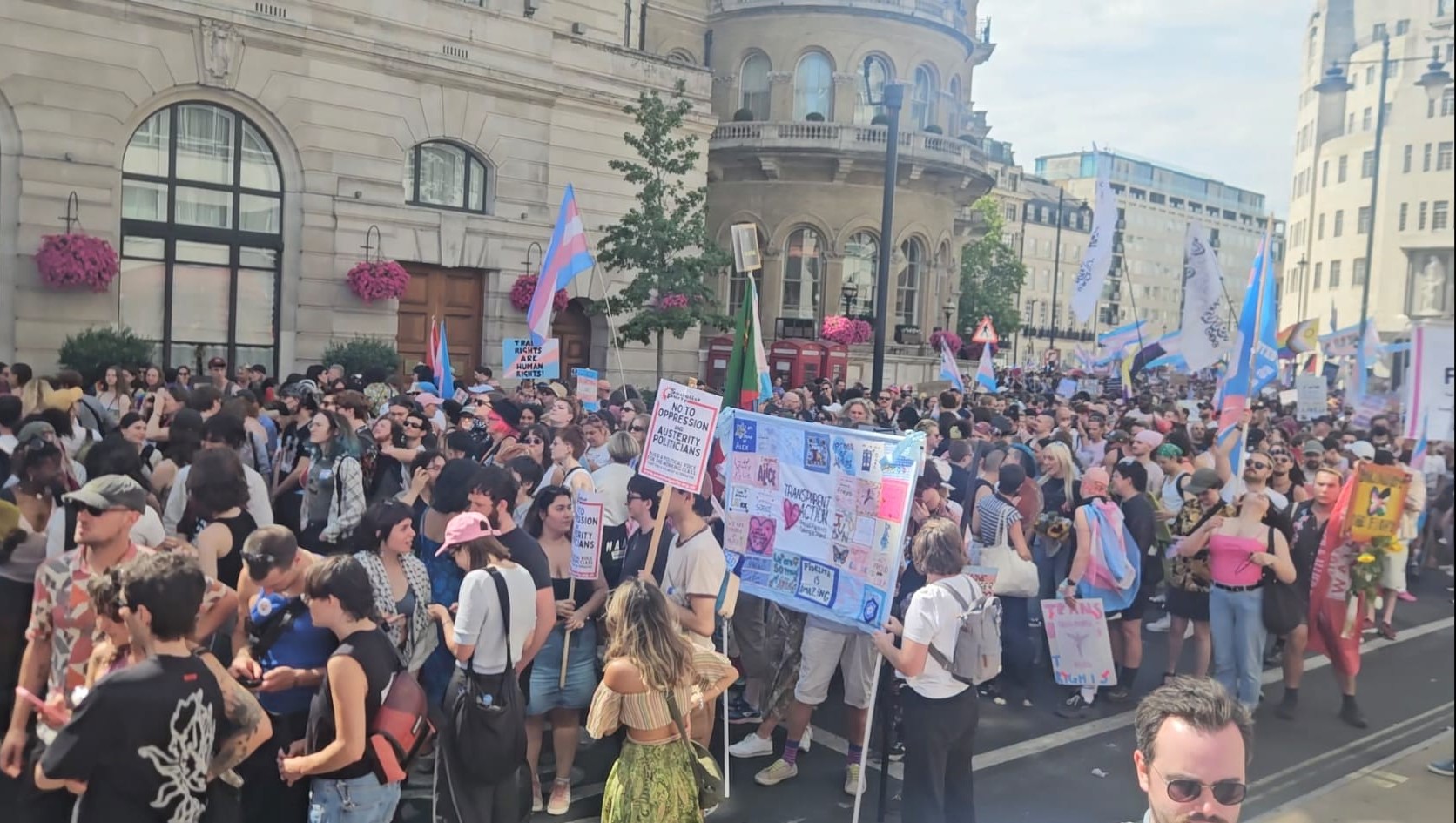
[Featured image – from the London Trans Pride March – 25 July 2026 – photo Left Horizons]