
By David Niven, PCS member, Defra North West & Cumbria Branch
In our article ‘Who runs PCS – the members or the bureaucracy?’ we described the power struggle at the top of PCS between the national President (Bev Laidlaw) and the Coalition for Change (CFC) majority on the NEC on the one hand and the Left Unity (LU) General Secretary (Fran Heathcote), backed up by the LU minority on the NEC and sections of the PCS bureaucracy (full time officers), on the other. We explained how this was delaying action on important policy motions that were agreed at this year’s Annual Delegate Conference (ADC).
Bev and Fran have since sent out a joint email to PCS members stating that ‘We are seeking to work together to build a strong and united trade union that delivers for members at the bargaining table on jobs, pay and terms and conditions’ and that despite the differences expressed at the NEC meeting on 11th June, the NEC has ‘agreed to adopt a process to get the union’s business back on track.’
Time to deliver on conference decisions
This truce between the rival factions, which may prove to be only temporary, should now allow the NEC to now focus on implementing the key policies agreed at annual delegate conference (ADC).
The PCS conference policy on pay and jobs for 2026 was covered in our earlier Left Horizons article ‘The way forward for the PCS union – part 1’. Other key policies agreed at this year’s conference were as follows:
Insourcing
PCS has long campaigned for services to be delivered directly in house for the benefit of both workers and consumers, and this was again a key issue discussed this year.
Insourcing will tackle the multi-tier workforce that currently exists across government workplaces. Bringing workers in-house will create greater parity, coherence and fairness in pay, terms and conditions, ensuring staff are treated with the dignity and respect they deserve.
It will also generate savings for the taxpayer and will improve performance and accountability, rather than allowing private companies to extract profits from publicly funded contracts.
The debacle with payments from the Civil Service Pensions Scheme
The disgraceful performance of the private sector administrators of the Civil Service Pensions Scheme (CSPS) over the last year understandably prompted a number of motions from PCS branches.
Almost all fully and partially retiring civil servants have been left waiting for months on end, and in some cases for over a year, for payment of their pensions after their retirement start date, often causing serious financial hardship.
When the administration transferred from one private company (My CSP) to another (Capita) at the end of 2025 things only got much worse.
We need more urgency on the Government promise on insourcing
The Labour Government promised the biggest wave of insourcing in a generation, but we have not seen enough urgency and action to back this promise up yet.
In fact, Capita, who have failed so badly in administrating civil service pensions have since been rewarded with a further government contract for the Synergy Programme for four government departments which involves providing payroll, HR, finance, and procurement services!
PCS members are certainly not looking forward to Capita messing up our monthly pay as well as our pensions, and as you would expect the motions adopted by conference contained the following statements and demands:
- That public services should be delivered in house in the public interest not for private profit
- For an independent public enquiry into the CSPS outsourcing process
- For the government to insource the administration of the CSPS
- For a strengthened statutory and contractual framework for all critical payment and pensions services
- For increased staffing resources for CSPS administration
- For the government to cancel the Synergy contract with Capita and to bring the functions back in house
Since conference the government has announced that around 2,000 workers employed on some of the outsourced facilities management (FM) contracts delivering support to civil service departments will be insourced when the current contracts expire in 2028.
Workers rights for workers formerly outsourced
PCS needs to ensure that these workers, who are employed in a wide range of roles including security, cleaning and catering become civil servants when the current contracts expire rather than being transferred to a separate government owned company where low pay and inferior terms and conditions are maintained.
We also need to campaign for workers employed on other outsourced FM and other government contracts to be brought in house.
New Prime Minister, Andy Burnham, has made a number of statements railing against an ‘outsourced state with little accountability’ and promising to rein in government outsourcing, so PCS should do everything we can to hold him to account on this in the coming months.
Anti Austerity
Attacks on some of the most vulnerable members of society by this current Labour government formed the basis of a key motion which proposed a progressive overhaul of the welfare system.
The disgraceful cuts to the winter fuel allowance which were partially reversed following public pressure, the refusal to compensate the WASPI women, and the planned cuts to disability benefits were all referenced in the debate.
The motion commits PCS to:
- Encourage members to be part of local and national campaigns alongside other trade unionists to defeat any further government attacks on our welfare system
- Campaign for a progressive alternative for welfare based on a decent standard of living for all claimants, in conjunction with sufficient council housing with strict rent controls
- Produce outward-looking campaigning material for the progressive alternative for welfare with a clear guide on what PCS members can do to help build the campaign in local areas and how we can work closely with others such as claimant organisations, trades councils and other unions to defeat further attacks.
Climate Change & The Environment
In response to the growing climate crisis and the serious issue of biodiversity loss conference passed a motion committing PCS to campaign for support for the ‘Climate and Nature Bill.’
This private member’s bill is in response to the increasing risk of food insecurity, flooding, disease and instability and a result of these two threats.
If the bill is passed the UK’s international commitments to the global 1.5°C target to limit the increase in average global temperatures (Paris Agreement) and halting and reversing nature loss by 2030 (Montreal Agreement) would both become legally binding in UK law.
Whilst such legislation would be useful, what is urgently needed now is the delivery of a democratic plan to tackle these issues based on public ownership of key industries such as energy, transport, and housing.
Anti Racism
With the growing threat from the Far Right both on the streets and within council chambers and Parliament, conference discussed motions which re-assessed our anti racism strategy.
The best of the motions that were carried stated that it is essential that the trade union movement plays the leading role in building a united movement against the Far Right.
And it recognised that the strike wave over the last few years ‘has shown that workers and their unions are prepared and able to fight to defend jobs and living standards, and when they do so, they become a pole of attraction for all those suffering from austerity and who the far right are targeting with their divisive policies.’
The motion commits the NEC to working towards ensuring that:
- PCS takes a lead in calling for the TUC and the other unions to organise behind the demand: ‘Worker’s unity not division – jobs and homes not racism’. And in all PCS interventions, our anti-austerity programme must be to the front.
- Where the far-right call protests in localities, the trade union movement takes the lead in organising counter protests, linking up with migrant, refugee and any targeted communities as well as anti-racist and anti-fascist organisations.
- These protests should be well stewarded by trade unions to guard against any threat from far-right groups. PCS should take the lead in demanding that the TUC and other unions organise and build a national organisation of union reps to steward protests against the far-right.
- The unions must fight to compel the Labour Government to implement pro-worker policies and if it does not do so, the unions should call a conference to discuss the building of a political vehicle for workers.
Trans+ Rights
Conference debated the implications for Trans+ comrades as a result of last year’s Supreme Court ruling (that the terms “sex”, “man”, and “woman” in the Equality Act 2010 mean biological sex), and the EHRC’s Code of Practice resulting from that judgement.
The motion that was agreed overwhelmingly by conference stated PCS’ belief that the High Court ruling of 13th Feb, which upheld the EHRC’s guidance that single sex spaces can legally be restricted to biological sex, poses an urgent threat to the Trans+ community, and that PCS should lobby Parliament to amend the law to explicitly state that trans women are women and trans men are men for ALL purposes with protections for non binary identities.
The motion also instructed the NEC to seek legal advice to ensure:
- PCS is prepared to defend the rights of Trans+ members once the updated EHRC Code of Practice is laid before Parliament and comes into force.
- PCS reps and members receive clear policy advice on their rights under the Equality Act.
- Our members and reps have access to guidance on workplace facilities disputes arising from the High Court’s ruling.
- Trans+ members are supported in grievance and employment tribunal proceedings where their rights under the gender reassignment protected characteristic are engaged.
The motion also committed PCS to provide support for the Good Law Project’s appeal against the High Court’s ruling on workplace facilities.
‘Solidarity’ and ‘An injury to one is an injury to all’ was the clear vibe amongst the vast majority of delegates during the debate.
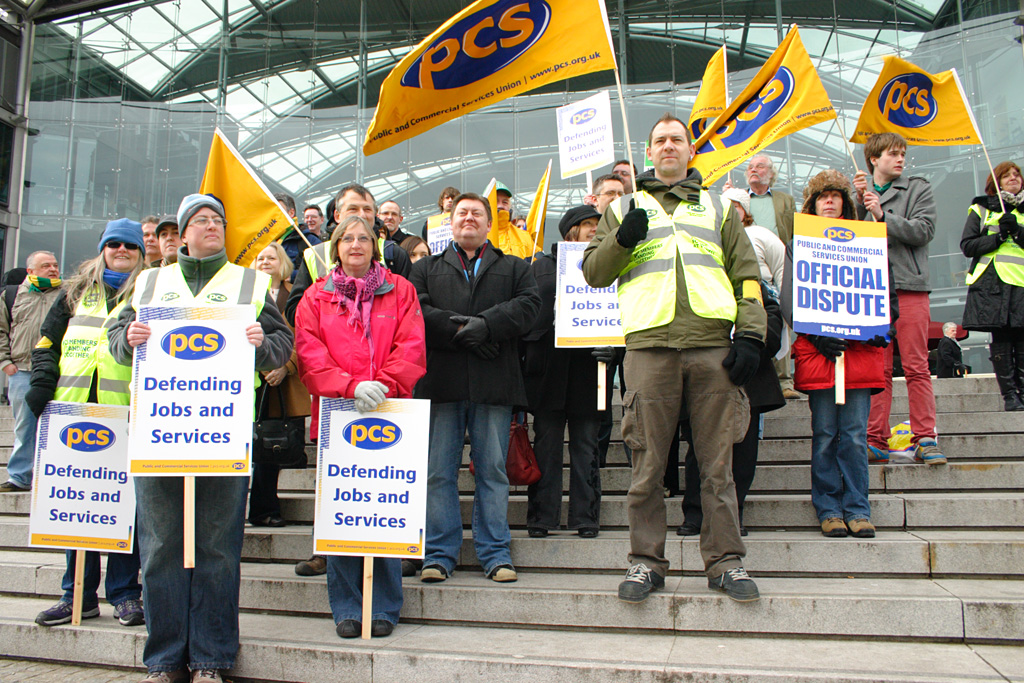
The photo at the top of this article shows PCS members on strike in Norwich in 2010. The image is from Wikimedia Commons. Accreditation: Roger Blackwell. This file is licensed under the Creative Commons Attribution 2.0 Generic license.