
By Glenda O’Brien, Retired Mental Health Nurse RMN with 30 years clinical experience, and John O’Brien
With the Autumn Budget of Wednesday 28 October 2026, the Treasury has delivered its verdict, and for millions of disabled people across Britain the message remains unchanged: our lives are an inconvenient line item in a national ledger.
As Chancellor John Healey reeled off figures, deficits and fiscal rules, disabled households were once again left watching a performance staged in a language of scarcity that never seems to apply to corporate subsidies or military budgets. Standard benefit uprating was presented as benevolence. Yet anyone surviving on disability support knows the truth.
Pegging support to general inflation ignores the brutal reality of our costs. The extra electricity needed to charge electric wheelchairs, power ventilators and keep joint pain bearable does not vanish when general inflation eases. Social care was handed crumbs that will do nothing to stop bankrupt councils from squeezing eligibility, slashing care packages and chasing people in poverty for care charges.
The wider numbers lay bare the depth of the crisis and shatter the toxic myth that life on disability support is a comfortable existence funded by the state. This is not about pitting one struggling section of society against another, nor is it a race to the bottom between generations. Everyone deserves dignity in old age, just as everyone deserves dignity in illness and impairment. But the stark economic divide created by state policy must be confronted honestly.
According to official Households Below Average Income figures (Department for Work and Pensions, 2026) and research by the Joseph Rowntree Foundation (2026), more than a quarter of disabled people, 28 per cent, live in poverty after housing costs. That is far above the rate of around sixteen per cent recorded among pensioners. Even that shocking number hides the full truth, because standard government measures count disability benefits such as Personal Independence Payment as if they were spare income. In reality, that money is swallowed at once by the essential costs of survival.
True poverty rate
The disability charity, Scope, calculates the extra cost of living with an impairment at more than one thousand pounds every single month, simply to reach the same standard of living as a non-disabled household (Scope, 2025). Once those unavoidable costs are taken into account, the true poverty rate among disabled families rises far higher.
The starkest proof sits at the doors of food banks. Trussell Trust research shows that nearly seven in ten people referred to food banks in its network are disabled (Trussell Trust, 2023). Far from a life of ease, disabled households are being pushed to the outer margins of subsistence.
However, focusing only on the Budget misses the forest for the trees. This Budget is not an administrative oversight. It is the financial scaffolding for a much darker project.
Quietly moving through the Department for Work and Pensions pipeline is an aggressive campaign to shrink the welfare roll. The planned scrapping of the Work Capability Assessment, and the push to tie the health element of Universal Credit to Personal Independence Payment awards, is not simplification. It is a trapdoor. It creates a single point of failure. Fail one opaque and humiliating assessment run by an outsourced private contractor, and you lose your daily living support and your out-of-work health protection in one fell swoop. Meanwhile, politicians line up on Sunday morning shows to pathologise neurodivergence and mental health conditions, preparing the public for harsher evidence hurdles and desk based reviews.

[image – screen shot from live BBC broadcast]
The scandal is that the state already knows that these private contractor assessments are broken. Ministry of Justice tribunal data consistently shows that around two thirds to 70% of PIP appeals heard by independent judges are decided in favour of the disabled claimant (Ministry of Justice, 2026). Yet the DWP pours billions into private assessment firms to run a system where genuine medical evidence is routinely disregarded, leaving thousands to endure months of administrative terror, just to reclaim what is legally theirs.
Tougher conditionality and sanctions
Under the sanitised banner of getting Britain working, the state is preparing to unleash tougher conditionality and sanctions on bodies and minds that cannot work, least of all under the brutal terms set by modern capital. The message is clear. If you are not producing surplus value for the market, your right to live in dignity is forfeit.
Why does the state get away with this year after year? Because the law itself was built to protect the status quo, not disabled people.
Britain prides itself on the Equality Act 2010, yet disability sits in a fundamentally weaker tier than other protected characteristics. In British law, you cannot bar someone from an establishment, deny them a job or refuse them equal treatment because of their skin colour, their religious faith or their sexual orientation, and then claim it was too expensive to treat them fairly. There is no statutory defence that says treating a Black person, a person of faith or a gay person equally places an unreasonable burden on a business’s balance sheet.
For disabled people, however, the whole legal framework turns on one cowardly word: reasonable. The duty to make reasonable adjustments only requires what a tribunal decides is reasonable. And under Section 15 of the Act, an employer or service provider can treat a disabled person unfavourably because of something arising from their disability, such as absence from work, if it can argue this is a proportionate means of achieving a legitimate aim. If treating a disabled person fairly costs too much money or disrupts managerial convenience, the law too often lets discrimination pass.
This trapdoor plays out daily in workplaces across the UK. In Griffiths v Secretary of State for Work and Pensions [2015] EWCA Civ 1265, a long serving DWP employee was given a formal written warning after 62 days of absence caused by post viral fatigue. She asked for that absence to be disregarded and for her absence trigger point to be extended. The Court of Appeal accepted that the attendance policy put her at a substantial disadvantage as a disabled worker. It still ruled that neither adjustment was one the DWP could reasonably be expected to make. The message from the courts is chilling: a disabled worker can be managed out of their livelihood because their impairment inconveniences a corporate spreadsheet.
Institutional contempt
The institutional contempt runs through every layer of the justice system. The gutting of Legal Aid under the Legal Aid, Sentencing and Punishment of Offenders Act 2012 all but wiped out early state funded advice on welfare benefits, housing and employment. A disabled claimant fighting an arbitrary DWP sanction, an unlawful eviction or discriminatory treatment at work is forced into complex tribunals entirely alone, while the state and corporate employers deploy barristers paid for by the taxpayer or the shareholder.
Meanwhile, the Public Sector Equality Duty under Section 149 of the Equality Act has been reduced to a bureaucratic paper exercise. Public bodies and councils need only show “due regard”, usually by drafting an Equality Impact Assessment. Time and again, the courts have confirmed that an impact assessment does not force a minister or a council to halt a destructive cut. It simply requires them to tick a box acknowledging the harm before slashing the service anyway.
Criminal law shows exactly the same hierarchy. Racial and religious hostility are covered by specific aggravated offences carrying higher maximum penalties (Crime and Disorder Act 1998, sections 29 to 32). Disability hostility has no such offences. It can only be reflected through a sentence uplift within the ordinary maximum (Sentencing Act 2020, section 66). The Law Commission (2021) recommended extending the aggravated offences to disability, and the government refused.
Physical infrastructure remains deliberately exclusionary. Building regulations treat fully wheelchair accessible homes as an optional extra rather than a mandatory standard, allowing private developers to build entire estates without a single home meeting the M4(3) standard (HM Government, 2015). Hundreds of thousands of disabled people remain trapped in unsuitable, inaccessible homes, unable to get through their own front doors or use a bathroom safely, because developer profits take priority over human mobility.
Transport law repeats this abandonment. Train operators are granted rolling exemptions from accessibility deadlines, while international aviation rules cap the liability of airlines when they wreck specialised electric wheelchairs in transit (Montreal Convention 1999). A destroyed piece of bespoke medical equipment is treated in law like lost luggage, leaving disabled passengers stranded without a replacement and without full compensation.
Under the Care Act 2014, councils are legally empowered to means test essential care, levying heavy charges on disability benefits to claw back the cost of personal assistance. A disabled person is effectively taxed by their council for needing help to get out of bed, wash and eat, while the NHS remains free at the point of use.
Burden of enforcing rights
The burden of enforcing civil rights is dumped squarely on the exhausted shoulders of the disabled individual, who must fund tribunals, fight through inaccessible courts and risk financial ruin just to get a ramp built or keep their job.
Successive governments have also stubbornly refused to incorporate the UN Convention on the Rights of Persons with Disabilities into domestic law. Doing so would give us enforceable rights to independent living under Article 19 and to an adequate standard of living under Article 28 (United Nations, 2006). The UN Committee on the Rights of Persons with Disabilities has found the UK guilty of grave and systematic violations of our rights (UNCRPD – United Nations Committee on the Rights of Persons with Disabilities, 2016), yet Westminster simply shrugs.
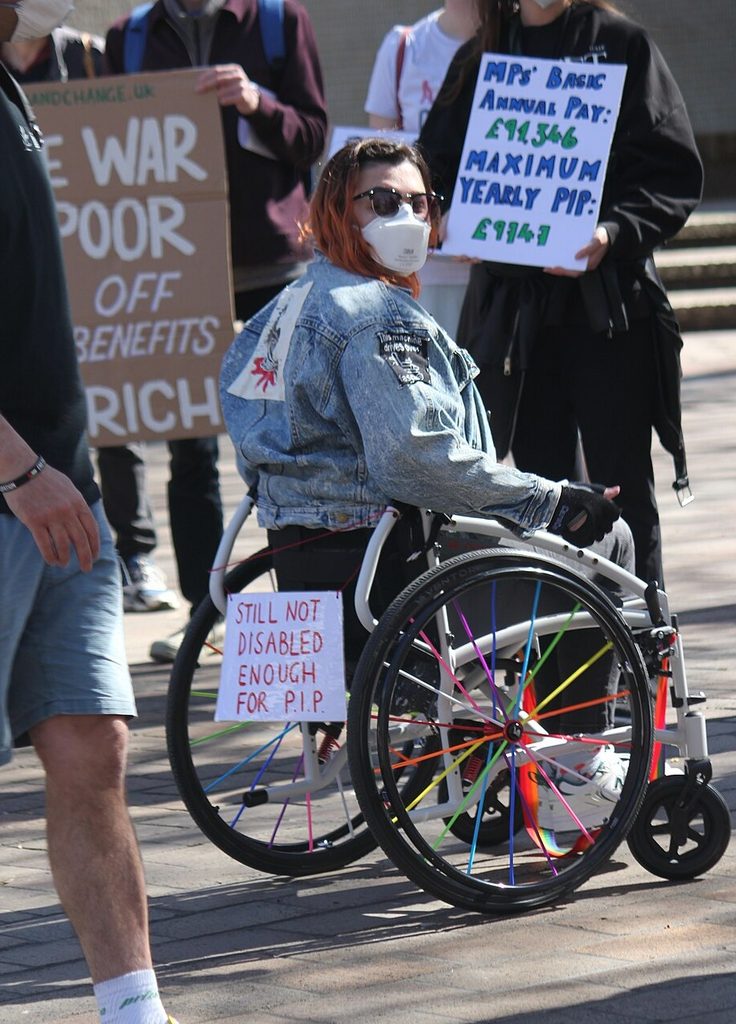
[Image – Tim Sheerman-Chase, wikicommons}
The cruelty of the right is expected. What cuts deepest is the cowardice and failure of our supposed allies: the Labour Party and the trade union movement.
Labour has surrendered entirely to Treasury orthodoxy and respectability politics. Terrified of being painted as reckless by right wing tabloids, its leadership speaks of disabled people almost entirely through the degrading lens of economic inactivity. We are no longer human beings entitled to rest, care and collective solidarity. We are an idle labour pool to be cajoled, coached and nudged back into an inaccessible labour market. Rather than dismantling the hostile environment built by years of austerity, Labour adopts its very grammar, promising to be tough on welfare to reassure the City of London.
The trade union movement, meanwhile, has never fully resolved its historic blind spot. Built on the industrial model of the able bodied, full time worker, unions too often treat disability as a niche welfare issue rather than a frontline class struggle.
Bureaucratic mincer
Too many disabled workers are abandoned to the bureaucratic mincer of capability proceedings, advised by undertrained reps to accept a meagre settlement agreement rather than seeing their branch mount a collective defence against institutional ableism. Picket lines remain inaccessible, meetings remain stubbornly exclusionary, and the struggle of those pushed out of the workforce altogether is rarely built into core industrial demands.
Behind every policy announcement, every council cut and every hostile speech lies a toxic ideology: the capitalist model of disability. Under this model, disabled people are framed as an incurable cost, a burden on the state and a drag on public finances. We are expected to plead for charity, submit to invasive inspections and apologise for existing.
We reject that premise entirely.
The Social Model of Disability taught us decades ago that we are not disabled by our impairments. We are disabled by an inaccessible, profit obsessed society that refuses to adapt to human diversity. Our worth as human beings does not depend on our contribution to GDP, our capacity to work forty hours a week or our usefulness to an employer. Rest, care, autonomy and full participation in community life are inalienable human rights.
Institutions will not fight for us out of the goodness of their hearts. The history of the disabled people’s movement proves that every right we hold was dragged out of the state through disruptive, militant solidarity.
We do not need another consultative working group. We do not need patronising speeches about getting Britain working from politicians who have never had to choose between charging a powerchair and heating a meal.
- We demand equal access and full equality, so that treating a disabled person differently is as unlawful as it is on grounds of colour, religion or sexuality.
- We demand an end to the “reasonable” loophole that lets institutions buy their way out of accessibility.
- We demand an immediate end to council care charges.
- We demand parity in hate crime law.
- We demand enforceable legal rights to accessible housing and transport.
- We demand the restoration of Legal Aid for benefits and discrimination disputes.
- We demand the direct incorporation of the UNCRPD into UK law.
- We demand the abolition of outsourced, profit driven assessment regimes.
- We demand that the trade union movement step up and make disability rights a core industrial priority.
- We serve notice on every political party and every institution: we are not an inconvenience, we are not a burden on the state, and we will not be traded away to balance your books.
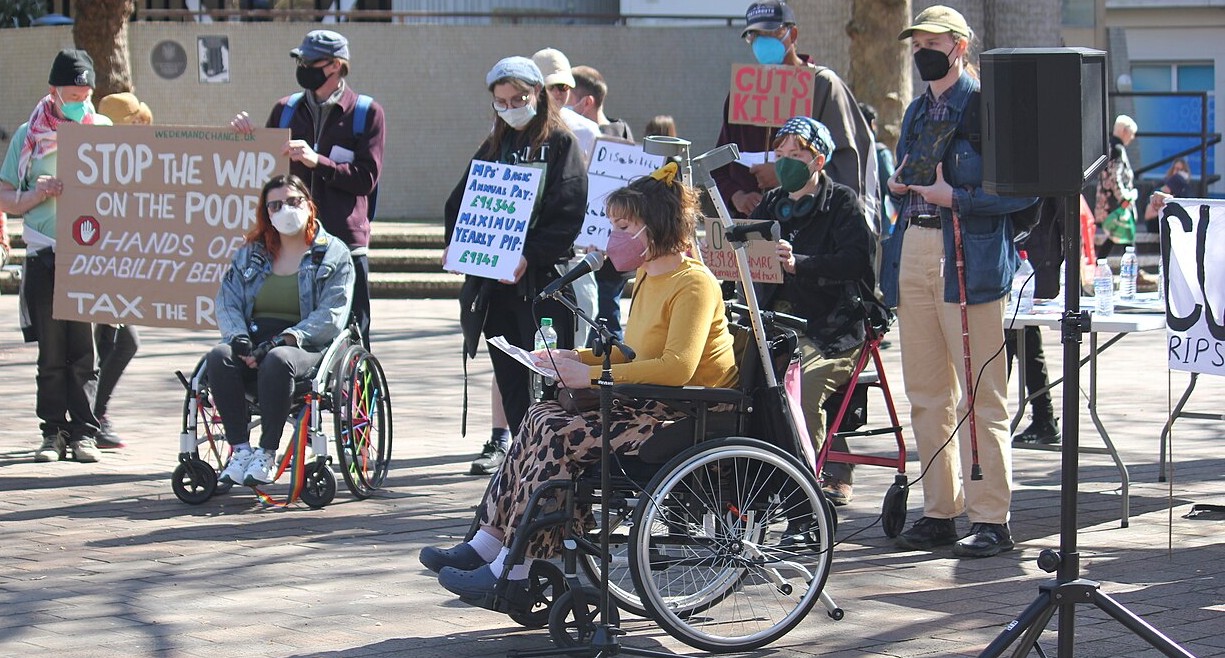
[Featured photo – from a demonstration in Portsmouth in April 2025 – By Tim Sheerman-Chase – wiki commons]
References
Care Act 2014, c. 23. London: The Stationery Office.
Crime and Disorder Act 1998, c. 37. London: The Stationery Office.
Department for Work and Pensions (2026) Households below average income: an analysis of the UK income distribution, FYE 1995 to FYE 2025. London: Department for Work and Pensions.
Equality Act 2010, c. 15. London: The Stationery Office.
Griffiths v Secretary of State for Work and Pensions [2015] EWCA Civ 1265.
HM Government (2015) The Building Regulations 2010, Approved Document M: Access to and use of buildings, Volume 1: Dwellings. 2015 edn, incorporating 2016 amendments. London: NBS.
HM Treasury (2026) Autumn Budget 2026. London: HM Treasury.
Joseph Rowntree Foundation (2026) UK Poverty 2026: the essential guide to understanding poverty in the UK. York: Joseph Rowntree Foundation.
Law Commission (2021) Hate crime laws: final report (Law Com No 402). London: Law Commission.
Legal Aid, Sentencing and Punishment of Offenders Act 2012, c. 10. London: The Stationery Office.
Ministry of Justice (2026) Tribunal statistics quarterly: April to June 2026. London: Ministry of Justice.
Montreal Convention 1999: Convention for the Unification of Certain Rules for International Carriage by Air. Montreal: International Civil Aviation Organization.
Scope (2025) Disability Price Tag 2025. London: Scope.
Sentencing Act 2020, c. 17. London: The Stationery Office.
Trussell Trust (2023) Hunger in the UK. Salisbury: The Trussell Trust.
United Nations (2006) Convention on the Rights of Persons with Disabilities. New York: United Nations.United Nations Committee on the Rights of Persons with Disabilities (2016) Inquiry concerning the United Kingdom of Great Britain and Northern Ireland carried out by the Committee under article 6 of the Optional Protocol to the Convention (CRPD/C/15/R.2/Rev.1). Geneva: United Nations.