By Mic Craig
I was born an atheist in Northern Ireland in the middle of the 20th Century, and my ancestors were Protestants who came here centuries ago from Scotland. I am neither Unionist or Nationalist. I am a socialist. So what is my take on the current situation on the Garvaghy Road?
Too many socialists look at this place and simply say ‘Unionism bad, nationalism good’, without applying a class perspective. The fact is that the working class here is being divided and exploited by the politicians in both camps. All political parties here (except People Before Profit and possibly the Greens) serve the interests of capitalism. They need division in order to do this. None of them believe in unity of the working class as that would not be in the interests of the system they represent. Practically anyone could go into an election here waving a flag, whether a tricolour or a union jack, and get elected.
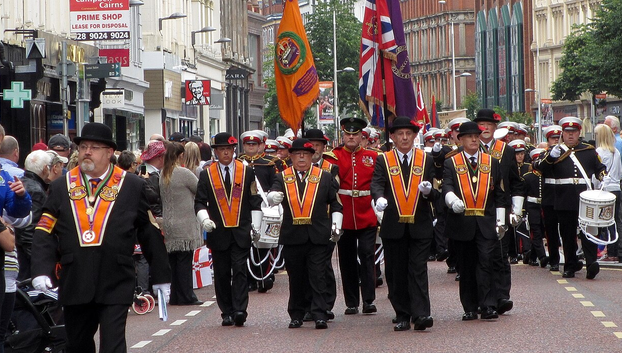
The Orange Order, who want to march down the mainly nationalist Garvaghy Road may be supported by many working class Protestants but it’s not a working class organisation. It represents an upper class Protestant ascendancy .and has origins as a breakaway from the Peep O’ Day Boys, which was a brutal anti-Catholic terrorist organisation in the 18th Century.
Nationalism not a vehicle for working class freedom
Irish Nationalism is not a vehicle for working class freedom either. It is and has always been in the interests of a middle-class, pro capitalist section of the population. Ireland was controlled by Catholic aristocracies until the invasion of The Dutch Prince William of Orange in the 17th Century. It was never united except under British rule.
Having a society ruled by an aristocracy, whether British or Irish, is not something a working class person should be fighting for, it is the antithesis of their interests. Nationalists are focussed on British colonialism and imperialism and claim that these took away their freedom and their right to self-determination. The reality is that the working class will never determine their own destiny under the capitalist system, so supporting the class which oppresses you through the capitalist mode of production is not going make you ‘free’, no matter which flag they fly.
This tribal division has led to the ghettoisation of both sides, which is why we have a mainly nationalist area in the vicinity of the Garvaghy Road.
There is no question that Catholics were discriminated against in Northern Ireland since partition at the hands of a local Government controlled by members of the Orange order, and to rub salt into the wounds the Orange order paraded their triumphalism by marching through mainly Catholic/Nationalist areas several times a year for decades.
Parades Commission set up
This stopped in 1998 when the Parades Commission was set up to determine who could march where without intimidating the local residents. Unfortunately, the Parades Commission, after 28 years of keeping the peace, became complacent and lax and stopped taking its responsibility seriously allowing an opening for the Orange order, backed by sinister right-wing elements, to renew their intimidation.
Things have changed in 28 years. The Orange order no longer controls Northern Ireland, there is no longer any discrimination in jobs and housing (The misery of poorly paid jobs and the housing shortage is suffered by both sides now). There is a nationalist party in government here and the population is almost equally divided by religion and national identity.
Looking at this, anyone might think that 30 Orangemen walking past the cable of a nationalist house isn’t much of a threat, but there’s much more at stake here.
The Orange Order is completely unapologetic about its role in the discrimination and oppression carried out against the Catholic population here, and in fact would like to return to such a regime.
The Order is egged on by extreme right-wing elements who share the political views of Farage’s Reform in GB. This is why the Orange Order parade should not be allowed down the Garvaghy Road!
[Feature picture: Orange march in Belfast 2016, from Wikimedia Commons, here]