By Andy Ford
This is the second part of an article on the eightieth anniversary of the beginning of the Chinese revolution in 1946. The first part of the article was published in July and can be found here.
……………………………………………………………………………………………
July- September 1946: a massacre of Communists in the Yellow River plain thwarted
By July 1946, the commander of the KMT (Kuo Min-Tang/National Peoples Party), Chiang Kai-Shek and his American sponsors were ready to wipe out the troublesome Chinese Communists. He aimed to start in the North China Plain where the Yellow River flows out of the mountains and towards the sea. It is a huge area of 300,000 square kilometres, none of it more than 50 metres above sea level.
As such, it is one of the most densely populated places in the world, with thousands of peasant farms producing sorghum, millet, maize and cotton. The Communists had established themselves there amidst the 30million peasants during the fighting against the Japanese invaders.
In southern and eastern Henan province, Chiang Kai-Shek had 300,000 troops in place by late June 1946. He then issued a secret order for them to surround the area controlled by the Peoples Liberation Army (PLA) guerillas, break it into smaller pockets and then destroy them.
The PLA could count on just 60,000 regular soldiers, armed with a mixture of rifles, pistols, spears, swords – and whatever modern weapons they had captured from the Japanese. But it had another, much more important weapon, which was mass support in the villages. While the KMT had simply abandoned the area to the Japanese, the CCP guerillas had freed huge areas of the countryside from Japanese control and defended the peasants from Japanese punitive expeditions and atrocities, such as the murderous “Three Alls” campaign – “Kill All, Burn All, Loot All”.
During the war against the Japanese, Mao had instituted the “Three Rules of Discipline and Eight Attentions” for the People’s Liberation Army, to prevent mistreatment of civilians in the areas they controlled:
The Three Main Rules of Discipline were:
- Obey orders in all your actions.
- Do not take a single needle or piece of thread from the masses.
- Turn in everything captured.
The Eight Points for Attention were:
- Speak politely.
- Pay fairly for what you buy.
- Return everything you borrow.
- Pay for anything you damage.
- Do not hit or swear at the people.
- Do not damage crops.
- Do not take liberties with women.
- Do not ill-treat captives.
The fact the PLA upheld these rules during the civil war with the KMT (although there were occasional lapses), even occasionally executing their own soldiers for serious breaches, helped them build mass support from the peasants. When Chiang Kai-Shek’s forces surrounded the Communists, the importance of such discipline was really shown.
The peasants allowed the PLA guerillas to move without hindrance; they fed them and sheltered them and informed them of every move by the KMT and their warlord allies. On the other hand, the KMT soldiers, who routinely robbed and mistreated the peasants, got nothing from them – no information, no food (except what they could steal}, and no co-operation.
Central Plains breakout – July-September 1946
Surrounded by roughly 300,000 KMT troops, the Communist leadership followed Mao’s principle of avoiding battle against superior forces. The main PLA force on the Yellow River plain was ordered to break out westward toward the Funiu Mountains on the margins of Henan and Shaanxi border, while a smaller diversionary force would move eastward three days earlier. Its mission was to draw KMT attention by attempting to reach the Communist-controlled Dabie Mountains to the east on the Anhui–Jiangsu border.
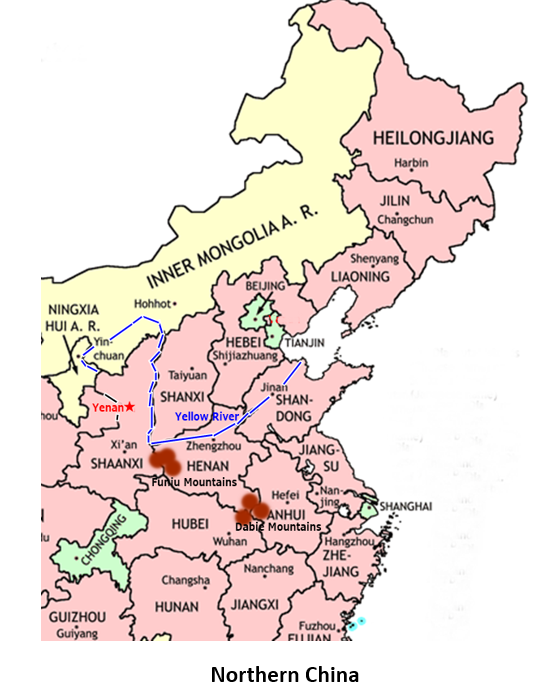
The diversionary force infiltrated weak points in the KMT encirclement by moving at night and suddenly appeared in the rear of the Nationalist positions. As expected, the KMT shifted resources eastward, believing this was the main Communist escape. Once they did so, the main force broke out to the west toward the Funiu Mountains.
Meanwhile, the diversionary force marched ahead of its pursuers and fought a major battle at Green Ridge Pass (Qingfeng Ling), where KMT troops attempted to block their advance through the Dabie Mountains. After defeating the blocking force, the PLA crossed the Pi River and reached safety in the liberated area on the Anhui-Jiangsu border. At that point, the KMT had to abandon the pursuit and redeployed westward again to try to catch the main force.
The main Communist force undertook a difficult westward march through successive KMT blockades, avoiding battle where the odds were unfavourable, but engaging, and defeating, Nationalist units when they faced equal or inferior numbers.
Through forced marches, night attacks, and eventually by splitting into two columns of roughly 7,000 men each, the PLA eventually reached Communist-controlled territory in the Funiu Mountains in southern Shaanxi by September 1946. None of that would have been possible without the support of the rural communities that the PLA were moving through, in the attempt to reach safety.
The PLA also left behind a force of 10,000 experienced guerilla fighters in the original liberated area, forcing the KMT to use two thirds of their troops to garrison the main towns and cities in the region, tying up hundreds of thousands of KMT troops in a static defence.
The outcome: for Chiang Kai-Shek, a tactical victory but a strategic defeat
What looked like a Communist defeat, in that the PLA had to give up the territory they controlled, was in reality a strategic defeat for the Nationalists, because the main PLA forces had escaped destruction – and they still maintained a guerrilla presence in the North China plain. Despite the disparity in numbers and weapons, losses were about equal, with an estimated 10,000 dead and wounded on each side. Also, the obvious treachery of Chiang Kai-Shek, attacking the communists after signing a truce with them, harmed the public reputation of the KMT across China.
The political basis of the Chinese Communist Party in 1946
The Chinese Communists at that time, in 1946, stood on paper, on Mao’s programme of ‘New Democracy’ adopted at the Seventh Communist Party Congress in Yanan, attended by 700 delegates, representing the 1.2 million members.
Unlike the Bolsheviks in 1917, the CCP did not stand for working class rule, or a worker’s state. They stood instead for a ‘bloc of four classes’ – the peasants, the workers, the urban middle classes and the ‘patriotic capitalists’. They did not look to create a socialised economy, instead believing that a mixed economy could be constructed under communist leadership, while in the countryside their policy was of land reform or “land to the tiller”. They also aimed for national independence and freeing China from foreign domination.
In reality, it was a Menshevik, not a Bolshevik, programme. But very little of the New Democracy programme survived contact with reality in the 1950s, when the ‘patriotic capitalists’ of Mao’s imagination proved, like all other capitalists, to be treacherous snakes, at the beck and call of the USA and the big world monopolies.
In the 1940s, where the Chinese Communist Party was more or less restricted to the rural areas, the only thing that mattered was land reform. That was the magic key that saved them from defeat in1945 and ultimately handed them victory in 1949. A Central Committee directive of November 7 1945 had proclaimed rent reductions and instructed party members to “Support the army and cherish the people”. But there was a constant confusion as to who exactly were “the people” to be cherished.
The peasants were a very mixed group, with innumerable layers, from landless labourers to tenant farmers, who paid rent in cash or in kind, through to those who farmed their own family fields but employed no other labour. Others were petty employers with larger plots, and at the top of rural society, wealthy families, who owned and rented out farms to dozens of tenants. Who exactly were the ‘exploiters’, and who were the ‘poor’ peasants?
Communists went too far in some areas
In some areas, such as Manchuria, the local Communist cadres went too far, labelling everyone who employed labour as ‘landlords’, and dispossessing them by violence and arbitrary action. But this policy, euphemistically called “cooking raw rice” by the CCP leadership, allowed the real landlords to rally support against the CCP, as the village majority were alienated by the process. It was exactly the same mistake the Afghan communists were to make 40 years later, in their struggle against the Mujaheddin.
On the other hand, in some other areas, the local Party administrators were too close to the rich peasants and failed to implement land reform at all, instead reverting to rent control rather than expropriation and redistribution of land.
That this confusion came from the top, and was not the result of either ‘overzealous’ local cadres or ‘weak’ of local administrators is shown by this garbled instruction from Mao in 1946:
“In the rural areas, on the one hand, we should resolutely solve the land problem, rely firmly on the farm labourers and poor peasants and unite with the middle peasants; on the other hand, when solving the land problem, we should distinguish the ordinary rich peasants and middle and small landlords from the traitors, bad gentry and local tyrants.
“We should be stricter in our treatment of the traitors, bad gentry and local tyrants, and more lenient in our treatment of the rich peasants and middle and small landlords. In places where the land problem has already been solved, we should change to a moderate attitude towards the landlord class as a whole, with the exception of a few reactionaries.
“In order to reduce the number of hostile elements and to consolidate the Liberated Areas, we should help all those landlords who have difficulty in making a living and induce runaway landlords to return and give them an opportunity to earn a living. In the cities, besides uniting with the working class, the petty bourgeoisie and all progressives, we should take care to unite with all the middle elements and isolate the reactionaries.”
(Mao, Smash Chiang Kai-Shek, July 20, 1946)
Make of that what you will…
What happened in practice, in true Stalinist style, was that successes in land policy were attributed to Mao, and mistakes landed on whichever local functionary was too slow to avoid the blame. But at least Mao would come to recognise reality, and the original programme decided at Yanan in 1945, of rent control and raising wages, was replaced in September 1946 with a clear steer towards land redistribution:
“The experience of these three months has proved that the peasants stood with our Party and our army against the attacks of Chiang Kai-shek’s troops wherever the Central Committee’s directive of May 4 was carried out firmly and speedily and the land problem was solved radically and thoroughly.
“The peasants took a wait-and-see attitude wherever the “May 4th Directive” was not carried out firmly or the arrangements were made too late, or wherever this work was mechanically divided into stages or land reform was neglected on the excuse of preoccupation with the war. In the coming few months all areas, no matter how busy they are with the war, must resolutely lead the peasant masses to solve the land problem and, on the basis of the land reform, make arrangements for large-scale production work next year.”
(Mao, Concentrate superior force to destroy enemy forces one by one, September 16, 1946)
By adopting a strong policy on land redistribution, the CCP assured mass support in the rural areas for its army, the PLA. The other deficiencies of the programme of New Democracy – alliance with the “patriotic capitalists” and an equal bloc of the working class with the urban middle classes – hardly mattered as the Communists had no position in the cities, other than heavily secret underground cells.
This was the basis for the KMT failure on the lands around the Yellow River in Henan, and for subsequent PLA victories across north China. The next article will deal with subsequent events leading to the victory of the PLA in 1949
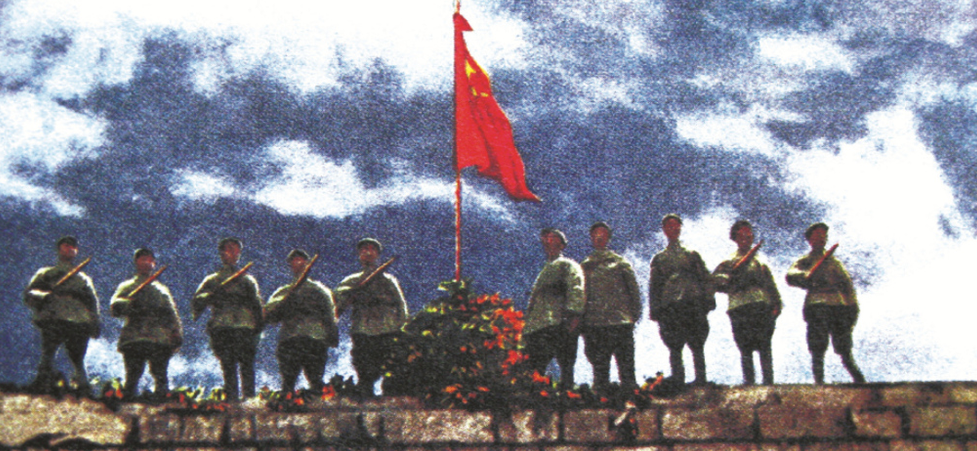
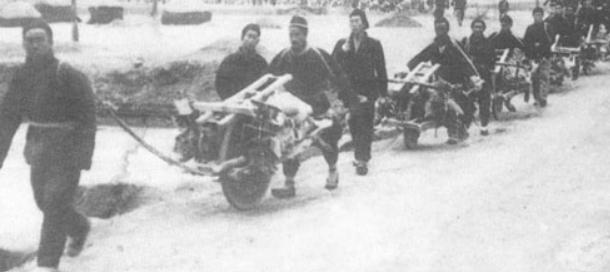
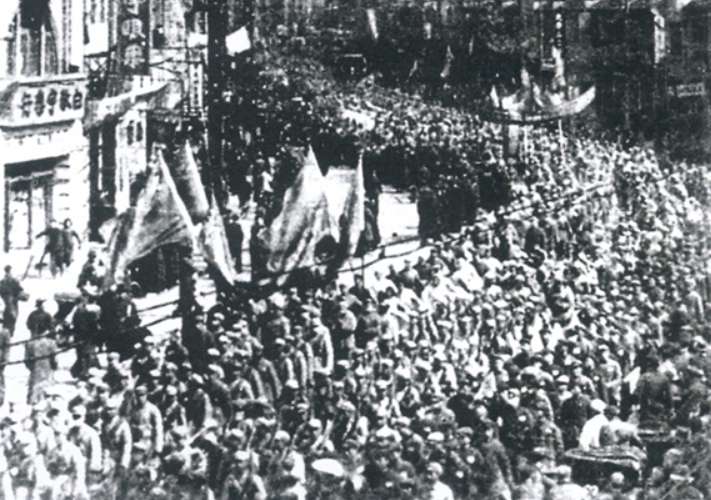
[All pictures from Wikimedia Commons, here, some showing the PLA in 1949]