By Cain O’Mahony
The scale of the election victory for the student-led protest movement in Serbia last week is seismic, and the tremors will be felt throughout Eastern Europe, all the way to Moscow.
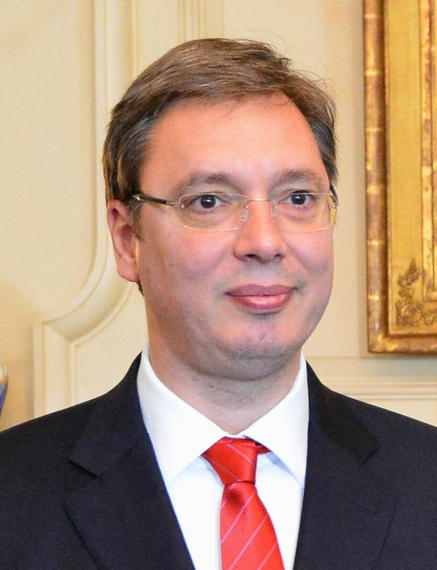
In a staggering 70 percent turnout, the ruling Serbian Progressive Party (SNS) led by Vucic could only muster just over 39 percent of the vote, despite two years of state-led intimidation and violence, and virtual complete control of the state and most private sector media.
The ‘Student List’ gained nearly 53 percent.
The students did not stand themselves but put forward candidates who belonged to no political party, made up of academics, health workers and sports and arts personalities. They did this to demonstrate they were not a ‘self-interest’ group but were fighting on behalf of wider society.
They stood on an 11-point programme that would purge the country of corrupt officials and end of political control of the media.
The fuse was lit in Serbia two years ago, on November 1, 2024, when the canopy of the recently-reconstructed railway station in Novi Sad collapsed, killing 16 people. [See article here]. There was outrage in the city, as the corruption and resultant corner-cutting of the project was well known locally.
The anger turned to fury when Aleksander Vucic’s SNS government attempted a cover up. Meanwhile, when local students and teachers held a peaceful vigil to commemorate the dead, it was attacked by a gang of thugs known to be supporters of the SNS.
Two words repeatedly use: “largest ever”
When covering the past two years, there are two words that get often repeated – the ‘largest ever’. The initial attack on the students provoked the largest ever demonstration in Novi Sad’s history. From there, the protests exploded across the country, with the largest ever strike wave, from health workers to power workers, and the largest ever protests – one in Belgrade in January numbering 326,000. And now there has been the largest ever election turnout in Serbian history.
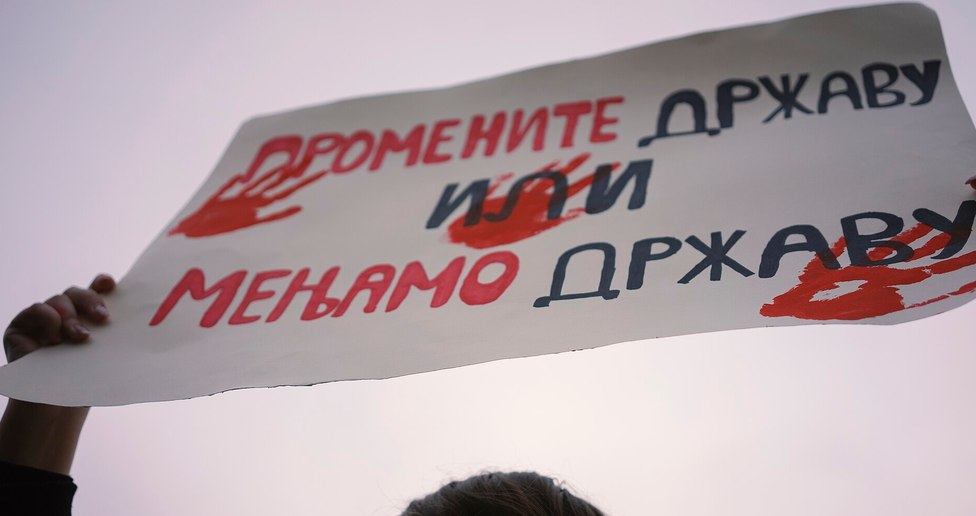
The struggle led by the students, but with widespread support from youth generally, as well as the trade union movement, adopted the ‘bloodied hand’ motive, to demonstrate that the corrupt Vucic government had ‘blood on its hands’. It became a generalised movement that wanted an end to corruption and demanded a new general election.
The calmness and strategy of the student movement must be commended. Organised through ‘Student Plenums’ (assemblies), they have refused to be provoked by the pro-Russian SNS government, which used every trick in the Putin playbook: physical attacks, agent provocateurs, constant abuse from the Vucic media, and electoral fraud.
Importantly, neither would the students let the state attempt to divide them along ethnic lines, with such blatant provocations as police arresting those students of Croation ethnicity, accusing them of being Croation secret agents. Rather, the students inspired and organised student solidarity across the Balkans.
Intimidation tactics failed on election day
In the election campaign itself, they targeted rural areas that had been seen as strongholds for the SNS. They marched across the countryside in large columns, under the slogan ‘Serbia or Mafia?’, and then canvassed door to door to ‘patiently explain’ to rural workers why they needed their support.
On election day, the usual intimidation tactics were employed by the SNS and its far-right Serbian nationalist thugs, with sinister mobs hanging around polling stations, blatantly photographing completed ballot papers, while the Vucic government ordered large parts of the capital sealed off by riot police, in an attempt to portray the threat of civil war if the Student List won. This time, they were met by wave upon wave of voters, with packed lines of voters queuing way out into the streets at all polling stations.
So, an understandably euphoric day. But what now?
It will seem strange to us in the West that a key strategy of the Student List was to put forward candidates who did not belong to a political party. But that is because in eastern Europe, political parties have become a watchword for corruption, from the Balkans to Russia itself.
This is a legacy of Stalinism. In the initial enthusiasm for the socialist transformation and the ridding of society of capitalism and landlordism, there was party-political control over all enterprises and governance, to defend against reaction and to ensure the ‘white terror’ of imperialism did not return. This became institutionalised and degenerated under the Stalinist bureaucracy.
When the Soviet Union collapsed, the former Stalinist parties abandoned any semblance of their socialised economies but retained their cynical, bureaucratic control and methods of party control of the state apparatus. Thus today, as the Balkan writer Vladan Lausevic puts it, people in the East “… see political parties mainly as a source of income, positions and privileges, or even criminal networks, not as ideological driven class organisations or interest groups.”
Which road to take now?
So from that perspective, the Student List may be correct tactically, and an historic first step. But the next step will fast approach, and the students and the new government will need to decide which road to take, as they will soon discover that even without corruption, ‘good’ capitalism will still mean unemployment, exploitation and want.
The quote above from Vladan Lausevic is taken from an article he wrote earlier this year in February for Balkan Insight, in which he put the case for socialism, and reminded the Balkans of their historic socialist traditions.
It was significant because Balkan Insight – set up to promote a ‘strong, independent and free media’ for the Balkans – is mainly funded by the European Union, the Austrian banking giant ERSTE, and the Rockefeller Brothers Fund. They, of course, put a disclaimer on Lausevic’s article (you can be ‘independent and free’ as much as you like, but don’t mention socialism!).
But the fact they carried it anyway demonstrates that there must be some traction for socialist ideas in the current debates in the Balkans, which they needed to reflect to maintain credibility amongst their Balkan audience.
That aside, while Lausevic was writing about the mass protests in Sarajevo at that time, inspired by the Serbian student movement, he makes a good point that historically and up to this day, imperialism and Stalinism have always attempted to structure the Balkans around ethnic representation and thus to legitimise nationalist politics.
Rather, he argues, the unity of the youth and students emanating from Serbia which has sparked similar movements in Bosnia, Montenegro, Croatia and Slovenia, “… reflect that tradition of class based and universalist engagement” and that the youth were “… not engaging as Bosniaks, Serbs, Croats or others, but as individual citizens, networks and movements. Their slogans and symbols do not focus on religion or nationality but on social and everyday demands about safety, justice and institutional responsibility” (‘Sarajevo tram protests reflect deeper frustration with a dysfunctional Bosnia’, Balkan Insight, February 27, 2026).
He rightly asks the question that the movement in Serbia now must face: “The question now is whether (the) younger generation can transform episodic protest into organised civic initiatives, movements and communities that bridge social justice and institutional reforms.” That is the task now in Serbia – and that needs a socialist programme.
[Feature photograph of placard: “Change country or we change country” from Wikimedia Commons, here]