
John O’Brien, Welfare Rights Adviser, Cumbria,
A big government report on PIP came out today. Parts of it are good news. Parts of it need watching. And none of it changes people’s PIP entitlement or value…yet.
I have spent 35 years helping disabled people fight for the benefits they are owed. I could have written this report myself. Most of the problems in it go back to the Conservative and Liberal Democrat governments that brought PIP in, and to a Department of Work and Pensions (DWP) that never applied its own rules properly. The law was rarely the problem. The way the department used it was.
The report is called “Making PIP fit for purpose”. It runs to 144 pages. I have read it so you do not have to.
First things first: PIP has not changed
This report is advice to the government. It is not the law. If you get PIP today, you will get the same tomorrow. Nothing changes until Parliament passes a new law, and that will not be before next year.
The good news
The report sticks up for disabled people on the big things. PIP stays as money in your hand. It should stay a cash payment. It is not about your income. Your wages or savings should not affect it. It is not a work benefit. You can get it whether you work or not. Around one in five people of working age on PIP have a job.
It also lists fifteen ways to fix the system we have now. Most of them are things people like me have been asking for over many years:
- No more pointless check-ups for people whose condition will never get better.
- A simpler claim form.
- Letters that are clear and polite, and explain why you got the decision you did.
- Proper help if you need things done differently, like a home visit or extra time.
- Free, independent help from someone who can speak up for you.
- Better trained assessors.
- A fairer deal if you are in hospital for a long time.
- Fair treatment if you have good days and bad days.
Why does this matter? Because the system gets it wrong far too often. About 54 out of every 100 people assessed are given PIP at first. After people challenge the decision or appeal, that goes up to about 59. Thousands of people every year have to fight to get what they were owed all along.
A new benefit to replace PIP
In the longer run, the report wants PIP replaced with a new benefit. Here is how it would work:
- A quick first check to see what help you need.
- One record of your details, which you control, so you only tell your story once.
- A fast route for people who are very seriously ill or near the end of their life. They would get the money without a full assessment.
- For everyone else, an assessment looking at how your condition affects your daily life and what extra it costs you.
There was talk of people getting services instead of money. The report says money comes first. You could swap part of your payment for a service, much like people do now with a Motability car, but only if you choose to. You could also change your mind later. That is good, but we need to make sure it stays that way when it becomes law.
What worries me
One: the money is not going up. The government told the review it had to work within the amount already planned for PIP. Not a penny more. The report also says that under a new benefit “there is likely to be a rebalancing”. In plain English, this means the rules on who qualifies would be redrawn. If some people get more out of the same pot, others will get less. The report does not say who. After 35 years, I know that word “rebalancing” usually means somebody loses out.
Two: PIP could become the key to other money. At the moment there is a separate test to decide if you are too ill to work and should get extra Universal Credit. The government wants to scrap that test and use PIP instead. That means PIP would decide far more than it does now, and it will come under far more pressure as a result. Not everyone who wrote the report agreed with this.
Three: there are big gaps. The report says nothing clear about the points system that decides your award, the walking test for the mobility part, or what happens to young people. That last one matters, because a separate government review on young people and work has been looking at under 25s, and the government is going to look at both reports together.
What happens next
So far, the government has agreed to just two things:
- Fewer check-ups for people whose condition will not get better.
- A fast route for people who are very seriously ill or dying.
Everything else is still up in the air. The government says it will reply in the coming weeks. Then it will publish its plans in the new year. After that comes a new law, which means next year at the earliest.
That new law is the bit that really counts. A good report can be quietly watered down before it ever reaches Parliament.
My verdict
This is a better report than many of us expected. It listened to disabled people, it backs cash payments, and it keeps PIP separate from work. But it is only a report. Nobody gets a penny more, and nobody loses a penny, until Parliament votes.
The real fight comes next year. Keep an eye out, keep informed, and if someone’s PIP is ever cut or refused, they must get advice and challenge it. Plenty of people win.
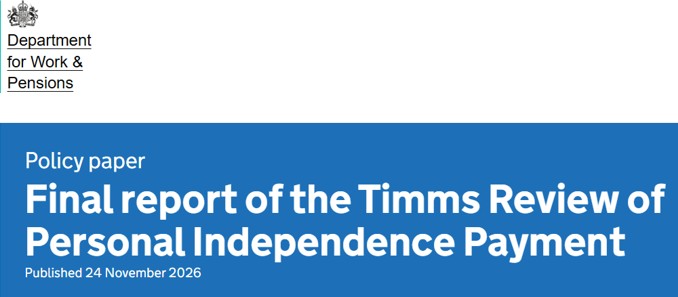
[Featured image – front page of the Timms Report – Department of Work and Pensions]