By Joe Langabeer
Wes Streeting has been Health Secretary for well over a year, but his promises to deliver fundamental change to the NHS have so far failed to materialise. While he and the Labour government insist that their priority is to bring waiting lists down – a mixed picture at best, which we will discuss – Streeting and his junior ministers have been championing the notion that their reforms have improved the NHS. But if anything, they have widened existing cracks and emboldened the right-wing press and its supporters to push harder for privatisation.
A fairly scathing report from the Institute for Government in October found that although the NHS was performing slightly better as it still recovers from the pandemic, much of Streeting’s reform agenda – from cutting administrative staff to the broader vision he claims to have – is not working. In fact, it may actively hamper efforts to improve the NHS.
Worse, one of Streeting’s central arguments is that government must focus on prevention, caring for people before they need specialists or hospital treatment. Yet as the report makes clear, there is no coherent plan underpinning this vision, particularly when it comes to community care.
It is really a rehashed pledge made by previous governments. Streeting’s 10-year plan offers little new, relying instead on repeated references to “investment”.
Abolition of NHS England mishandled
Another comment released last week by the same group, and reported by The Guardian, found that Streeting mishandled the abolition of NHS England, leaving hospitals in administrative disarray. There is also nothing in place to halt the mass exodus of senior GPs, undermining the government’s supposed mission to tackle prevention through “community care”.
In fact, The Royal College of GPs, says that “GPs can no longer guarantee safe care for millions of patients because of a dangerous shortage.” Surgeries, the chair of the Royal College said, are “desperate” to hire more doctors, but “lack funding to do so.” So one of Streeting’s key priorities is already falling apart.
Streeting promised a great deal for the NHS before the election, but often to its detriment; specifically, he repeatedly demands greater involvement from the private sector. He looks like handing more to private providers, thereby bolstering the representatives of the capitalist class – including the likes of Nigel Farage – who want to sell off one of the country’s most essential public institutions.
Outsourcing and PFIs
Outsourcing, in the context of the state and local authorities, is contracting a job or a public service to a third party — almost always the private sector. It has gone through many iterations within public services, with contractors brought in with the justification that they are cheaper than services provided in-house. In fact, in the big majority of cases, the opposite is true. Oursourcing provides a worse service, at greater cost and with the workers involved on lower wages. The only benefit is to the bank balance of the private providers.
The Private Finance Initiative (PFI) were another expensive venture used on a large scale by the Tony Blair government. Under PFI private finance was used to build schools and hospitals “in partnership” with the public sector, but with the companies then expected to “maintain the assets”. It usually meant that a school or hospital was paid for – like a super-expensive mortgage – over decades. Long after the initial capital cost was repaid, NHS is paying billions every year for hospitals built years ago.
Even the Tory government eventually scrapped this ludicrous policy in 2018 after the National Audit Office found that the taxpayer was shelling out £10bn a year with no clear benefit compared to what would have been the case if the NHS itself had built facilities as part of a public service.
A report from the Association of Infrastructure Investors in Public Private Partnerships last year, also reported by The Guardian, warned that 154 PFI-funded projects out of more than 600 could face “serious disruption” unless the government intervenes.
Substandard assets from PFI
According to The Guardian, the Public Accounts Committee found that mismanagement of PFIs led to substandard assets, including schools and hospitals, being returned to government. Most of the original PFI contracts will expire over the next decade, yet public services are still expected to owe around £136bn in charges to the private sector.
The Financial Times reported on one incident where a fire broke out at London’s Whittington Hospital in 2018. The Lloyds Banking Group, worth an estimated £51.28 bn, ended up suing the NHS for £56mn, arguing that even though they were responsible for maintaining the building, the damage was not their fault. That kind of money, funnelled into the private sector, could have gone towards improving hospital infrastructure and preventing similar incidents in the future.
Yet here we have Wes Streeting who has consistently argued against keeping the NHS fully publicly owned. He occasionally takes a shot at Nigel Farage over Reform’s plans to privatisation the NHS – and we agree with Streeting on that – but it is hypocritical of Streeting, when he follows policies that open the door precisely to a Reform-type sell-off plan.
Incredibly, Streeting is now talking about reintroducing Private Finance Initiatives (PPPs) – at this stage primarily for the construction of neighbourhood health centres – although rebranding them a little. In a Financial Times article in September, the Department of Health and Social Care was reported to be seeking private investors to fund new “NHS centres”.
We still have not been told what his PFI model would look like, beyond vague assurances that the government will “learn the lessons” from the previous PFI catastrophe, without explaining what those lessons are.
No difference between PFI and the ‘new’ PPP
But from the description provided by the Financial Times, and based on documents of the Health Department, there appears to be no meaningful difference between PPPs and PFIs. As before, investors would receive long-term contracts to design, build and maintain the health centres, with one planned for every community by 2035.
In principle, it may be a good idea to have clinics that combine healthcare, voluntary and local authority services, with the aim of taking some of the burden of care from hospitals. But having them built by the private sector is like hanging yet another large and heavy financial millstone around the neck of the NHS. According to the FT, each centre would cost between £10mn and £40mn and each one will leave a legacy of huge payments to the private sector for decades into the future.
Earlier this year the campaign group We Own It condemned the move towards PPPs, arguing that attempts to reform PFI have repeatedly failed. If Labour is going to use the so-called ‘Welsh’ model, private companies will not even provide “soft services” like cleaning or catering; the public sector will hold only a small stake capped at 20%; investors will extract profits; and payments will broadly mirror those of a PFI. The Velindre Cancer Centre, for example, a project under the Welsh Mutual Investment Model, had an initial capital cost of £312 mn.
PFI fleecing the NHS
Yet the Welsh government must pay £33.5mn annually for 25 years for construction and maintenance. The eventual total cost will be almost triple: £837mn. This is no different to the fleecing of the NHS by PFI.
Just imagine this same model replicated in every local authority across the UK. If these levels of spending go ahead, with the private sector milking the NHS, exactly as it did under PFIs, local authorities already teetering on the brink of bankruptcy could be wiped out in a stroke: first by paying for the service, then by funding maintenance, and finally by facing lawsuits once private providers realise profits are drying up and projects begin to unravel.
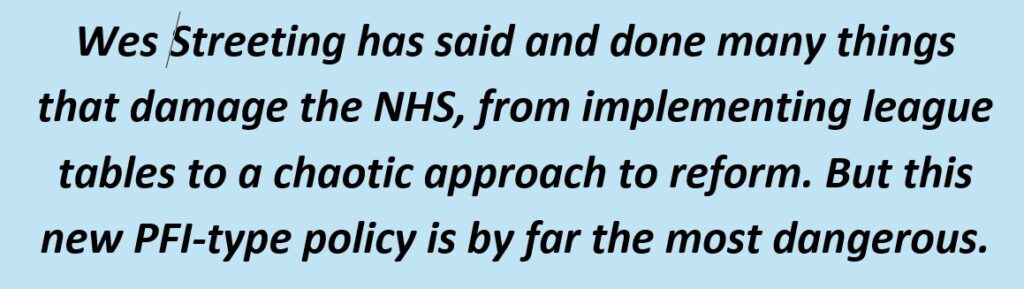
Streeting has said and done many things that damage the NHS, from implementing league tables to a chaotic approach to reform. But this new PFI-type policy is by far the most dangerous.
This ‘Labour’ government seems determined to press ahead with a revamped PFI scheme, because they base their whole outlook on the ‘market’ and big business – that is, the private sector – rather than public services and public bodies. Whether it is utilities like water and energy, or Royal Mail, or health, the right wing of the Labour Party have no conceptions or policies based on public service. For them, it is profit or nothing.
Fixing the NHS
Even a lot of mental health care is now being outsourced. A survey by the charity Rethink reported that 66% of respondents believed they had not received mental health support in an appropriate timeframe, and that 80% thought their mental health had deteriorated while they were waiting.
The damage that has been done to the NHS and long waiting lists are driving increasing numbers of people to the private sector. A recent survey by the independent Healthcare Providers Network found that more than seven in ten people would now consider using private healthcare, up from just 10% two years ago. Most said difficulties accessing NHS appointments were the main driver behind turning to private providers, alongside trying to access support through their workplace. Private providers are cashing in, with regular adverts on radio stations about the ‘advantages’ of private care – cost not being one of them.
The best answer to fixing the NHS is not outsourcing, but an end to it. From PFIs to third-party companies that rake in cash for poorer services, outsourcing has hollowed out the health service.
Streeting can tell the public that the NHS “is broken”, but it was the disgraceful policy of the last Tory government – deliberately running down the NHS so people would be forced to go private – that have left it unequipped for today’s demands. We should add that decisions by the previous Labour government, introducing the ‘internal market’ prepared the ground for the Tories.
It is Streeting’s belief that the NHS can be fixed by the vry private sector which is currently killing it. Funds need to go into the NHS, but should not simply re-emerge as private-sector profit.
Social care largely profit driven
The labour movement should fight for a fully public NHS, with all services and provision brought back into full public ownership. Moreover, private clinics and hospitals – which don’t train a single nurse or doctor – should be nationalised and integrated into the NHS.
Social care, which is largely profit-driven at present, should also be placed under the NHS’s remit, with full public funding and links to related local authorities’ services. Pharmaceuticals and drugs should be manufactured within the NHS rather than funnelling billions each year to private profiteers who exploit people’s health and force the NHS to subsidise affordability for the public.
There are many ways to repair the NHS, but the single theme running through all of them is that privatisation, whether outsourcing, PFIs or any rebranded variant, must be reversed. Streeting’s policies will not protect the service, but will open the door to Farage who wants to sell it off entirely. The message to both of them is simple: the NHS is not for sale.