ANDY FORD looks at the life and works of this remarkable film maker.
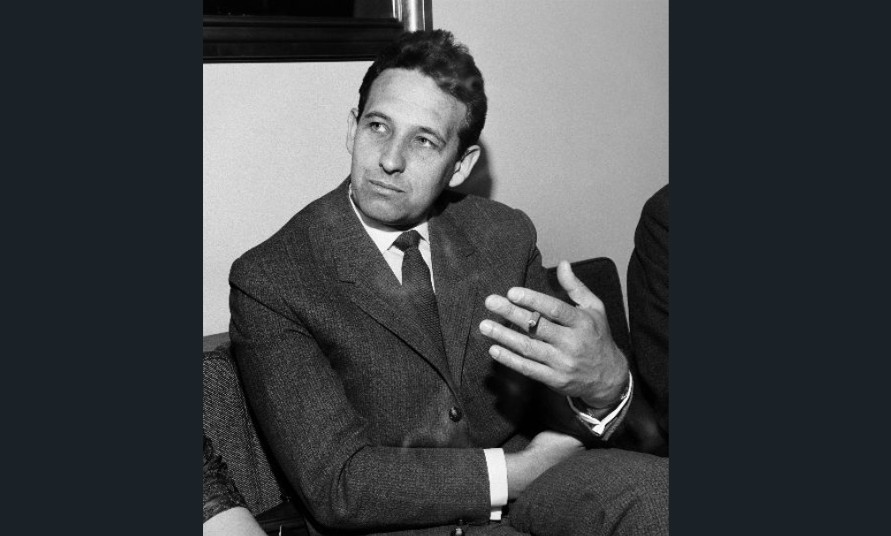
Polish film maker, Andrzej Wajda, was born 100 years ago, in March 1926. His films explored the suffering of the Polish working class, through war and Nazi occupation and then resistance to Stalinist domination.
His films put Polish cinema on the map and created a body of work outside the Hollywood machine which went on to influence the French New Wave, and ultimately Hollywood itself. Both Martin Scorcese and Leonardo DiCaprio have lauded his films as amongst the best of all time. Some are on You Tube (see below).
Wajda was born in Suwalki, north-east Poland, in March 1926. At that time, the city was a mixed Polish/Lithuanian town, with a large Jewish minority. When he was 13 the area was taken over by the Soviet Union as part of the agreements made between Hitler and Stalin, and then subsequently handed over to the Germans!
So began five terrible years of brutal Nazi occupation, where the Polish population lived without even the most basic of rights, and the Jewish community were deported first to ghettoes, and then to death camps. In 1942, when he was sixteen, Wajda joined the Polish resistance, the Armia Krajowa (AK) who had gradually established a complete underground state complete with underground newspapers, schools and even courts [Read more here].
This period informed Wajda’s first film, A Generation, in which a young boy is drawn into the anti-Nazi resistance by older workers in a furniture workshop. A Generation became the founding instalment of Wajda’s acclaimed war trilogy, being followed by Kanal (1957) and Ashes and Diamonds (1958).
Heroic struggle
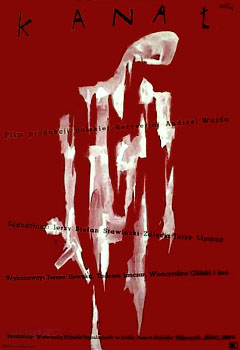
Kanal – meaning ‘sewer’ in English – chronicles the heroic struggle of the AK fighters in the Warsaw Uprising of 1944 [Read more here]. Fighting in the ruins of the city, against overwhelming odds, they are gradually forced into the sewers beneath the city, attempting to carry on the battle literally from underground. But when the fighters make their way towards the light at the sewer outfall, thinking they have escaped, they find the end barred off by a huge metal grid, and that there is to be no escape: a metaphor for the fate of the Polish working class at the end of the war, when they escaped from Nazi occupation, only to find themselves under Stalinist repression.
[image – wiki commons]
Ashes and Diamonds tells the story of Maciek Chelmicki , who is part of the faction of the AK who tried to carry on a military struggle against Stalinism after the war. The title refers to the way that diamonds are produced from carbon and ash under pressure within the earth’s core, an allegory for the suffering of Poland during the war, and the hopes for its post-war youth.
The action takes place in 1945, where Maciek has been tasked with the assassination of Konrad Sckzuka, the local Communist Party secretary. A previous assassination attempt only led to the death of two innocent bystanders, and now, faced with the reality of killing a man he has never met, purely to obey orders, doubts and hesitations creep in.
While drinking in a bar, ready to shoot Sckzuka, Maciek strikes up a relationship with a beautiful waitress, Krystyna, played by Ewa Krzyzewska. He now has a choice – to return to normal life with Krystyna, or to carry out his duty and kill Sckzuka. He chooses the latter, but is himself shot and fatally wounded by a militia patrol, dying alone on a rubbish dump.
The film was very successful in Poland partly due to its depiction of the rebellion of youth rather than any political message, although the Stalinist officials were not so sure. Nevertheless, after the thaw in repression following the workers uprising of 1956 the authorities permitted the film to be made and distributed, and even entered into international competitions where it won the critics award at the Venice Film Festival of 1959.
Stalinist repression
Ashes and Diamonds showed the human cost of the Stalinist repression of Poland and also of the underground struggle against it. It shows the ultimate futility and waste of the methods of individual terrorism, and the way that the struggle of the AK degenerated to pointless killing before its ultimate defeat.
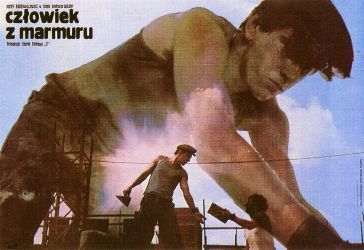
Wajda showed no hesitation, though, in backing the mass struggles of the Polish working class. Man of Marble (1977) shows the naïve enthusiasm of a young bricklayer, Mateusz Birkut, exalted by the Stalinist regime for laying 30,000 bricks in a single shift during the construction of the new city of Nowa Huta. But once he is famous, Birkut realises that it was all a propaganda stunt, and lapses into apathy and drunkenness. He tries to take up the workers’ grievance’s but is first blocked and marginalised, and ultimately put on trial.
[image – wiki commons]
Man of Marble examines the grating propaganda of the Stalinists in 1950s Poland, before change was forced by the workers uprising of 1956. Its title calls out the seemingly impressive, but actually fragile, nature of the regime established in Poland by Stalin after the war. The film concludes prophetically at the Lenin shipyard in Gdansk, the birthplace of Solidarity just 3 years later, as film makers track down Birkut’s son and hear how his father’s life ended in repression and obscurity.
Man of Iron (1981) picks up where Man of Marble left off. Birkut’s son, Maciej, has become involved in underground trade union activity in Gdansk, and it is revealed that his father, Mateusz Birkut, was killed in clashes with the Stalinist police during an illegal strike in 1970. In a series of flashbacks, the suppression of 1970 is depicted using newsreel footage from the time, when tanks rolled into the city and dozens of strikers were shot. There is a tremendous scene where the workers carry Birkut’s body through the streets of Gdansk as the city resounds to gunfire and the shipyard whistles blow.
Ten years later, in 1980, the authorities recruit a washed up, alcoholic journalist, Winkel, to investigate and dig up dirt on Maciej. However, as Winkel gradually gets to know the trade unionists, he converts to their cause. He is then allowed into the shipyard during the historic strike of 1980, where he witnesses the signing of the agreement that permitted independent trade unions in Stalinist Poland.
Katyn
Later on, Wajda made Katyn (2007) about the massacre of 20,000 Polish officers by the Stalinist secret police, the NKVD, in the Katyn Forest near Smolensk, while they were helpless prisoners of war. Wajda’s own father was murdered at Katyn. Unbelievably, Wajda’s was the first film about this event, 67 years after it happened!
It is hard to characterise Wajda’s politics. He championed the cause and struggles of the Polish working class and people, but he was no crude Polish nationalist. Many of his other films were based on Russian classics like Siberian Lady MacBeth (1961) which was based on Lady MacBeth of Mtsensk by Nikolai Leskov; Pilate and Others (1972), based on Bulgakov’s The Master and Margarita; and Nastashja (1994), a version of Dostoevsky’s‘ The Idiot’.
He was a personal friend of Lech Walesa [leader of the Solidarność independent trade union in the 1980s and later president of Poland 1990-95 – Ed] and he made a film about him in 2013, near the end of his life, and certainly Man of Iron gives prominence to the Catholic church, but that was the historical fact. He was a committed critic of Stalinism and a champion of the Polish workers.
His final film, Afterimage (2016) hints at a sympathy with the ideas of the Russian Revolution as it tells the story of the revolutionary artist, Maksymillian Strzeminski, who had been a pioneer of Constructivism in the 1920s, but who was shut-down, silenced and forced into poverty in Stalinist Poland.
Andrzej Wajda was no Marxist, but he was perhaps a sincere and talented humanist, as was Marx himself before he fully developed his socialist ideas.
[Some of Wajda’s films are on YouTube, with sub titles:
Kanal (Sewer) – Kanal – (Sewers, 1957), by Andrzej Wajda (With English subtitles).
Man of Marble – Man of Iron – Czlowiek z zelaza – ( Andrzej Wajda, 1981) – YouTube]