By Umar Shahid
As the eyes of the whole world are on the US-led war on Iran, a conflict between two neighbouring countries has entered its deadliest phase in years. These armed clashes between Pakistan and Afghanistan have not come out of nowhere. They are the result of decades of cynical policies, betrayals, and imperialist games.
The same Pakistani state that once nurtured the Taliban now finds itself threatened by the consequences of its own actions. This is not irony. This is history taking revenge.
The so-called international community, led by Saudi Arabia, Turkey, and Qatar, managed to broker a temporary “Eid pause” in the hostilities, but as Pakistan’s information minister has warned, this is not peace; it is a tactical halt. Operations will “immediately resume” with “renewed intensity” if conditions are not met.
This is the language of an occupying power, not a negotiating neighbour. China, despite its economic interests in the region under its Belt and Road Initiative, has found its calls for dialogue politely ignored. The fact is, that the Pakistani military believes it can bomb its way to security, a delusion shared by every imperial power that has ever set foot in this region.
The Imperialist Chessboard
This conflict did not arise in a vacuum. It is intrinsically linked to the geopolitical designs of world imperialism. The recent escalation coincides directly with the sharpening crisis involving Iran. The United States, despite its rhetoric of withdrawal, has effectively given Pakistan a “green light” for these operations, viewing a destabilised Afghanistan as another pressure point against Tehran, and a means to keep the region in perpetual turmoil. By fuelling conflict between Islamabad and Kabul, the West ensures that no independent, unified bloc can emerge in this strategic heartland.
Islamabad’s current justification for this open warfare, is the presence of the Tehrik-i-Taliban Pakistan (TTP), also known simply as the Pakistan Taliban, on Afghan soil. Pakistan claims the right to “defend itself” against groups like the TTP and the Balochistan Liberation Army .
This is the logic of the sorcerer who, having unleashed the genie, now finds it impossible to put it back in the bottle. The state nurtured an entire ecosystem of jihad; it cannot now pretend outrage now that the seeds it sown have yielded a bitter harvest of terrorism that respects no border.
The humanitarian catastrophe of conflict
There is a massive humanitarian catastrophe, although it is treated as a mere “spillover.” The UN reports that since February, nearly 115,000 families have been displaced and key border crossings like Torkham and Chaman remain closed, strangling trade and causing food prices to skyrocket in landlocked Afghanistan.
As World Health Organization (WHO) chief Tedros Adhanom Ghebreyesus, said “the intensifying conflict is placing additional strain on health systems and increasing risks to the health and well-being of vulnerable populations”. For the working classes on both sides, this war means only one thing: hunger, poverty, and death.
The recent strike on the Omid Addiction Treatment Hospital in Kabul is a grim metaphor for the region’s sickness. It was a centre meant to heal the social wounds caused by decades of war and the opium economy – something that the intelligence agencies on all sides once actively encouraged to fund covert operations. The victims were not warriors; they were the wretched of the earth, the collateral damage of a system that views human life as expendable.
Across the Durand line, separating the two countries, the effects on Pakistani working class are enormous. Pakistan is passing through an economic crisis and more than half of its population are living under poverty line. Yet the ruling class is estimated to be burning through $15-25mn every day on active military operations, including airstrikes, artillery, drone sorties, and expended ammunition.
In about a month of conflict, the total cost of the conflict, including military expenditure, equipment losses, and stock market destruction is conservatively estimated at $2-3bn.
Homes abandoned for safety
In Khyber district near the Torkham border, cross-border firing has brought daily life to a standstill. Residents have abandoned their homes in villages like for safety, taking refuge in old railway tunnels. Traders report that shoppers have disappeared, and many shopkeepers have shut down permanently.
Through the media, the state is also ramping up nationalist and racist propaganda against ordinary Afghans workers who happen to be in Pakistan, and it is running a campaign of hatred against that community.
A recent report of the United Nations Development Programme entitled, “From Return to Build” highlighted the economic and social hardships of Afghan deportees from different countries.
According to report, “A significant percentage of returnee households (88%), IDP households (85%), and host community households (81%) report being in debt, with many relying on loans to cover everyday expenses… Poverty driven by low-paying work contributes to widespread food insecurity, with many households reducing meals or selling assets to afford food… Families adopt harmful strategies such as borrowing, meal reduction, or selling assets to cope with financial stress caused by low-paying work.”
In this situation this war is going to add more misery and pain to already inflicted wounds. The Taliban regime in Kabul offers no progressive way forward. It rules through fear and dogma. It cannot solve poverty. It cannot bring stability. It survives on the ruins of a society devastated by decades of war.
On other side, there is a Pakistani state trapped in its own contradictions. That these two crisis-ridden economies are at war betrays the real contradictions within and between both regimes.
The “Frankenstein’s monster” returns
Historically, Pakistan and Afghanistan did not always have tense relations. In the early 1990s, they worked together. When imperialism flooded the region with weapons and money. The United States and its allies backed reactionary forces to fight their Cold War battles.
Pakistan’s ruling elite played along. They built networks of jihadist militancy, thinking they could control them. Pakistan’s intelligence services helped create the Afghan Taliban and before 2001, openly backed it. It sent advisors, experts, and personnel to help run their military and equipment.
After 2001, things changed on the surface. Pakistan joined US and NATO efforts in the so-called ‘war on terrorism’. But its support for the Taliban did not stop; It just became quieter. Reports from the US State Department, the Congressional Research Service, and a leaked NATO document in 2012 all point to the same thing: that Pakistan’s intelligence agency were still helping the Taliban and gave them safe a haven during the US presence in Afghanistan.
In 2021, US troops left Afghanistan and the Taliban returned to power. At first, Pakistan welcomed this. Former Pakistani Prime Minister, Imran Khan, even said Afghans had “broken the shackles of slavery.” But things didn’t go as expected.
Violence driven by Taliban-like groups started rising inside Pakistan. In late 2022, the Tehrik-i-Taliban Pakistan ended its ceasefire with the government and resumed attacks along a 1,622-mile border that Afghanistan has never fully accepted.
The impact has been serious. By 2025, more than 1,200 people were killed in Pakistan. That was more than double the number in 2021. Pakistan responded and in 2023, began deporting Afghan refugees, saying it was a ‘counterterrorism’ move. By 2025, it had expelled over one million Afghans. Then, in October 2025, it closed the border. Since Feb 2026, effectively, war has been started.
Which way forward?
The only genuine solution is one that the ruling classes on both sides cannot entertain – a socio-economic transformation that addresses the root causes of so-called extremism: mass unemployment, feudalism, and imperialist exploitation. As long as the youth of Pakistan and Afghanistan see no future but a gun or the desperation of a drug-induced haze, war will continue in one form or another.
The deadly legacy of British imperialism’s “Durand Line” is still bleeding by the blood of innocents on both sides. Established in 1893, the line is one of the most contentious and consequential borders in the world, largely because it was drawn up by a British colonial diplomat and it cuts through the heart of the Pashtun homeland, dividing families and tribes.
This historical grievance is a root cause of the ongoing tensions and conflict between the two nations. The destiny of the Afghanistan and Pakistan working classes are not separate but are tied together.
In the past, the Afghan working class has shown a tremendous revolutionary potential, such as in the Saur revolution of 1978. Although it did not then spread across the Durand line, it is still a beacon of hope for the masses of South Asia.
In this period of continuous war and repression, there will once more be revolutionary upheavals and socialists will fight for the socialist transformation of whole region.
As one of our revolutionary poets, Faiz Ahmed Faiz, wrote;
qatl-gāhoñ se chun kar hamāre alam
aur nikleñge ushshāq ke qāfile
jin kī rāh-e-talab se hamāre qadam
muḳhtasar kar chale dard ke fāsle
(From our killing fields, our banners gathered
More caravans of lovers will set forth.
From whose path of seeking, our footsteps
Have shortened the distances of pain)
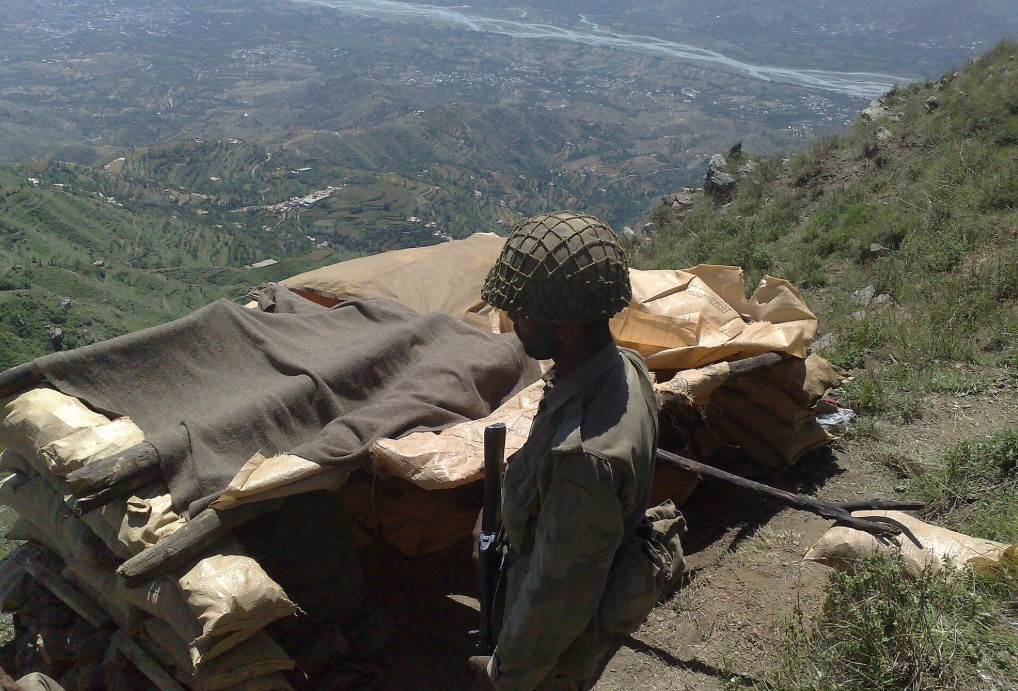
[feature picture shows a Pakistani soldier near the border, from Wikimedia Commons, here]