By Ray Goodspeed
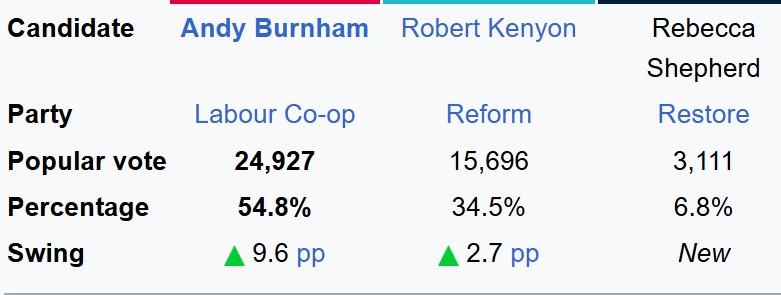
What is propelling Burnham into the Labour leadership and Downing Street, is the overwhelming mandate he won in the Makerfield by-election. Despite Labour being way below Reform in national polls, he achieved a bigger victory over Reform, and on a higher turnout, than his predecessor Josh Simons managed in 2024.
In Makerfield, Labour won 54.8%, up 9.6% on 2024; Reform won 34.5%, up 2.7%, meaning a 3.4 point swing from Reform to Labour. Burnham returned to Westminster, therefore, with a majority of 9,231 (20.3%).
The turnout was high by the standards of by-elections, at 58.7%, which is an indication of how important voters thought this by-election was. It was even up on the 52.5% of the 2024 general election and his is the first time since the SDP won Greenwich in 1987 – nearly forty years ago – that a by-election has seen a higher turnout than the preceding general election.
Moreover, the 6.2% rise in turnout is the third highest in post-war electoral history – only Torrington (11.4%, 1958) and Montgomeryshire (8.4%, 1962) were bigger.
Burnham’s achieved another rare thing, a by-election swing in favour ofthe governing party. The last time a governing party gained ground in a by-election was in Hartlepool in 2021 at the peak of Boris Johnson’s “vaccine bounce”.
However there is still a stark warning to the working class in the vote that went to Reform. Their 15,696 votes represent that party’s best ever vote total, more than the 12,645 they got in Runcorn and Helsby when they beat Labour by 6 votes. Reform’s 34.5% vote share this time is second only to the 38.7% won in Runcorn and Helsby.
In the May local elections, Reform leader, Nigel Farage used “vote Reform to get rid of Starmer” as a slogan, but this clearly back-fired in Makerfield and some Reform voters clearly took him at his word…voting for Burnham in the knowledge that it would mean the end of Starmer.
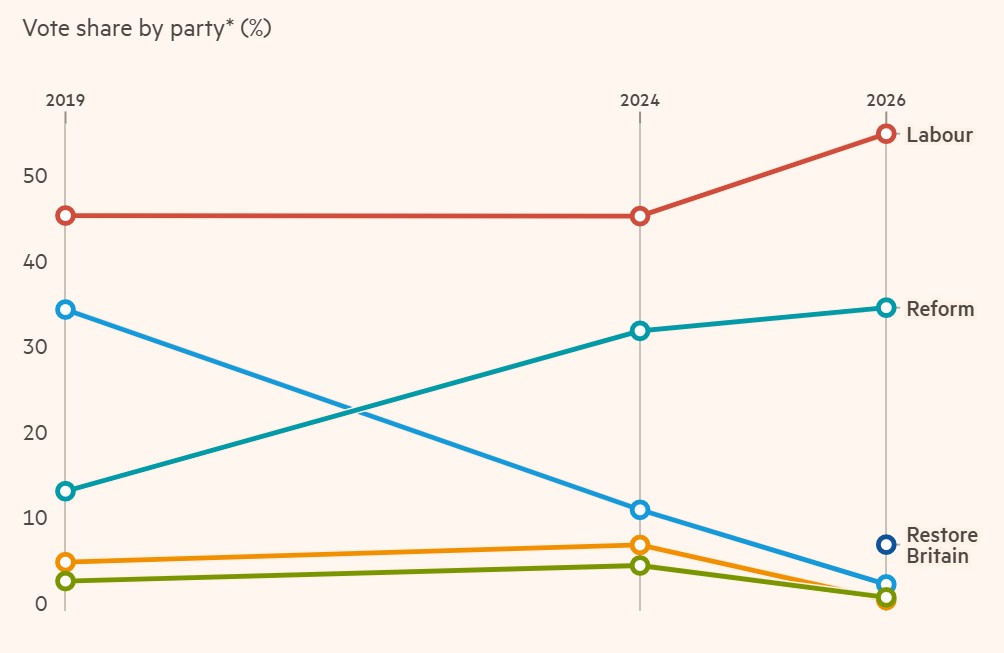
But as alarming as the Reform vote was, the 6.8% vote for Restore, which easily saved its deposit was more so. Restore is an openly racist party, much closer to an explicit neo-fascist party, in the toxic traditions of the National Front or British National Party. The previous electoral gains of the BNP, which won 7.4% in Makerfield in 2010, may help explain why there was a substantial constituency here for Restore, whose signature policy is the mass deportation of immigrants.
The other so-called “progressive parties” were squeezed almost to extinction, largely through tactical voting to stop Reform. Both the Greens (0.7%), and Liberal Democrats (0.4%) lost their deposits, and saw their vote shares fall sharply on the 2024 general election. They got only 1.1 % between them!
Back in 2024 the LibDems had got 6.8%, the same as Restore this time, and saved their deposit. Their tiny 0.4% of the vote (just 163 votes) is the lowest vote share for a ‘major’ party in any by-election, even less than the party’s 0.9% in Rochester and Strood. It is a like Monster Raving Loony Party type result (or TUSC!!).
The Greens’ vote collapsed, from 4.4% in 2024 to 0.7% . It is clear that Green Party voters were understandably desperate to avoid a Reform win and wanted to remove Starmer by voting for Burnham.
The Tories’ vote, at 2.2%, was their second-lowest ever in a by-election, beaten only by the February Gorton and Denton contest. In Makerfield in 2024, they got almost 11% and it was calculated that they would have got an estimated 34.4% in the current boundaries in 2019. This is an extraordinary collapse for the Tory Party, now virtually replaced by Reform, with Restore on the far-far-right. Their collapsing vote went mostly to Restore and partly to Reform
Labour’s victory for Burnham was significant in this by-election, gaining 55% of the overall vote. But we should put that into a context. Labour got 45% in both 2019 and 2024, but under Jeremy Corbyn’s leadership in 2017 – and before Starmer and other sabotaged Labour’s stand on Brexit, they got 60%.
Corbyn’s vote in 2017 shows how class-based policies can win workers to vote Labour. Although this time it was only the perception and the hope of more class-based policies with Andy Burnham, the same general lesson holds true for Makerfield this week.
[See editorial on what Burnham leadership will mean for Labour]
[Feature graphic is from Wikipedia]