By Maureen Wade, chair, Birmingham UNISON retired members section.
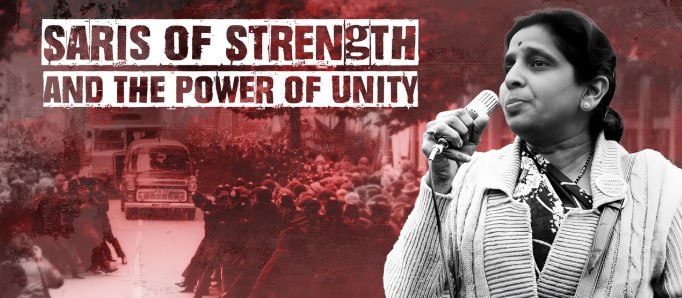
This month sees the fiftieth anniversary of the beginning of the Grunwick strike, and it is being marked by a new film, Saris of Strength. The dispute began officially on August 20 and it involved 137 workers, 80 percent of whom were South Asian Women, led by Jayaben Desai. They walked out for the right to join a trade union.
The women were employed at the Grunwick Film Processing Laboratory in North London and they walked out because of low pay and intolerable working conditions. At a time when the national average wage was only £72 per week, they were paid £28. They faced ‘no-notice’ compulsory overtime, and during the hottest summer for decades, they had no air conditioning.
As one of the strikers, Jayaben Desai put it: “The strike is not so much about pay, it is a strike about human dignity.” Incredibly, the strike was to last for two years, as the women fought tirelessly to get recognition for their trade union.
The employers had banked on the women being passive and easy to control, playing on the racial stereotyping that existed at the time. Instead, they got a pride of lionesses – the women were dubbed by the media as the Strikers in Saris – and they managed to galvanise the wider labour and trade union movement in support.
Attempts to organise a trade union
The dispute marked the first time that the mass of trade unionists stood with and showed support for immigrant and Black workers.
Not, however, that the TUC leadership demonstrated such interest. There had been an attempt to unionise Grunwick in 1973, with workers joining the Transport and General Workers Union [one of the main constituent unions of what became Unite], but they were immediately laid off by the company. On this occasion, the TUC bureaucracy assigned the Grunwick strikers to the largely clerical trade union, APEX, at the time one of the most right wing unions. [APEX later amalgamated with the GMB].
Fortunately, any lack of action on the part of APEX was compensated by Brent Trades Council, which, filling the vacuum, organised widespread support throughout the labour movement.
During the course of the dispute, several mass pickets took place, involving thousands of trade unionists, with Arthur Scargill from the NUM bringing thousands of miners to the picket line.
The Post Office Workers were balloted and refused to deliver mail to the Laboratory. This was important because in the days before digital cameras, a lot of photographic film was sent away by post to be developed into pictures. The Grunwick company were told to collect their mail from the local mail sorting office, but even there, the Post Office Workers refused to handle the company’s mail.
The dispute was often marked by violence during the mass pickets, with the Metropolitan Police unleashing the notorious Special Patrol Group against the strikers and their supporters. There were over 550 people arrested, which at the time was the highest number of arrests during any industrial dispute since the 1926 General Strike.
Unfortunately despite an heroic struggle, the dispute was lost as Grunwick continued to refuse to recognise the union, and it was backed up in this by both the Conservative Party and an extreme right wing organisation which called itself the National Association For Freedom.
An embarrassment to the Labour leadership
The Labour government of the time, led by Jim Callaghan, found the whole dispute an embarrassment rather than an essential battle for workers to have the right to join a trade union. The strike was a threat to the cosy relationship the Labour leaders had nurtured with the tops of the TUC to sell the government’s so-called ‘Social Contract’: a policy which effectively limited wage rises below what was the current rate of inflation.
The government attempted to bury the dispute with – yes, same old, same old – an ‘enquiry’, led by Lord Scarman. In spite of his recommendations in the subsequent report, which called for the strikers to be reinstated and their union recognised, Grunwick refused…and the Callaghan government did nothing.
Subsequently, after a two year battle, the TUC withdrew support for the dispute. Desai, echoing the view of many trade unionists through the ages, whether one hundred years ago during the General Strike, or 40 years ago in the Miners Strike, commented: “Trade union support is like honey on the elbow – you can smell it, you can feel it, but you cannot taste it.”
To mark the anniversary, Saris of Strength, is being shown in Birmingham in August with a Q&A session at the end of the film, with speakers who were involved in the dispute. It is believed it will then go ‘on tour’. Keep an eye out for a showing near you.
The film, Saris of Strength is a production by DESIblitz, one of the UK’s best known British Asian and South Asian magazines. See here for a trailer.