By Paul Atkin
This guest article by Paul Atkin is based on a presentation at a recent Left Horizons Zoom discussion on climate change. The first part of his article, dealing with projections of global warming by UN scientists, is here.
……………………………………………………………………………………….
All the projections made by UN scientists and others are essentially technical and for the scientists, undisputed. But there is a suggestion that the changes to come and those already in train will develop with an orderly, predictable, ‘Fabian’, gradualism which that we can slowly adapt to. This this plays down the potential for sudden and catastrophic shifts as climate warming reaches certain tipping points.
We have already seen a tipping points, such as the mass deaths of coral, the Amazon becoming a carbon source not a carbon sink and accelerating methane release from melting permafrost. The idea of ‘gradual’ warming gives a false impression that everything is under control. The point about tipping points is that that seems to be the case, until it isn’t. A report just out from IOP Science indicates that “warming-induced” emissions of greenhouse gases from natural sources – including permafrost, wetlands and wildfires – could amplify global temperature rise by a further 20-30% for example.
We have to bear in mind that the rise in greenhouse gases driven by human industrial and agriculture activity now is 40 times faster than during the Paleocene-Eocene thermal maximum (PETM) 50m years ago, and over 100 times faster than during the warming at the end of the last ice age. Those who say that the Earth’s climate has always changed for natural reasons are right, but wrong to ignore the way our actions are giving it such a ferocious acceleration in such a short space of time.
In the case of the PETM it took about 3,000 years for global temperatures to increase by 5-8C. On average, that works out at between .0017C and .0027C a year. At the moment, the temperature is increasing on average by .024C a year and rising. So this is almost unbelievably fast, and so must our response be.
Sea level rises
We should also bear in mind that the last time the Earth had a 430ppm concentration of CO2 was during the Pliocene, three million years ago, when temperatures were 3-4C higher than the pre-industrial average and sea levels were 5 to 25m higher.
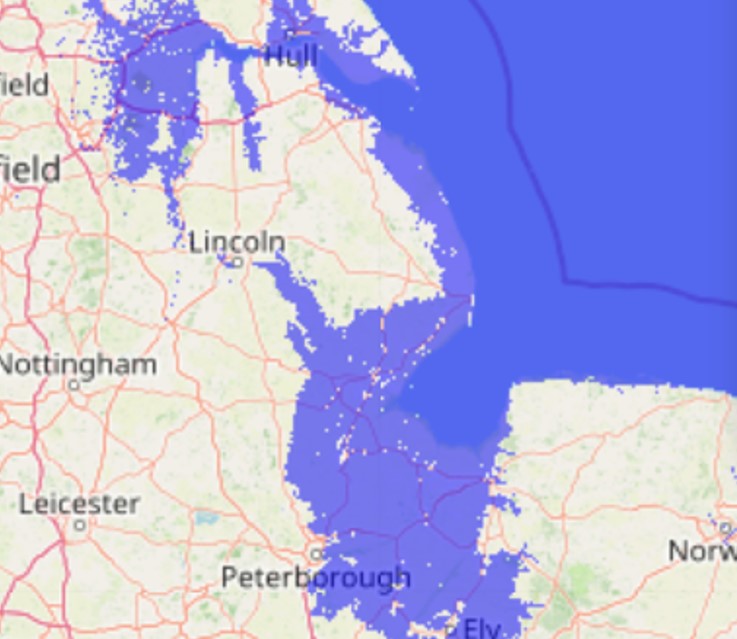
The inset picture (left) shows the East coast at a 5m rise, the low end of that projection. Peterborough and Cambridge are now on the Wash, and the Thames estuary would start somewhere near Wapping in east London. With a 25m rise, the estuary it would start at Windsor. The current IPCC projections are for a 1m rise by 2100, with an outside chance of 2m, but the speed of the rise is increasing.
A recent report, from the Institute and Faculty of Actuaries (the Insurance Industry essentially) and Exeter University, applied a planetary solvency model on the basis that the existing technical models underestimate the risks and the knock-on negative impacts that are already being felt and are accelerating.
Their projection is that by 2070-2090 the impacts will be so severe that world GDP will halve and 4 billion people will die. While fact-check websites poo-poo this, these are actuaries making this projection based on insurance industry risk projections, so it shouldn’t be dismissed out of hand. And if it is even the remotest possibility, it should concentrate minds and give us more of a sense of proportion…and urgency.
Social and geopolitical factors
And here is the core of the problem. All of these projections seem to be based on presumptions that all other factors are equal, and that existing social economic and political structures stay essentially the same, when there is actually no way that they can do; if only because of the impact of climate consequences that are already baked in.
They rest on UN projections that the global population will rise from 8.23 billion (now) to 9.6 billion by 2050, peak at just over 10 billion around 2080, then slowly decline from then on. By the end of the century, the projection is that people will be, on average, 10-25% poorer than they are now.
But there is no ‘average’ person, no ‘average’ state. Projections of climate impacts vary – with the Canadian government projecting rises of 3-5C by 2100, with 10C in the Arctic, the threat of mass deaths from wet bulb temperature events at a global average of a 2C rise primarily in Northern India, Pakistan, Bangladesh, Eastern Asia, the Arabian Gulf and the African Sahel Zone. Let us not forget that the medium scenario gets us to 2C in 2050 – only 24 years from now.
Moreover, the existing state of affairs is not socially or economically static. It is characterised by rapid shifts in wealth and power within states and between them. There is an ever-growing concentration of wealth in fewer and fewer hands in the West under neoliberalism, and an increased global weight of the BRICS in general (with a combined economy now greater than the G7) and China in particular, with its colossal exports of renewable products and technology.
Part of this is an attempt by the Western ruling classes to sustain their bloated lifestyles by keeping the global south as poor as possible to keep kits carbon footprint down. The UK government decision under Starmer to cut overseas development aid (ODA), including climate finance to pay for the first installment of increased war spending expresses this perfectly.
Political struggles within and between states
These questions will be resolved in political struggle within and between states. The most decisive of these now is to defeat the attempt by the United States to sabotage international cooperation on climate change. It is trying to roll back the deployment of renewable energy and transport, to secure “global energy dominance” through its own abundance of fossil fuel reserves, through control of those of other states, and hence by enforced dependence on its exports.
The US is trying to shore up its slipping global imperial dominance by preparing itself and its allies for apocalyptic war, in an attempt to sustain the bloated lifestyles of the western ruling class, by keeping the global south as poor as possible. The UK’s cut of ODA, including climate finance, to pay for the first installment of increased war spending expresses this perfectly.
Some good news is that we could be reaching a tipping point in this energy shift. The cost of renewable technology, wind, solar and batteries, has dropped so far and so fast that they are now cheaper than carbon alternatives just about everywhere.
More than half of countries have passed peak fossil fuel use and China is plateauing, with solar now producing more energy there than coal for the first time. Other global south countries have a viable and sustainable path to development which also liberates them from carbon dependence and everything that goes with it.
Because electric energy is so much more efficient that fossil fuel, every unit of additional renewable energy displaces three units of fossil energy. And the total amount of extractive mining needed for all the resources needed for the transition up to 2050 is equivalent to the amount needed just for coal, just in 2024. Once the initial bottleneck of grid upgrades is dealt with, costs will drop even further. Quids in.
And that also poses questions about domestic politics. The GJAs model motion for a transformative response to the fossil fuel cost crisis driven by Trump’s war on Iran, which had some input from Fuel Poverty Action, CACCTU and CND is based on three core principles.
* To stop the crisis, we need to stop the war, tax war profits and transfer military spending to other purposes
* The transition to renewable energy and energy conservation is the solution.
* Crisis measures must be social justice measures.
We can look at these one at a time
Stop the war to stop the crisis. Fossil fule price spikes have resulted from the wars in Ukraine and the Gulf. The spike for the latter is less severe than from the former, because of the rapid increase in renewable energy use here and across the world. Nevertheless, the rise in prices is damaging for the cost of living and at the same time a financial windfall for the oil and gas companies and the banks that finance them; with Shell, BP and Total doubling their profits in the first three months.
The same is true for arms manufacturers and billionaires with investment in all of them, not least Trump. Ketan Johsi, writing on Al Jazeera, put it well. “We cannot survive in this system. Hooking humanity on a fuel that becomes more profitable for companies when there is more bloodshed and conflict is a guaranteed recipe for more suffering in every way imaginable.”
So the bottom line demand we need from the labour, climate and anti-war movements is for 100% windfall taxes on all war profiteering to undercut this dynamic. We go a bit further in calling for a commitment that the increase spending on war preparation, as demanded by Trump, (which would cost an additional £70 billion a year if fully implemented) needs to be transferred to investment in hastening the climate transition and sustaining people in the meantime. The TUC’s “investing in our future” programme spells out what that could look like.
The energy transition is the solution. A paradox of Trump’s war is that, while it has led to a small uptick (1.2%) in coal use, its primary impact has been to drive countries and individuals towards renewable/electric alternatives, whether that’s Ethiopia banning petrol/diesel car imports to the sharp rise in people here and elsewhere buying EVs or putting up solar panels.
It is important to stress this point, because the whole of the Right here, and two very powerful unions, GMB and Unite, are arguing that “reopening the North Sea” with new investment in oil and gas fields will solve the problem. The truth is that it won’t. The North Sea is a declining basin, and has been since 1999. Production is down to 25% of peak, despite new licenses allowing new exploration.
“saving jobs” in North Sea Oil is an illusion
As with fracking, the delusion of a renewed oil and gas bonanza can be painted in the press, and live in people’s heads, but can’t survive contact with geological (and economic) reality. It costs four times as much to extract gas from the North Sea than it does in Qatar.
Some people argue that this is needed to “save jobs”, but jobs in N Sea oil and gas have been declining (at an average rate of 700 a month) every year this century. That’s for 309 straight months…and is set to continue. The number of long term jobs predicted for the Rosebank oilfield is 450. Not even a month’s worth of decline.
Jackdaw is even worse. Being a largely automated operation, the additional jobs projections range from none, to the dizzy heights of 27. When unions ignore this reality and, instead of campaigning flat out for their members to get easier access to offshore wind jobs, or for the government to force their owners to decommission defunct rigs, which is another potential source of jobs, they are leading their members up the garden path, where Nigel Farage and Kemi Badenoch are waiting for them.
All emergency measures should be social justice measures. Crisis measures across the board should not only hasten the transition, but also actively promote social justice. So, food shortages, generated by bad harvests and the squeeze on fertilisers from Russia and the Gulf, if left to the market, will lead to rationing by price.
So moving from limiting purchases of core goods (as in the pandemic) would need to move to a core food guarantee/rationing system for essentials, as and when things get bad enough. That may not be this crisis, but something like that is coming, so we need to think this through.
With petrol and diesel getting too expensive, there needs to be a subsidy for public transport, the addition of more routes and fares cut. Private jets should be banned.
Rising energy price caps similarly ration by the market. So we need an Energy For All approach, which would offer the real security of a baseline which no one can fall below, and based on higher prices for high use of energy, free or low prices for low users, combined with adjustments for those who need more energy because of disabilities, large families, or housing conditions. This would offer the real security of a baseline which no one can fall below.
The Emergency Advice issued by the government recently to stock up on beans and bottled water indicates how their first instinct is to propose token actions which are posed as the responsibility of individuals, rather than the large scale collective measures that are needed from government level.
The full motion can be read here. https://greenerjobsalliance.co.uk/motion-on-a-transformative-approach-to-the-fossil-fuel-energy-crisis/
PAUL ATKIN is a retired teacher and convenor of the NEU climate change network, and he also edits the Greener Jobs Alliance Newsletter. Please send any feedback to editor@left-horizons.co.uk, so it can be passed on to Paul