The US midterm elections have delivered a crushing blow to Trump’s Republican Party and show the huge popularity of left and radical ideas within the American working class. They are a stunning and potentially decisive defeat for Trump and his policies, and they open a new era in US politics.
Across the board, every demographic swung against the Republicans: men and women, white, black and Latino, but above all young people. Although events will unfold over years, the sheer scale of the swing against Trump has the same revolutionary implications as the huge movements of young people in France, Germany, Serbia, India, Bangladesh, Madagascar and in many other places around the world.
There is a wave of anger across the globe as young people especially are objecting to being ground down in terms of their living standards and prospects, while the rich get richer and corruption proliferates. The US midterms can be considered a part of this general process.
The Democrats have won their biggest majority in the House of Representatives for nearly 20 years. Some seats are still to declare, and their total majority in Congress may in the end be bigger that it was at the beginning of the presidencies of Barack Obama and Bill Clinton. The Democrats, as we write, have already flipped 43 seats.
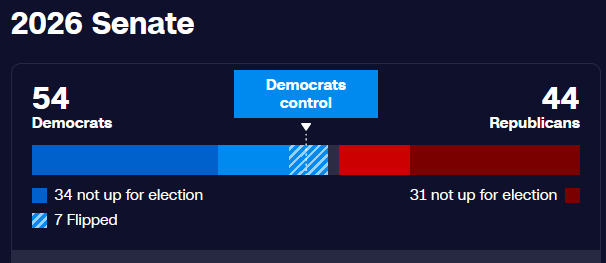
These astonishing results exceeded the most hopeful expectations of the Democrats. Just a few months ago it was doubted by media pundits that the Democrats could take control of the Senate, but in this upper house of Congress, the Democrats already have a majority of at least ten. There were 29 state governorships up for election, and of these, the Democrats won 17, five of which were flipped from Republicans.
Democrats took states that Trump won in the presidential election of November 2024, some by large margins. They won North Carolina, Maine, South Carolina, Ohio, Texas and Iowa. Kansas, too, a state that has not elected a Democratic Senator since 1932, nearly a hundred years.
For the Senate, there is a chance of further gains in formerly strong Republican states like Alaska and – astonishingly – Mississippi, where a black Democratic candidate is marginally ahead of the incumbent Republican, in the historical heartland of White Supremacy.
For the Senate, Texas flipped to the Democrats for the first time in almost 40 years. The Democratic candidate, James Talarico, a preacher and former teacher, has been the victim of a huge advertising campaign which dealt in all kinds of absurd smears and nonsense. It was funded by Elon Musk’s fortune and was thought to be the most expensive Senate election ever.
Billionaires and ICE
Yet, after a campaign that focused on economic questions, the influence of billionaires and issues around ICE – while not conceding on questions of identity and discrimination – Talarico got 55% of the votes, beating a right-wing bigot, Ken Paxton. Talarico said the election was not about left and right but top and bottom, hinting again at class issues.
An even more right-wing Republican bigot, Greg Abbott, lost the Texas governor race to a young Latina woman. Abbott had savagely attacked abortion rights and authorised the hunting of trans kids, even to the point of prosecuting supportive parents for ‘child abuse’.
Some races were marked by disgusting racist, Islamophobic and anti-trans attacks. $200mn dollars nationally was spent on anti-trans ads alone. But voters rejected all that filth, and several trans candidates were actually elected in state legislatures, including a trans woman who flipped a Republican seat in Alabama.
Most Democratic candidates (though not all) supported trans people and none of them seems to have suffered for it. Voters either supported trans people or, faced with the problems of daily life, didn’t care about the issue enough to influence their vote. Voters were looking for solutions to their life problems – not culture wars.
The most high-profile attacks came against Abdul El-Sayed, running to be Senator for Michigan. While he concentrated on the real problems of Michiganders – high prices, lack of Medicare for all, housing – and to get ‘big money’ out of politics, $70mn was spent to defeat him just in the primary, including $30 million by the pro-Israel lobby group AIPAC.

Hundreds of millions of dollars were spent by the Republicans in the election. All the ads focussed on El-Sayed’s name and religion in a naked display of racism, while he stuck rigidly to class-based demands, that could barely even be called radical. He called for millions of tax-dollars to be spent on schools and hospitals and roads and not on buying weapons for Israel to murder Palestinians.
To get to be the candidate, El-Sayed had beaten Haley Stevens in the primaries, but two days before the actual vote on Tuesday, she endorsed the Republican candidate, not that it made any difference. In fact, it may have boosted his campaign by galvanising angry voters to turn out. In one polling area in Detroit, a thousand young people queued to vote on polling day, mainly for El-Sayed.
A wave of discontent
El-Sayed’s campaign rode a wave of discontent, especially among young people, from all backgrounds. Most media observers described him as a “controversial” candidate who could perhaps only win narrowly in Michigan, but he won comfortably, by 7% (45-52%). El-Sayed will be the first Muslim senator in US history. Most Jewish Democrats voted for him. This represents a wounding defeat for the Israeli lobby, which is furious, and it is a marker of just how much support for Israel has slipped away over the last few years.
The election saw many first victories for Black women candidates for state governors, a gay senator, and so on – but the Democrat victory was firmly based on what might be called class issue of “affordability” that cut across and united different communities.
It is important to note that this huge victory has been won even though in some cases Republican control at state level had led to the deliberate redrawing of district boundaries to gerrymander results in their favour. But this fiddling only resulted in two seats won, because the scale of the collapse in Republican support rendered such dirty tricks redundant.
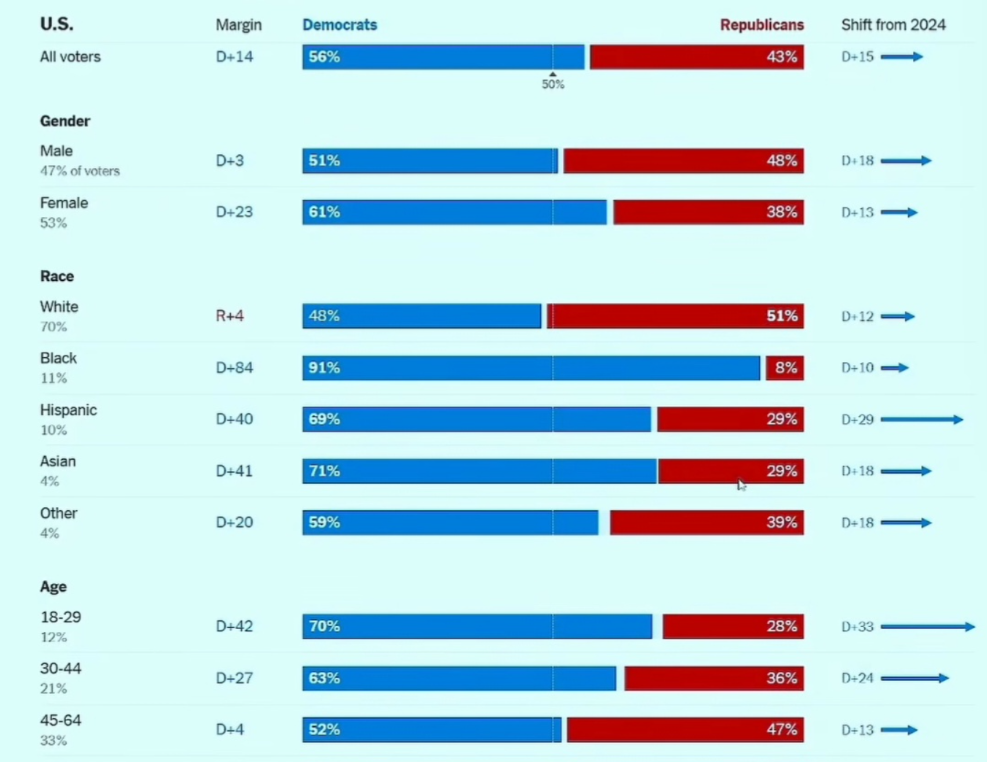
In 2024 Trump came within about 10-15% of winning a majority of young voters (under 29 years old). This time, no fewer than 72% of these voters voted Democrat. Trump won a majority among young men last time, and specifically young Latino men. But in this election the Democrats won 65% and 72% respectively. This an earthquake among young voters under 30 and polls show that a third of voters in this age group self-identify as ”democratic socialists”.
In a less publicised contest, for Mayor of Los Angeles, the two candidates in a run-off election were a Democrat and a member of the DSA (Democratic Socialists of America), and the socialist is expected to win. Eight members of the DSA have been elected to the House of Representatives, and several other successful candidates ran on progressive demands based around issues of living standards.
Many DSA candidates successful
In addition, several dozen DSA members have been elected to positions in state legislatures and the myriads of local official positions that are elected in the US system. A socialist, Angie Nixon, came within about 3% of gaining the Senate seat for Florida, which would have been an incredible result.
There are several reasons why Trump and the Republicans lost on such a scale. These include the rocketing prices, particularly of petrol and diesel caused by what is perceived to be as an unnecessary war with Iran. Diesel prices have had a dramatic impact on the transport and agriculture, which depend heavily on farm equipment, not to mention the huge impact on ordinary workers having to pay persistently high prices for petrol. This factor must have been behind the loss of some formerly ‘solid’ Republican agricultural states.
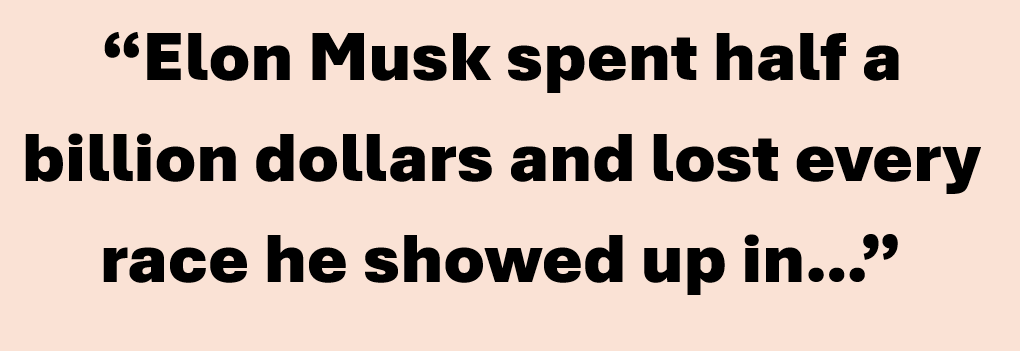
The issues directly affecting workers meant that they were far less inclined to be taken in by slick advertising campaigns lying about the economy and the candidates. Silicon Valley alone spent $600mn on candidates, most of whom lost. “The money didn’t work,” said one political operative who had co-ordinated Big Tech spending in the months leading up to the midterms. “Elon Musk spent half a billion dollars and lost every race he showed up in.” (Financial Times, November 5)
Far from swaying voters their way, ‘big tech’ has met huge opposition. Its frantic and reckless building of AI data centres threaten the water and electricity supply of local communities, not to mention environmental damage, and there have been scores of protests movements across different states against the building of data centres.
Another major factor in this election has been the disgust at the behaviour of ICE agents: masked men snatching men, women and children from the streets, workplaces and schools; savage concentration camps and deportations to other client nations; even the shooting and killing of peaceful protestors in the street. This has mainly affected and alienated Latino voters who have borne the brunt of this brutality, but it has inspired widespread revulsion and solidarity action across whole communities.
An important turning point in US politics
But there are wider and more long-term causes of discontent. The failure of the USA to guarantee health care to all citizens, and Trump’s actual cuts to Medicare funding, to give tax cuts to the rich, have led to a shocking crisis of medical debt and bankruptcy. Housing costs, to buy and rent, are outstripping income levels. Real net income for US workers has stagnated for decades, and destitution, mental illness and drug addiction are tragic symptoms of that crisis.
The policy of blanket support for Israel during the genocide is deeply unpopular, now even among Republican voters. There has been a collapse in public support for Israel, because of the genocide in Gaza and the ethnic cleansing in the West Bank. For the first time ever public support for Palestinians exceeds support for Israel and the latter’s role in involving the USA in yet another war in the Middle East would have been noted by many voters.
As if manoeuvring for a future presidential bid himself, JD Vance has openly blamed the Iran war for the Republicans mauling. The Financial Times reported, “One of the four points suggested by Vance for a revival of Republican fortunes was “change our relationship with Israel”.
The FT report goes on, “Amit Segal, a prominent Israeli journalist who is close to Netanyahu, posted on X: ‘What happened in America last night is a catastrophe. Take AIPAC’s worst nightmares, double them, and you still don’t get close,’ he said, in a reference to the pro-Israel US lobby group”.
It is hardly surprising that the impact of the American Israeli Public Affairs Committee (AIPAC) has been far less than in previous elections. This organisation spent $55mn on losing Republican candidates and rather than crowing over its ‘successes’ as it usually does, it has gone quiet.
This election marks an important turning point in US politics and Marxists must weigh up its significance. It is too early to say if it means the end of the war with Iran, but it will mean that Trump is effectively a ‘lame duck’ president for the next two years. At best, he will face ongoing constitutional and legal battles over the relative powers of Congress and the Presidency. At worst, he may face impeachment or investigations over corruption. More than one winning Democrat has referred to the need to investigate the ‘mafia’ family in the White House.
Increasing class divide within the Democrats
An important development that we can expect in the coming months and years is an increasing class divide within the Democratic Party. Radical and left-wing candidates, including DSA members, have won some startling victories. But the openly pro-capitalist ‘establishment’ in the Democratic Party is still very powerful and, backed by Republicans, the media and economic ‘experts’ it will do its utmost to check or tone down the radicalism of new Senators and members of Congress. Some Democrats are already proving more conciliatory towards Trump, where the big majority of Democratic voters want the man prosecuted for corruption.
In the longer run, there will be profound divisions and eventually splits in the Democrats, between the ‘old guard’ who are proud defenders of the capitalist market system and those more left members, especially in the DSA, who will move towards socialist ideas: public ownership, taxation of wealth, a national health service and democratic control of the economy and society.
Socialists in the USA should take an active part in the debates and ongoing discussions, particularly within the milieu of the DSA, where ‘left’ ideas will be discussed, challenged and tested against the realities of political developments. Activists within the DSA will be called upon to distinguish between woolly ‘left’ ideas and semi-left policies and a genuine socialist programme for the alleviation of general want and the provision of the necessities of life.
We live in an epoch of war, revolutions and counter revolutions, as capitalism writhes and struggles to maintain its rotten system. This election has revolutionary significance in that it marks the likely beginning of new parties and movements based on the independent struggles of the working class, moving in the direction – at long last – of a US party of labour. In that sense, it also marks the beginning of the end of a system built on corruption, lies, the enrichment of a tiny few and the increasing impoverishment of the many.
[Feature photograph of US Capitol building from Wikimedia Commons, here]