
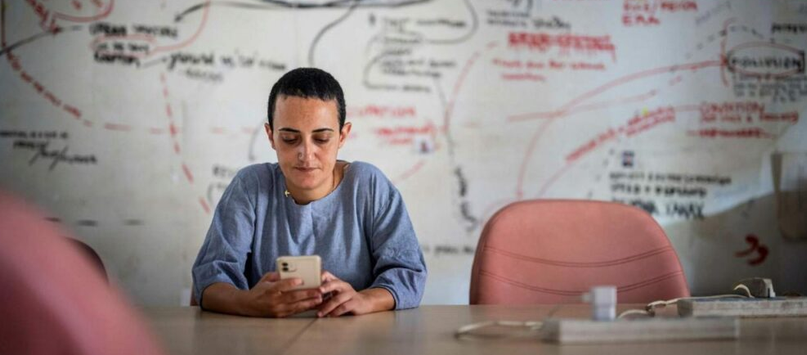
By Lina Attalah (From Substack)
On October 27, I stood before a judge in a courtroom in Cairo with my defence team of eight committed lawyers beside me. A week earlier, I had been summoned for interrogation on charges of running a website without a license. It was the sixth time over the last few years that I had faced prosecutorial questioning. But it was the first time I was referred to court.
At the beginning of the court session, the judge repeatedly assured us that this was a small, simple case; it shouldn’t be a big deal. Apparently for this judge, and for others with power, shutting down Egypt’s leading independent newsroom was not a big deal.
As the trial proceeded, all of our defence team’s requests were summarily rejected, including requests for time to prepare a defence, submit additional documents, or to summon witnesses. As the space in the courtroom was being increasingly void of law, the judge decided to ignore all my lawyers and instead appointed a lawyer to take up my defence.
I objected, my eight lawyers objected, and the judge proceeded to pronounce his ruling in this small, simple case, as I was being forcibly carried by policemen out of the courtroom. I didn’t get to hear the verdict.
Seven hours id dark, musty custody
After seven hours in dark, musty custody, I learned from a paper that I had to sign to be released that the court ordered Mada Masr [website here] to be shut down and imposed a fine of 3 million Egyptian pounds. Just like that, 13 years of journalism practice had ended in a five-minute judicial performance.
That day in court came at the tail end of various other encounters with the law, where we took every initiative possible to avoid that outcome. A media law was passed in 2018 ordering us to get licensed. We applied right away but did not get a response. In 2020, when the legislation’s bylaws were finally published, we applied again.
Again, we did not get a response, despite the law obligating the licensing authority to provide a response within a 90-day period of the application. In 2022, we learned during an interrogation session at the public prosecutor’s office that in fact, our license had been rejected, a decision that was never addressed to us and never included any reasoning.
Nonetheless, we contested the decision at the State Council and when that contestation was rejected, we resubmitted our application with additional paperwork. We have received no response from authorities since 2023. Recounting these details is only an index for how we have always tried to stay within the bounds of a law designed to control, rather than to regulate.
Our battle has not just been to do independent journalism, but to institute in a sustainable way—including through legal practice—the expansion of the space allowed for us and others to operate.
In 2013, we, a group of journalists from Cairo, came together to create Mada Masr in a moment of political turmoil. Regime change was at the door, followed a year later by the election of President Abdel Fattah al-Sisi. Thirteen years ensued of heavily tightened political rule with very little spaces of politics left, including power politics, and a rising integration in the global economy as one of many debt-drunk “emerging” markets, all in the midst of a radically shifting region.
That summer of 2013, the urge was to understand the moment, to give it shape in thinking and writing, to create a record of it. In doing so, we sought to keep people engaged in these transformations, and to find the connections between them and their daily lives. This is the space of politics we have been building over the last 13 years.
Unrepresentative parliaments, powerless opposition
In our minds, journalism has always been a vocational space through which we can resist the active cancellation of politics. In times where this cancellation is manifested in the removal of spaces and people—unrepresentative parliaments, powerless opposition parties, fractured civil society, jailed regime opponents, propagandist media—independent journalism, with Mada Masr at the forefront of it in Egypt, kept some of this space alive.
The substance of this space is asking questions, finding answers, thinking about them, and presenting all of it to the public, which enlarges the scope of the questions and the answers. It’s the dynamism of thinking that keeps life political.
Keeping our life political, living our life politically, is a way to assert the legitimacy of our existence as a people; a legitimacy that transforms our need for dignified life into a right.
Over these past 13 years, we have been working, and over our heads, a chorus was repeating at Egyptians, at times shouting at us: that those in power know it all, that the stability of our country lies in their hands alone, that we should just mind our own business (business here is strictly tied to putting food on the table if you are from the middle class and below), that we are too needy, that many sacrifices are made for us. At Mada Masr, we simply chose to ignore the shouting and do the work.
Today, it is not surprising to find ourselves being punished because we ignored the shouting. This is why we now find ourselves under a storm of targeted shouting.
Tried and sentenced without being informed
And this is why we are fighting to expand that margin of space for us and others to operate. And this is why we still hold on to our right for appeal, with a court date set for November 25.
And this is how we will go back to court next week, on November 11. Because upon my release last week, I learned that I had been convicted in absentia in 2024 on charges of publishing “false” news and running a website without a license (again) and sentenced to one year imprisonment and (another) LE2 million fine.
The ruling was handed down in absentia even though I always lived in the country. They had charged me and tried me and never told me. We will go back to court this week, and we will try to push for our defence statements to be made; this time adding that journalists should not be jailed, not only as a moral position, but also as a right inscribed in Egypt’s constitution.
And because journalists should not be jailed, and because there is no individual salvation in a context like this, we hope to come out of this court session free, but also followed and preceded by another 26 journalists behind bars. The latest of these imprisonments are six young journalists, some of whom I have personally mentored, and together, they made up the entire newsroom of the fact-checking platform Matsadaash.
I hope to come out of court next week, and make it back to our newsroom, and stay there until the late hours of the day trying to understand, report, write, further institute, and have coffee with young journalists, including with those of Matsadaash, who made their entry into our world with the magical double “C”: curiosity and courage. These are the substances of political living that we are fighting not to lose.
Lina Attalah is the co-founder and editor-in-chief of Mada Masr. She lives in Cairo, Egypt. From her Substack blog, here
Feature photograph of Lina Attalah is from the Mada Masr website











“After seven hours in dark, musty custody, I learned from a paper that I had to sign to be released that the court ordered Mada Masr [website here] to be shut down and imposed a fine of 3 million Egyptian pounds. Just like that, 13 years of journalism practice had ended in a five-minute judicial performance.” And the ruling class will do the same in the UK as the ruling class will/do elsewhere in the world. But just ask those pensioners in the UK that have been arrested for holding up a blank cardboard placard, because the courts have ruled it illegal to do so!