By Éric Jouen
The Israeli-Palestinian question has historically often been approached as a religious war, a war between Jews and Muslims, or a war between two peoples, Jews and Arabs. But the conflicts in Palestine and more generally in the Middle East were the product of European or American imperialism, with, as a corollary, settler-colonialism (one aspect of the various colonialisms that have taken place) and class contradictions.
For decades, long before the creation of the state of Israel, the Zionist movement advocated the granting of land to Jews, especially that which had been ʺpromised to them by Godʺ. This idea was promoted by figures who wanted to get rid of people of the Jewish faith or by rabbis who dreamed of a Jewish kingdom. It was in Central Europe at the end of the 19th century, that the Zionist movement truly took shape, under the influence of Theodor Herzl.
This movement echoed the dominant European political ideas of the time, advocating the establishment of a nation for Jews on land to be colonised. This colonial ideology was tinged with German romanticism, and the idea of a distinct “Jewish people.” However, the vast majority of Jews in Europe were assimilationists, meaning they wished to be part of their respective nationalities as citizens and not as religious communities.
While pogroms were organised in Eastern Europe, notably in Tsarist Russia, the Dreyfus Affair in France saw the rise of an entire political force fighting for equal rights, fighting anti-Dreyfusard and anti-assimilationist forces. The labour movement at the time defended equality of rights and unity in struggle of all workers, regardless of religion. In Central Europe, faced with rampant and murderous antisemitism, Zionism attracted followers but remained a minority tendency.
Herzl sought support among ruling elites
Theodor Herzl’s project notably gained the support of the King of Italy, Victor Emmanuel III, after the country’s unification, as well as Cecil Rhodes, a major figure of British imperialism and a fervent supporter of looting and repression in Africa. He would give his name to two British colonies: Northern and Southern ‘Rhodesia’ (later Zambia and Zimbabwe).
Some Jewish socialist currents claimed to wage a class struggle by aspiring to occupy territory over which they would form the majority. It is difficult to call “socialist” communities of settlers who, refusing to accept the Palestinians, were simply land-exploitation colonies, cloaked in an exclusive sectarian utopian ideology.
The first Zionist congress, in 1897, was initially supposed to take place in Munich, but German rabbis considered Zionism contrary to Judaism, insisting that only a messiah could lead the Jews to the promised land. The congress, therefore, took place in Basel, Switzerland, under Herzl’s presidency. He had been vague enough about the geographical area to establish a Jewish nation: Madagascar was mentioned, as well as Uganda, and Argentina. Finally, the Basel program decided that “Zionism aims to establish a homeland for the Jewish people in Palestine.”
For Zionists, it was necessary to strengthen Zionist consciousness, a notion largely a minority at the time. Indeed, they were dealing with very diverse Jewish populations, in culture, social role, language, and in the practice of religious rites. A Jew in a poor rural part of Russia had practically nothing in common with a French bourgeois Jew, a Jewish merchant in Morocco, or a Jewish owner of a wool spinning mill in Thessaloniki.
There was also at this time the “Bund” party, established notably in Tsarist Russia, which was radically opposed to Zionism. For the Bund, the fight against antisemitism had to be part of a class struggle. It believed that antisemitism would not end until the advent of a socialist society.
Outpost of imperialism
Unlike the Marxists who appealed to the conscience of workers to build a world free from discrimination and oppression, Herzl sought the support of great powers to realise his project. For one, he turned to a Russian minister, the notorious antisemite Viatcheslav Plehve, to whom he proposed to rid Russia of Jewish revolutionaries by sending them to Palestine. He also met the Ottoman Sultan, but he refused to sell him land, Palestine then being part of the Ottoman Empire.
At the beginning of the 20th century, very few Jews settled in Palestine, even though they were present throughout the Ottoman Empire. The Palestinian population then consisted of 5% Jews, 15% Christians, and 80% Muslims.
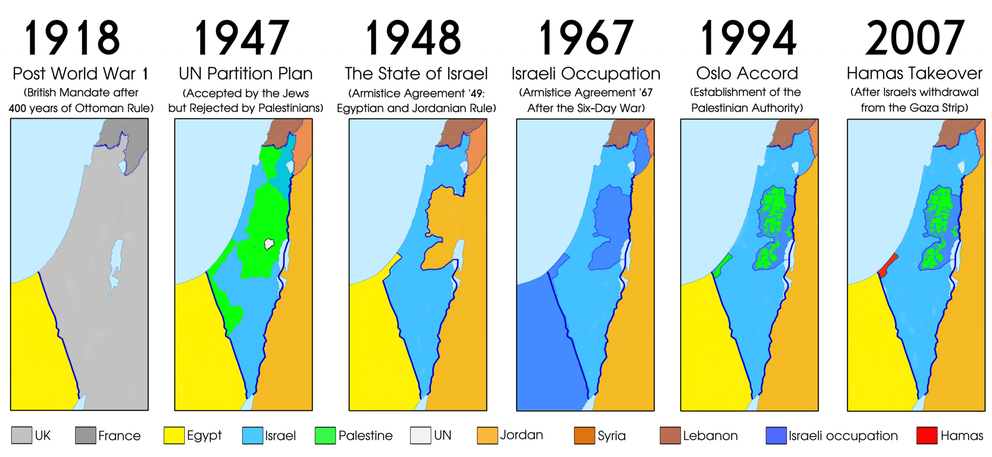
The leading power of the time was Great Britain. One can only understand Britain’s involvement in the region during the First World War by appreciating the strategic importance of the Suez Canal for imperial expansion. Thus, British imperialism promised the creation of a great Arab state including Palestine, in exchange for Arab support against the Turkish Empire in the First World War. At the same time, they promised the Zionists the establishment of a “Jewish national home” in Palestine (Balfour Declaration of 1917), which they saw as an outpost of imperialist interests in the region.
The two biggest empires, Great Britain and France, betrayed the promise made to the Arabs, dividing the the region in their interests. Lebanon and Syria went to France. Palestine and Transjordan (now Jordan), and Iraq up to Kuwait passed to Great Britain. Far from leading the Arab peoples to independence, “not yet capable of governing themselves” according to the League of Nations, French and British imperialism brutally suppressed revolts in Palestine, Syria, and Iraq.
Between the two world wars, the Zionists accelerated land acquisition, emptying them of their Palestinian occupiers, and in doing this, they were administratively and militarily supported by British proxies. The resistance of Palestinian peasants and workers was at first limited to petitions, delegations of Muslim and Christian notables and demonstrations by Palestinian women in particular. Later there later riots, leading up to the Great Revolt of 1936-1939. (See article here)
Collaboration of official Palestinian representatives
The revolt began in the cities, then spread to the countryside, despite the collaboration of official Palestinian representatives, who were feudal and clan-based. The peasant and working masses fought against the British imperialist forces administering the region, against the Zionists stealing their land, and against the Palestinian feudal elites who collaborate with the British forces.
The fighting at that time took place under the Palestinian flag, with both a cross and a crescent, symbols of the unity of Christians and Muslims. Men and women together, the insurgents armed themselves and fought side by side. Palestinian political life was much more diverse than it is often shown through a religious prism. There were many different parties and movements, including Palestinian communists, some of whom went on to fight in Spain during the civil war of 1936-1939.
British répression of the Revolt was brutal, using naval artillery and air bombardments, destroying entire villages whose inhabitants were massacred by armored cars. Special night squads, composed of British soldiers and Jewish fighters, acted savagely in villages, including collective executions. The future Israeli Chief of the Staff and Minister of Defence, Moshe Dayan, made his debut there, as did Yigal Allon, a future Deputy Prime Minister.
The toll of the Palestinian revolutionaries was terrible: thousands of fighters were killed or wounded, nearly 50,000 are detained, and dozens are tried and hanged. Thousands of houses or entire villages are razed. The The leaders of the Arab High Committee were deported to other places in the British Empire, notably to the Seychelles, so the Palestinian political leadership was decimated.
Both of the Jewish militias, the Haganah, which defended Jewish settlements, and the Irgun, a terrorist organisation – which advocated violence against Arab populations – emerged militarily and financially strengthened.
To try to appease the Arab population, the British government promised the establishment of a Palestinian state within 10 years, led by Jews and Arab Muslims and Christians, and limiting Jewish immigration and land sales. Jewish militias then turned against Great Britain and launched a campaign of assassinations and terrorist acts against both the British authorities and Palestinian Arabs.
Nazi policy of extermination of Jews
The Second World War and the Nazi policy of extermination of Jews gave a strong boost to emigration to Palestine. The Holocaust the lives of more than six million men and the memory of those events are still seared into the consciousness of Israelis today.
During the war, the Haganah and the Irgun had observed a truce regarding their attacks against the British, but one group, Lehi (or Stern group after its founder), which included Yitzhak Shamir, a future Prime Minister of Israel continued its attacks. In November 1944, the Lehi assassinated the British Minister of State for the Middle East, Lord Moyne. From February 1944, the Irgun, then led by Menahem Begin, (another future Prime Minister) also resumed its armed struggle against British rule. Thus, Israel has had two Prime Ministers who were former leaders of terrorist organisations.
From October 1945, the Haganah, led by David Ben-Gurion, the future first Israeli Prime Minister, organised terrorist attacks. On July 22, 1946, the Irgun blew up the King David Hotel in Jerusalem, housing the secretariat of the British High Commission in Palestine, causing 91 civilian casualties, mostly Palestinians, but including Jews, and on October 31, the British embassy in Rome was targeted.
In the summer of 1947, not wanting to resort to the same punitive methods they had used in suppressing the Arab revolt, and with the country becoming ungovernable in the face of incessant attacks by Jewish militias, Britain decided to submit the matter to the newly-established United Nations. The British population was so horrified by terrorist attacks on British army personnel by the Jewish militias that in several British cities there were antisemitic demonstrations and some synagogues and shops were attacked.
Following a UN vote on a proposed partition of Palestinian territory, clashes broke out between Jewish and Arab workers. The idea of the UN, of creating a separate Jewish state, divided the working class in Palestine on religious and communal grounds. Meanwhile, attacks against British soldiers continued.
On April 9, 1948, the Irgun and Lehi attacked the village of Deir Yassin, which had maintained good relations with the Jews living nearby. But the Jewish militias massacred men, women, and children, spreading terror among the Arab population. The inhabitants of many other villages fled, fearing more massacres, although in the expectation that at some future date they would be able to return.
The creation of the State of Israel
After the genocide of the Jews perpetrated by the Nazis, the need for a Jewish national home, free from persecution and discrimination in Europe and elsewhere, greatly increased Jewish migration to Palestine. However, the events that led to the creation of the State of Israel in May 1948 was not a progressive process of and liberation and “self-determination”. The state of Israel was born in a mass ethnic cleansing and, violent colonisation at the expense of the non-Jewish population of Palestine.
Of the original Palestinian territory, 55% came to constitute the Jewish state, although Jews were only a third of the population. Out of the 900,000 Arabs who had lived in this territory of the new Israeli state, 750,000 are forcibly expelled and entire villages are completely razed, cemeteries included. To Palestinians, this episode is the Nakba, or catastrophe in Arabic.
The ethnic cleansing took place even though the UN mediator, the Swedish Count Bernadotte, had obtained a truce. Shocked by the scale of the forced exodus, Bernadotte proposed the unconditional return of all refugees and a new, more balanced partition of the territory. Following his report, the UN would vote for a resolution in favour of Palestinian refugees.
However, in September, Count Bernadotte and the head of the UN military observers, driving in a convoy of cars flying the UN and Red Cross flags, were assassinated by the Lehi. Even though Prime Minister Ben-Gurion dismantled the Lehi and the Irgun after this assassination, its leader Lehi, Yitzhak Shamir, was enrolled into Mossad (the Israeli Secret Service), and only one of the Lehi leaders ever served time in prison – 15 days. The man who confessed to shooting Bernadotte, Yeoshua Cohen, far from being prosecuted for his criminal acts, would become one of the founders of a kibbutz in the Negev, where Ben-Gurion would retire and become friends with him.
An outpost of imperialism, first British, then American
After being, as a Jewish homeland, an outpost of British imperialism, the State of Israel became an outpost of American imperialism, serving its economic, strategic, and military interests in an oil-rich region, located at the crossroads of three continents and near the Suez Canal, a passage point of great importance for global maritime traffic.
When Nasser, the then Egyptian president, decided to nationalise the Suez Canal in 1956, the first country to attack Egypt was Israel, followed by France and Great Britain to defend their own economic interests. In fact, the Israeli attack was pre-arranged with France and Britain, to give the latter two the pretext for intervention. (See article here). This attack on Egypt caused about 250 deaths on the coalition side and ten times more on the Egyptian side, with nearly 3,000 military deaths and about 1,000 civilians.
Since then, Israel has become a pillar of US imperialist strategy, with the division of Arab countries and the conflict with Israel allowing the United States to intensify its presence and forcing Arab countries to “normalise” their relations with the United States (Camp David Accords in 1979, Oslo Accords in 1993, Abraham Accords in 2020). American military and financial support to Israel since its creation amounts to hundreds of billions of dollars.
The class struggle in Palestine
The Israeli-Palestinian conflict is often presented as an essentially religious ethnic conflict, which obscures the class divisions that exist on both sides of the conflict. The mass of Palestinians face a desperate situation, and are either refugees or, at best, second-class citizens, facing discrimination in housing, employment, and access to public services. The Israeli capitalist class – as well as capitalists and various exploiters in Palestine and the Arab states in the region – benefit from cheap labour without real rights.
Israeli settlers exploit land and resources forcibly taken – and are still being taken today – at the expense of the Palestinians, alway on the pretext that these lands had been “given to them by God”.
The Israeli policy of domination requires significant development of military technologies, which benefits capitalists invested in this highly profitable sector worldwide. Israel has an agreement with the USA, related to the provision of munitions, aircraft and other hardware that Israel will always have a military capability greater than the next two biggest Arab states together.
In Israel, Arabs in general and Palestinians in particular, are designated an ‘enemy’, and this has the effect of masking and to some extent counteracting class contradictions between the interests of Jewish workers and capitalists, on the grounds of promoting “national unity” and security. Through this ‘fortress’ mentality – fuelled by reactionary and racist organisations like Hamas – Jewish workers have come, mostly, to support oppressive and genocidal governments.
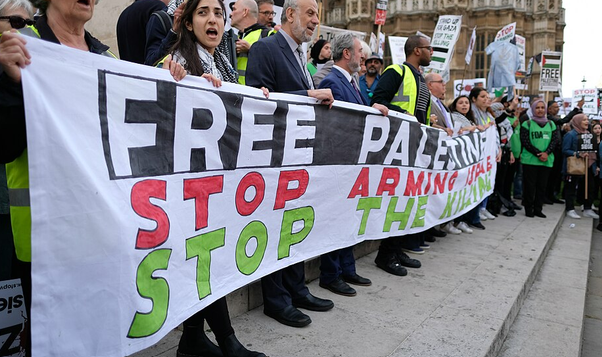
Regardless of the level of workers’ consciousness in the region and their attitude toward the conflict, the starting point of a genuinely internationalist and socialist policy in the region must be to highlight common class interests among workers of all countries, even if it means being very strongly – and sometimes dangerously – in a minority. The ruling classes in Arab countries or in Iran and Turkey betray the cause of the oppressed Palestinians, despite their support in words.
While making anti-Israel speeches to their populations, who are outraged by what is happening in Gaza, there is no regime in the region that would have an interest in achieving true national, social, and democratic emancipation of Palestinian workers. On the contrary, neither the Israeli ruling class nor those of other Middle Eastern countries could tolerate the establishment of a free and democratic Palestinian society, free from capitalist exploitation, for the simple reason that it would undermine their own class interests, as well as the interests of the imperialist powers with which they are in cahoots.
No Arab states allow pro-Palestine demonstrations
With the exception of Yemen, where protests organised by the Houthi regime have brought out hundreds of thousands, not a single Arab state allows pro-Palestine demonstrations, despite the undoubted sympathies of the population. The concern is that anti-Israeli demonstrations would quickly turn into anti-government protests and their fear for the stability of their own régimes come before their fears for the Palestinian people.
Thus, the class struggle in Palestine is inseparable from the class struggle throughout the Middle East, including within Israeli society. As difficult as it appears now, we must strive to convince Jewish youth and workers to clearly break with the genocidal policy of their ruling class, just as the Palestinians of the West Bank and Gaza must turn against the reactionary organisations that dominate them and claim to speak on their behalf. Cross-border, international class solidarity is essential to achieve the liberation of Palestine and for the emancipation of workers in all Middle Eastern countries. The end of colonialism is inconceivable without the overthrow of all local tyrannies.
A revolutionary perspective
It is up to Marxists to understand that a lasting solution will be impossible without challenging the current capitalist and imperialist system. On the left, many defend a two-state solution, with an Israeli state and a Palestinian state, side by side. These such comrades have good intentions, but under current conditions, with a militarily powerful Israel and imperialist domination, even if a Palestinian state were to emerge, it would be only a stunted caricature of a state, administering a geographically discontinuous territory.
It would be neither economically nor politically viable. In truth, Israeli imperialism and its foreign supporters will not even allow the emergence of a truncated and subjugated “independent” state of this kind and they have worked assiduously for decades to minimise the possibility.
The reality of the Palestinian people today is so catastrophic that it seems unlikely, if not impossible, for a solution comes from ‘within’, that is, from changes inside Israel and the occupied Palestinian territories. It seems more likely that a solution would be given greater impetus as a result of revolutionary developments in other countries in Europe, the Middle East and North Africa, with the dramatic effect these would have on the consciousness of Arab and even Israeli workers.
A revolutionary socialist transformation in Iran or Egypt, for example, would alter the class balance of power throughout the region to the detriment of Israeli and Western imperialism, opening the prospect of Palestinian liberation and the possibility of creating a Socialist Federation of the Middle East. This is the only prospect that would definitively end colonial and imperialist structures and establish a just and lasting peace.
Éric Jouen is a member of the French Communist Party in Seine-Maritime, and a regular contributor to the French Marxist website La Riposte, which can be found here.
[All pictures from Wikimedia Commons, here]