By John O’Brien, in Carlisle, retired welfare rights adviser and tribunal representative with 35 years’ experience
Alan Milburn wants to replace Personal Independence Payment and the health element of Universal Credit for people under 25. Parliament should look very hard at the cost before it agrees to anything.
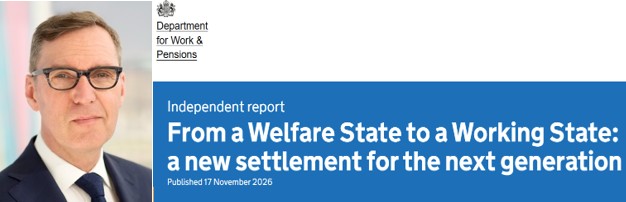
I spent 35 years in welfare rights, preparing claims, challenging decisions and representing people at tribunals. That work teaches you to read the small print and to ask who pays when a promise is not kept. Those are the questions I bring to Alan Milburn’s final report, From a Welfare State to a Working State, published on 17 November 2026.
It is an independent review and it is not law. Nobody has lost a penny because of it, and nobody should give up a claim or an appeal because of what they have read in the newspapers. The Government says it endorses the core principles of the review and has promised a White Paper next year, so the argument over what happens next has already begun.
What is being proposed
For people aged 18 to 24, Personal Independence Payment would go. In its place would come an Additional Cost Allowance for those with significant, established and ongoing extra costs caused by disability. It would not be means tested and could be paid to somebody in work. We are not told the rate, the test or how long an award would last, because paragraph 751 leaves the design of the assessment for further work.
The health element of Universal Credit and the Work Capability Assessment would both be abolished for this age group. A new Youth Allowance would be paid at the present under-25 rate of Universal Credit, with a higher amount for those living independently, including care leavers and young people estranged from their families.
A Local Health and Disability Fund would help with equipment and with daily living or mobility costs, although it would not be a fixed award. A small group who meet a very high test would receive Severe and Complex Needs Insurance, a stable long term income above today’s maximum rates.
Milburn is open about the bargain he is offering. Paragraph 776 speaks of “less cash tied to proving incapacity” in return for quicker support and more opportunity, and paragraphs 736 and 737 accept that some young people will be worse off at first. I at least give him credit for saying so.
Who would be caught, and when
Every area is meant to have a Youth Opportunity Service or something similar by the end of 2029. New claims would move to the new benefits as each area becomes ready. People already claiming would move at their next scheduled reassessment, after six months of preparation, and Milburn wants that finished within five years at most.
If that timetable holds, most people who are 23 or 24 today will have reached 25 before any of this touches them. Those most at risk are younger claimants and the teenagers coming up behind them.
The money at stake
Nobody can yet say what any individual will lose, because the new rates have not been set. What we can do is look at what young disabled people receive now, using the rates for 2026/27.
Take someone of 22 with a severe mental illness who receives Universal Credit and nothing else. With the standard allowance and the higher health element they get £768.38 a month. A Youth Allowance at the basic rate would leave them £429.80 a month short, which is £5,157.60 a year. On the lower health element, which applies to most new claims, the shortfall would be £217.26 a month, or £2,607.12 a year. A higher allowance for living independently would reduce either figure.
A 20 year old on standard rates of Personal Independence Payment receives £107 a week, or £5,564 a year. Fail the new test and all of that is at risk. A local fund that buys the occasional piece of equipment will not pay for help that is needed every week.
Now consider a 22 year old living alone with recurrent severe depression, on the standard allowance, the higher health element and the standard rate of daily living. Together those come to £13,208.96 a year. If the Additional Cost Allowance were refused and the Youth Allowance paid only the basic rate, £9,146 a year would go.
Someone of 24 with heavy care and mobility needs might have both enhanced rates and the higher health element, which comes to £15,276.80 a year. That person may well qualify for Severe and Complex Needs Insurance and could finish up better off. We simply do not know, and neither does anybody else.
The help that goes with the award
Anyone who has worked in this field knows that a disability award opens other doors. Milburn’s welfare proposals say very little about what happens to them.
A carer who gives at least 35 hours care a week can claim Carer’s Allowance, currently £86.45 a week, where the disabled person receives the daily living part of Personal Independence Payment. Take away that award without a replacement link and the carer could lose their entitlement, and possibly the carer element of Universal Credit as well.
The Motability Scheme depends on the enhanced rate of mobility. It makes little sense to urge a young person into work and then take away the car that gets them there.
Single private tenants under 35 are usually limited to the shared accommodation rate for their housing costs, and the daily living part of Personal Independence Payment is one of the exceptions. Without it, a disabled tenant could be living in the same home with the same needs and face a lower limit on help with the rent.
Personal Independence Payment and the health element of Universal Credit also protect a household from the benefit cap.
Every one of these links needs a clear rule in the legislation, so that families do not find out what they have lost after it has gone.
Disability does not always come with a receipt
Personal Independence Payment looks at what a disability does to a person’s daily life. The regulations ask whether an activity can be done safely, to an acceptable standard, repeatedly and within a reasonable time. Nobody is asked to produce an invoice.
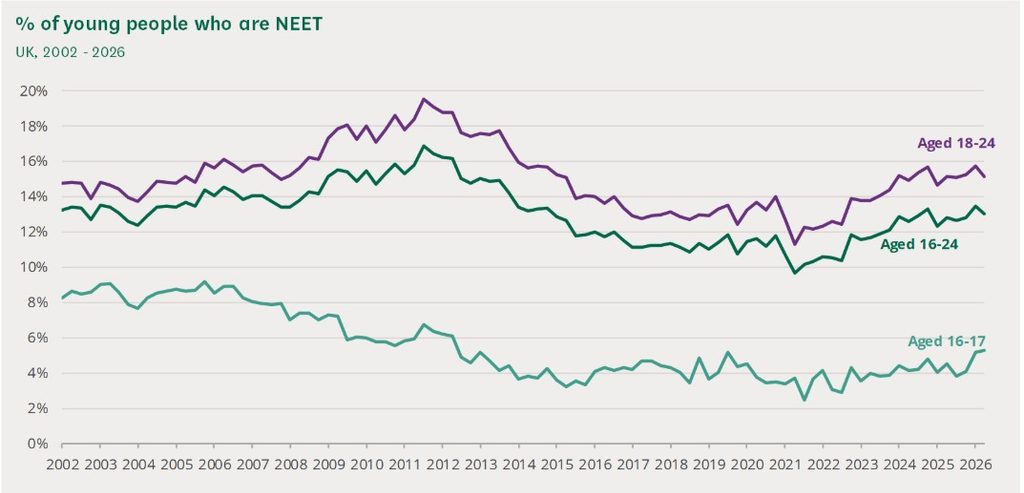
[graph from House of Commons Library]
A test based on extra costs is a different animal. A mother who reminds her son to wash, eat and take his tablets does not send him a bill. A friend who goes with someone on a journey they cannot face alone does not issue a receipt. The young person who stays indoors because a taxi is out of the question has spent nothing at all, and that is exactly the problem. Being too poor to pay for help must never be taken as proof that no help is needed.
Milburn relies on research from the Resolution Foundation, which found that 21% of Personal Independence Payment recipients aged 16 to 24 reported little limitation and no additional costs (paragraph 754). That is a survey result. It does not show that any individual award was wrong, and it tells us nothing about the other 79%.
The missing right of appeal
This worries me as much as anything in the report. The published review contains no express right of appeal to an independent tribunal. Paragraph 755 says a young person refused the Additional Cost Allowance should receive a decision identifying the support that could help them. It does not say how the refusal can be challenged, and the local fund has no independent route set out either.
I do not say Milburn intends to remove appeal rights. He has left the question open, and it cannot be left open. Sections 8 and 12 of the Social Security Act 1998 provide the framework for appeals on named benefits, including Universal Credit and Personal Independence Payment. A new benefit has to be brought within that framework by the Bill or by regulations.
Scotland already shows how a local fund can be held to account. Since April 2016 the Scottish Public Services Ombudsman has reviewed Scottish Welfare Fund decisions and can direct a council to make an award. Nobody should need judicial review to argue about the cost of a wheelchair cushion.
What the figures leave out
Milburn’s model shows savings of £3.6 billion in 2036/37 and £13.7 billion in total from 2029/30, at 2026/27 prices. The analytical annex says the work should not be regarded as official government analysis. It gives no breakdown of who gains and who loses by condition, severity, family type or amount. Before any vote, Parliament should be told how many people stand to lose £10, £25, £50 and £100 a week, and how many carers would lose their entitlement. An average can rise while the young person who cannot work grows poorer.
What Parliament should insist upon
1. Publish the eligibility rules and payment rates before any vote.
2. Write into law that no existing claimant’s payment will fall until replacement support is working and an individual decision has been made.
3. Recognise hidden costs and unpaid care, and do not make receipts the test of need.
4. Protect carers, Motability, housing and benefit cap exemptions in one published schedule.
5. Guarantee a right of appeal to the First Tier Tribunal, with independent review of local fund decisions.
6. Publish independent assessments of the effect on households before the Bill is passed.
Where this leaves us
Milburn is right that too many young people have been left for years with no real help. A named adviser, early treatment, better apprenticeships and supported employment could change lives, and an extra costs payment that can be paid in work is the right principle.
Where we part company is on the order of events. For a great many disabled people, the money is what makes work possible in the first place. Milburn himself says current payments should continue while the transition is carried out. Parliament should hold him to that and write it into the Act.
After 35 years, I judge a benefit system by what happens to the person at the far end of the decision, and I hope Members of Parliament will think of that person when this comes before them.
[Featured image – Alan Milburn from wiki commons. Front page of report from Department of Work and Pensions]