
 Good result for Polanski in Holborn and St Pancras
By Ray Goodpseed
In a year of important by elections, the media frenzy regarding the result in Holborn and St Pancras (H&SP) is remarkable. Along with the right and the Labour Party, they are desperate to spin the result as a major defeat for Zack Polanski, the candidate and leader of the Green Party, and to step up the disgraceful smear campaign against him and the party as a whole.
Even before the result they were claiming that a failure to win the seat from Labour, recently vacated by Sir Keir Starmer, would represent the end of Polanski’s radical insurgent challenge, and make his position as party leader precarious.
This is all nonsense. The local Green Party, and Polanski himself, always regarded it as a difficult target and did not expect to win. When asked, Green Party staffers would give the normal evasive reply “It is a tough seat – but it may be very close, if we really work hard”. In the absence of a local opinion poll, the bookmakers had Labour as the runaway favourites from the very beginning. But after not standing in Gorton and Denton, and saying he would stand in a London seat if one became available, Polanski was virtually obliged to stand or be accused of cowardice. It was effectively a trap.
Historically, this seat or its predecessor on very similar boundaries has always been a safe Labour seat since 1950 (except 1959). Just nine years ago, under Jeremy Corbyn, of course, Starmer got 70%; in 2019, 64%. The Greens lost their deposit in both elections.
Starmer was challenged by Andrew Feinstein the Gaza independent in 2024 who got an impressive 19%, and Starmer’s vote share was reduced to 49% even while becoming Prime Minister in the famous “loveless landslide”. The Greens came third with 10.4%. Their best ever previous result (13%) was when Natalie Bennett stood against Starmer in 2015. Bennett, of course, was also a leader of the Green Party at the time and she also took the party more firmly in a left-wing direction.
The local elections in London in May 2026 brought Greens sweeping victories – taking full control of Waltham Forest, Hackney and Lewisham and jointly running Lambeth, Southwark and Haringey.
Heartland of the Labour right
But Camden, which includes H&SP, was the heartland of the Labour right and Starmerism. Greens did make gains and took eleven councillors out of 55 but achieved nothing like the gains in some other London boroughs. And that was at the deepest trough of unpopularity of the hapless Starmer.
[Photo – Left Horizons]
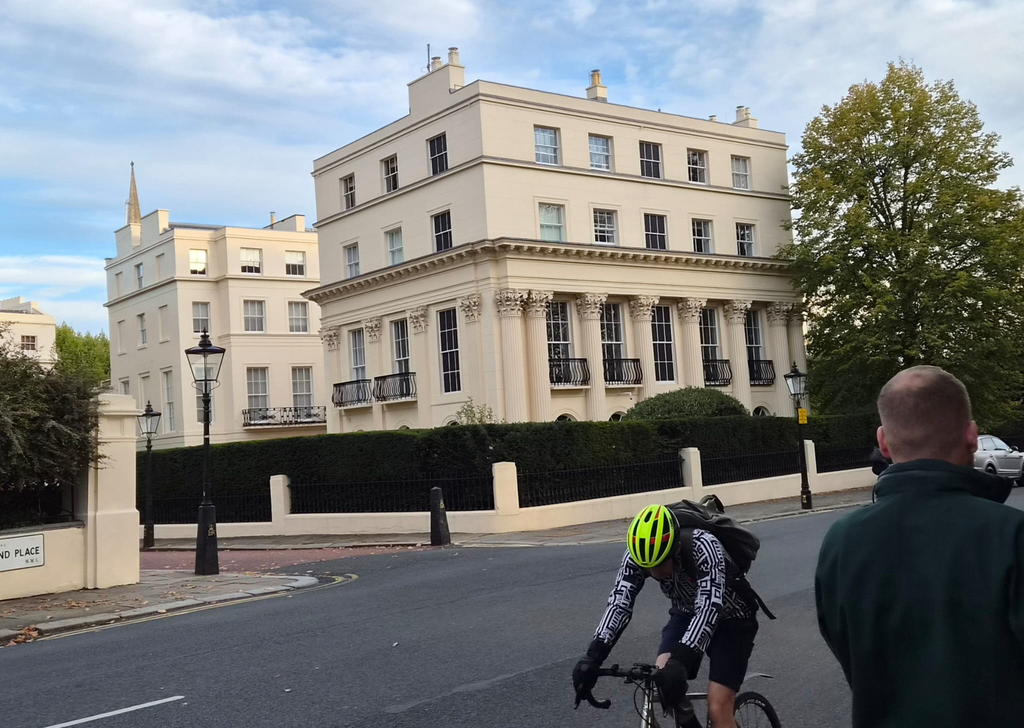
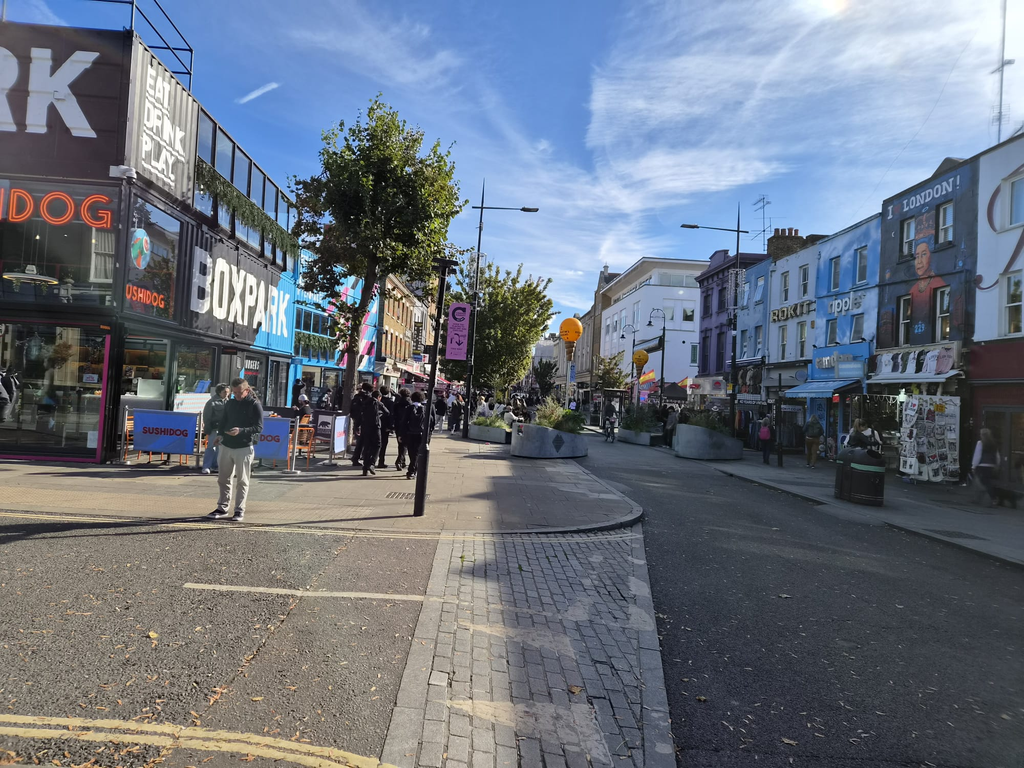
H&SP is different from areas like Hackney. It covers a chunk of the commercial, historic and tourist heart of London. Yes, it has many huge council estates and poor quality but expensive rented housing, as well as the counter-cultural Camden Lock market. Yes – it is young and well-educated, but it contains within it areas that are extremely wealthy, such as the palatial properties overlooking Regent’s Park, valued at around £12 million each. The average house price in the constituency is over £1 million! It is notable, during media coverage, how many of the pundits confessed to having a vote there.
The election was held under very difficult circumstances for the Greens. It was an unexpected snap election, with a very short campaign which caught the Greens napping. It was carefully timed to take place before the first year university students of University College London and the School of Oriental and African Studies, in Bloomsbury, could move in or register to vote, losing thousands of potential Green votes.
Nevertheless, the Greens threw everything at it. I was campaigning in H&SP – leafleting on several sessions and working on polling day. It galvanised hundreds of activists – particularly, but not exclusively, young people and people of every ethnic group. Many volunteers were former members of the Labour Party. My team on polling day were all ex-Labour!
As an aside – Galloway’s so-called Workers’ Party stood explicitly to damage Polanski’s chances, in opposition to the Green position on Ukraine and on trans rights. One of their supporters was handing out fake Green party leaflets outside a polling station, wearing a Green rosette. He was eventually removed by the police. Galloway got a grand total of 314 votes, but did at least beat Barmy Brunch.
Second lowest Labour vote since 1950
At the count, the Labour vote share fell to 45%, lower even than that received by Starmer. This was Labour’s second worse result in the seat since 1950. Contrast this with the result in Makerfield in June, admittedly in a very different kind of seat, where Burnham got 54% on a 9% swing to Labour.
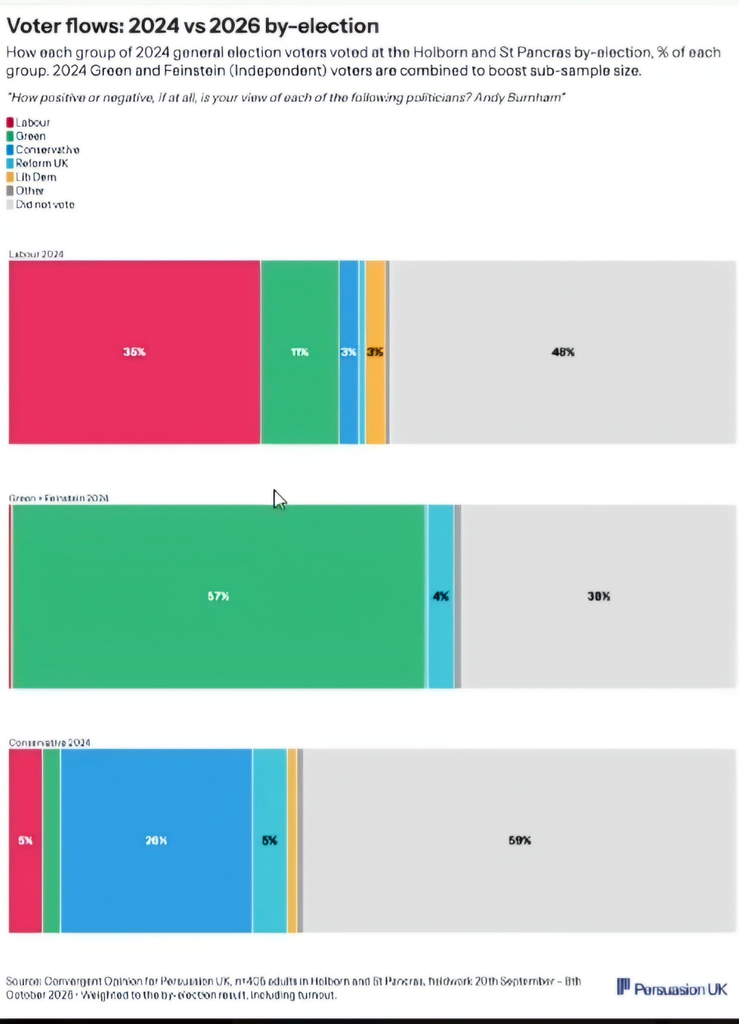
Zack Polanski got 33% in H&SP, tripling the vote on a swing of 13%. This was a record high vote for the Greens. From spring and over summer Polanski faced a relentless barrage of personal smears in all the print and broadcast media – denying his Jewishness and accusing him of antisemitism. Yet the media narrative is “Shock defeat for Polanski!”
The media claim that the increase in the Green vote share was only 4%, as the combined Green and Feinstein vote in 2024 was 29% but you can’t assume that all Feinstein’s voters would just transfer to Green. Some who identify as socialists would never vote Green on principle, and in any case, even a 4% rise, in the present circumstances, is a good result.
[image from Persuasion UK]
We are still in the period of the famous “Burnham bounce” with the new leader enjoying a honeymoon of impressive personal popularity. His speech at Labour Party conference, held during the by election campaign, reinforced that. He is widely seen as a breath of fresh air – a hopeful new start. I found this on polling day when a voter who had promised to vote Green voted Labour to “give Burnham a fair chance.” Exit polling confirms that as a major factor among Labour voters. Ironically, without Zack Polanski, Burnham would likely still be in Manchester.
Miliband’s change in tone on Gaza and the West Bank and the new limited sanctions would have had an impact. Similarly, all Burnham’s mood music about turning away from 40 years of neo-liberalism, and even reindustrialising Britain, will have tempted some voters to stay loyal to Labour rather than vote Green. He has condemned privatisation and the right to buy council houses, but has not announced ending either. Huge numbers of council houses are promised, though he is already back tracking over the quotas of council house new builds.
The Labour candidate – Sagal Abdi-Wali – was, on the surface at least, as far from Starmer as you can imagine: a Somali child refugee, a hijab-wearing Muslim woman. The seat has a large Muslim population (22%). Many of the Muslims in H&SP are from a Somali background. I spoke to some Somali women on their way to vote and they told me that they supported Green policies but were keen to vote for one of their own community.
Homelessness
However, Abdi-Wali was not as far from Starmer as she appeared. The Greens were actually too soft on her, partly because of the racist attacks on her by the far-right. They could have focused more on her local government record. She was the leader of Camden Council and previous cabinet member for housing. Her election material mentioned her concern for housing and homelessness – but homelessness went up 48% under her watch. In the net provision of Council homes, taking into account new builds and those homes demolished to make way for posh new developments, Camden had one of the worst records in London.
Since October 2023 the Council investments in Palantir have increased by 1,200%! She has been silent and complicit in Labour’s shameful record on Palestine. Her winning strategy was to hide from all debates and difficult questions on her record throughout the campaign and to focus heavily on her personal life story.
It is clearly true that in large parts of the country many workers will still vote Labour (or possibly Plaid Cymru) to beat Reform. However, in seats where Reform have no support, especially those urban multi-ethnic seats which are not so affluent, with many young, precarious workers, the Green party is still a threat to Labour – even the noted psephologist, Sir John Curtice says so! On the basis of the H&SP results, a dozen seats or more could be taken from Labour by the Greens. Moreover, if Burnham really disappoints then maybe many more seats could be lost.
Is Burnham likely to disappoint? Perhaps not immediately. Even the next Budget may make some gestures to the left in terms of taxation of the highest incomes. Like Miliband’s Palestine statement – it will be sold as radical, with great fanfare, but will actually be pretty mild.
But UK Growth figures, currently slightly above predictions, will slow again next year. Inflation is not slowing down. Energy prices are rising sharply, after Trump’s Iran War. The pledges on defence spending will have to be paid for. There will be pressure from the markets and from the right wing Labour MPs to cut the welfare bill.
The Green threat to the system
In the light of this the ruling class and their client press know that the Greens still pose a threat to their system. The Green surge threatening to challenge the more reliable and compliant Labour Party panicked them, just as the Corbyn surge did before..
[Photo – Left Horizons]
Even the ghouls of the Labour Together faction saw that if they did not take action to remove Starmer and replace him with a more charismatic leader who could have some appeal for left voters, then the Labour party was facing an enormous crisis. That is why Josh Simons stood down for Burnham in Makerfield.
At the same time they are trying to use the same tactic to destroy Polanski as they used against Corbyn and the Labour left – accusations of antisemitism. After the genocide, and the collapse in support for Israel in public opinion, this is not such a useful weapon as it once was but they are still making the most of it.
Polanski is more steadfast than Corbyn, and less apologetic, ironically reflecting his stronger position in his own party. He clearly identifies as an anti-Zionist Jew, and told the Board of Deputies that to their faces in a public hustings. He has accused Israel of genocide, ethnic cleansing, and apartheid, and he has called for a total boycott and sanctions of Israel – not just the settlements – a total arms boycott, de-proscription of Palestine Action, and implementation in full of all the international court judgements. He had very widespread, united support in the party on that basis.
It must be said that the Zionism motion passed at Green conference the weekend before the by election, which Polanski wanted amended, has sadly now created an additional stick to beat him with and has empowered those in the party opposed to his more radical leadership. It also drowned out any other motions or policy announcements from the conference.
Controversial motion
The wording and some of the content of the motion have been controversial even among many on the pro-Palestinian left, particularly in terms of allowing the debate to be framed around definitions of Zionism and issues of Jewish identity, and specifying support for a future settlement based on a single state of Palestine. Many socialist Palestine campaigners have preferred to leave issues of any future state arrangements to the Palestinians themselves, and to focus on solidarity work.
In terms of day to day demands and slogans regarding Palestine, it changes nothing. Polanski’s position remains clear and principled.
The motion did not have a huge effect in the by-election, as the motion was passed on the Sunday before polling day. There was not enough time for it to break through to most voters, beyond a limited, anecdotal effect. But it will have an ongoing effect. Polling already has voters regarding the Greens as the most antisemitic party. Many on the left have been here before.
Polanski knew the motion was coming up for months and made a serious miscalculation in not more forcefully trying to amend it or to speak in favour of the amendments, which could have succeeded if he had. The Green Party constitution, where votes are decided by whoever can attend the conference, is unsustainable in a party of quarter of a million members. There may need to be a change to a clearer delegate system to ensure that motions passed are representative of the wider membership.
But let us be crystal clear. The motion is not antisemitic and neither is the Green party. Many Jewish Greens actively supported the motion. The media frenzy around it is absurd and unhinged. It reflects similar attacks in Europe such as those on La France Insoumise in France and Die Linke in Germany.
Solidarity against attacks
Whatever you think of the Zionism motion, the Party and Polanski himself need, and must receive, solidarity in the face of these attacks.
The media are baying for his head but there is little desire among members to replace a leader who has brought them the greatest electoral success in their history, and tripled their membership. Among the canvassers I was with, there was no suggestion than Polanski’s position was brought into question. On the contrary, there was enthusiastic support. He faces a routine election next year in any case and is very likely to win it, possibly unchallenged.
It is important to remember that he was elected by the original 70,000 members, not the 150,000 members who joined because of his victory. Just because the press want to destroy him does not mean that the members will agree – they found that out in the Chicken Coup against Corbyn.
Over the next few years, the Burnham government will be pressured by the capitalist class and their friends and allies in the Labour movement to backtrack – and to disappoint their current supporters.
The Greens are unlikely to replace the Labour Party on a national basis in the short term and the links between the affiliated trade unions and Labour are still very important. Yet the Greens will continue to be a pole of attraction for those looking for a more radical policy. And by challenging Labour electorally it will put pressure on it to make concessions to the left.
[Featured photo – top – Zack Polanski in Holborn and St Pancras – photo from Green Party website]
 The way forward for the PCS union – part 1 - By David Niven, PCS member, Defra North West & Cumbria Branch PCS is the largest union representing workers across national government bodies such as the
 General Strike paper “The British Worker” – a good initiative of a timid leadership – part two - In this second and final part, RAY GOODSPEED looks at the reporting of the sudden end of the strike and its aftermath (9-17 May). Part
 Cruise liners: stop the boats! - By Robin Jamieson Day after day desperate hungry people beholden to violent criminals are still risking and losing their lives boarding overloaded rubber dinghies with
 General Strike paper “The British Worker” – a good initiative of a timid leadership – part one - In this article RAY GOODSPEED looks at the first four issues of this paper, from 5-8 May. Part two (here) will look at issues produced
 Polanski: the next left smear campaign - By Joe Langabeer A quote attributed to Mark Twain reads: “History does not repeat itself, but it often rhymes”. Well, in this case, history is