By Steve McKenzie, Unite Community branch member
What is the best estimate for the membership of UNITE the union? Eight hundred and fifty thousand ballot papers were sent out to members in the 2023 Unite executive council elections. Then you would have to add about twenty thousand community members who do not currently get a vote in Executive Council elections. This seems to be more indicative of overall Unite membership than some figures that are put forward by organised factions within the union, and by senior officers.
Groups and individuals with a vested self-interest to promote and protect, have a tendency to exaggerate. Membership levels that have been presented to some regional councils by senior full-time officials, would certainly indicate that there are a lot more members than were sent ballot papers. So, either our union’s membership records are not up to date, or senior unelected officers are being economic with the truth, or perhaps it’s a bit of both.
Let us take the figure of 870,000 as probably the most accurate we have. If it is true that the membership stood at just over a million, when Len McCluskey left office in 2021, this tells us that there has been a significant drop in membership since then. But I was given to understand that the membership level was reported to be 1.5 million when he took office back in 2010. At that time Unite was clearly Britain’s biggest union.
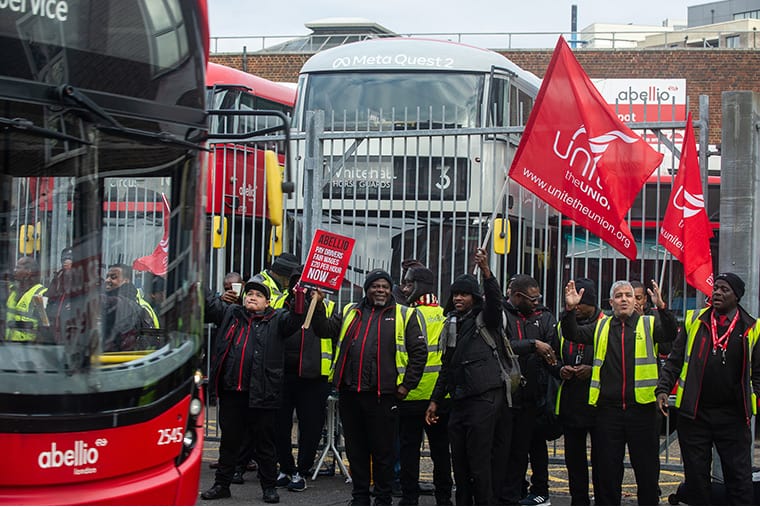
(photo Guy Smallman)
So this recent fall is not as significant as the membership loss that took place, year in and year out, when Len McCluskey was the general secretary, and the so-called ‘United Left‘ controlled the union. If the membership figures of 1.5 million in 2010 and just over a million in 2021 are true, it means hundreds of thousands of members were lost over an eleven-year period. That is a significant net loss year on year.
If we fight our way through the fictitious claims, and try and stick to the hard facts, or at least as close as we can get to them, it would appear that the continuing membership loss, over the past two years is bad, but not quite as bad as it was before. That isn’t to say that the exodus won’t accelerate again, especially when the period of heightened union activity comes to an end.
Rebuild union organisation
However, every genuine unionist in Unite, those without a vested self-interest to protect, wants to put a stop to members walking out of the union. To achieve this it is crystal clear that we need to REBUILD our union organisation, at a workplace and branch level.
Competent shop stewards and branch officers are desperately needed. At a workplace and industry level, effective shop stewards’ committees need to be operating. Every member should belong to a branch and every branch should be well-run and active.
Any member faced with an employment problem, no matter what their employment circumstances, should be able to go to their shop steward, or contact the relevant branch officer and get a timely and accurate response in answer to their questions.
For far too long, those who have really controlled our union have failed to address these issues despite the dramatic loss of members. Closing your eyes, and denying that a problem exists means that it will never be confronted and resolved. Strutting around claiming we are Britain’s biggest union, even when it became clear we no longer were, claiming we are a membership led union, while centralising power and control to unelected officers and closing down branches and blocking membership involvement, is not the way to rebuild the union.
As a first step let us establish what is really going on, and then we must work out what needs to be done to turn the situation around. That will not be done by falsifying membership figures and using them as a weapon to attack the other faction, or to massage the egos of the unelected.
[Editorial note: this article was amended after publication, to correct an error in the claimed membership of Unite. The figure in the text of a claimed “1.5 million” members had originally said 2.4m. We apologise for this error, but the editors feel that the political points made in the article are unaffected by this error].