By Michael Roberts
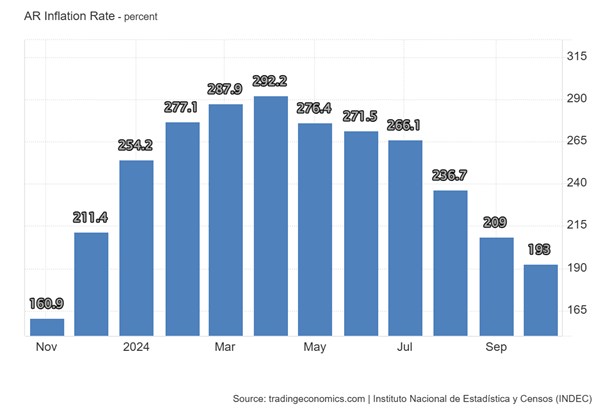
It’s one year since the self proclaimed ‘anarcho-capitalist’ Javier Milei became President of Argentina. He took power in a country where annual inflation was running at 160%, over four of every 10 people were below the poverty line and the trade deficit stood at $43 billion. In addition, there was a daunting $45 billion debt owed to the International Monetary Fund, with $10.6 billion due to be paid to the multilateral lender and private creditors.
The previous Peronist administration had failed miserably to deliver on economic expansion, a stable currency and low inflation. And it also failed to deliver on ending poverty and reducing inequality. Argentina’s official poverty rate rose to 40% in the first half of 2023. According to the World Inequality Database, the top 1% of Argentines then had 26% of all net personal wealth, the top 10% had 59%, while the bottom 50% had just 5%! In incomes, the top 1% had 15%, the top 10%, 47% and the bottom 50% just 14%.
Milei’s plan for unrestricted capitalism
Milei’s plan was clear (at least in his own mind). He would dismantle Argentina’s state sector, ‘free up’ markets from regulation for big business and foreign investors to make profits; devalue the currency with the eventual aim of complete dollarisation and then rely on unrestricted capitalism to solve the perpetual crisis. This is a living experiment in free market policies over reformist, semi-interventionist Keynesianism adopted by previous administrations.
On taking power, Milei implemented a series of austerity measures, including slashing energy and transportation subsidies, laying off tens of thousands of government workers, freezing public infrastructure projects and imposing wage and pension freezes below inflation.
It has been brutal. The economy has gone into a deep slump. The IMF forecasts a contraction of 3.5% for 2024. That’s the biggest contraction in any of the G20 top economies and only surpassed by gangster-ridden Haiti and civil war-smashed South Sudan.
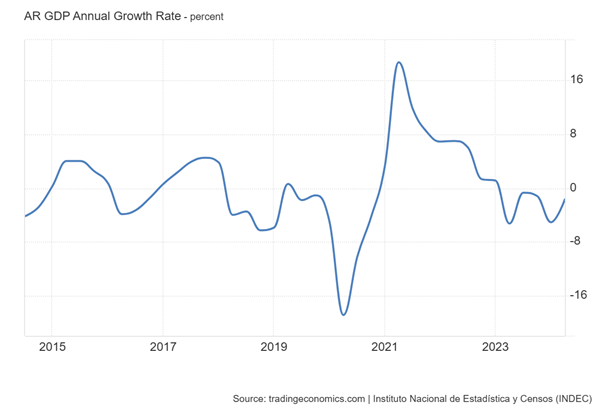
Milei aims to end hyperinflation in the economy through a deliberately engineered slump in production and consumption that destroys costs for capital. By cutting public sector spending and jobs and subsidies for the poor, he aims to increase the rate of exploitation for business and eventually boost the profitability of Argentine capital in order to inspire investment.
Argentines forced to cut back on spending
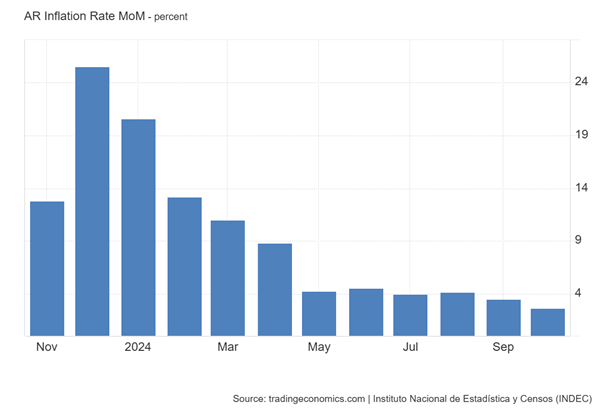
After one year, monthly inflation has dropped sharply as most Argentines have been forced to cut back on spending.
However, prices are still nearly over 190% higher than a year ago, when Milei took office.
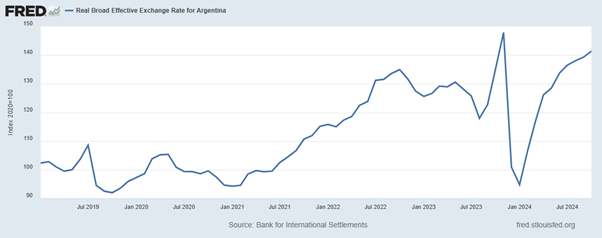
Slowing inflation has strengthened the Argentine peso and reduced borrowing costs. And with a tax amnesty, Milei has lured rich Argentines to declare their hidden US dollar savings (hidden in offshore bank accounts and under mattresses). That brought $19 billion into Argentina’s banks, boosting foreign exchange reserves.
Milei wants to free up the peso from controls but if he does that now, the peso, being hugely overvalued, would plummet, making it difficult to meet repayments to the IMF. Luckily, the much-hated IMF is very pleased with Milei’s policies. The IMF commented that they have “resulted in faster-than-anticipated progress in restoring macroeconomic stability and bringing the program firmly back on track,”, thanking Argentine authorities for “the decisive implementation of their stabilization plan.” So the rich are not having to pay tax and Milei’s austerity measures have been greeted with enthusiasm by the IMF and Argentine big business.
Public spending cut by 30% in one year
Public spending has been reduced by 30% year-over-year in real terms (adjusted for inflation), according to calculations by the Center for Argentine Political Economy (CEPA) and the Association for the Budget and Public Financial Management (ASAP).
Milei has closed 13 ministries and fired some 30,000 public employees, 10% of the federal workforce. He has also frozen public works and reduced the funds that are allocated to education, health, scientific research and pensions. The budgetary cuts have been especially hard on infrastructure (-74%), education (-52%), social development (-60%), healthcare (-28%) and federal assistance to the provinces (-68%).
200,000 job losses in the construction sector
The Argentine Chamber of Construction (CAC) estimates that the state now owes contractors about 400 billion pesos (or $400 million) and that 200,000 workers have been fired in the construction sector since the start of the Milei administration. State pensions have been frozen. As it is, a pensioner in the lowest income bracket currently receives the equivalent of $320 a month, or barely a third of the $900 that a household requires to survive.
According to the National Interuniversity Council, 70% of teaching and non-teaching salaries fall below the poverty line. Milei has now eliminated the National Fund for Teacher Incentives, which subsidised these very low salaries of teachers throughout the country and represented almost 80% of the transfers from the federal government to the provinces for educational purposes. In addition to suspending infrastructure upgrades to schools, he also cut student scholarship programs by 69%. University budgets were frozen and so many campuses were left without resources to pay for gas heating and electricity and the university system declared a state of emergency.
Milei has cut the salaries of researchers and support staff at the National Scientific and Technical Research Council (CONICET), the main organization dedicated to science and technology in the country. He also drastically reduced the number of doctoral and postdoctoral scholarships, dismissed 15% of the administrative staff of CONICET, froze the budget for the National Agency for the Promotion of Research and ceased projects in key institutions, such as the National Institute of Industrial Technology (INTI) and the National Atomic Energy Commission (CNEA). As a result, there was a 30% drop in applications to research and scientific positions in the country. In a public letter addressed to Milei, 68 Nobel Prize winners warned that “the Argentine science and technology system is approaching a dangerous precipice.”
Big jump in poverty rates
Poverty levels have worsened significantly. Argentina’s poverty rate has jumped from almost 42% to 53%, an extra 3.4m Argentines. Two-thirds of Argentine children under the age of 14 are living in poverty. Milei has eliminated subsidies that were managed through social organizations. Among the aid interrupted is the distribution of food to soup kitchens, which serve children and entire families. Employment programs channelled through worker cooperatives have also been cancelled. Argentines increasingly cannot get jobs and cannot afford even enough to feed the family properly.
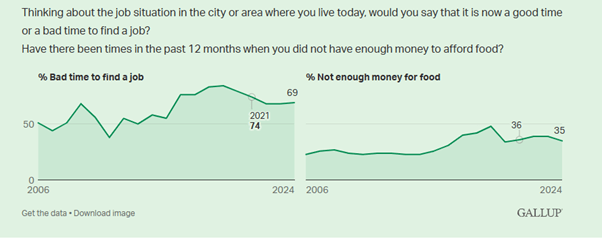
Subsidies on electricity, gas, water and public transit have been cut. In December 2023, a middle-class family spent about 30,105 pesos (about $30) a month on electricity, gas, water and public transportation. But in September 2024, spending had risen to 141,543 pesos ($142).
These massive hits to the living standards of average Argentines, along with continuing rises in inflation have led to a collapse in consumption. In the Buenos Aires Metropolitan Area (AMBA) a 12.9% year-on-year decline was recorded and -2.3% compared to April 2024. In the rest of the country, consumption fell 15.5%% yoy and 3.6% compared to April 2024.
There has been further increase in inequality. The top 10% of income earners now earn 23 times more than the poorest decile, compared to 19 times a year ago. The fall in income reached 33.5% year-on-year in real terms among the poorest decile, but only 20.2% among the richest. The gini inequality index has hit an all-time high of 0.47.
Milei’s approval ratings are currently stable
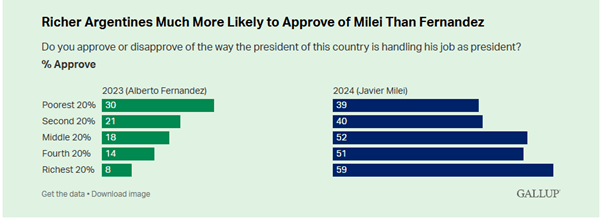
Despite this vicious attack on average living standards, Milei has maintained a sufficient degree of support. People are still hoping that he will end the chaos of inflation and then restore growth. His approval ratings have been stable.
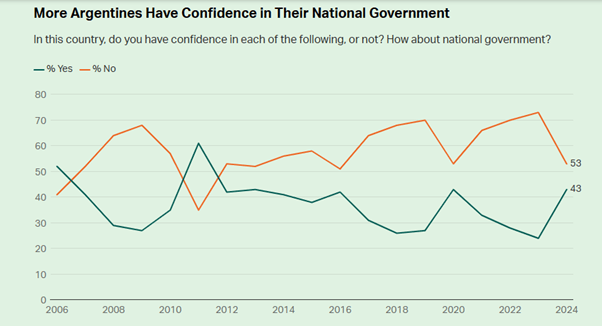
Naturally, support for the Milei government mainly comes from rich Argentines, but even the poorest who are taking the bulk of the burden of his measures still show more support for him than for the previous Peronist administration.
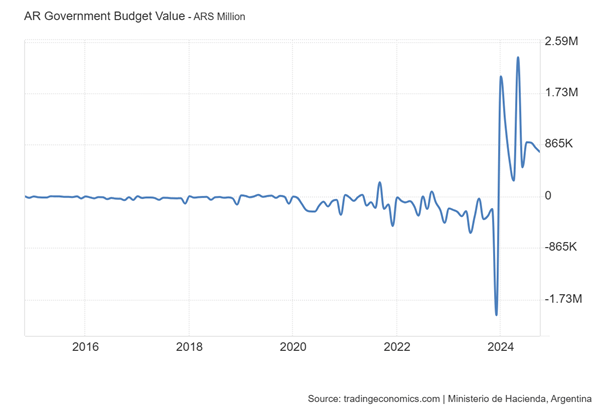
By aggressively cutting spending and chopping government ministries in half, Argentina has swung from a fiscal deficit of 2 trillion pesos (US$2 billion) at the end of last year to a surplus of 750bn pesos in October this year. This is the first fiscal surplus in 16 years.
Will Miele’s policies work? It certainly provides a living experiment in the success of ‘free market’ policies over Keynesian macro management in a country. But Argentina is a weak capitalist economy dominated by imperialism. It had been running a huge trade deficit. Milei’s devaluation of the peso did enable exports to recover over the last year (now up 30%), while austerity domestically crushed imports. The tax exemptions for the rich have led to a small net influx of capital after massive outflows in the last year of Peronist government.
So foreign exchange reserves have improved slightly, but are still way short of being sufficient to meet debt repayments ahead, mainly to the IMF. The country faces large external debt payments of approximately US$9 billion in 2025. But maybe the IMF will be kind.
The peso is well overvalued
The immediate problem is that the peso is still well overvalued even though the US dollar is strong and needs to be devalued by at least another 30% to make Argentine exports competitive. But that would only re-accelerate inflation.
Milei’s anarcho-capitalist plans are really a form of ‘creative destruction’, the term that Joseph Schumpeter, the Austrian economist of the 1930s, used to explain how slumps are necessary under capitalism in order to create the conditions for new expansion. It is necessary to ‘cleanse’ the system of unnecessary spending, unproductive workers and weak firms, making the economy ‘leaner and fitter’.
So far, in ‘creative destruction’, Milei has only achieved destruction. But, as Marx argued, the creative bit requires a sharp rise in the profitability of capital that will lead to a burst of investment and thus employment and incomes. Is that really likely, given global stagnation and how far Argentina’s capitalist sector has sunk? Indeed, will a deep recession in Argentina be so deep that the economy will sink into a depression for the rest of the decade?
The importance of commodity prices for the Argentine economy
Argentina could possibly get out of its mess if there were a boom in commodity prices, as there was in the early 2000s. Argentina is the world’s largest exporter of soya bean oil and meal, the number two exporter of corn and the third biggest exporter of soya beans. However, for now, soybean and corn prices are not very buoyant.
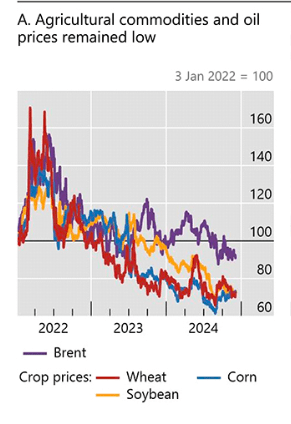
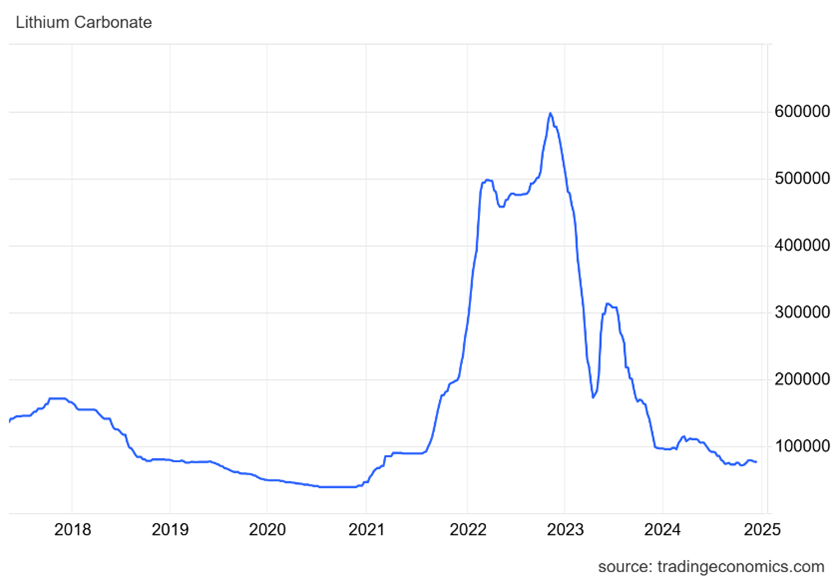
Argentina has the world’s third largest lithium reserves, making it a key player in the global energy transition. However, lithium prices have dived recently.
Argentina also has considerable reserves of shale gas. The Vaca Muerta oil field is one of the world’s largest unconventional hydrocarbon resources, with an estimated 16 billion barrels of oil and 308 trillion cubic feet of natural gas, but so far largely unexploited.
The risk from Trump’s plan to raise tariffs
Exports are key and that means an even greater devaluation of the peso that could re-accelerate inflation, unless even more austerity is applied domestically. And the big worry is that incoming President Trump says he aims to raise tariffs on all US imports by at least 20% and that will hit Argentina. No wonder Milei has spent time cosying up to Trump at Mar-a-Largo.
From the blog of Michael Roberts. The original, with all charts and hyperlinks, can be found here.
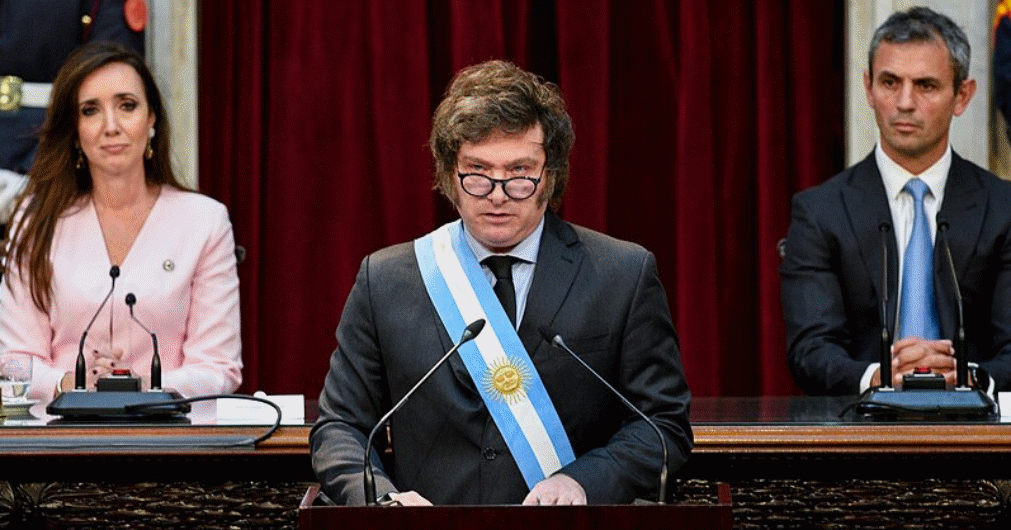
The featured image at the head of the article shows Argentina’s president, Javier Milei opening the ordinary sessions of the Congress in March 2024. The image is from Wikimedia Commons. The image has been put into the public domain and is from the Argentina’s Deputies Chamber website.