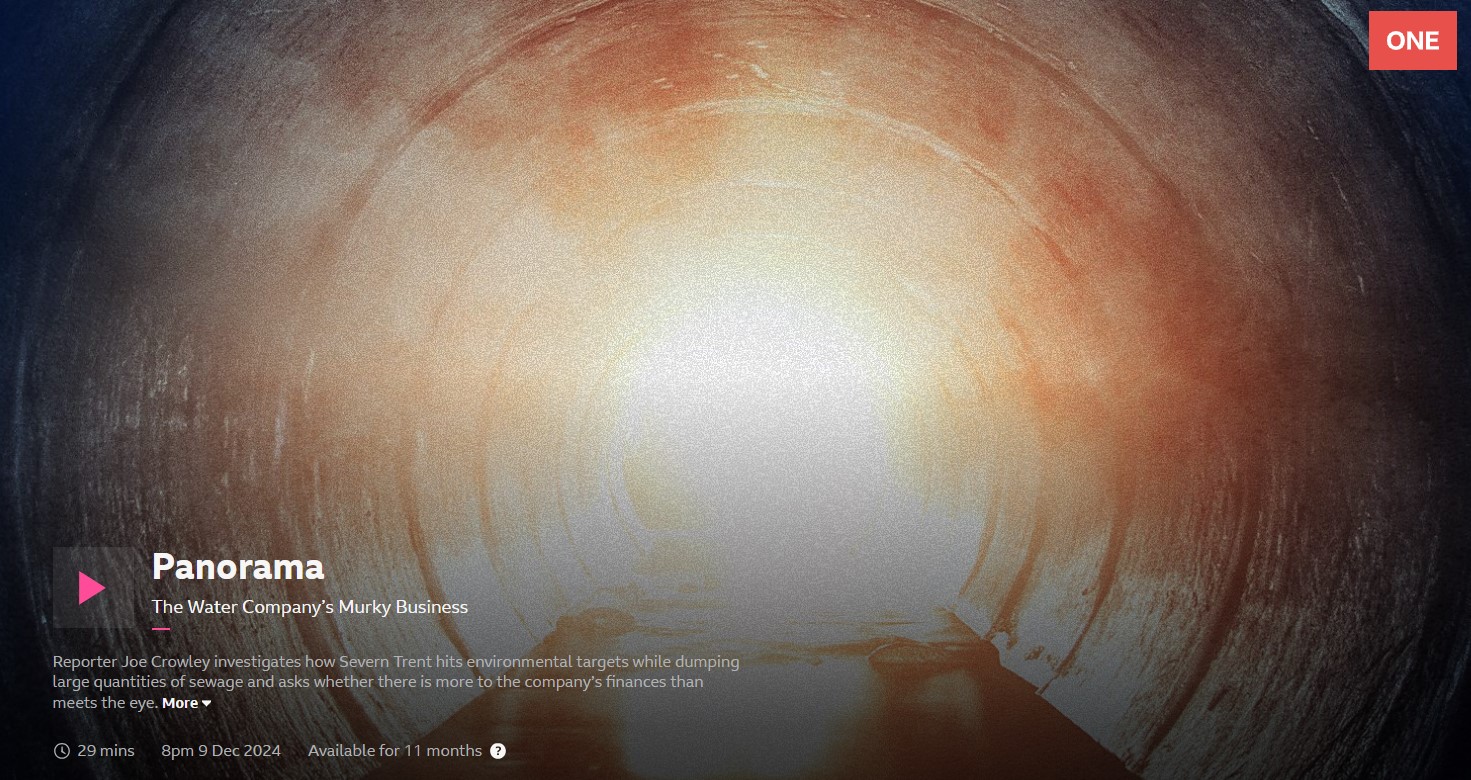
Mark Langabeer watched the recent BBC 1 Panorama documentary which can be seen here
Severn Trent is considered a highly profitable water company. The CEO of Severn Trent has received £30 million in salary since 2014. This is more than any other water company. Severn has been seen as the best of them, because it has topped the league on reducing raw sewage into Britain’s rivers. However, Joe Crowley, Panorama’s investigative reporter, casts doubt on these claims.
He suggests that Severn Trent is not as environmentally friendly as it appears. The Environment Agency lists what are described as “reasons for not achieving good status”, (RNAGS) These can be cancelled if the water companies take remedial action over sewage pollution. Since 2017, Severn has had over 140 RNAGS removed. Despite this, there is raw sewage entering rivers that are covered by Severn. Nationally, 86% of Britain’s rivers are failing to meet the required standards. An environmental campaigner states in the programme that this is due to a lack of investment over the past 20 years or more.
Crowley interviewed an accountant who stated that Severn are inflating their real value by creating a company that has no assets and then transferring £3 billion into it. Severn acquired a 49% stake in the phantom company and half of this £3 billion appears on the company’s balance sheet. Moreover, it also accrues interest and this is entered on the accounts each year. It gives the appearance that the business is healthier than it really is. This makes the company more attractive to investors and the prospect of greater dividends. It is estimated that £80 billion has been paid in dividends since privatisation of the Water Companies.
Billions in dividends
Since 2017, Severn has handed out £1 billion in dividends and yet has recorded only £369 million in profit. This policy is effectively draining cash from the business and causing the problem of indebtedness in the water industry. The regulator is due to announce how much water bills can be increased in the next five years. Severn are demanding a 30% increase. Environmental activists believe that it would take years before our rivers and coastlines are cleaned up. It will take considerable levels of investment and the question arising from this is “who pays”. The likelihood is that the “customers” will foot the bill.
As predicted by many, privatisation of our public services, such as water supplies, turned public monopolies into private ones. They were sold at prices that were below their real value. Back in the days of Thatcher, Lord Stockton, a former Tory Prime Minister who couldn’t be described as left-wing, stated that “privatisation is the equivalent of selling off the family silver”.
The case for public ownership of the water companies has never been greater. Labour’s right-wing argue that this is unaffordable and more regulation is the best way forward. They argue that fines and deductions from bosses bonuses are the way to improve environmental standards, but many of the water companies are struggling financially. Their priority will always be the shareholders ,not the consumers.
There’s never been a time where public ownership has been more relevant. Compensation should be minimal and based on need. In my view, that is the course which Labour should be following.